Opinion: L3 has almost all the same problems as L2
TechFlow Selected TechFlow Selected
Opinion: L3 has almost all the same problems as L2
L3 chains have lower fees, but are less decentralized than L2 chains, and their interoperability and necessity for development remain controversial.
 Navigating Web3 tides with focused insights
Written by: @jarrodWattsDev
Translation: Baihua Blockchain
TLDR (Summary):
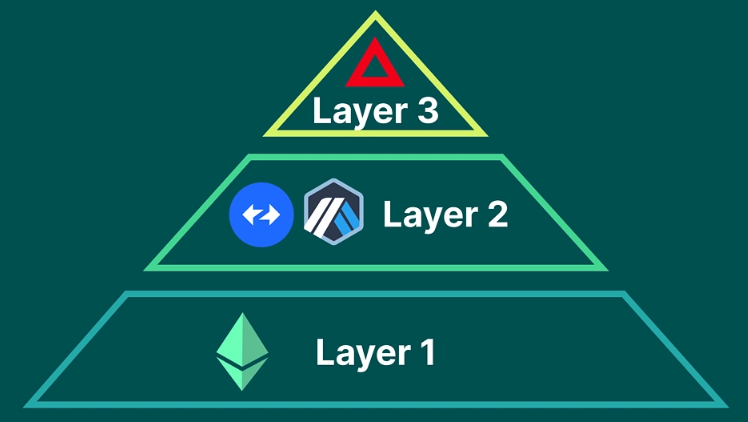
L3 chains offer very low fees, but are less decentralized than L2 chains.
Current L2s are not yet ideally decentralized—perhaps it's worth waiting for their improvements before building L3s on top of them.
L3s still face nearly the same problems as today’s L2s: lack of interoperability.
Arguably, we may not even need L3s to achieve the scalability we want. There remains significant room for improvement at the L2 layer, with methods available today that can make it extremely cheap.
In the crypto space, discussions around L3 chains are growing. Are L3s overhyped, or do they truly offer certain advantages? This article explores the pros and cons of L3 chains. Below are arguments both in favor of and against L3s:
1. Arguments in Favor of L3s
1) Lower user fees: The bulk of L2 costs still come from posting data back to Ethereum. L3s post their data to L2 instead of L1, thus paying a small L2 fee rather than a large L1 fee for data storage.
When data submission costs are low, user transaction fees can also be low.
Imagine the cost of posting data from L2 → L1 is $100.
If we simplify this, that $100 would be distributed among L2 users as gas fees. Essentially, the $100 the chain pays to Ethereum is "repaid" by users via gas fees paid to the L2 sequencer.
In contrast, the cost of posting data from L3 → L2 is $0.10. Users now pay gas fees to cover just $0.10 instead of $100.
Compared to L2s, L3 users could pay fees that are orders of magnitude smaller.
2) Cheaper entry costs: The argument here is that some L2s are not yet directly supported by CEXs (centralized exchanges).
To use these L2s, the process is: CEX → L1 → L2
One L1 fee to transfer to an L1 address
One L1 fee to bridge to the L2
Assume this totals around $40.
An L3 built on a CEX-supported L2 avoids this, as the flow becomes: CEX → L2 → L3
One L2 fee to transfer to an L2 address
One L2 fee to bridge to the L3
Assume this totals around $0.20.
This works, but also feels solvable through other means. Cross-L2 interoperability solutions like aggregation layers are being developed and could resolve this issue.
2. Arguments Against L3s
1) Current L2 decentralization: I believe the key point here is that L2s are not yet ready to serve as settlement layers for other chains like Ethereum does.
Before becoming trusted settlement grounds for other chains, L2s need many more improvements in decentralization. Each additional layer increases scalability but also adds more potential points of failure.
For most chains, L2 decentralization is still in early stages. I think we should wait until they reach later stages before building chains on top of them. The same applies to L4, L5, and every future layer.
2) L2s are already good enough: L2s, app-specific chains, and interoperability between them are already quite solid—and improving rapidly.
Today, there are multiple ways to build very cheap L2s: Polygon CDK, OP Stack, ZK stack, Arbitrum Nitro, etc.
They can become extremely cheap by implementing validium-style models or using alternative DA solutions.
Any team today can create dedicated blockspace at the L2 level.
3) L3s face nearly identical issues as L2s: Application developers can only reach a fraction of their potential audience by building on isolated individual chains. Liquidity and user base remain limited.
Interoperability across L2s solves more problems than adding additional layers.
Join TechFlow official community to stay tuned
Telegram:https://t.me/TechFlowDaily
X (Twitter):https://x.com/TechFlowPost
X (Twitter) EN:https://x.com/BlockFlow_News
 @jarrodWattsDev