Analyzing Solana's DEX Landscape: Is Jupiter the Future of the Ecosystem?
TechFlow Selected TechFlow Selected
Analyzing Solana's DEX Landscape: Is Jupiter the Future of the Ecosystem?
Jupiter's emergence was no accident, but a strong testament to technological innovation and user experience optimization among numerous DEXs.
 Navigating Web3 tides with focused insights
Author: Joe@Go2Mars
As a rising star within the Solana ecosystem, Jupiter has quickly established itself in the DeFi space despite its relatively short launch period. However, without a robust economic model and stable token price to support it, Jupiter risks falling into a death spiral that could prove fatal to its long-term viability.
Over the past week, activity on the Solana chain has surged, and Jupiter’s $JUP token has closely followed Solana’s momentum—nearly doubling in value over the last two weeks.
Most market analyses of Jupiter and $JUP focus on secondary market performance. Behind its impressive (or temporarily strong) market cap lies not only savvy community management and strong community engagement but also solid product design. Today, we’ll take a deep dive into Jupiter's product philosophy from a product perspective.
Within the Solana ecosystem, Jupiter did not emerge by accident—it represents a powerful demonstration of technological innovation and user experience optimization among numerous DEXs. As one of the most competitive DEXs on the Solana network, Jupiter has become a primary choice for Solana traders.
Jupiter’s Three Core Features
The key to Jupiter’s popularity lies in three core functionalities: liquidity aggregation, limit orders, and DCA/dollar-cost averaging. These innovative technologies not only enhance Jupiter’s competitiveness but also set new benchmarks for the entire DEX sector.
Core Feature Module 1: Liquidity Aggregator
Jupiter’s liquidity aggregator technology is one of its core competitive advantages. In traditional DEX models, each exchange operates isolated liquidity pools. Users must manually search for the best trading pool to achieve optimal prices—an inefficient and time-consuming process. Due to fragmented liquidity, it’s difficult to guarantee optimal trade execution. Jupiter’s liquidity aggregator overcomes this by scanning across multiple liquidity pools within the Solana ecosystem and using algorithms to automatically find and aggregate the best available liquidity, delivering users an all-in-one optimal trading route.
Before executing trades, users can customize parameters such as transaction fees, slippage tolerance, and whether to use direct paths. This allows users to access the best prices and lowest slippage across the entire ecosystem through a single interface, significantly improving efficiency and cost-effectiveness. Jupiter achieves this via backend smart routing technology.
On the backend, Jupiter employs complex algorithms to monitor and analyze real-time market data—including prices, order book depth, and slippage—across multiple dimensions. Based on this data, the smart routing algorithm dynamically selects the optimal path for every trade, ensuring high success rates and cost efficiency even during periods of high volatility. Once Jupiter acquires market data, its multi-path search algorithm begins identifying the best possible trade route.
This involves sophisticated calculations—not just evaluating direct swap pairs, but also analyzing whether better pricing can be achieved through intermediate tokens. For example, if a user wants to swap Token A for Token C, the smart router evaluates not only the direct A→C path, but also potential indirect routes like A→B→C or A→B→D→C, ultimately selecting the lowest-cost option.
Despite the technical complexity behind smart routing, Jupiter prioritizes simplicity and ease of use. The routing process is entirely transparent to users: they simply input the desired token and amount, and the system handles the rest. This design minimizes user effort, enabling even non-technical individuals to execute efficient trades seamlessly.
Core Feature Module 2: Limit Orders
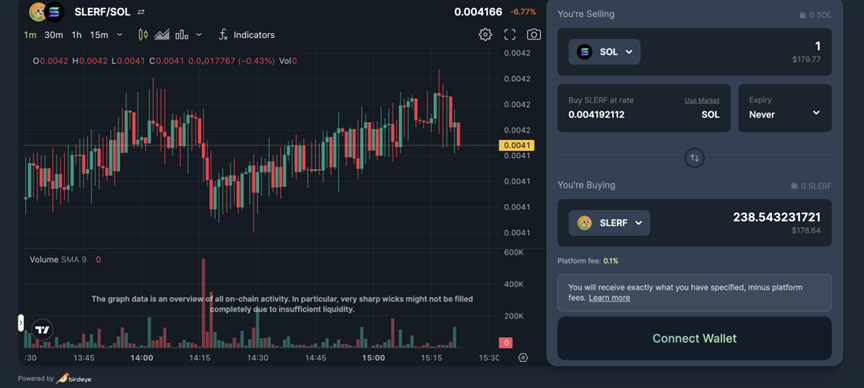
Jupiter offers traders a limit order feature, effectively mitigating price impact costs and slippage while avoiding MEV (Miner Extractable Value) issues. Partial fills are allowed—if a limit order isn't fully executed, the user still receives tokens for any completed portion. When placing an order, users can specify the validity period, target exchange price, and quantity, allowing precise control over their trading strategy. The protocol partners with Birdeye and TradingView: Birdeye provides on-chain price data, while Jupiter leverages TradingView’s technology for chart visualization. This functionality makes Jupiter’s user experience feel much closer to that of centralized exchanges.
Core Feature Module 3: DCA (Dollar-Cost Averaging)
Dollar-Cost Averaging (DCA) is an investment strategy where investors make regular purchases at fixed intervals to average their entry price over a predefined range. This helps reduce the risk associated with investing at a single price point. On Jupiter, users can set up DCA investments by defining purchase frequency (from minutes to monthly), price range, total duration, and the asset they wish to buy. After initiating a DCA plan, the user’s tokens are transferred to a dedicated DCA account and automatically traded according to the preset schedule and price conditions.
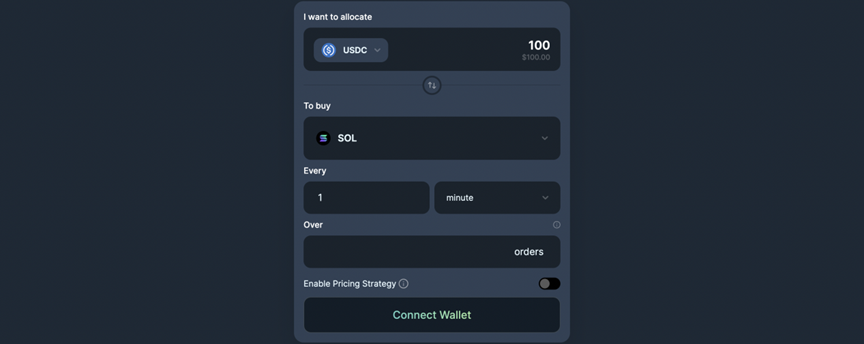
Upon completion of the DCA cycle, the acquired tokens are automatically returned to the user’s wallet. Jupiter charges a 0.1% fee on DCA transactions. With predictable costs, low fees, and a fully managed trading process, DCA becomes an attractive tool for accumulating assets during bear markets. However, this feature tends to remain underutilized during bull runs, so overall demand remains limited for now.
Other Ecosystem Modules of Jupiter
Upstream Incubator: Jupiter Labs
An independent lab operating separately from Jupiter, expected to function autonomously in the future, focused on driving innovation in new projects. Jupiter users and community members receive certain privileges, including early access and token incentives. Currently, Jupiter Labs is concentrating on two major areas: perpetual contracts and LSD-based stablecoins.
Derivatives Protocol: Jupiter Perpetual
A derivatives protocol launched under Jupiter Labs, modeled similarly to GMX V1, which is already live and operational. The protocol defines two main participant roles: liquidity providers and traders. Liquidity providers deposit funds into the pool, which are then converted into a basket of tokens—primarily BTC, ETH, SOL, USDC, and USDT—with higher weightings on SOL and USDC, making them the primary trading assets.
Traders open leveraged positions using these pooled assets. They don’t need to worry about slippage and only pay trading fees and borrowing costs, the latter calculated based on token utilization rates. Liquidity providers earn 70% of trading fees and all borrowing fees, but also bear the risk of losses from profitable trader positions and token depreciation.
LST Stablecoin Protocol XYZ
This project has not yet launched. Similar to Lybra V1, it will allow users to mint interest-bearing stablecoins (SUSD) by staking SOL, with no interest charged on loans. Income generated from LST staking will be distributed to SUSD holders and governance token holders. Notably, when LST yields exceed the SOL borrowing rate, the protocol may employ leveraged arbitrage strategies to maximize returns.
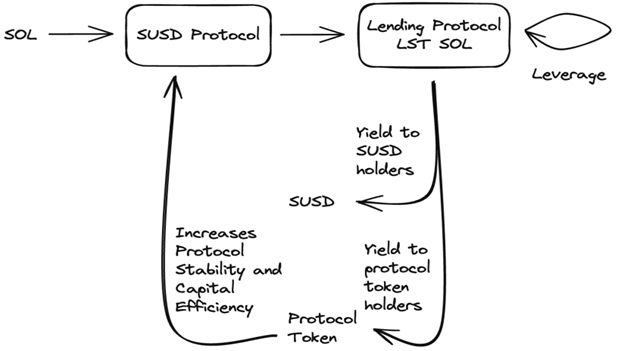
Additionally, the protocol includes a redemption mechanism to maintain SUSD price stability, though this may affect borrower positions—especially during market volatility. To mitigate this, the protocol might allow SUSD redemptions in governance tokens within a narrow price band. For instance, if SUSD trades between $0.95 and $1.00, the protocol could redeem SUSD for governance tokens to reduce forced liquidations. However, this approach may lead to most redemptions being fulfilled in governance tokens, potentially causing significant token inflation if the price remains below $1 for extended periods.
Back to the $JUP Economic Model
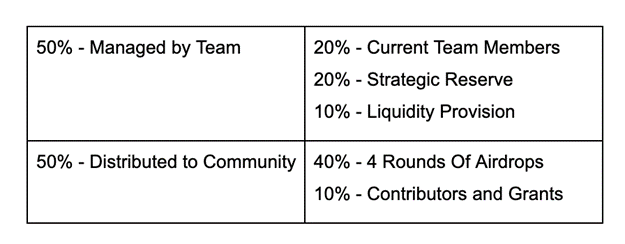
$JUP is the governance token of the Jupiter ecosystem, granting holders voting rights on key decisions such as project launches, dispute lists, and grant allocations. The Jupiter team has committed to strictly following the token distribution roadmap, with any transfers from cold wallets requiring six months’ prior notice. The initial circulating supply is set at 1.35 billion tokens, with future circulation managed via a community multisig wallet to ensure the sustainable development of the Jupiter ecosystem.
After Building the Tower — Reflections on Jupiter’s Ecosystem Growth
Compared to other DEXs in the Solana ecosystem, Jupiter clearly excels in trading efficiency and user experience. Despite competition from Raydium, Orca, Serpent, and others, Jupiter currently aggregates over 50% of Solana’s trading volume, establishing itself as a foundational liquidity layer on the network. However, given limited room for further growth in spot trading volume, Jupiter has adopted a long-term strategy of horizontal expansion across the broader DeFi landscape. Jupiter Start may represent the primary direction for this expansion.
Currently, Jupiter Start offers only introductory, educational, and pre-launch features. Its core module—the LFG Launchpad—has not yet launched, but held its first round of launchpad voting on March 7. The top three projects were Zeus Network (cross-chain communication), SharkyFi (NFT lending protocol), and UpRock (DePIN). Given Jupiter’s large user base and strong traffic advantage, projects launched through its platform are likely to be of high quality.
On the other hand, Jupiter Labs—the financial innovation incubation platform—fills a gap in the Solana ecosystem and holds significant potential backed by Jupiter’s resources. The initiative demonstrates deep exploration into derivatives and stablecoin domains, aiming to inject new momentum into Solana’s DeFi sector. However, these innovations bring additional risks—such as protocol risk and oracle pricing risk—alongside higher returns. Maintaining system balance will require a sound economic model, well-designed incentive mechanisms, and dynamic redemption strategies.
As a hotly watched player in the Solana ecosystem, Jupiter has quickly gained a firm foothold in DeFi despite its brief history. Its user-centric product philosophy, comprehensive and innovative feature set, and seamless trading experience have earned widespread trust, making it the largest DEX by trading volume on Solana. Beyond that, the Jupiter team aims to transcend the limitations traditional DEXs face due to blockchain constraints, actively exploring broader horizons—giving Jupiter the potential to evolve into something far greater.
However, new challenges arise as Jupiter ventures into derivatives and stablecoins—whether as an incubator or developer. These financial products rely on leverage to generate high returns, and without a solid economic model and stable token valuation, the protocol could easily fall into a death spiral, posing existential risks to Jupiter itself.
Join TechFlow official community to stay tuned
Telegram:https://t.me/TechFlowDaily
X (Twitter):https://x.com/TechFlowPost
X (Twitter) EN:https://x.com/BlockFlow_News
 Go2Mars Capital