








The "Token-Image Duality" of ERC404: Implications for the Blockchain Gaming Sector (Part 1)
TechFlow Selected TechFlow Selected
The "Token-Image Duality" of ERC404: Implications for the Blockchain Gaming Sector (Part 1)
ERC404's future could at least completely replace the original ERC1155-type NFTs.
 Navigating Web3 tides with focused insights
Preface: It's been a long time since I last felt the urge to write. With the bull market here, everyone is busy chasing wealth—someone bags hundreds of thousands in Bome, another scores millions in SLERF. Even if I write a lengthy piece, probably no one would have time to read it. On top of that, Guatian Lab has already published over 300,000 words on blockchain gaming. Many ideas and perspectives have been repeated multiple times. Some content even involves confidentiality agreements—for instance, innovative economic models we've provided to partner projects—so there’s less and less I can openly discuss. So I might as well pause for now.
But this time… it’s truly different. After days of contemplation, the more I think about it, the more excited I get. So fired up, I just had to put my thoughts down and share them with you all.
1. What Is ERC404?
I'm not a technical expert, but from what I understand, ERC404 is simply a type of protocol, similar to the familiar NFT standards like ERC721 and ERC1155. The unique feature of ERC404 is its "image-token duality": when you own an NFT, you simultaneously own its corresponding token; when you transfer that token to another wallet, the original wallet’s NFT is automatically destroyed, and a new NFT is minted in the receiving wallet. Put differently, while NFTs are indivisible, tokens are divisible. So once you accumulate enough fractional purchases to reach one full token, an NFT automatically appears in your wallet.

The first project built on ERC404 was the legendary Pandora back in early February. At that time, crypto KOLs worldwide went absolutely wild for Pandora—the price surged from a few hundred USD to a peak of 30,000 USD within just six days! People confidently hailed Pandora as the liberator of NFTs, believing it could lead NFT holders into a new bullish era. It seemed as though ERC404’s arrival would instantly multiply the value of Bored Apes tenfold, bringing them back to their glorious days at 100 ETH.
Is ERC404 really that magical? Let me state my personal view upfront: Yes, ERC404 is indeed extraordinary—so much so that it could potentially spark an entirely new narrative wave for NFT 2.0. But the magic isn’t merely the “image-token duality” most articles highlight—that NFTs can now be fractionalized, allowing players who couldn’t afford a whole NFT to buy pieces instead. If users just want to invest in fractional assets, why not buy tokens directly on exchanges? That’d be easier, right? Moreover, the decline of profile-picture (PFP) NFTs wasn’t due to their lack of divisibility. Rather, it’s because many founding teams long ago abandoned their projects (like Yuga Labs behind Bored Ape—seriously, thinking about these lazy bums makes me furious). More importantly, PFP NFTs without real utility were never sustainable in the long run.
So where exactly lies the true magic of ERC404? Let’s uncover its hidden attributes!
2. The Hidden Attributes of Image-Token Duality
I don’t know which influencer coined the term “image-token duality,” but it immediately reminded me of the dreaded “wave-particle duality” from high school physics. Beneath this poetic phrasing, I sensed something deeper: ERC404 introduces a smoother, more fun, and more stakeholder-aligned existence in the Web3 world. Let me break this down into several layers:
The first layer is what we’ve already mentioned: When an NFT is too expensive, users can buy fractional tokens instead—which genuinely enhances liquidity smoothness.
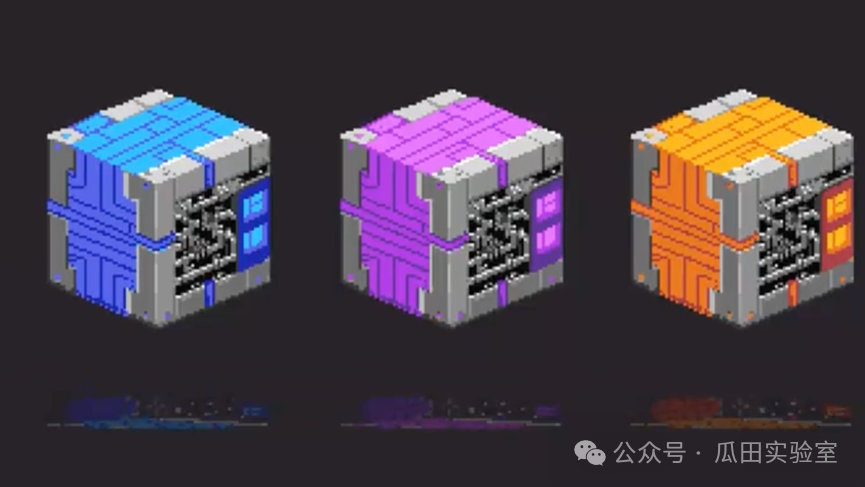
The second layer is even better: ERC404 itself embeds gameplay mechanics. Any project adopting it—even non-gaming ones—can suddenly become playable. And playability means more trading opportunities! Take Pandora, for example—it uses the gamer-favorite “blind box” mechanism. Every time a single Pandora token is transferred to a wallet, a randomly generated blind box NFT appears in that wallet. These NFTs come in five tiers—red, orange, purple, blue, and green—with red-tier boxes having only about a 5% drop rate. What do these boxes unlock? Nobody knows yet—the mystery remains! Some players keep transferring tokens across their multiple wallets just to chase rare boxes. Who benefits?
First, happy group: blockchains and miners! Gas fees go through the roof. Don’t forget who pushed the first wave of inscription mania—miners! The more inscriptions you create, the more gas they collect.
Second, happy group: project teams using ERC404! Everyone’s struggling these days with bloated user address counts (UAW). But ERC404 naturally incentivizes users to spread activity across multiple wallets. In an era where UAW is the ultimate KPI, shouldn’t every project team embrace ERC404 with open arms?
Third, happy group: exchanges! Previously, users traded tokens purely for price appreciation. Now, ERC404 tokens offer an extra perk—they might unlock rare blind boxes! This dramatically boosts trading volume. Which exchange wouldn’t welcome a token inherently designed for high activity?
Third layer: let’s dive deeper into the model mechanics under ERC404. Still using Pandora as an example—what happens when the token price rises? Users may find one full token too expensive, so they only buy 0.5. As a result, NFT supply enters deflation mode. Only wallets holding one complete token can generate an NFT. That’s why the total supply of 10,000 Pandora boxes shows only 5,000–6,000 visible on NFT marketplaces. Rising token prices lead to fewer NFTs—a reverse scarcity mechanism that fuels FOMO during bull markets. The most famous precedent? Bitcoin halving. Bitcoin’s halving is hardcoded by Satoshi Nakamoto—every four years—and people love scarcity, driving BTC prices up. Pandora achieves a similar effect through dynamic mechanism design. Honestly, brilliant engineering.
What if the token price falls? Then it becomes easier to hold one full token, and NFT supply rebounds—up to the maximum “one flower, one world; one image, one token” ratio: 10,000 NFTs for 10,000 tokens. However, newly minted high-tier boxes will inevitably be rarer, since diamond-handed players who score red boxes will likely hodl them forever. This fosters a sense of exclusive community belonging—“We’re all red box owners, the chosen ones.” They form DAOs, build social circles, and start playing together.
Fourth layer: community identity + implicit token locking. By now, you might sense something else, right? Exactly! As community identity strengthens, tokens are effectively soft-locked. To keep your red box, you must hold onto your Pandora token—sell even 0.001, and the box disappears. Reduced token circulation makes price appreciation easier, doesn’t it?
3. The Future of ERC404?
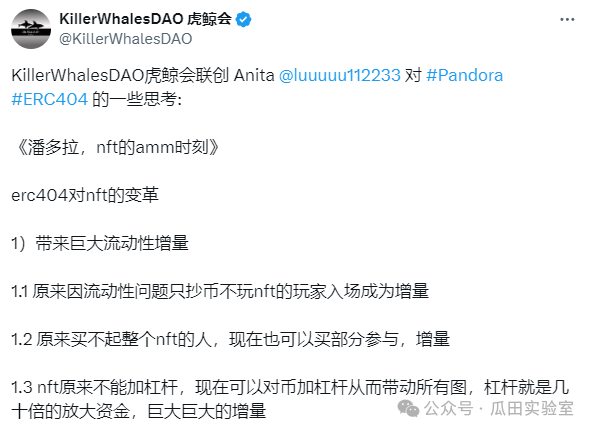
Alright, after all this thinking and writing, someone might say: “This is hindsight bias. Why didn’t you talk about this when Pandora first surged from a few hundred USD in early February?” I must admit shamefully that yes, I underestimated it. I treated Pandora purely as a meme. Even when friends from Killer WhalesDAO kept pushing me to pay attention (“Pandora: The AMM Moment for NFTs” https://x.com/KillerWhalesDAO/status/1755572550275584097?s=20), I remained unmoved.
So why am I researching ERC404 now? Because actual blockchain games using ERC404 have started emerging. Recently, two projects—Lumiterra and Yuliverse—have begun experimenting with it. After studying their moves, I realized Pandora wasn’t just hype—it was actually groundbreaking. Further research completely converted me. I now believe ERC404 could eventually replace all existing ERC1155-style NFTs, enabling users, projects, and partners alike to enjoyably engage, trade, and FOMO together!
That’s all for today. In the next part, we’ll examine specific case studies to explore how ERC404 can be practically implemented to truly launch blockchain games into orbit.
To be continued
Join TechFlow official community to stay tuned
Telegram:https://t.me/TechFlowDaily
X (Twitter):https://x.com/TechFlowPost
X (Twitter) EN:https://x.com/BlockFlow_News
 瓜田实验室W Labs










