Virtual Protocol: An AI factory born for games and the metaverse, where everyone can contribute and benefit
TechFlow Selected TechFlow Selected
Virtual Protocol: An AI factory born for games and the metaverse, where everyone can contribute and benefit
Simply put, the project focuses on two main things: democratizing AI and intelligent gaming.
 Navigating Web3 tides with focused insights
Author: TechFlow
The AI sector’s surge is evident for all to see, becoming a consistent narrative throughout the year.
On another front, Base chain has recently seen a sharp rise in trading volume, with its TVL hitting a record high of $745 million.
However, meme coin mania cannot last forever. The combination of Base's traffic momentum and credible AI projects may open up new opportunities.
Current crypto-based AI projects often focus on high-end infrastructure and algorithms—close to the future, yet distant from everyday life, entertainment, and personal involvement. What we lack is a project that individuals can actively participate in, one that is low-barrier, perceptible, and tangibly impacts retail users’ entertainment experience.
Therefore, identifying AI projects with differentiated business models is key to discovering hidden gems.
Recently, Virtual Protocol on Base chain stands out as a prime example meeting these criteria.
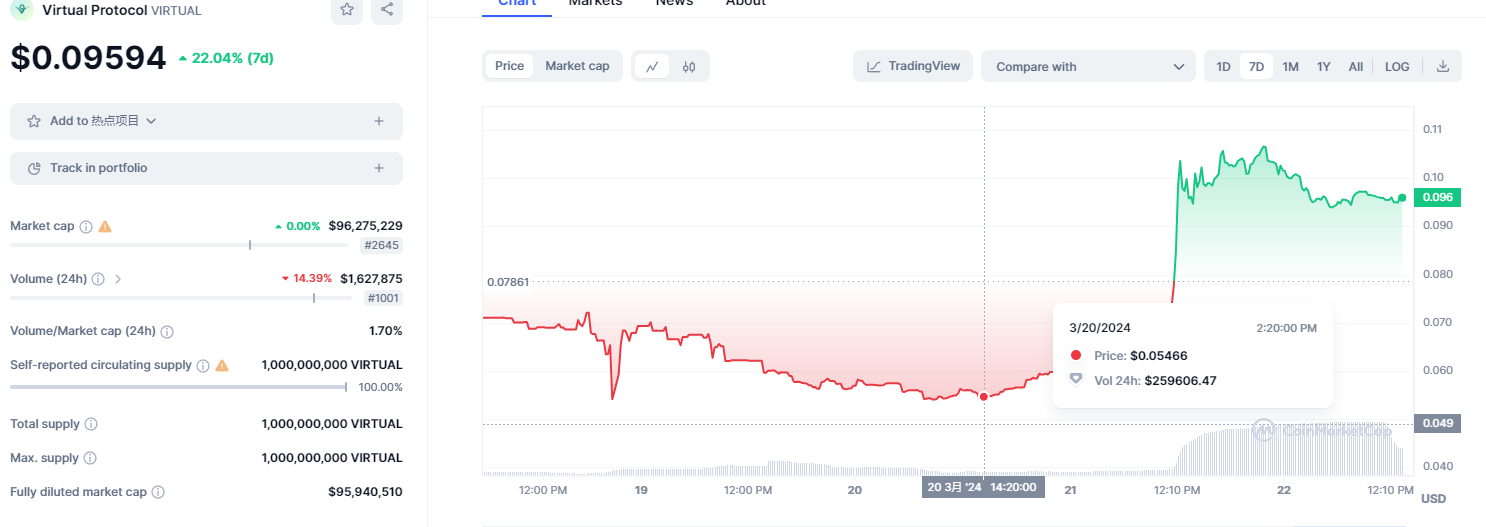
Its token VIRTUAL doubled in price within a single day, while the protocol itself ranks among the few legitimate AI projects on Base;
the project aims to build an AI factory designed for gaming and the metaverse—open for everyone to contribute and benefit from—making games smarter, more immersive, and interactive.
The GameFi and Metaverse narratives have long been dormant; combined with AI, they might spark something new.
More importantly, game developers can leverage Virtual Protocol’s capabilities to enhance their own games, paving the way for Virtual Protocol to achieve a “golden shovel” effect similar to Pyth.
As AI projects grow increasingly homogeneous, could Virtual emerge as the next Bittensor—but focused specifically on gaming and entertainment?
In this article, we break down this AI gem on Base chain in the most accessible way possible.

Democratizing AI, Intelligent Gaming
To assess Virtual Protocol’s potential, we must first understand what gaps exist in the market and whether it effectively addresses them.
Given that the project targets the AI + Game space, what are the current pain points in both AI and gaming sectors?
Starting with AI, a widely criticized issue is its "black box" nature:
You contribute data to AI but cannot claim ownership, track how your data is used, or selectively contribute specific data. Most control and profits go to the AI model providers.
In gaming, particularly GameFi or the metaverse, a major drawback is the lack of immersive interactivity, making such experiences less appealing compared to traditional games.
Insufficient interaction in virtual worlds makes them feel unreal, unengaging, non-immersive, and impersonal—diminishing their ability to capture players' attention over time.
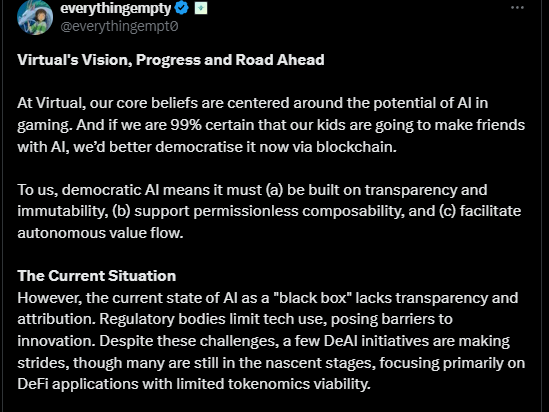
From an industry observer’s perspective, we’re already seeing AI being applied in crypto to improve user experience and efficiency. However, these applications are mostly limited to DeFi and transaction-focused areas. Mature examples of AI integration into gaming remain extremely rare.
This gap is precisely where Virtual Protocol finds its strategic niche.
Simply put, the project focuses on two core goals:
Democratizing AI, and making games intelligent.
By democratizing AI, users can contribute desired data, share in the resulting benefits, understand how their data is used, and retain full ownership—breaking the aforementioned "black box."
This concept naturally aligns with Web3’s ethos of decentralization and grassroots empowerment, making it intuitive and compelling.
Game intelligence means integrating AI-trained data from diverse contributors into various game mechanics, transforming interactions from "semi-social" to "fully social"—imagine scenarios like "playing games with my AI friend" gradually becoming reality.
In traditional gaming circles, players have already integrated GPT-4 into NPCs in games like *The Elder Scrolls*, significantly enhancing dialogue quality and immersion. Similarly, Web3 games can adopt such methods to boost interactivity and immersion, serving the broader gaming/metaverse ecosystem.
Another advantage of intelligence is composability—AI characters can carry memories and backgrounds across different games and virtual worlds. The character you know in Game A accompanies you on adventures in Game B...
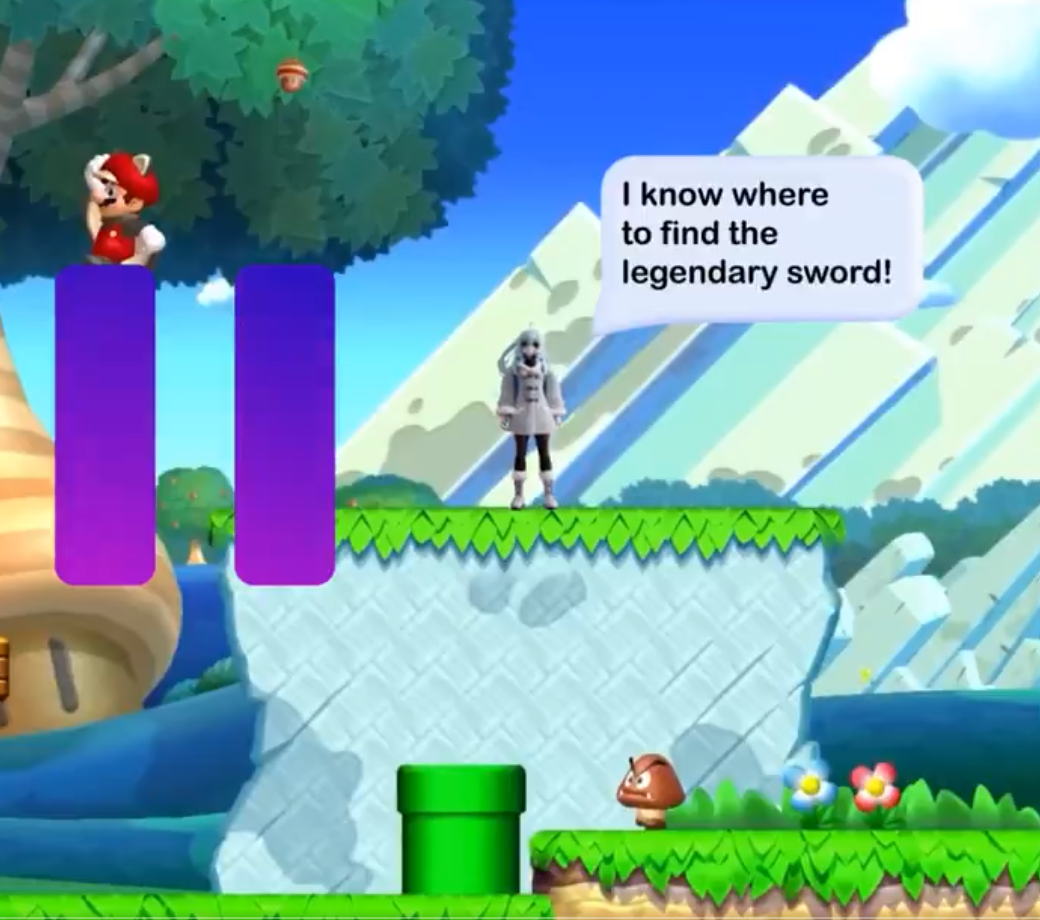
An AI character adventuring in Zelda learns through memory where Mario’s sword might be hidden
Generative AI enables personalized expansion, while multimodal outputs—including text, sound, and visuals—enhance immersion. Together, they eliminate monotony in virtual interactions, ensuring each moment becomes more engaging than the last.
The benefits are clear, the narrative solid—it all comes down to execution.
An AI Factory Built for Games and the Metaverse
Back to the project: how does Virtual Protocol actually deliver a collectively owned, human-curated, plug-and-play gaming AI?
Beyond technical jargon, the essence of the project can be captured by a simple analogy: building a decentralized AI factory connecting supply and demand.
Like any factory, there are two fundamental questions:
For the supply side: What goods does Virtual Protocol source? Where do they come from?
For the demand side: What does Virtual Protocol sell? And to whom?
Let’s start with the supply side.
You can think of the inputs Virtual acquires as "components for virtual AI characters," categorized and stored in the factory for final assembly.
These components fall into three main categories:
-
Cognitive Core: Incorporates complexity from large language models (LLMs), excelling at creating contextually coherent and linguistically rich interactions.
-
Voice Core: Covers voice tone, inflection, and ambient sounds accompanying interactions.
-
Visual Core: Encompasses everything from basic appearance to complex animations. This core packages visual aspects so AI entities become visible and recognizable.
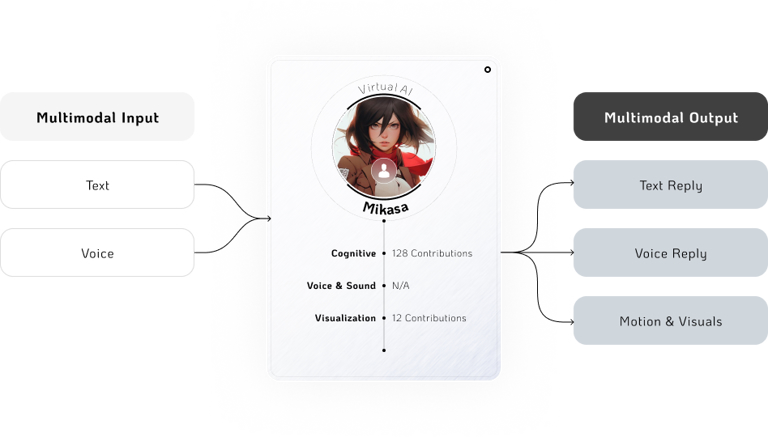
Officially, these component types are known as Modular Cores—the foundational building blocks enabling virtual characters to exhibit AI capabilities.
Where do these components come from? The answer is: "from the people, by the people."
Anyone can contribute their expertise to develop Modular Cores, enriching a given AI character, which can then be deployed across games and other applications.
You could be a text data contributor, providing essential textual data to shape AI dialogues, backstories, and personalities—forming the character’s identity;
You could be an LLM model contributor, fine-tuning language models using targeted text data to enhance AI communication, ensuring natural and context-aware interactions. This process transforms general-purpose AI into specialized tools proficient in particular domains;
You could also be a voice data contributor, offering diverse voice samples to craft expressive virtual voices, capturing full emotional and tonal ranges;
Or even a visual contributor, skilled in designing appearances—from static images to intricate animations.
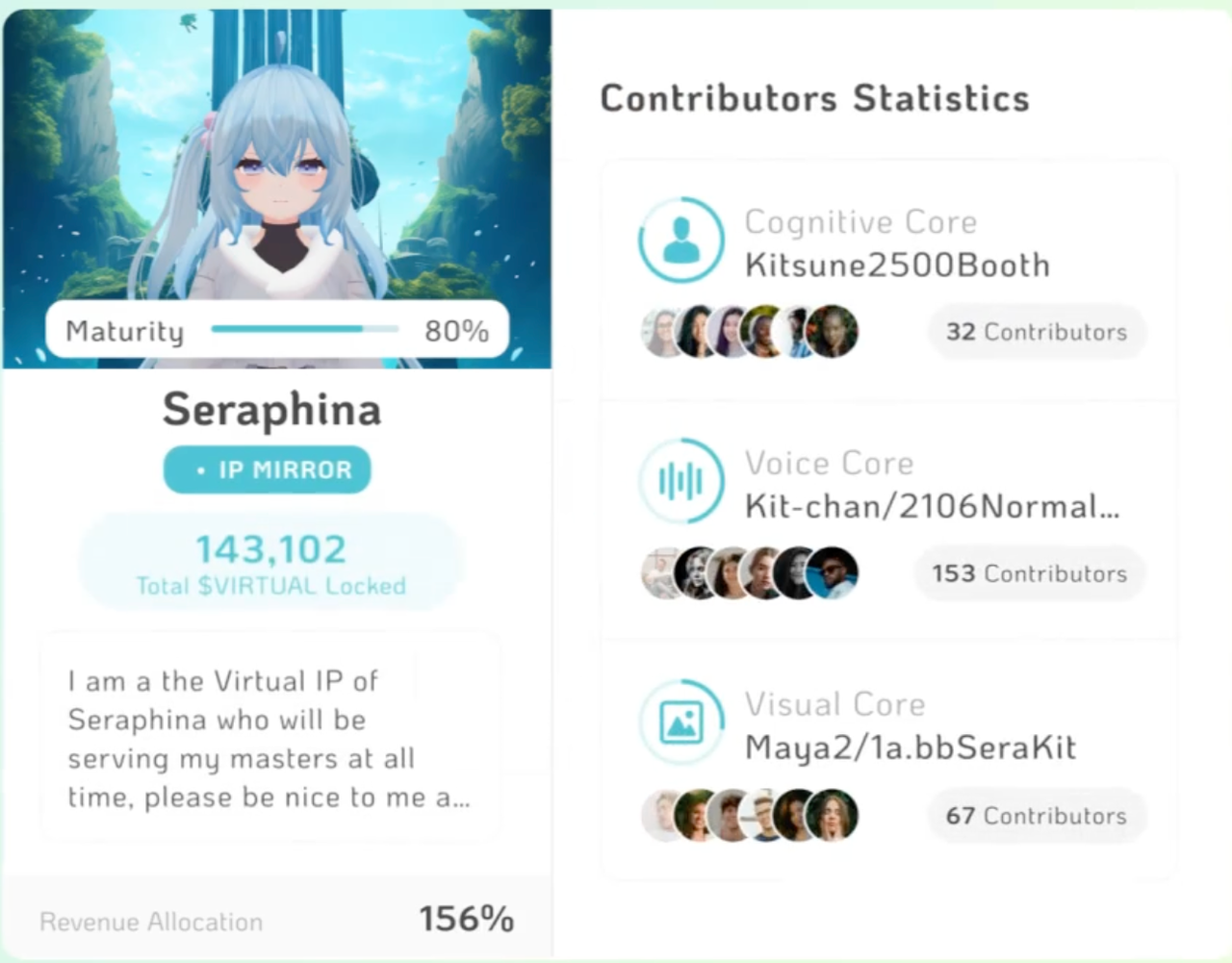
Eventually, these components are assembled into complete AI-driven virtual characters. Everyone contributes, owns, and benefits.
All contributed materials are minted as NFTs for transparent revenue sharing and data provenance, with original files stored on IPFS.
Once assembled, what products are sold?
These AI virtual characters can broadly be categorized into three types:
-
Virtual Mirrors of IP Characters: Designed to emulate iconic characters from various IPs, allowing fans to interact with beloved figures in highly personalized and authentic ways, enriching their engagement with original intellectual properties.
-
Function-Specific Virtual Agents: Custom-built to perform specialized tasks, akin to expert systems. Whether crafting horror stories or guiding players in DOTA, these AIs possess domain-specific knowledge, acting as assistants or autonomous agents delivering expert advice and interactive learning experiences.
-
Personal Virtual Avatars: Not only resembling you visually, but behaving and interacting just like you. These customizable digital selves offer users unique, deeply personal ways to engage with digital spaces.
Who needs these products? Naturally, various DApps with differing AI requirements.
Virtual Protocol starts with some “in-house production.”
For instance, its self-developed AI girlfriend game, AI WAIFU, leverages the AI factory to create three distinct AI girlfriends capable of conversing, responding dynamically to dialogue contexts, increasing affection levels, and forming a gameplay loop based on conversational feedback.
We previously covered this in detail in our article: Decoding AI WAIFU: Blast’s First AI-Powered Virtual Girlfriend Game, Token LBP Launching Soon.
Likewise, the AI factory can supply third-party DApps.
Through a simple SDK integration, developers across platforms can access the protocol’s multimodal reasoning capabilities, seamlessly embedding VIRTUAL into diverse DApp environments with minimal friction to implement advanced AI features.

A crucial advantage here is the previously mentioned “plug-and-play” feature.
Developers build their game logic independently. When AI functionality is needed, they don’t need to build from scratch or train a dedicated AI model—they simply plug in Virtual Protocol’s pre-built capabilities.
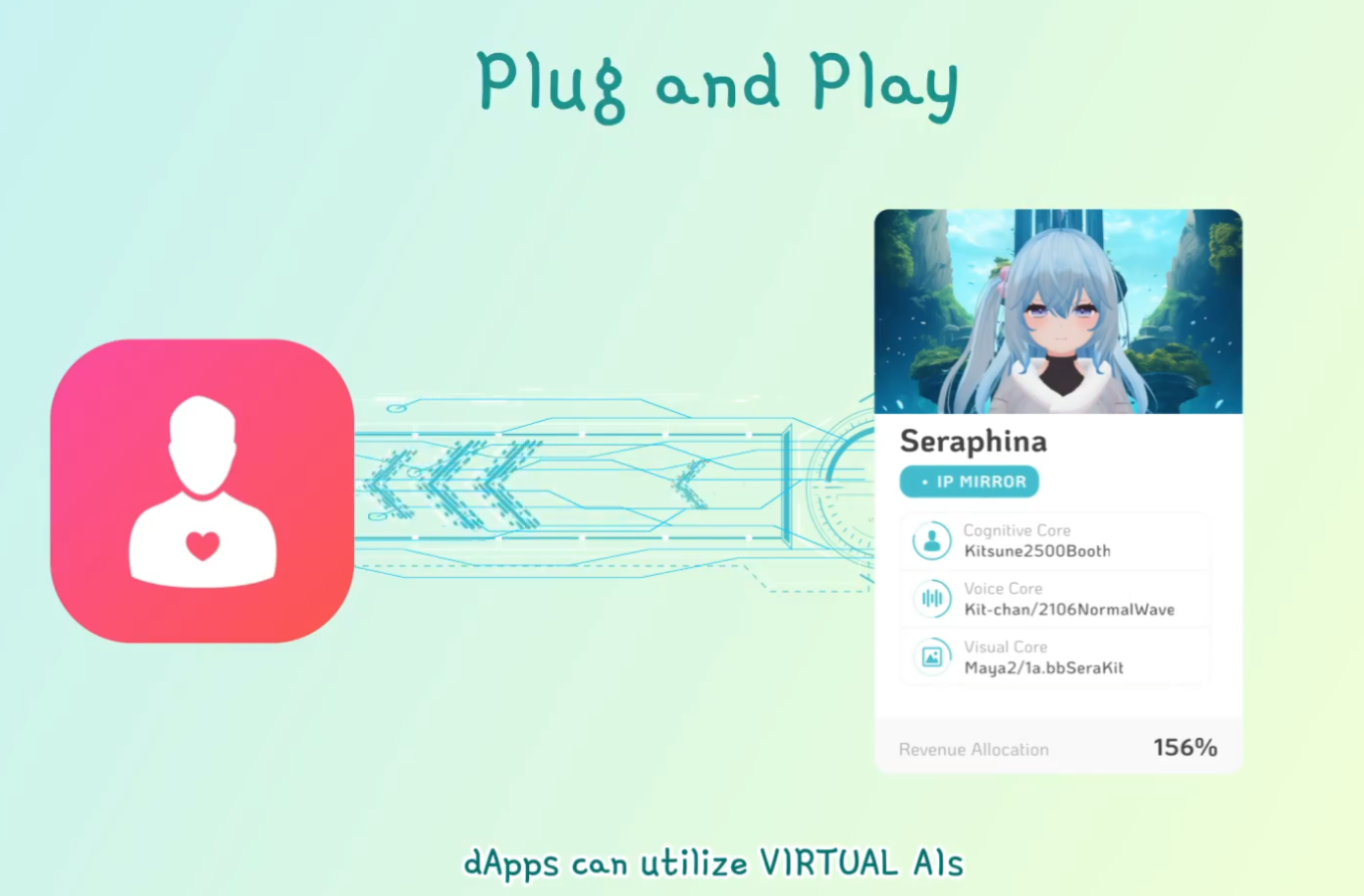
Ultimately, Virtual Protocol’s shared ownership, collaborative creation, and plug-and-play gaming AI creates the following value flow for participants:
Contributors provide required data, models, and materials across various modular cores;
Validators use their expertise to review, verify, and approve submitted data and models, ensuring top-tier output quality;
DApp developers utilize these vetted models and data. Revenue generated from end-users then flows back to validators and contributors—thus completing the construction of a dedicated AI factory for gaming.

The Virtual Token: Aligning Stakeholder Incentives
For a platform bridging grassroots contributors and DApp developers, token-based incentives will be critical to ensuring the AI factory operates transparently and efficiently.
$VIRTUAL’s overarching role is to align incentives and increase value for all stakeholders.
Specifically, $VIRTUAL functions as a utility token for transactions, governance, and staking, enabling users to access, use, and contribute to the virtual ecosystem. Let’s examine $VIRTUAL’s value through the lens of an ordinary user.
Suppose Alice believes in Virtual Protocol and holds $VIRTUAL. She can stake her tokens to support system security and earn staking rewards;
But where should she stake for maximum return?
Alice must choose a virtual character within the Virtual ecosystem to stake towards, as shown below. Think of it as a staking pool—the more tokens pooled, the greater the development resources attracted to that character;
Essentially, the project links VIRTUAL tokens to AI virtual characters. More staked tokens reflect higher popularity. Greater popularity incentivizes contributors to supply more data (due to larger potential rewards), thereby attracting even more development resources to that character.

At its core, Alice participates in a crowd-voting mechanism—voting with tokens and earning returns accordingly.
However, staking implies responsibility. After choosing a character, Alice also assumes the role of a Validator, reviewing submissions related to that character—language, voice, appearance, etc.
If she lacks the skills to validate, she can opt for a delegation model similar to Ethereum—entrusting her staking rights to professional nodes and still sharing in the rewards.
Later, when other DApps leverage Virtual’s technology and AI characters to build games, Alice may receive token airdrops from those games simply because she holds VIRTUAL.
Beyond Alice’s individual perspective, the VIRTUAL token orchestrates the entire protocol’s value flow:
First, VIRTUAL tokens reward contributors who upload and update Modular Cores of virtual characters; second, VIRTUAL rewards validators who audit submissions; finally, the Virtual Protocol team will use part of the revenue from DApps utilizing virtual characters to repurchase $VIRTUAL tokens, boosting token value and ecosystem stability.
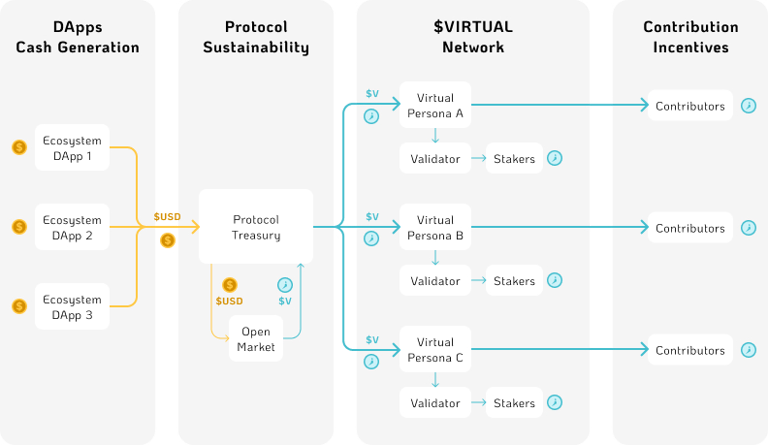
Beyond the token’s utility, its economic model deserves closer attention.
According to public documentation, 40% of VIRTUAL tokens are held by the project’s DAO. Any use of these tokens requires a formal proposal and community vote, meaning the unallocated portion won’t be dumped suddenly, diluting circulating supply.
Meanwhile, the remaining 60% is already fully circulating, supported by the buyback mechanism. As affiliated games generate revenue, token holders also receive profit-sharing distributions.
Overall, VIRTUAL’s sell pressure is manageable, and it exhibits strong “shovel” characteristics.
Additionally, the VIRTUAL airdrop portal is now live. Holding VIRTUAL grants eligibility for various airdrop rewards. While exact details aren’t public yet, this further boosts market anticipation.
Upcoming Catalysts to Watch
Public information indicates that Virtual Protocol’s mainnet officially launched on the evening of the 22nd, enabling users to begin contributing data and models via its website. Beyond this, what other positive developments should we watch for?
First, favorable macro conditions: Base chain is heating up, and the AI sector continues to gain momentum—these dual tailwinds bode well.
Second, an often-overlooked point: although the protocol resides on Base, applications across any blockchain can leverage Virtual’s capabilities. While token incentives and value flows occur on-chain, the AI functionality operates off-chain via SDK integration—meaning it isn’t restricted to specific L1s or L2s. This dramatically expands the pool of potential partners and use cases, echoing the “Pyth golden shovel” effect mentioned earlier.
Perhaps every game and metaverse project is about to enter an AI spring—and Virtual could be the first warm breeze.
This cross-chain capability also opens up a potential “bribery” dynamic.
DeFi-savvy readers are familiar with Curve Wars—where protocols stimulate demand for veCRV to attract more liquidity to their pools.
A similar “Virtual War” could unfold:
With limited attention and liquidity, different game projects may invest heavily in xVIRTUAL stakes tied to their preferred virtual characters, luring others to stake for higher yields—thereby boosting activity and adoption of their AI characters.

Beyond these fundamentals, certain ecosystem partnerships also merit attention.
Virtual recently announced on its official Twitter that it has joined NVIDIA’s Inception Program—a free initiative supporting startups with cutting-edge technologies, networking opportunities with VCs, and access to NVIDIA’s latest tech resources.
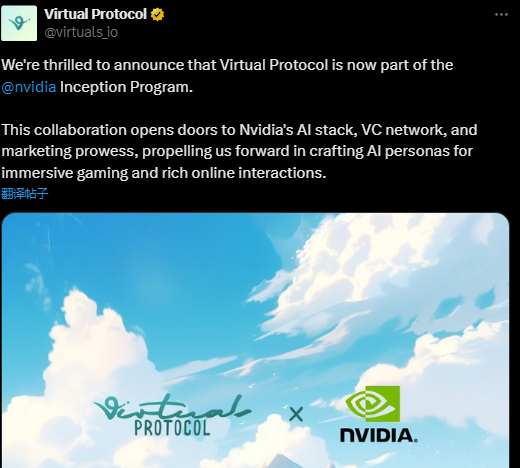
Any association with NVIDIA and AI instantly provides fertile ground for narrative hype.
Moreover, Virtual’s AI characters can essentially be seen as AI agents tailored for the gaming industry. OLAS ($OLAS), the leading project in AI agent space, has partnered with Virtual, opening possibilities for collaboration in resource sharing and token synergy.

Virtual, Drawn from Reality
Finally, the name “Virtual Protocol” itself reflects the core of its mission:
Decentralized collection of real-world content to make the virtual world smarter.
The name Virtual Protocol is intriguing, and its corresponding business and narrative are compelling enough to激发 broader participation.
The virtual world isn't entirely separate from reality—in fact, it aggregates human wisdom and effort from the real world. This collective input deserves fair compensation, enriching the entertainment industry while ensuring everyone gains joy and rewards of their own.
Join TechFlow official community to stay tuned
Telegram:https://t.me/TechFlowDaily
X (Twitter):https://x.com/TechFlowPost
X (Twitter) EN:https://x.com/BlockFlow_News
 深潮TechFlow