








How did Backpack succeed after its main investor FTX collapsed?
TechFlow Selected TechFlow Selected
How did Backpack succeed after its main investor FTX collapsed?
Backpack's success is largely due to its supporters.
 Navigating Web3 tides with focused insights
By Jacquelyn Melinek
Translation: TechFlow
The founder of Backpack is building a crypto exchange and wallet that has seen strong growth since launching in 2022. But the journey hasn't been smooth.
FTX co-led Backpack's $20 million strategic funding round in September 2022. Less than two months later, in November 2022, FTX collapsed.
“We lost 80% of our operating capital with FTX. After spending so much time building this protocol, it was like getting knocked out cold—we had to revive ourselves,” Armani Ferrante, co-founder of Backpack and NFT collection Mad Lads, told TechCrunch.
They not only lost investment funds and a key partner, but FTX’s collapse also ushered in a crypto bear market that has only recently begun to rebound.
Backpack’s success owes much to its supporters. “It was a combination of product, community, goodwill, and timing that attracted an incredible group of talent,” Ferrante said. “From there, it took on a life of its own.”
On Monday, “Preseason Phase One”—the exchange’s testing phase—ended after just over a month. According to the company’s post on X, during this period, its total trading volume exceeded $27.5 billion, processing 259 million orders at a rate of roughly 5,000 per minute. It also added 252,000 KYC users, bringing its total user count to 560,000.
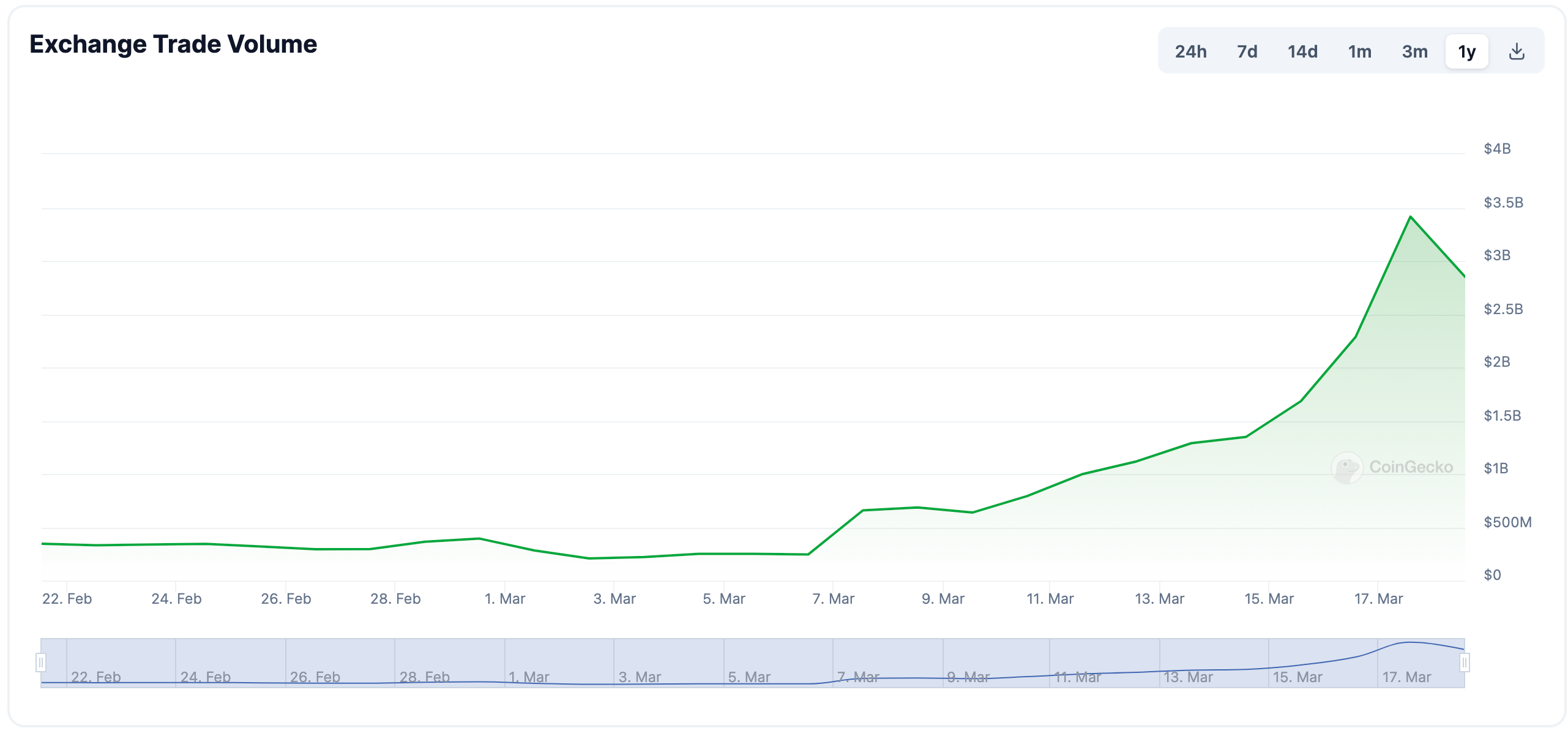
According to CoinGecko data, the exchange hit a peak of $3.66 billion in trading volume on Sunday, with around $2.8 billion in 24-hour volume.
“In a strange way, we’ve captured lightning in a bottle. People are just starting to talk about Backpack as a new emerging exchange and see the promise of the next-generation platform—one that can learn from the failures of previous exchanges,” Ferrante said.
Ferrante said there are many lessons learned from FTX. He added that one of Backpack’s core design goals is to address issues exposed by FTX.
Unlike FTX, Backpack designed its exchange system to ensure balances are controlled by independent entities or nodes that collectively verify each other, checking every order, cancellation, deposit, withdrawal, and more. The goal is to eliminate single points of failure and distribute Backpack’s exchange operations across multiple entities. “The industry has been forced to mature and improve,” Ferrante said.
“The collapse of FTX was terrible, but from another perspective, it was like a phoenix rising from the ashes—we had to step up and tackle problems that hadn’t yet been solved,” Ferrante said. “We’re shaping the product in our own direction,” he added, noting it has already expanded beyond the exchange into other products.
Backpack is also building its crypto wallet and xNFT platform, a new token standard on the Solana blockchain similar to NFTs, but also serving as a platform for Web3 applications. This brings us back to how Backpack got its name, inspired by MMO games like World of Warcraft or RuneScape that give players backpacks to store items. “In a [regular] wallet, you can carry cards, some cash, and coins—but a backpack can hold everything, not just money. So we see this as a more dynamic version of a wallet,” Ferrante said.
Mad Lads, one of Backpack’s largest Solana NFT collections, is also an xNFT. At launch, its floor price traded around 172 SOL, or $34,400. “We’ve been lucky—our community complements our business,” Ferrante said. “We want to build a product that improves our users’ lives in crypto.”
But Mad Lads isn’t the only xNFT. For example, the NFT collection Solana Monkey Business has an xNFT with a newsletter called Banana Split that updates regularly, allowing owners to access the newsletter directly within their Backpack wallet.
As for replacing FTX as an investor favorite, things are going well too. At the end of February, Backpack raised $17 million in a Series A round led by Placeholder VC, valuing the company at $120 million. Backpack has recently expanded into the UK and operates in 11 U.S. states, Dubai, and across the Asia-Pacific region. But this is just the beginning—the team plans to use its new funding for global expansion, aiming to cover 95% of global GDP by the end of 2024 “to serve customers compliantly.”
Looking ahead, Backpack’s focus is on execution across many fronts. But product distribution remains the top priority for the exchange as it aims to enter every country around the world.
“It’s crazy—winner takes all in these markets,” Ferrante said. “We want to seize the moment. Given everything we’ve discussed, the opportunity exists this year, and we intend to make the most of it.”
Join TechFlow official community to stay tuned
Telegram:https://t.me/TechFlowDaily
X (Twitter):https://x.com/TechFlowPost
X (Twitter) EN:https://x.com/BlockFlow_News
 Jacquelyn Melinek







