The Shift of Trends and the Exploration of a New Era
TechFlow Selected TechFlow Selected
The Shift of Trends and the Exploration of a New Era
Those who bravely set sail will find wealth and danger in the new world of blockchain.
 Navigating Web3 tides with focused insights
Author: Danny Sursock
Translation: Block unicorn

The most exciting part of ETHDenver 2024 was witnessing two opposing groups collide in the classic left-curve/right-curve debate.
One arrived with a "go big or go home" mentality, eagerly anticipating the next major cycle.
The other is struggling to find fundamentals that justify today’s market frenzy.
In the short term, I believe both could be right. While public and private markets are almost certainly detached from fundamentals in the current environment, the setup for sustained, long-term growth in crypto still looks quite strong.
But upon closer inspection, something different may be unfolding this time.
Past bull runs brought users, but those cycles often resembled macro leverage beta more than genuine adoption.
Today, three powerful forces are converging to replace volatile liquidity waves with lasting tides:
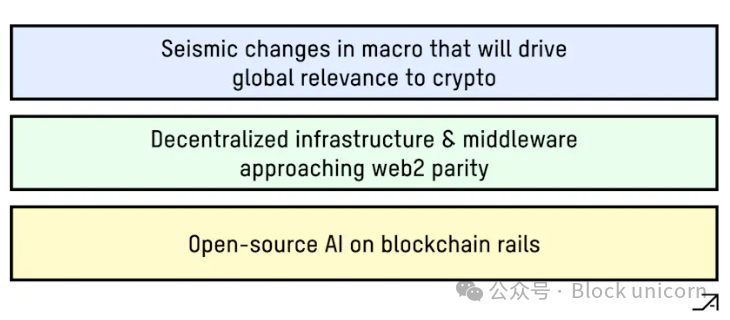
Macro Meets Crypto Mainnet
Explosive growth in public and private markets—fueled by AI hype and economic optimism—has overshadowed some profound secular shifts taking place beneath the surface.
In fact, a radically different geopolitical paradigm is emerging—not a return to pre-pandemic norms, but one centered on fragmentation and cross-border competition.
While these new dynamics will pose significant challenges for incumbent enterprises, they present a generational opportunity for crypto to leap into global adoption.
Crypto's first decade was an extraordinary testnet, marked by grassroots development, boom euphoria, and brutal bear markets. Now, entering its second decade, crypto is ready to mainnet as the world’s interoperability layer: a neutral home for economic exchange and technological innovation at a time when it’s desperately needed.
Why?
For crypto, secular change acts as a positive catalyst arriving just before perfect timing.
In reality, the foundational architecture that supported global trade over the past two decades is being rapidly undermined by deep fractures in international relations. In 2023, the restructuring of global supply chains and trade routes accelerated, becoming a top priority for businesses and governments alike.
Corporate focus on reshoring is growing:
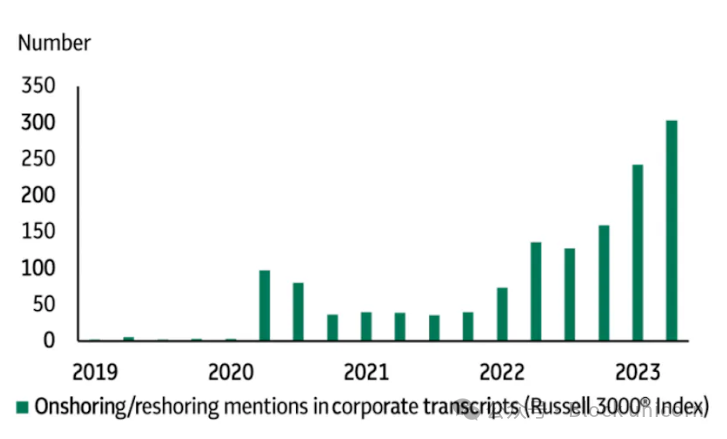
Source: Macrobond/Macquarie
Meanwhile, over 54% of the world’s population and nearly 60% of global GDP are undergoing election cycles, and protectionism has taken center stage amid several ongoing military conflicts playing out in real time.
Equally relevant to crypto is the evolution of international competition, where nations no longer rely solely on rockets and bullets.
The U.S. has weaponized international finance in response to Russia’s invasion of Ukraine, while OPEC and Russia have signaled their willingness to retaliate by manipulating energy supplies.
At the same time, tech nationalism around semiconductors and other critical inputs has shifted from rhetorical warnings to concrete actions like sanctions and subsidies.
This fragmentation of global commerce is hurting corporate profits in developed economies, and the impact is even more severe for the 40% of the world’s population living in low- and middle-income (LMI) countries.
For individuals in LMI nations, crypto offers vital solutions to everyday problems—solutions whose importance only grows with systemic challenges. Data confirms this: grassroots crypto adoption not only strengthens but accelerates during periods of heightened geopolitical tension.
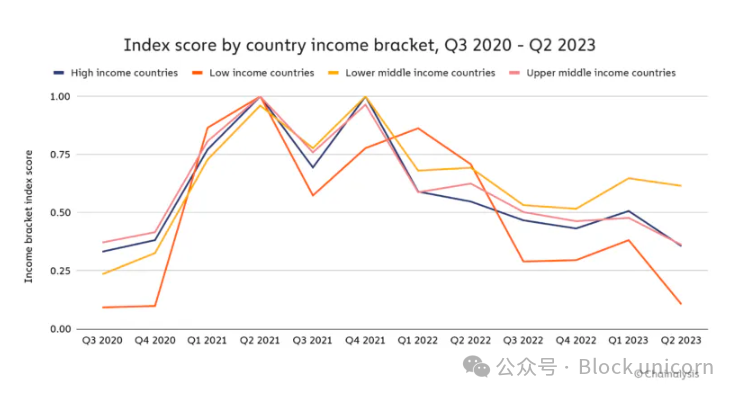
Source: Chainalysis
Likewise, for private enterprises, the convergence of these factors leads to significantly higher costs and restricted access to new consumer markets—all occurring in a world where capital is no longer free.
Trade wars and tariffs over the past few years have already harmed businesses and domestic economies, and these negative effects may intensify as companies adapt to a new reality.
As a result, both businesses and individuals face increasingly difficult choices:
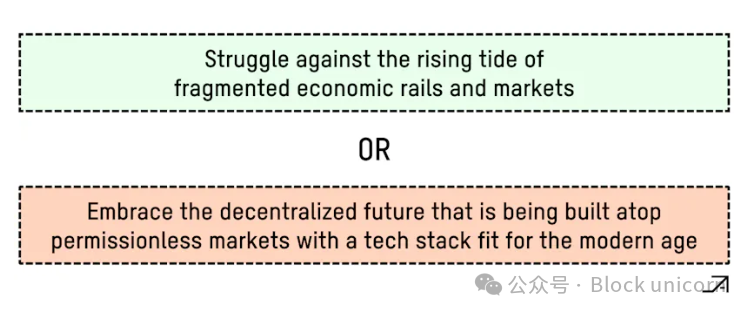
This crossroads reminds me of a striking historical parallel:
When Constantinople fell to the Ottoman Empire in the 15th century, the new conquerors inherited control over the geographic hub connecting global commerce along the "Silk Road."
As history tells us, the Ottomans quickly began restricting land-based trade routes that had flourished for centuries. This prompted European powers to sail overseas in search of new routes, igniting the "Age of Exploration" that shaped the modern world.
This time, it will be blockchain—and those brave enough to set sail—who will discover new worlds of wealth and danger.
Reaching Enterprise Scale
There’s another crucial point worth noting: historically, crypto has served as a testing ground for large corporations experimenting with new technologies.
Due to the factors outlined here, traditional enterprises are now shifting their exploration of crypto from R&D phase to production-grade deployment.
-
Enterprises will accelerate their exploration of digital assets and on-chain ecosystems as key sources for opening new markets. What were once vanity projects will increasingly become missions essential to survival.
-
Capital allocators will expand native crypto deployments and participation to hedge against the "beta" exposure of global risks and uncertainties. In the old world, there will be few places left to hide.
-
Systemic challenges across regions—hyperinflation, capital controls, hot/cold conflicts—will drive greater relevance and demand for digital assets. Permissionless blockchain infrastructure will start from the grassroots and scale globally.
To be sure, economic and geopolitical challenges have always driven users toward crypto, especially in emerging markets.
Yet the scale and scope of challenges the world must confront in the coming years offer crypto a unique opportunity to become the de facto system for free commerce and culture.
Institutional Capital Flows
Of course, all of this hinges on one final puzzle piece: bringing institutional capital on-chain.
The approval of spot Bitcoin ETFs marks a major turning point in this regard, and Ethereum appears poised for a similar breakthrough.
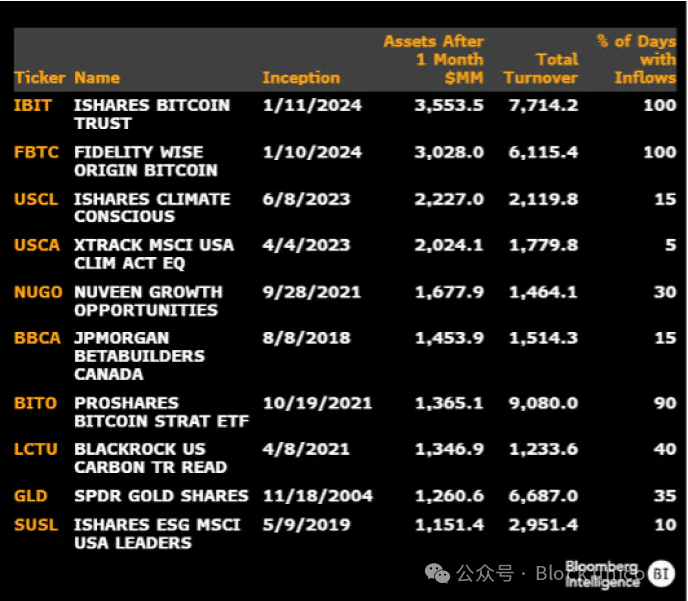
Source: Bloomberg Intelligence
So far, Bitcoin ETFs have attracted over $7.5 billion in net inflows, with ETFs launched by BlackRock and Fidelity setting records for the largest first-month launch in the 30-year history of all ETFs.
This incredible momentum will ultimately allow the largest institutions to join the on-chain economy, alongside over 52 million Americans and another 500 million people worldwide (according to Crypto.com, the number of global crypto owners reached 580 million by the end of 2023).
If structural macroeconomic changes are providing the spark, then institutional capital flows represent the fuel that will ignite crypto’s golden age.
Middleware and Infrastructure Upgrades Driving Growth
With external conditions exceptionally favorable, are we ready to seize this opportunity?
I believe the answer is yes.
After the 2022 crash scattered investors, crypto natives turned inward, reflecting on the excesses and flaws that led to the bubble.
With capital and talent consolidating around comprehensive system upgrades, massive progress has been made across every layer of the stack, laying the foundation for the upcoming wave of mass adoption.
Private funding flows throughout the year reflect this trend. At the start of the year, financial infrastructure captured the largest share of funding, followed by wallets, and later financial infrastructure regained dominance, with L2 and interoperability projects close behind.
Among all this, what stands out is that the virtuous cycle of infrastructure applications is becoming more focused and purposeful than ever before.
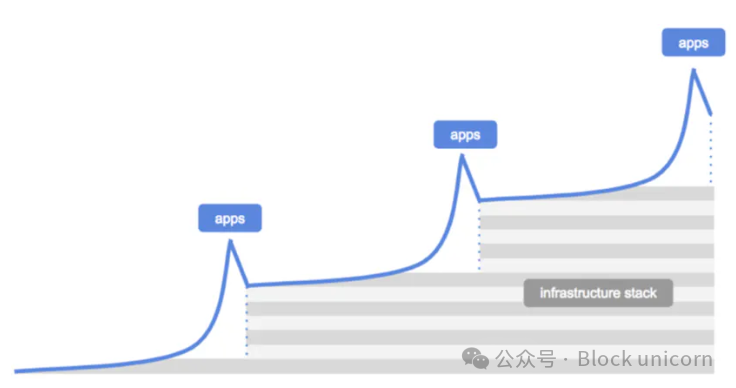
Source: USV ("The Myth of the Infrastructure Phase")
Increasingly, the needs of crypto-native consumers are driving targeted and concentrated improvements in the technology stack, which in turn generate new use cases and applications.
Superior UI/UX Is Driving Adoption
Block unicorn note: UI/UX refers to User Interface Design and User Experience Design.
In Q1 2023, the ERC-4337 standard was released, aiming to transform externally owned accounts (EOAs) into smart contract wallets, enabling customization, better private key recovery mechanisms, and a more streamlined user experience.
Even more impactful, teams like Privy* have made significant strides by simplifying onboarding through embedded wallets, minimizing user friction while allowing developers to design richer contextual experiences.
Privy’s efforts helped Friend.Tech rapidly attract 100,000 addresses within weeks, and over the past 13 months, they’ve supported onboarding for platforms like OpenSea, Zora, Blackbird, bringing in over 2 million users from more than 150 countries.
Meanwhile, Farcaster*'s introduction of Frames—a new primitive allowing interactive experiences to be embedded directly within Casts—has been transformative, significantly boosting platform engagement.
Farcaster has seen over 8 million replies across more than 4 million Casts—an early sign that crypto-native consumer applications may be approaching escape velocity.
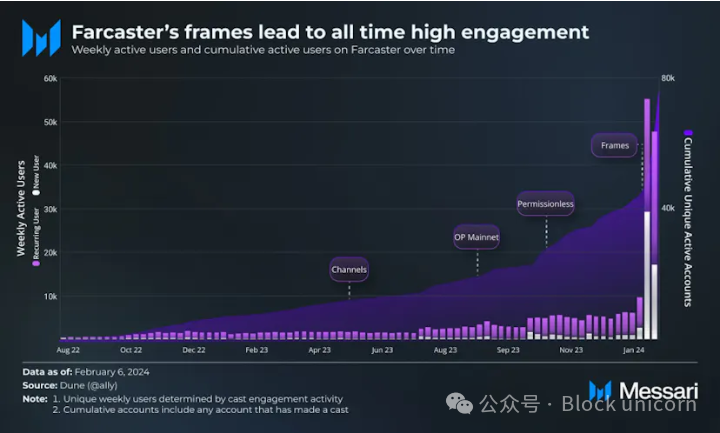
Source: Messari (Farcaster Frames)
New Design Spaces Are Becoming Broader and Better
Just as Ethereum sought to transcend Bitcoin’s functional limitations, a new generation of projects is now targeting Ethereum’s own structural flaws, solving them through modularity.
Alternative L1s and sidechains were features of previous cycles, yet none succeeded in disrupting Ethereum’s dominance in users, TVL, developers, and activity.
That changed with the emergence of rollups like Arbitrum and Optimism, designed to achieve higher throughput and lower fees by offloading computation from Ethereum.
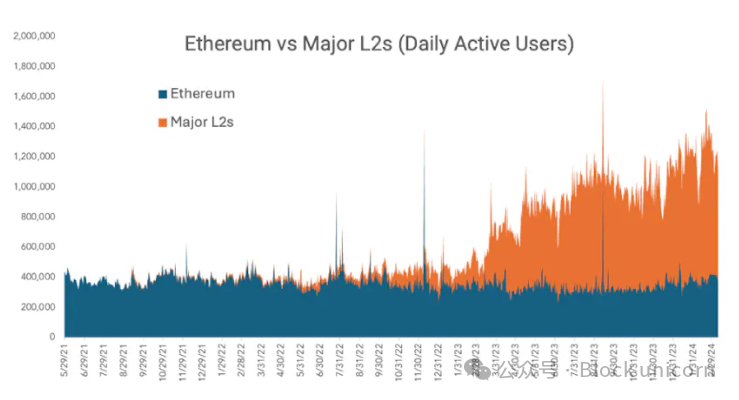
Source: TokenTerminal
Although these new layers now rival—or in some cases surpass—Ethereum in scale, builders seeking further optimization of the L1 stack are thinking bigger.
Because despite an 8x increase in daily active users on L2s last year, much of what users actually do resembles historical L1 activity. Thus, the emerging consensus is that offloading transactions to cheaper execution environments isn’t enough to enable truly novel on-chain experiences.
We actually need to rebuild the components underpinning blockchains—from data availability (DA) to state access bottlenecks and parallel execution.
Dedicated data availability (DA) layers built to scale toward Web2 performance parity (e.g., EigenDA, Celestia, Avail) will enter the market alongside upgraded virtual machines—some EVM-based, others using Move (Movement Labs*) or the Solana VM (Eclipse). Some are building L2s optimized purely for execution (MegaETH), while others are launching entirely new L1s from scratch (Monad).
Meanwhile, EigenLayer aims to provide a shared security layer via restaking, enabling a new generation of projects to launch with minimal bootstrapping requirements, thus preserving Ethereum’s core security model.
All of this means the underlying infrastructure, tools, and design options available to Web3 builders are approaching unprecedented levels of maturity and performance.
As crypto’s value increasingly aligns with infrastructure, tooling, and middleware upgrades, we see a promising story in the critical leading indicator: developer traffic. The data supporting crypto’s vital leading indicators reveals a hopeful narrative: developer traffic.
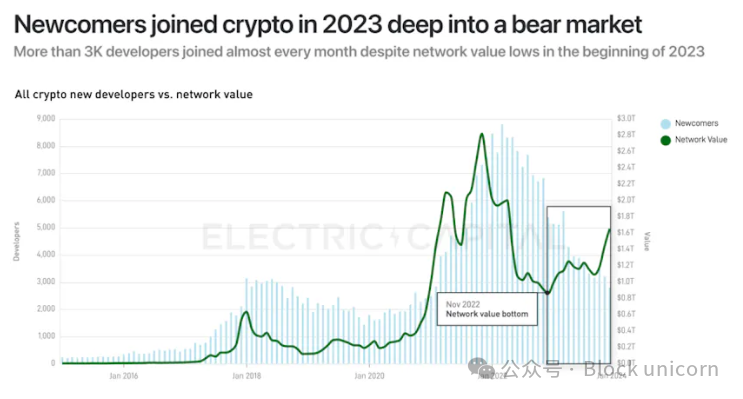
Source: Power Capital Developer Report
Building on blockchains should not only be a more meaningful exercise but also a more technically performant one—effectively empowering developers to design the future open internet. The significant improvement in retention among existing developers and the attraction of new ones during difficult market conditions speak volumes about the progress made.
Open-Source AI and Crypto Infrastructure
Finally, we believe the intersection of crypto and artificial intelligence—two paradigm-shifting forces in their own right—represents one of the most transformative moments in modern history.
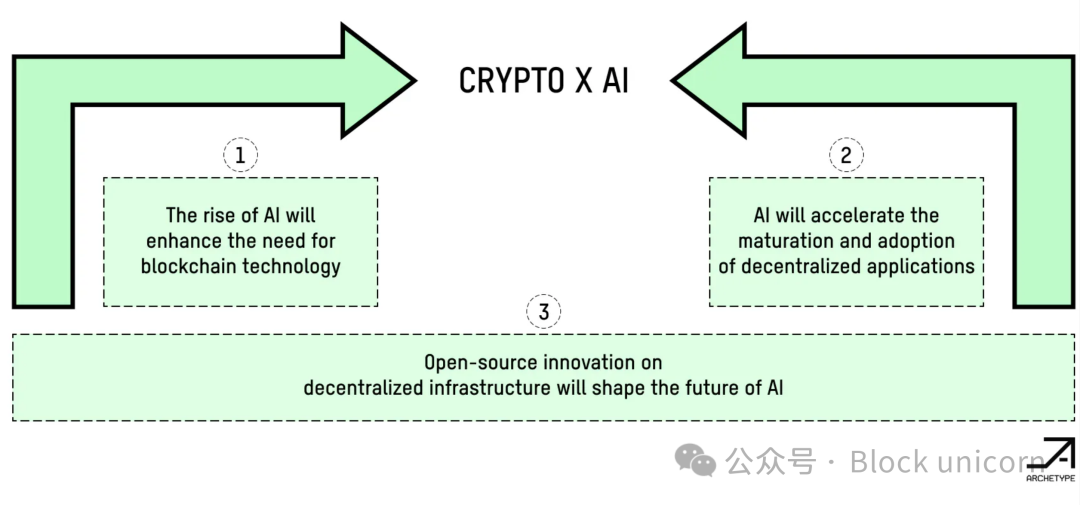
Over years of stress-testing, blockchain’s infrastructure has successfully evolved into a permissionless system suited for the digital age—especially one shaped by generative AI.
Crypto’s toolkit addresses critical issues including resource and liquidity coordination, asset ownership, data provenance, verification, and more. Crucially, the maturity of the ecosystem and technology stack is now catching up just in time to meet the demands of the AI revolution.
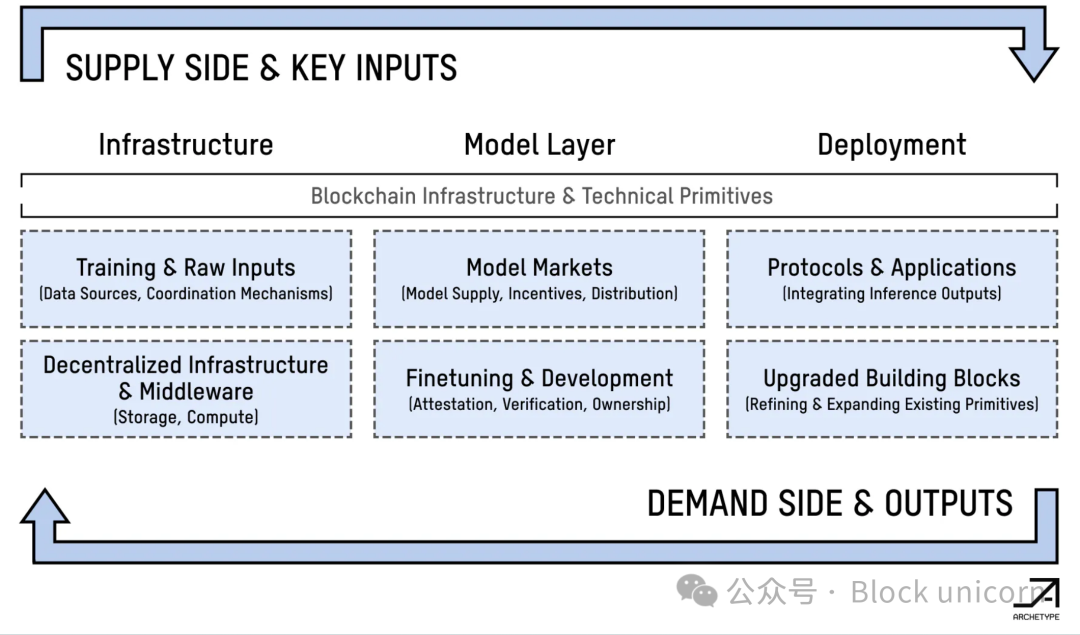
While there’s ample room for blockchain to optimize existing machine learning (ML) workflows, the most exciting opportunities will emerge at the intersection of crypto and AI, enabling entirely novel outcomes.
The most exciting new design spaces will include:
-
Decentralized storage serving as the foundation for shared, permissionless data warehouses, enabling better training or higher-performing models via retrieval-augmented generation (RAG).
-
Zero-knowledge proofs for model or content validation, training, user data privacy, or enabling edge and local (client-side) inference.
-
Novel information markets and improved mechanisms for collecting higher-quality data, as foundational models require increasingly specialized inputs to evolve.
-
Autonomous agents transacting via smart contracts, enabling them to accumulate resources, knowledge, and assets using machine-operated private keys.
As crypto infrastructure impacts the supply of computing resources, data markets, and the collective creation and monetization of powerful base models, open-source AI/ML will be strongly propelled by crypto, driving a revival in human productivity and open collaboration in the years ahead.
Crypto will become the best way to gain exposure to the rise of AI—either through proxy holdings in blue-chip assets like Ethereum (ETH), or through direct ownership or speculation in agents, models, networks, and datasets.
What’s Next?
We are at an inflection point for this industry. After years of pushing forward despite market headwinds, resistance from incumbents, and regulatory pressure, the tide is finally turning.
The moment for crypto has arrived, thanks to the convergence of several powerful tailwinds, ultimately ushering in a decentralized future. Against this backdrop of infrastructure and middleware renaissance, which has already enabled quantum leaps in on-chain experiences, there’s one crucial point we must remember.
In a perfect world, modularity enables specialization while distributing control and points of failure across multiple contributors. However, each new component involves different technical and security assumptions, incentive structures, token distribution roadmaps, venture backing, foundation setups, and internal politics.
I don’t mean to diminish the efforts of builders across the space over the past year, especially amid a brutal economic downturn. But as activity and excitement return, we must move beyond narrow echo chambers that endlessly repeat the same narratives and mislead with disinformation—signals that might falsely suggest token drops equal real partnerships, effective marketing equals community endorsement, or incentivized behavior substitutes for organic adoption.
In the coming years, we have a responsibility to ensure that an increasing number of projects act responsibly in their technical design choices, token allocations, value distribution, ideologies, and governance.
This is how crypto wins in the end.
Join TechFlow official community to stay tuned
Telegram:https://t.me/TechFlowDaily
X (Twitter):https://x.com/TechFlowPost
X (Twitter) EN:https://x.com/BlockFlow_News
 @archetypevc