








As Bitcoin Reaches New Highs: A New Perspective on Understanding Bitcoin
TechFlow Selected TechFlow Selected
As Bitcoin Reaches New Highs: A New Perspective on Understanding Bitcoin
The journey of Bitcoin's birth and development.
 Navigating Web3 tides with focused insights
Author: @LiamWang88
Just a few days ago, Bitcoin's price surged past $70,000, reaching an all-time high. From Satoshi Nakamoto’s release of the Bitcoin white paper in 2008 to today, Bitcoin has now traveled 16 years on its journey. Over these 16 years, Bitcoin evolved from being dismissed by nearly everyone to gradually gaining mainstream acceptance, and from having zero perceived value to setting historic highs—clearly reflecting the typical, winding upward path of any groundbreaking new phenomenon.
Undoubtedly, the surge in Bitcoin’s price has created massive investment and speculative opportunities. Whether you're a long-term believer, a speculator, or merely an observer, it’s impossible to avoid being enveloped by intense FOMO (fear of missing out). Everyone is eager to debate Bitcoin’s next peak: $80,000? $100,000? $150,000? Or even $200,000… While answers vary, there is surprising consensus on one point: the expectation that prices will continue rising.
In my view, this heightened enthusiasm helps strengthen broader consensus around Bitcoin. But precisely in such an environment, it becomes even more important to step back and reflect on Bitcoin’s origins and developmental journey.
A Brief History of Bitcoin: Milestone Moments
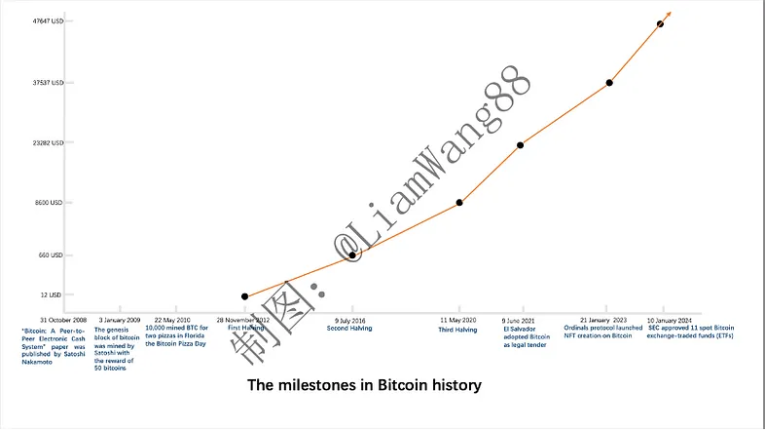
On October 31, 2008, a person using the pseudonym Satoshi Nakamoto published a paper titled “Bitcoin: A Peer-to-Peer Electronic Cash System.” In this paper, Nakamoto laid out the technical feasibility of an electronic currency based on timestamps and proof-of-work mechanisms.
Of course, many people ask: Why did Nakamoto publish such a paper? To answer that, we must revisit what exactly happened in the world in 2008.
On September 15, 2008, Lehman Brothers, a major U.S. financial institution, collapsed, triggering a global financial crisis.
To respond to the crisis, the U.S. government launched large-scale bailouts for its domestic financial system. The Federal Reserve fired up the printing presses, implementing quantitative easing with massive liquidity injections—actions that severely undermined the stability of the global financial system. That year, financial professionals in New York, London, Tokyo, and Hong Kong all felt vulnerable, worrying about whether they’d lose their jobs the next day. Influential global media outlets like The Wall Street Journal, Bloomberg, The New York Times, and the Financial Times filled their front pages daily discussing solutions. Every major international gathering had only one topic: how to rescue the markets. In short, 2008 was a year of global financial despair, with everyone living under the shadow of economic recession.
The systemic collapse of financial intermediaries, combined with self-inflicted consequences from malicious incentives, rampant inflation due to sovereign currency over-issuance, exchange rate volatility, and sluggish global rescue efforts—all highlighted the inherent fragility and flaws of traditional finance and the global monetary system. It was precisely against this backdrop that Bitcoin emerged.
On January 3, 2009, with the official launch of the Bitcoin network, Satoshi Nakamoto mined Bitcoin’s genesis block (block 0), marking the birth of the Bitcoin network—and earned 50 BTC as a reward. Interestingly, embedded in this block was a message: "The Times 03/Jan/2009 Chancellor on brink of second bailout for banks."
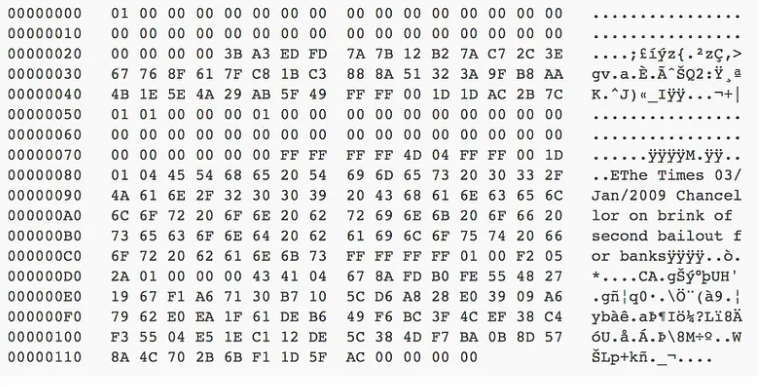
https://en.bitcoin.it/wiki/Genesis_block
On May 22, 2010, Laszlo Hanyecz, a programmer living in Florida, decided to try buying something tangible with his Bitcoin. He successfully traded 10,000 BTC for two pizzas delivered from a local pizzeria. This marked Bitcoin’s first real-world exchange value. Ever since, May 22 has been celebrated by crypto enthusiasts as “Bitcoin Pizza Day.”
On November 28, 2012, Bitcoin experienced its first halving event. At that time, Bitcoin traded at approximately $12 per coin. Six months later, on May 28, 2013, its price had risen to $130.
On July 9, 2016, Bitcoin underwent its second halving. The price then hovered around $660 per coin. By January 9, 2017, it had climbed to $900.
On May 11, 2020, Bitcoin went through its third halving. The price stood at roughly $8,600 per coin. Six months later, on November 11, 2020, it reached $15,700.
The magic of Bitcoin didn’t stop there. On June 9, 2021, El Salvador’s parliament passed a bill approving Bitcoin as legal tender—the first time a sovereign nation formally adopted Bitcoin as official currency.
On January 21, 2023, Bitcoin developer Casey Rodarmor introduced the Ordinals protocol, unleashing a wave of inscriptions and marking a historic moment when Bitcoin began building its own ecosystem.
On January 10, 2024, the U.S. Securities and Exchange Commission (SEC) approved 11 spot Bitcoin ETFs. This meant retail and institutional investors in traditional financial markets could now easily buy Bitcoin to diversify their portfolios—an epoch-making milestone in Bitcoin’s history.
Looking back at Bitcoin’s development, if a new phenomenon is to become a truly compelling investment asset, continuously establishing and reinforcing consensus is essential. But even more importantly, it requires the “perfect” integration of multiple coincidental and inevitable factors:
① A unique historical context or opportunity tied to systemic transformation in human society;
② Demonstrated scarcity—the fixed supply of 21 million coins ensures Bitcoin isn't infinitely available;
③ Innovative yet mysterious attributes—no one still knows who Satoshi Nakamoto really is;
④ Uniqueness—no one denies that Bitcoin is the first true embodiment of blockchain’s decentralized spirit.
Bitcoin’s Value: More Than Just Digital Gold
It is precisely this “perfect” confluence of multiple coincidental and necessary factors that gives Bitcoin its distinctiveness—and thus, its unique value.
Currently, the most widespread consensus views Bitcoin as “digital gold,” meaning it functions similarly to gold—as a strong hedge against inflation and a safe-haven asset.
This analogy seems reasonable, given the many similarities between the two. Most notably: ① both have limited supplies; ② both can serve as alternatives to fiat currencies.
Following this logic, let’s examine the current gap in market capitalization. According to companiesmarketcap, as of March 12, 2024, gold’s market cap stands at $14 trillion, while Bitcoin’s is around $1.4 trillion.[1] From this perspective, Bitcoin still has at least tenfold room for growth. To many, this reasoning serves as a strong argument supporting continued price appreciation.
Extending the timeline, consider the decade from 2013 to 2023. As shown in the chart below, except for 2014, 2018, and 2022, Bitcoin’s overall returns significantly outperformed assets such as gold and the S&P 500 index—further highlighting its superiority in investment growth and inflation resistance.
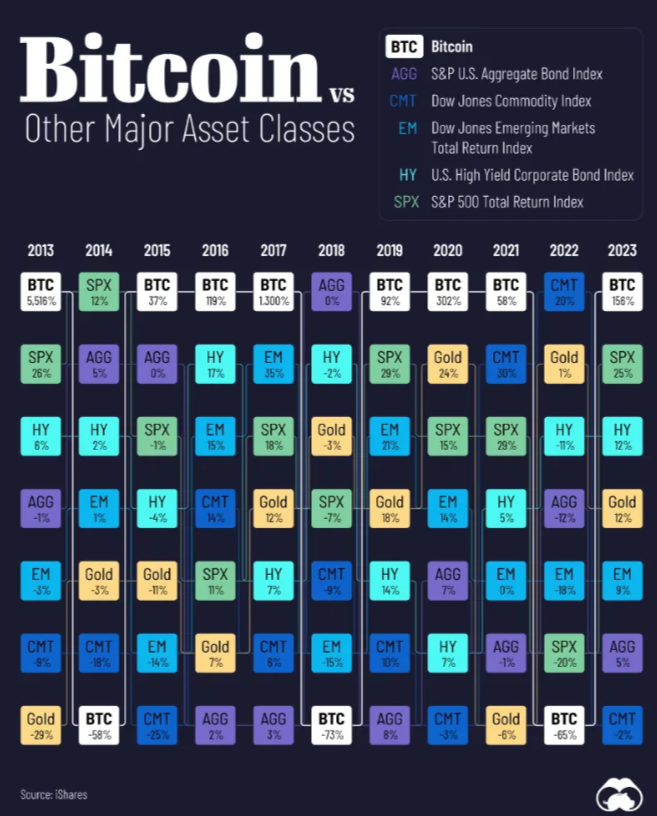
https://www.visualcapitalist.com/bitcoin-returns-vs-major-asset-classes/
The low-market-cap “digital gold” narrative offers Bitcoin substantial growth potential. However, in my opinion, viewing Bitcoin solely through the lens of “digital gold” falls far short. In other words, Bitcoin is much more than just digital gold—it possesses greater imaginative potential than gold. I hold two main arguments:
1. Gold is money, but Bitcoin is money + technological ecosystem. Since its emergence in human society, money has primarily served three functions: ① store of value; ② unit of account; ③ medium of exchange. From this standpoint, both Bitcoin and gold clearly fulfill these roles. But Bitcoin holds an advantage: beyond being a currency, it represents a new technological innovation—one that gold simply cannot match.
Because of its technological nature, blockchain represented by Bitcoin offers greater flexibility and expandability, making it easier to develop and grow a vibrant tech ecosystem. Today, with innovations like inscriptions emerging, the Bitcoin ecosystem is rapidly taking off. While we don’t yet know what form this ecosystem will ultimately take, one thing is certain: Bitcoin’s fusion of technological and monetary properties opens up vastly greater possibilities.
2. Gold was prepared for human society, but Bitcoin is prepared for a new intelligent civilization. By “human society,” I mean various social forms including slave societies, feudal societies, and capitalist societies. Throughout these eras, gold has accompanied humanity for thousands of years.
By “new intelligent civilization,” I refer to a future societal structure radically different from today’s—one created through superior human intellect:
① Interstellar Society: We will no longer be Earthlings, but spacefarers. Musk’s Mars colonization plans already show that some human pioneers are boldly moving in this direction.
② AI-Human Society: Yes, I said AI-human, not human+AI. This means humans won’t just coexist with AI—they may themselves gain AI-like capabilities, such as brain implants. Anything is possible. OpenAI has already demonstrated the immense power of AI, and we’ve heard countless new terms related to virtual societies: metaverse, digital humans, avatars… Humanity continues advancing steadily from physical reality toward virtual realms.
Whether interstellar or AI-human societies, each will require an economic system—and a form of money to serve as a store of value, unit of account, and medium of exchange. At least for now, nothing appears better suited than Bitcoin. Of course, as many worry, with quantum computing advancing, Bitcoin’s code might one day be cracked, undermining its scarcity. Others question: if humans colonize Mars someday and discover gold-like materials there, perhaps Bitcoin won’t remain the ultimate choice.
No one can predict the future. Viewed across the arc of history, every new phenomenon is essentially a grand social experiment tied to profound human transformation. But from today’s vantage point, after 16 years of evolution, Bitcoin’s story is far from over.
Bitcoin’s Opportunity: Standing at a New Starting Line
Since the creation of Bitcoin’s genesis block in 2009, early participants have reaped substantial rewards. When you prove you’ve made money on Bitcoin, you either demonstrate deep understanding—or extraordinary luck. With the January 2024 approval of spot Bitcoin ETFs, I believe Bitcoin has reached a new starting point. From here, my outlook is:
① Bitcoin’s role as a safe-haven asset will grow stronger. Holdings will increasingly concentrate in the hands of institutions and large holders. Retail demand for Bitcoin investing will rise, but new supply sources will need to emerge to meet it.
② The technological ecosystem aspect of Bitcoin has only just begun to surface. Whether long-term believers, investors, or speculators, people will consciously or unconsciously create and discover new alpha opportunities. The emergence of inscriptions marks one such attempt. I use the word “attempt” because I’m not sure whether inscriptions represent the right path—or if other paths exist. But if one day you make money on Bitcoin, remember: it either proves your insight was deep enough—or your luck was good enough.
Join TechFlow official community to stay tuned
Telegram:https://t.me/TechFlowDaily
X (Twitter):https://x.com/TechFlowPost
X (Twitter) EN:https://x.com/BlockFlow_News
 @LiamWang88









