








47 Crypto Security Incidents Retrospective: Everyone Fell for the Same Human-Caused Vulnerability
TechFlow Selected TechFlow Selected
47 Crypto Security Incidents Retrospective: Everyone Fell for the Same Human-Caused Vulnerability
Only by treating security as an ongoing, quantifiable cost—not a one-time checkbox task—can you survive.
 Navigating Web3 tides with focused insights
Author: Vladimir S.
Translated by: Saoirse, Foresight News
In the first quarter of 2026, I did something most people in crypto refuse to do: I read every major security incident post-mortem, on-chain forensic report, and leaked Discord chat log from this year—47 incidents in total, with over $3.8 billion in assets stolen. Yet not a single one involved a so-called “genius-tier zero-day smart contract vulnerability”—a previously unknown, unpatched flaw exploited before public disclosure.
Every time, funds were withdrawn through the front door—because someone manually opened it.
Everyone blames the code. I blame people. Below are irrefutable facts drawn from those 47 cases…
I’ve categorized them by breach type—the pattern is crystal clear. No fluff, just brutal truth:
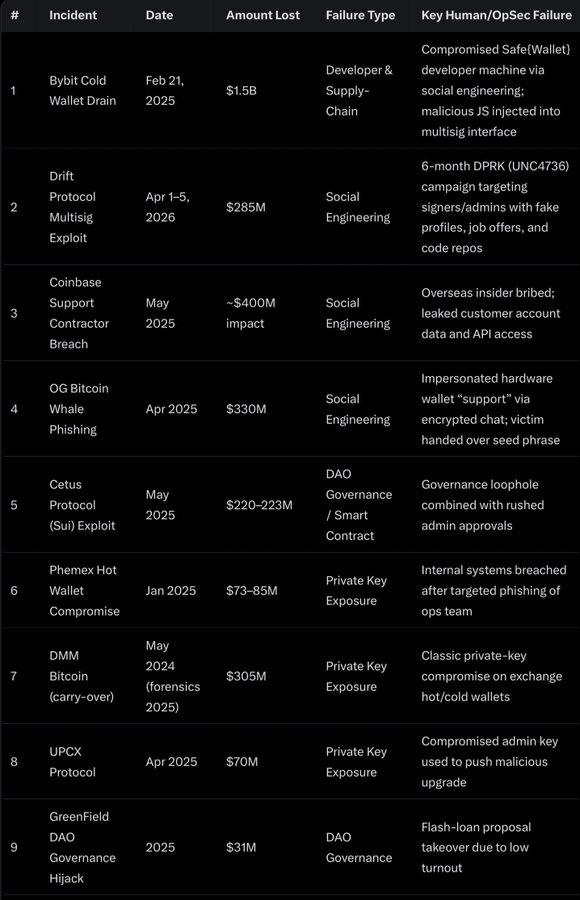
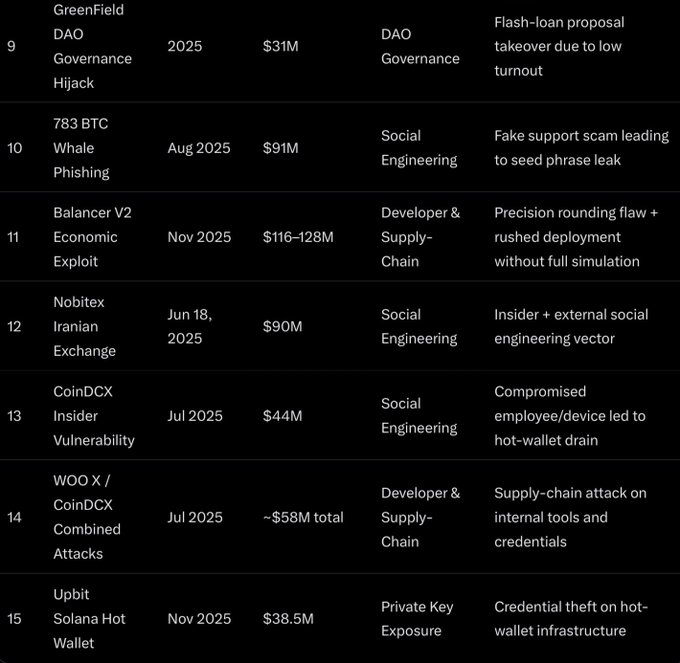
Overview of the remaining 32 incidents
- Social engineering attacks (13 new cases): ~$620 million total—primarily whale phishing, deepfake voice scams, and Telegram “official developer support” impersonation schemes. Average loss per incident: $35–40 million.
- Developer and supply chain security breaches (8 new cases): ~$480 million total—including malicious backdoors injected into npm/PyPI packages, compromised TestFlight apps, and developer machines hacked.
- Private key and credential leaks (5 new cases): ~$310 million total—including mnemonic phrase exposure, keys stored in the cloud, and weak two-factor authentication (2FA) bypasses.
- DAO governance hijacking and flash loan attacks (6 new cases): ~$150 million total—exploiting token-weighted voting flaws and low-voter-turnout proposals to seize control.
Social Engineering Targeting Privileged Personnel (19 cases, >$1.2 billion lost)
This category dominates all others. Attackers don’t need to crack algorithms—they break people.
- Drift Protocol (April 1, 2026; $285 million): The North Korean hacking group UNC4736 spent six months building trust with multisig signers and administrators—forging LinkedIn profiles, posing as recruiters, and gradually escalating access privileges. They fabricated collateral and obtained 2-of-5 multisig approval before draining the treasury in minutes. The code wasn’t hacked—the people were.
- Coinbase Customer Support Outsourcer Bribery (May 2025; estimated impact: $400 million): Overseas internal staff recklessly leaked user account data.
- 783-Bitcoin Whale Phishing (August 2025; $91 million): The victim believed they were communicating with official hardware wallet support—and surrendered their mnemonic phrase in an encrypted chat.
Developer and Supply Chain Intrusions (11 cases, >$1.7 billion lost)
The “security” of your wallet infrastructure is only as strong as the laptop your developer used at 2 a.m.
- Bybit Cold Wallet Theft (February 2025; $1.5 billion): Lazarus Group breached a Safe{Wallet} developer’s device and used it to approve massive transfers. One device. One person. Total collapse.
- Phemex Hot Wallet Breach (January 2025; $85 million): Targeted phishing led to unauthorized access to internal systems.
Private Key and Credential Leaks (9 cases, >$650 million lost)
This still happens in 2026. Seriously.
- DMM Bitcoin (Legacy forensic case from 2024; $305 million): A textbook private key leak—still cited by analysts today as the archetype for exchange hacks in 2025–2026.
DAO Governance Hijacking and Flash Loans (8 cases, >$220 million lost)
Low voter turnout + token-weighted voting = free money for anyone with a few million in liquidity.
- GreenField DAO (2025; $31 million): Single-block flash loan governance attack.
- UPCX Protocol (2025; $70 million): Classic proposal takeover attack.
Other smaller-scale incidents follow identical patterns: cheap vote-buying, treasury draining, and vanishing acts.
Without exception, every victim made the same fatal mistake: treating manual approvals as a reliable security boundary.
In each case, one person—or a small group—served as the final gatekeeper. No technical enforcement checks. No mandatory transaction simulation. No real-time identity verification. No time delay. Just one line: “Trust me—I’m the signer.”
That is the sole point of failure—not code, but the human in the loop.
A Seven-Layer Operational Security Framework
I’m not merely theorizing about this framework—I’ve already deployed it to protect two eight-figure fund pools. This full system would have prevented *every single one* of the 47 security incidents described above:
1. Air-Gapped Devices + MPC Multisignature
Never store mnemonic phrases on hot devices. Use hardware wallets or MPC wallets to ensure no single individual ever sees the full private key.
Air-gapped signing means final signatures occur on hardware that has never been connected to any network. MPC goes further: the private key never exists in its entirety anywhere. Key shards are distributed across multiple devices or individuals—only a threshold quorum can generate a valid signature. Use MPC for hot operations; use air-gapped cold storage for large transfers—and embed rate limits, whitelists, and other rules directly into the MPC engine. Even if one shard is compromised, the system will block execution.
2. Geographically Distributed Multisignature + High Threshold
Use a minimum 3-of-5 configuration, with signers located across different continents, devices, and time zones. Reject fragile setups like 2-of-3 where everyone knows each other.
Even if attackers socially engineer two signers, they’d still need a third—located in another time zone, possibly asleep or offline. Rotate signers quarterly, mandate hardware keys, and *never* use 2-of-3.
3. Mandatory Transaction Simulation & Preview
Every signature must be fully simulated in a sandbox environment, clearly displaying exactly what will happen on-chain. Blind signing is strictly prohibited.
If the simulation result deviates—even slightly—from expectations, the transaction terminates immediately.
4. Real-Time Identity Verification + Challenge-Response Authentication
High-value transactions require live video calls, paired with pre-shared passphrases or real-time display of on-chain random numbers. Deepfakes fail here outright.
Schedule calls in advance, record sessions for audit trails, and use tools like Signal.
5. Time Lock + Delayed Execution
Transactions exceeding $500,000 enter a publicly visible 48–72 hour time-lock queue—with emergency pause capability.
This gives teams breathing room to detect anomalies, preventing many flash loan governance attacks and rushed, unauthorized approvals.
6. Automated Anomaly Monitoring + Emergency Kill Switch
Trigger on-chain and off-chain alerts for anomalous signer behavior, IP changes, or unusual transaction patterns. Enable one-click freezing of the entire treasury.
Designate a dedicated multisig-triggerable transaction to pause treasury operations or initiate emergency recovery.
7. Quarterly Red Team Exercises + Fail-Safe Mechanism
Hire white-hat hackers to conduct social engineering tests against your team. If core signers go offline for 30 days, assets automatically migrate to a recovery multisig address.
Red teaming uncovers human vulnerabilities missed by audits; fail-safes mitigate risks like founders absconding with keys.
The Drift Protocol Hack: Why Military-Grade Operational Security Is Non-Negotiable
In April 2026, the North Korean state-sponsored hacking group UNC4736 spent six months forging identities, running fake job postings, and incrementally gaining trust with Drift’s multisig administrators—before stealing $285 million. They didn’t breach any code. They breached the “human trust layer” that every project still relies upon.
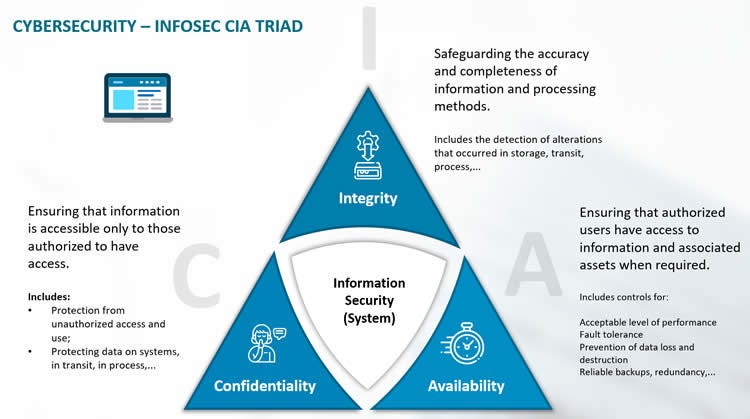
This event reveals a hard reality: once nation-state actors target your funds, consumer-grade security is utterly insufficient. Projects must adopt true military-grade operational security—grounded in the zero-trust principle of “never trust, always verify”—and implemented through confidentiality, integrity, and availability.
Every critical operation must follow aviation-grade checklists: mandatory simulation, real-time verification, independent review—and operating under the assumption that “compromise is inevitable.” Without meeting this standard, you’re simply waiting for the next nation-state actor to walk right through your front door.
Why Projects Need a Dedicated Internal Security Officer
Projects surviving into 2026 aren’t just spending money on audits—they’re hiring full-time internal security officers whose sole responsibility is operational security and incident response.
This isn’t a part-time developer side gig or a team-wide shared duty. This person must know all reputable audit firms, on-chain asset recovery teams, and white-hat emergency response groups—and know exactly who to call *first* when things go wrong.
In traditional industries, security officers often come from military, police, or special forces backgrounds—because they possess muscle memory for crisis response. Crypto is no different: you need someone deeply embedded in the on-chain world, capable of coordinating multisig freezes at 3 a.m. and simultaneously briefing security agencies.
Without such a central, accountable figure, even the most perfect seven-layer framework collapses instantly under real-world pressure.
Resolv Labs Incident: Detection Alone Is Not Enough
The Resolv Labs post-mortem—publicly released in early April 2026—is a textbook example among the 11 supply chain and infrastructure failures in our sample set of 47.
Attackers leveraged leftover GitHub permissions held by an outsourced employee to gain initial access, then moved laterally across cloud infrastructure, altered signature policies, minted 80 million unauthorized tokens, and stole ~$25 million worth of ETH.
Although real-time monitoring flagged anomalous transactions, the team took over an hour to initiate response.
That’s precisely why a dedicated security officer is indispensable: they can dial emergency and forensics teams instantly—the response protocol is drilled into muscle memory.
Why Every Project Needs Bug Bounties, Continuous Audits, and Audit Competitions
Smart teams treat security investment like insurance: invisible until disaster strikes—and life-saving when it does.
The mindset of “we’ve already audited once” is precisely what cost 47 projects billions of dollars.
You must:
- Maintain a public, well-funded bug bounty program (minimum $50,000–$250,000, scaled to TVL);
- Audit every update before deployment;
- Host at least one audit competition per quarter.
One major hack can kill a project outright. Only by treating security as a continuous, quantifiable cost—not a one-time checkbox—can you survive.
Personal Security Recommendations
Even the strongest seven-layer protocol-level defenses mean nothing if your personal laptop or phone becomes the weakest link.
- Windows/Linux devices: Install Malwarebytes + enterprise-grade EDR endpoint protection;
- iPhone: Enable Lockdown Mode and install iVerify to detect spyware and zero-click exploits;
- Mac: Use S1; enable FileVault on all Apple Silicon Macs; disable AirPlay if unused; set password-protected screen saver.
Perform all key-related or signing operations on a dedicated “clean” MacBook: never sign into iCloud, avoid casual web browsing, reinstall the OS quarterly, and store it in a Faraday bag when idle. Layer enterprise-grade DLP (data loss prevention) and lightweight SIEM (security information and event management) logging with alerting.
You can adopt Trail of Bits’ OpSec Minimal Checklist directly.
Personal security is the final line of defense. Once attackers reach you, there is no pause button.
Core Takeaways
This framework is not theoretical. I’ve stress-tested it against top-tier hacker tactics—and confirmed its real-world efficacy.
Smart contract security improves year after year—but human security awareness lags behind. In 2026, if you’re still running a protocol, DAO, or managing a high-value personal wallet—and still relying on platitudes like “the team is trustworthy” or “the contract has been audited”—your level of vigilance is dangerously insufficient.
The next target could be you.
Join TechFlow official community to stay tuned
Telegram:https://t.me/TechFlowDaily
X (Twitter):https://x.com/TechFlowPost
X (Twitter) EN:https://x.com/BlockFlow_News
 @officer_secret


