Why Does the Automated Market Maker (AMM) Mechanism Fail in Prediction Markets?
TechFlow Selected TechFlow Selected
Why Does the Automated Market Maker (AMM) Mechanism Fail in Prediction Markets?
For any liquidity provider to the pool, the mathematical outcome is nearly brutal.
 Navigating Web3 tides with focused insights
By: Melee
Translated by: AididiaoJP, Foresight News
In July 2017, Hayden Adams was laid off by his employer Siemens, where he worked as a mechanical engineer. His college roommate Karl Floersch was then employed at the Ethereum Foundation and frequently spoke to him about smart contracts. Adams had previously paid little attention. Now unemployed and looking for something to do, he decided to listen.
The Birth of Automated Market Makers (AMMs)
Floersch recommended a blog post by Vitalik Buterin on using mathematical formulas—rather than order books—to run on-chain exchanges. Instead of matching buyers and sellers, this approach enabled traders to swap tokens directly against a liquidity pool, with prices automatically determined by the ratio of tokens in the pool. At the time, no working implementation existed. Adams took it on as a learning project, secured a $65,000 grant from the Ethereum Foundation, and launched Uniswap in November 2018.
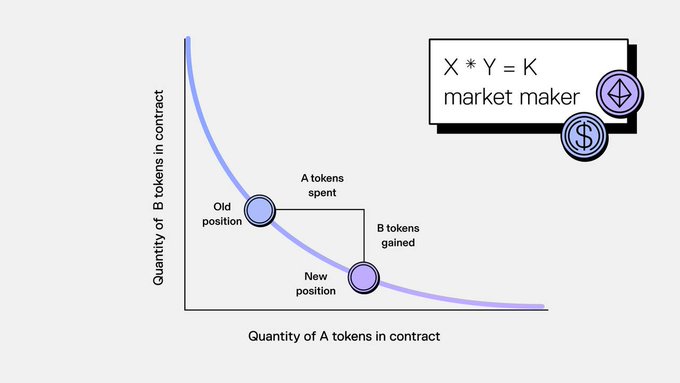
Its formula is almost comically simple: x * y = k.
Two tokens are placed into a pool, and their product remains constant. When someone buys one token, they must deposit the other; the pool’s ratio shifts accordingly, adjusting the price. No order book, no matching engine, no professional market makers required. Anyone can deposit tokens into the pool and earn fees from every trade.
Automated market makers thus became the cornerstone of decentralized finance. Uniswap, Curve, Balancer, and dozens of other protocols now handle billions of dollars in trading volume. On-chain order books are slow and expensive, and traditional market makers have no incentive to provide liquidity for tokens held by only two hundred people. AMMs enable anyone to create a liquid market for any asset, anytime. Before AMMs, launching a new asset required permission and infrastructure. After AMMs, all you need is a liquidity pool.
The benefits are obvious—which is why prediction markets naturally attempted to adopt them too.
AMMs and Prediction Markets
Prediction markets face the same cold-start problem as token markets: liquidity is needed before traders will participate, yet traders are needed before liquidity providers will step in. Less well known is that Robin Hanson proposed an automated market-making mechanism for prediction markets years earlier—in his 2002 Logarithmic Market Scoring Rule (LMSR).
He believed he had theoretically solved the cold-start problem. In practice, however, his scheme suffered from the same fundamental flaw that would plague every subsequent attempt to automate liquidity for prediction markets: the formula cannot distinguish between perpetually fluctuating tokens and time-bound, binary outcome securities.
Prediction market outcomes are binary—they settle at either one or zero. In a token swap pool, both assets can fluctuate indefinitely, and AMM formulas work precisely because neither token is designed to go to zero.
Early Polymarket used an LMSR-based AMM. Augur also experimented with similar mechanisms. If automated liquidity pools work for token swaps, they ought to work just as well for election betting.
They don’t.
Why AMMs Fail in Prediction Markets
When a prediction market event settles, one side is worth $1, the other $0. For any liquidity provider, the mathematical outcome is nearly brutal: as the market approaches settlement, the pool automatically rebalances toward the losing side.
Impermanent Loss
What decentralized finance traders call “impermanent loss” becomes fully “permanent.” Every market settles, and every pool ultimately holds a bundle of shares worth zero.
In conventional DeFi pools, trading fees gradually offset impermanent loss over time.
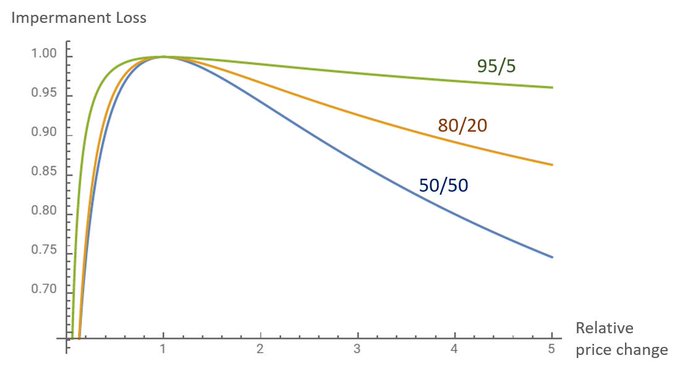
In prediction markets, the loss is structurally inevitable. The only question is how much liquidity providers lose. Protocols have tried persuading users to deposit assets into such pools via liquidity mining, reward programs, and various incentive structures. All of these are merely different ways of subsidizing users to lose money more slowly.
Price Discovery
Then there’s price discovery. AMMs price assets based on pool ratios and fixed formulas. For tokens, the “correct price” is inherently a moving target—and a formula-driven approximation suffices. But prediction market prices should represent probabilities. The slippage introduced by constant-product curves distorts that signal, especially in low-liquidity markets, where a single trade can shift implied probability by several basis points.
Are Central Limit Order Books (CLOBs) Better Than AMMs?
Polymarket recognized this early. At the end of 2022, the platform migrated from its LMSR-based AMM to a central limit order book (CLOB). AMMs were designed for continuous token swaps across price ranges. Prediction markets require precise probabilistic pricing over binary outcomes with known final values. These are fundamentally different problems.
The very features that made AMMs revolutionary for tokens—permissionless market creation, instant liquidity bootstrapping, and independence from professional market makers—are exactly what prediction markets need. The issue is that the specific mechanism—the constant-function formula built for token swaps—breaks down when confronted with binary outcomes and inevitable settlement.
The challenge for prediction markets is to replicate those benefits using infrastructure that reflects how such markets actually settle.
Join TechFlow official community to stay tuned
Telegram:https://t.me/TechFlowDaily
X (Twitter):https://x.com/TechFlowPost
X (Twitter) EN:https://x.com/BlockFlow_News
 @meleemarkets