Ritual, a $25 million-funded Crypto+AI upstart: The optimal solution for connecting cryptography with AI computing power and models?
TechFlow Selected TechFlow Selected
Ritual, a $25 million-funded Crypto+AI upstart: The optimal solution for connecting cryptography with AI computing power and models?
Ritual aims to combine the best principles and techniques from cryptography and AI to create a system that enables open and permissionless creation, distribution, and improvement of AI models.
 Navigating Web3 tides with focused insights
By Karen, Foresight News
The emergence of large language model applications such as ChatGPT has greatly accelerated the continuous evolution of the entire AI ecosystem, giving rise to new paradigms and technological innovations. However, as with any rapidly developing technology, these large language models also face numerous challenges—such as data privacy and abuse, computational integrity, resistance to censorship, licensing issues, centralized APIs, high computing costs, monopolization by tech giants, not to mention AI governance and ownership.
To address these issues, Ritual was created—a project envisioned as an open, modular, sovereign execution layer for AI. Ritual brings together a distributed network of nodes with computational power and model creators, allowing those creators to host their models on the nodes. Users can then access any model (whether LLMs or classic ML models) across the network via a universal API, supported by additional cryptographic infrastructure that ensures computational integrity and privacy.
What Is the Background Behind Ritual?
In November 2023, after several months of development, Ritual officially exited stealth mode and went public. The team aims to combine the best principles and technologies from cryptography and AI to create a system that enables open, permissionless creation, distribution, and improvement of AI models.
Ritual’s official website lists 21 team members. Co-founder Niraj Pant was previously a general partner at Polychain and is currently 27 years old. He joined Polychain as an intern at age 19 and dropped out of the University of Illinois one month later. Niraj conducted research on privacy at the Decentralized Systems Lab at the University of Illinois Urbana-Champaign.
The other co-founder, Akilesh Potti, was also formerly a partner at Polychain and has experience in machine learning, high-frequency trading, and systems building. Other team members include Ricky Moezinia—the former Chief AI Engineer at Microsoft AI and ex-software engineer at Facebook Novi and Diem, who now founded Alta, a cross-border payments company—as well as contributors from Polychain, Trust Machines, Dragonfly, Protocol Labs, dYdX, and others.
At its public launch, Ritual also announced a $25 million funding round led by Archetype, with participation from Accomplice, Robot Ventures, dao5, Accel, Dilectic, Anagram, Avra, and Hypersphere.
Angel investors in Ritual include Balaji Srinivasan, former CTO of Coinbase; Nicola Greco, researcher at Protocol Labs; DC Builder, research engineer at Worldcoin; Calvin Liu, Chief Strategy Officer at EigenLayer; Keone Hon, co-founder of Monad; and Daniel Shorr and Ryan Cao from Modulus Labs, an AI+Crypto project.
Ritual’s advisory board is equally impressive, including Illia Polosukhin, co-founder of NEAR Protocol and co-author of the seminal research paper “Attention Is All You Need” (Foresight News note: published in 2017, widely regarded as the foundational work for Transformer-based language models—in essence, all modern GPT variants trace back to this paper); Sreeram Kannan, founder and partner at EigenLayer; Tarun Chitra, founder and CEO of Gauntlet; and later, Arthur Hayes, co-founder of BitMEX, also joined Ritual as an advisor.
How Does Ritual's Architecture Work?
Ritual enables seamless integration of AI into applications or protocols on any blockchain, supporting fine-tuning, monetization, and inference execution. According to Ritual, its ultimate goal is to empower developers to build fully transparent DeFi systems, self-improving blockchains, autonomous agents, generative content, and more.
Currently, Ritual has launched Infernet—a lightweight library that brings computation on-chain. This marks the first phase of Ritual’s product roadmap. Infernet can also be viewed as an AI-optimized decentralized oracle network compatible with any EVM-compatible chain, enabling smart contracts to access AI models for various on-chain use cases and tasks.
Specifically, Infernet allows smart contract developers to request off-chain computations through Infernet nodes and deliver the results back to on-chain smart contracts via the Infernet SDK.
1. Infernet Nodes are lightweight off-chain clients responsible for listening to requests and executing computational workloads.
2. At the core of the Infernet SDK is the Coordinator, which manages node registration and activation within the network and allows users to subscribe to outputs from off-chain computational workloads. A subscription is a user request (one-time or recurring) sent to an Infernet node to process certain computations. Users initiate subscriptions, and nodes fulfill them.
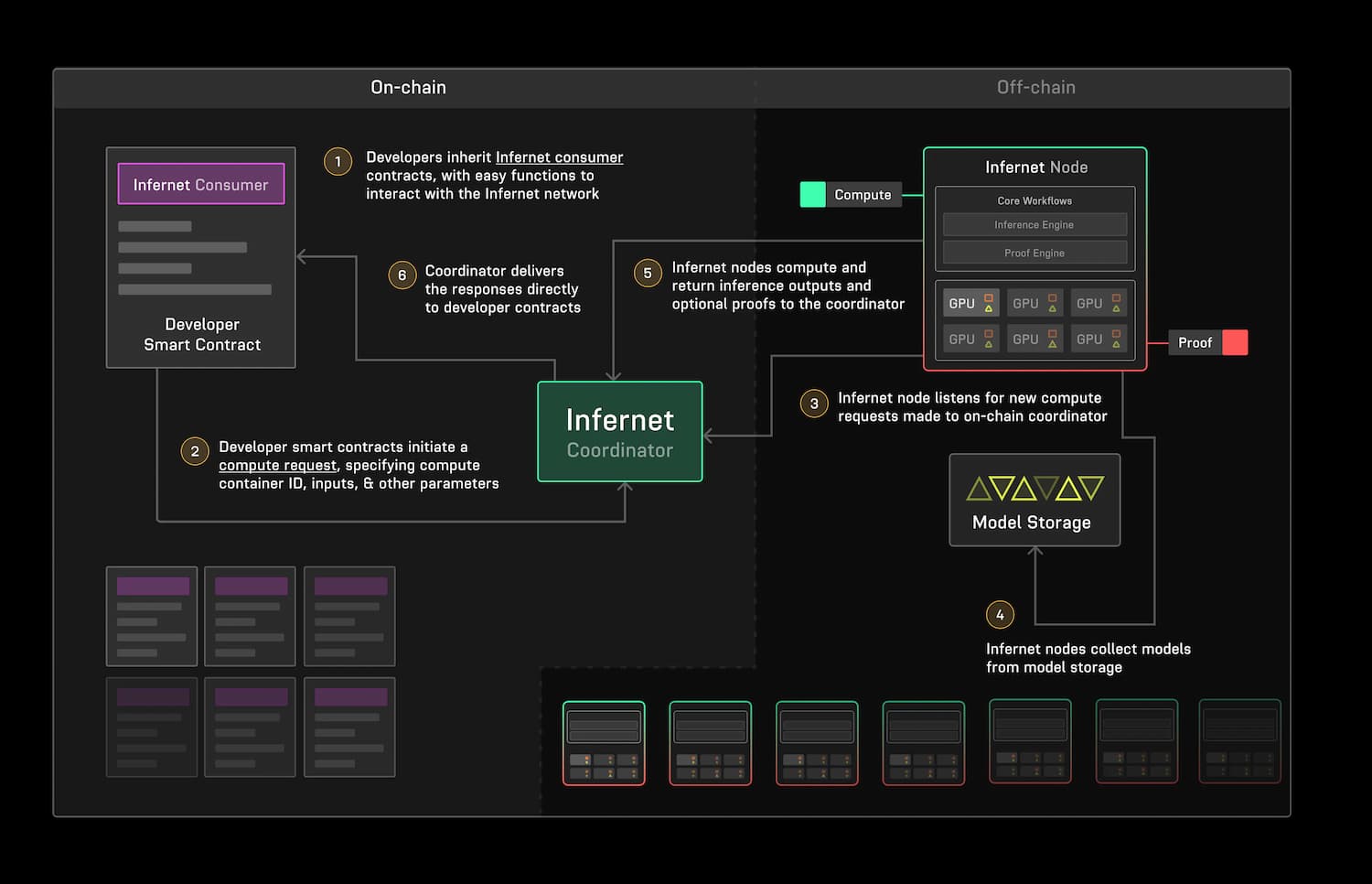
According to Ritual, developers can use Infernet to delegate compute-intensive operations—such as ML inference or ZK proof generation—to off-chain environments, consuming the output and optional proofs within smart contracts via on-chain callbacks.
Regarding incentives, Ritual stated that various participants in its network—including compute providers, model creators, and proof providers—will all be incentivized.
In the coming months, Ritual plans to launch its second phase: launching its own sovereign chain, Ritual Chain, equipped with a custom virtual machine that will act as a coprocessor (verifying computations), serving more advanced AI-native applications that will natively reside on Ritual Chain. On Ritual’s sovereign chain, ZK will serve as a key component for scalability.
Currently, there are two ways to participate in Ritual: by running an Infernet node or by using applications or protocols built on top of Infernet.
Ritual Partners with EigenLayer and io.net to Accelerate Decentralized AI
In late February, Ritual announced two major partnerships—first with EigenLayer, the leader in the restaking space, and then with io.net, an emerging AI computing player in the Solana ecosystem. Specifically, Ritual is developing an AI-native Active Validation Service (AVS) to support various components of Infernet and Ritual Chain, while simultaneously unlocking new AI-native opportunities for operators on EigenLayer. Ritual stated that thanks to EigenLayer’s high TVL and diverse set of nodes, Ritual Chain and its many features will benefit from strong economic security and decentralization from day one.
The diagram below illustrates how EigenLayer operators perform model operations. EigenLayer operators with access to compute resources can re-stake and register as Ritual nodes, thereby providing users with access to these operations. The Ritual AVS contract acts as the coordinator, offering coordination services once a user initiates a computation request. Then, the Ritual stage and operators receive the computation request from the coordinator. Operators retrieve the relevant model from model storage, perform the computation, and return the inference output to the coordinator, which then delivers the result to the user. As Ritual integrates payment flows for these services, restakers will benefit from the resulting revenue.
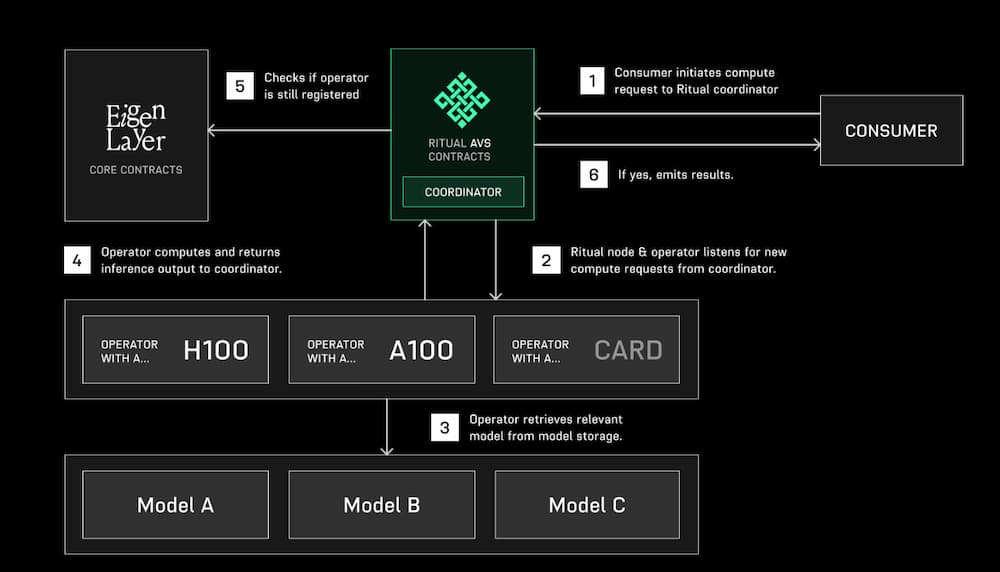
Additionally, since Ritual can guarantee computational integrity for model operations, once EigenLayer’s slashing mechanism goes live, EigenLayer operators registered as nodes on Ritual will be able to begin submitting proofs for generated model operations. If incorrect inferences are detected, their staked deposits will be subject to slashing penalties.
On the collaboration with io.net, Ritual will leverage io.net’s decentralized GPU stack to power the Ritual network, further accelerating its mission toward decentralized AI. In practical terms, Ritual clients will gain native access to GPUs available on io.net, enabling users to easily launch models and serve various applications both on-chain and off-chain. Ritual stated that with the launch of Ritual Chain, node clients running GPUs will be able to participate in securing the chain and servicing AI-related workloads, thereby increasing and diversifying revenue streams for io.net GPU providers.
Ritual added that as users gain access to an expanding array of models and nodes with diverse capabilities, the system will allow users to route preferences to optimal models and top-tier providers. This capability not only improves system efficiency but also ensures users receive the highest quality service. Furthermore, restaked EigenLayer nodes within the Ritual system can act as routers, creating a matching engine on Ritual that enhances system flexibility and scalability.
Achieving a truly open, secure, and decentralized AI system is no easy task—it requires overcoming significant technical and coordination challenges such as standardization, incentive design, and governance. Standardization is critical to ensuring different systems and components can interoperate seamlessly; incentives are essential to attract high-quality node providers and users; and governance ensures the stability and long-term sustainability of the entire system.
Join TechFlow official community to stay tuned
Telegram:https://t.me/TechFlowDaily
X (Twitter):https://x.com/TechFlowPost
X (Twitter) EN:https://x.com/BlockFlow_News
 Foresight News