








Happy Women's Day | Honoring the Women Power Behind Web3
TechFlow Selected TechFlow Selected
Happy Women's Day | Honoring the Women Power Behind Web3
Today, as Web3 thrives, looking back reveals numerous remarkable women whose contributions cannot be overlooked.
 Navigating Web3 tides with focused insights
By OKLink
The theme of International Women's Day 2024 is #InspireInclusion.
This means treating every woman’s contributions equally and fairly, respecting their choices, providing them with broader opportunities, and encouraging them to achieve even greater things.
As Web3 continues to thrive today, looking back, we see the undeniable brilliance of numerous pioneering women.
On this special day, we celebrate their remarkable achievements and honor their legacies.
The Woman Who First Proposed Zero-Knowledge Proofs: Shafi Goldwasser
Shafi Goldwasser is an outstanding computer scientist and mathematician renowned for her contributions to cryptography and theoretical computer science.
Goldwasser's research spans many areas, including cryptography, complexity theory, randomized algorithms, distributed computing, and computer security. She has received numerous honors such as the Turing Award, Gödel Prize, and Sloan Research Fellowship.
Her work in cryptography is particularly notable—especially zero-knowledge proofs, probabilistic encryption, and cryptographic schemes with robust security. Her research plays a vital role in building secure computing systems and protecting personal privacy.
The Woman Who Wrote the First Computer Program: Ada Lovelace
Ada Lovelace was a 19th-century British mathematician widely recognized as the world’s first computer programmer. The daughter of the poet Lord Byron, she was also an exceptional mathematician and logician.
Lovelace deeply understood the concept of the Analytical Engine. She believed it could process not only numbers but also symbols. She devised an algorithm describing how the Analytical Engine could compute Bernoulli numbers—considered the world’s first computer program.
Although the Analytical Engine was never fully built, Lovelace’s visionary ideas and algorithms profoundly influenced the development of computer science. She is celebrated as a pioneer in programming, and the second Tuesday of October each year is observed as "Ada Lovelace Day" in recognition of her contributions.
The Woman Who Designed the First Office Computer: Evelyn Berezin

Evelyn Berezin was an American computer scientist and engineer, widely regarded as a pioneer in the field of computer science.
Berezin is best known for designing computers for various specialized purposes. Her creation, the "Data Secretary," was recognized as the world’s first computerized word processor. While serving as head of logic design at an electronics firm, she designed the world’s first office computer.
She also developed the first computerized airline reservation system, reportedly covering 60 cities with a response time of just one second. Additionally, she designed the world’s first computerized banking system.
The First Woman to Use High-Level Programming Languages: Grace Murray Hopper
Grace Murray Hopper was an American computer scientist, considered a pioneer in computer programming and software development.
Hopper was among the first to program using high-level languages. She played a key role in developing COBOL (Common Business-Oriented Language), earning her the nickname "Mother of COBOL." She was also one of the original programmers of the Harvard Mark I, the first large-scale electromechanical computer. The now-ubiquitous term "debug" originated from Hopper, who famously removed a moth ("bug") that had caused a system failure.
The Woman Who Discovered Halley’s Comet: Caroline Lucretia Herschel
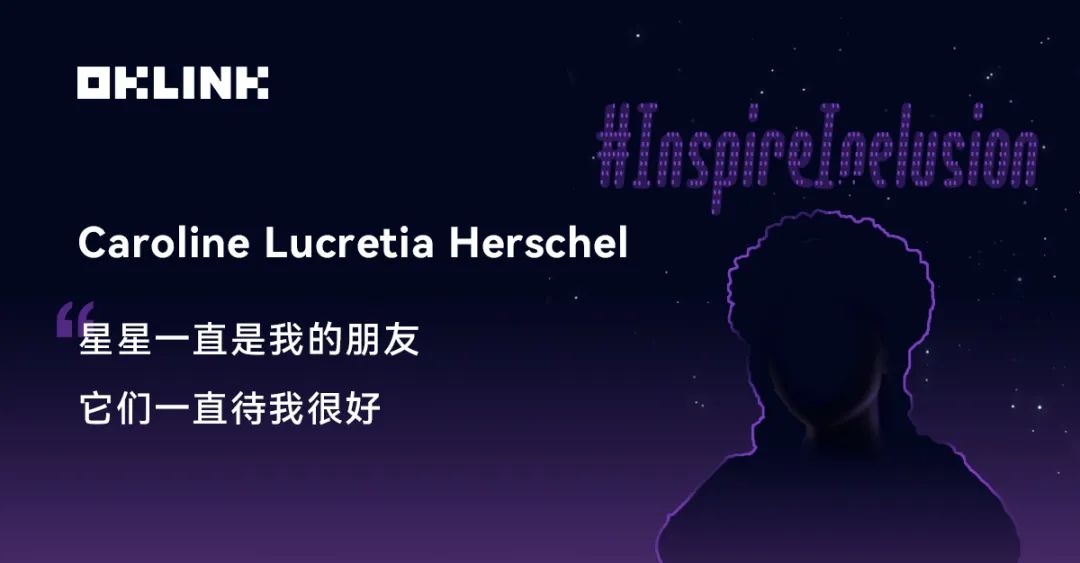
Caroline Herschel was the first woman to discover a comet, identifying eight comets in total, most notably Halley’s Comet in 1786. She also discovered dozens of new galaxies, star clusters, and nebulae.
Working closely with her brother William Herschel, she helped compile extensive star catalogs that significantly advanced later astronomical research.
Herschel was the first female member of the Royal Astronomical Society and the first woman to receive the Gold Medal of the Royal Astronomical Society.
In today’s world of cutting-edge technologies like Web3 and AI, countless talented women continue to apply their intelligence and make powerful contributions.
"When women’s strength gradually unites, they become invincible." Looking ahead, these goddesses will write even more magnificent and grand chapters.
Join TechFlow official community to stay tuned
Telegram:https://t.me/TechFlowDaily
X (Twitter):https://x.com/TechFlowPost
X (Twitter) EN:https://x.com/BlockFlow_News
 @OKGResearch










