









Gold and Bitcoin Surge: U.S. Debt Adds $1 Trillion Every 100 Days
TechFlow Selected TechFlow Selected
Gold and Bitcoin Surge: U.S. Debt Adds $1 Trillion Every 100 Days
The dollar is being slowly "killed," and this benefits gold and Bitcoin.
 Navigating Web3 tides with focused insights
Bitcoin and gold both approached all-time highs this week, drawing market attention. Analysts have offered various explanations, including Bitcoin's halving event, strong inflows into Bitcoin ETFs, shifts in Fed rate cut expectations, weaker-than-expected U.S. economic data, and escalating geopolitical tensions. However, some industry insiders have pointed to a deeper underlying factor: the rapidly expanding U.S. government debt is dragging down the dollar.
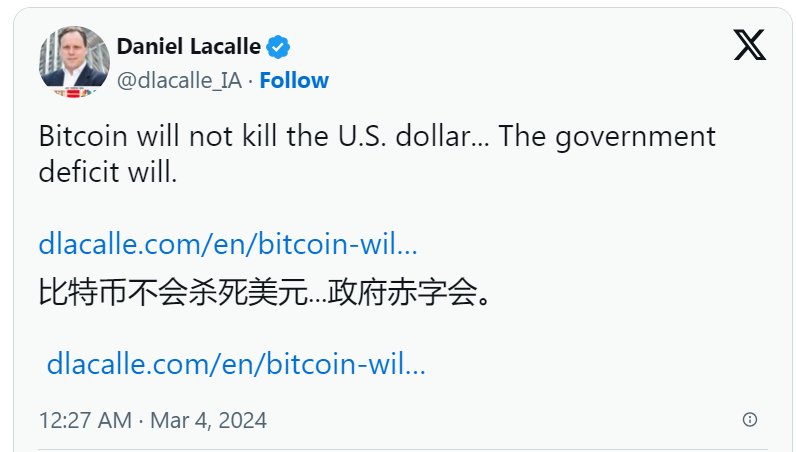
Daniel Lacalle, a well-known economist who previously served as vice president at Pacific Investment Management Company (PIMCO), expressed concerns on Monday about the future of the dollar—not due to the rise of cryptocurrencies like Bitcoin, but because of unsustainable U.S. fiscal policy.
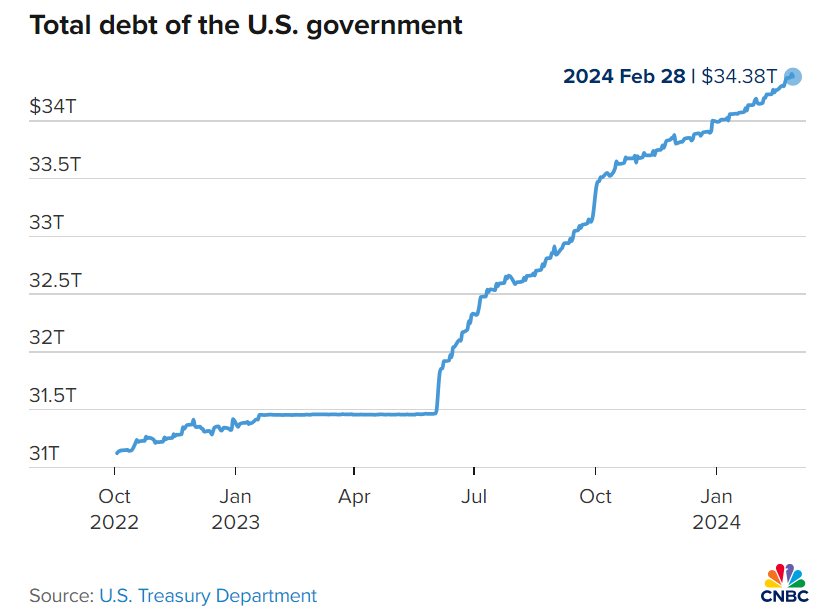
Lacalle highlighted the staggering pace of current U.S. government debt growth: increasing by $1 trillion every 100 days, with the total now exceeding $34 trillion. He called this trend contradictory during a period of so-called economic recovery and questioned official claims of robust U.S. economic growth.
The core of Lacalle’s warning lies in the sheer speed of debt accumulation relative to GDP growth. He challenged the narrative of U.S. economic recovery, citing declining wage purchasing power and rising financial pressure on American households.
Lacalle criticized Modern Monetary Theory (MMT), which suggests governments can spend without limit as long as inflation is controlled. He argued that continuing fiscal expansion despite cumulative inflation of 20% over the past four years reflects reckless disregard for economic health.
Lacalle believes surging Bitcoin prices do not threaten the dollar’s status as the world’s reserve currency. Instead, erosion of confidence in U.S. fiscal and monetary policy could lead to a sudden loss of monetary sovereignty, higher borrowing costs,恶性 inflation, or even the dethroning of the dollar. He further warned that the ideological appeal of MMT masks the severe dangers of fiscal irresponsibility.
Notably, Bank of America has recently also discussed the accelerating pace of U.S. debt, revealing the grim reality behind its rapid increase. Michael Hartnett, the bank’s chief investment strategist, said the U.S. debt trajectory will maintain its pattern of "expanding by $1 trillion every 100 days," soon reaching $35 trillion—and this trend is bullish for gold and Bitcoin. According to Hartnett’s forecast, U.S. government debt is expected to surpass $35 trillion by April 2024.
In a report last Thursday, he wrote: “No wonder ‘bond bear’ trades are near record highs.” At the time, gold reached $2,077 per ounce and Bitcoin hit $67,734. Gold and Bitcoin are seen as “devaluation hedges” when monetary or fiscal policies may cause significant currency depreciation.
Hartnett predicted that spot Bitcoin ETFs, which have recently shaken Wall Street, are heading toward an “explosive year,” partly driven by the collapse of the dollar.
Below are earlier warnings from prominent economic experts regarding the U.S. debt issue:
Joao Gomes, finance professor at Wharton School, warned that rising U.S. debt could plunge the country into a financial crisis next year. He told Fortune magazine: “Frankly, this could put the next administration in a bind. If they propose large tax cuts or another massive fiscal stimulus, markets might 'revolt,' interest rates could spike immediately, and we could be in crisis by 2025. This scenario is very possible. By the end of this decade, I’m very confident we’ll face this outcome regardless.”
Last month, Nassim Taleb, author of *The Black Swan*, said he believes the U.S. economy is in a “death spiral”... “As long as Congress keeps extending the debt ceiling and making deals because they fear the consequences of taking correct action, this is the political structure of the system. Eventually, it will fall into a debt spiral, which is essentially a death spiral.”
Jamie Dimon, CEO of JPMorgan Chase, predicted that rising U.S. debt could trigger a global “rebellion,” while Brian Moynihan, CEO of Bank of America, described the growing national debt as “the most predictable crisis we’ve ever faced.” In February, legendary investor Jim Rogers warned that the massive $34 trillion U.S. debt implies the coming recession will be “the worst of his lifetime.” Last year, Jefferies analysts forecast that the Fed would be forced to restart its printing press in 2024 amid a sharp economic downturn, potentially leading to a collapse of the dollar and a surge in Bitcoin prices that could rival gold.
Join TechFlow official community to stay tuned
Telegram:https://t.me/TechFlowDaily
X (Twitter):https://x.com/TechFlowPost
X (Twitter) EN:https://x.com/BlockFlow_News











