








AI New Dark Horse: Is KIP Protocol the Next Early "Bittensor"?
TechFlow Selected TechFlow Selected
AI New Dark Horse: Is KIP Protocol the Next Early "Bittensor"?
How to continuously enhance AI's deep learning capabilities while ensuring the security of creators' digital property rights is a critical issue that needs to be addressed—and the KIP Protocol, the first decentralized Web3 infrastructure protocol dedicated to AI, has emerged as the solution.
 Navigating Web3 tides with focused insights
Author: KIP Protocol
The recent launch of Sora, OpenAI's video generation model, and Google's Gemini 1.5 Pro, a large MoE-architected model, has sparked widespread global market enthusiasm.
However, alongside the rapid rise of AI giants like OpenAI and Google, growing public concerns have emerged around data privacy and security. How can we ensure creators' digital property rights while continuously enhancing AI’s deep learning capabilities? This is a critical question demanding thoughtful solutions.
Enter KIP Protocol—the first decentralized Web3 infrastructure protocol dedicated exclusively to AI—emerging precisely to address these challenges.
KIP Protocol: A Web3 Infrastructure Protocol Focused on Secure AI Innovation
In early 2024, a16z included “AI + Crypto” in its “Outlook for 2024” report, highlighting how cryptographic technology can “enable multi-party, global, permissionless markets where anyone can contribute computing power or new datasets to meet network needs and receive compensation.” Leveraging this long-tail resource pool could reduce AI costs and improve data accessibility.
Vitalik Buterin also expressed optimism about “AI + Crypto” in his writings, noting that cryptography can balance centralization and transparency in AI systems and help optimize AI data storage.
KIP Protocol aims to develop a secure and efficient decentralized Web3 infrastructure enabling AI creators (data owners, model developers, and AI application builders) to:
-
Deploy their work on Web3 while retaining full digital property rights
-
Interact and transact with other AI assets
-
Generate revenue without relinquishing access control
Moreover, KIP Protocol is the world’s first Web3 protocol supporting decentralized RAG (Retrieval-Augmented Generation). Its official Explainer series highlights RAG as a core concept.
RAG is an advanced innovation in generative AI that enables models to retrieve data from external knowledge bases and databases to generate answers they wouldn’t otherwise know. Think of it as an intelligent assistant that, although unaware of your query’s answer, can professionally locate the required information from external sources—all while preserving data security by not exposing raw data to the model.
RAG technology involves three key value creators in AI: app developers, model creators, and data owners.
By establishing a decentralized RAG framework, KIP Protocol essentially creates a decentralized system for controlling AI value creation—offering a level playing field for all contributors and breaking free from AI monopolies. It allows AI to function efficiently as a collective effort of millions of small and large creators, eliminating the need for any single corporation to dominate every core component.

Recently, KIP Protocol announced a strategic funding round led by Animoca Ventures. According to official statements, the KIP team brings together seasoned PhDs and technical experts who have been working on AI research since 2019, with deep expertise and extensive experience in the Web3 domain.
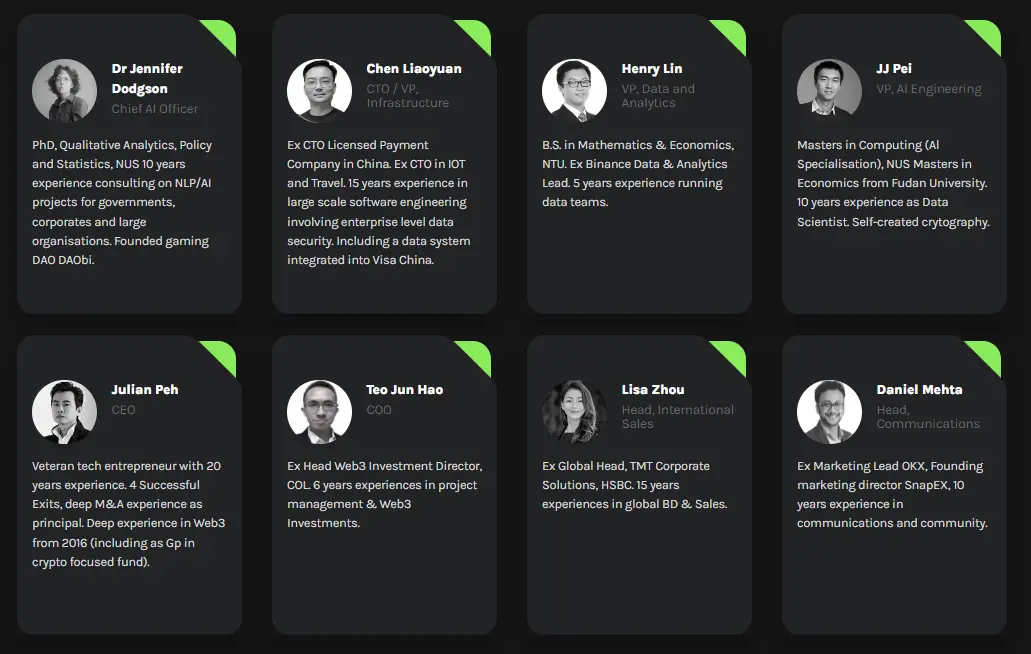
Additionally, the KIP Protocol team won the Tencent Cloud Award at the 2023 Chainlink Constellation Hackathon. Its first application, "Kipley.ai"—a security-first, multi-model RAG platform—has already partnered successfully with Animoca Ventures, Thailand Institute of Scientific and Technological Research, Anomaly, and numerous professors and researchers from leading universities. The protocol’s first dapp, "KnowledgeFi," is set to launch in Q1 or Q2 of 2024, as disclosed in its whitepaper.
Decentralization: The Inevitable Path Forward for AI
In the AI era, data and information underpin AI operations. The importance of data is now self-evident—only sufficiently large datasets can train algorithmic models effectively and deliver economic value. As the AI field evolves, a race to build the largest and most powerful models has begun, with “digital property monopolies” becoming a focal point of competition among tech giants.
KIP Protocol was founded with the mission of using Web3 to protect AI creators’ digital property rights, offering every creator a fair path to monetization. It aims to build a diverse business ecosystem composed of various partners (data owners, model creators, AI app developers), enabling them to freely collaborate and innovate on the KIP Protocol—freeing the AI landscape from the growing dominance of Big Tech monopolies.
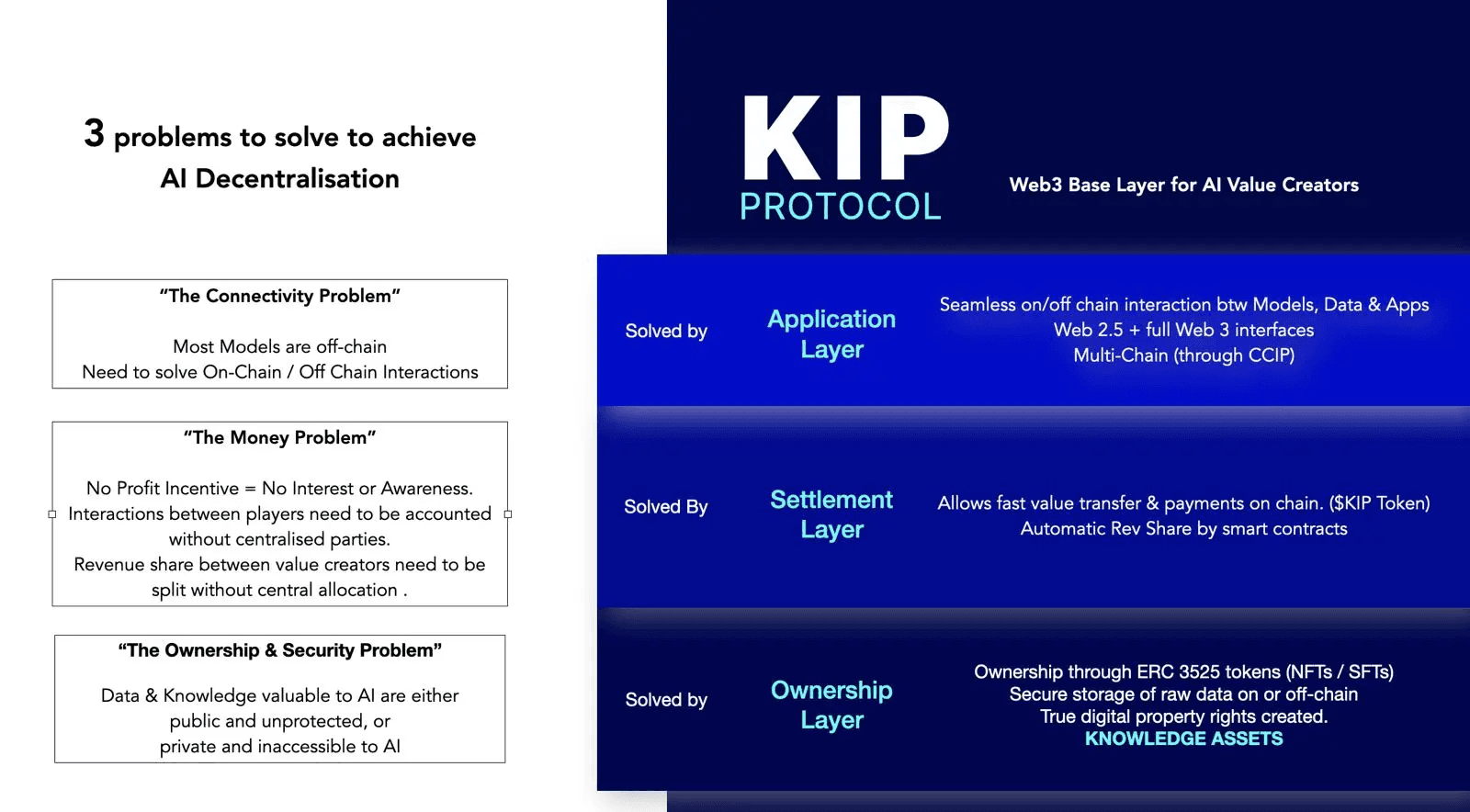
To achieve this, KIP addresses three fundamental challenges faced by AI model developers, app developers, and data owners when attempting to decentralize.
Solving the “On-chain/Off-chain Data Interoperability” Problem
With the continuous advancement of AI technology, the number of models on Hugging Face—an open-source model repository—has surpassed 500,000. However, due to current blockchain limitations in achieving full decentralization, most AI models remain off-chain. KIP Protocol’s application layer solves this on-chain/off-chain interaction challenge.
Through its application layer, KIP enables seamless uploading of various assets (such as software and data) onto the blockchain. AI applications can mint ERC-3525 SFTs (Semi-Fungible Tokens) on KIP Protocol, integrating and interacting seamlessly with AI models and data assets. All interactions are recorded on-chain via KIP Protocol. Meanwhile, AI creators and users retain full control over which models, data, and application formats they choose to use.
Solving the “Revenue Monetization” Problem
Currently, the primary revenue model in AI is pay-per-query, as each user query consumes GPU computing resources. Moreover, answering a single query often requires contributions from multiple AI value creators.
Therefore, for a decentralized AI initiative like KIP Protocol to succeed, it must ensure that all parties involved in decentralizing AI work are fairly compensated.
But this isn't simple in practice. Take a RAG-based query as an example:
-
A user asks a question to an AI chatbot.
-
The chatbot forwards the query to its “brain”—the AI model.
-
The model retrieves only the relevant data chunks from a knowledge base, formulates an answer, and sends it back to the app.
-
The app packages the response and delivers it to the user.
In this scenario, you can see how three distinct roles contribute to answering a single user query.
In a centralized ecosystem, one platform owns and controls all three roles. The user simply pays the platform, and internal settlements handle the rest.
But if KIP Protocol aims to be decentralized rather than monopolistic, each party must be paid directly. This raises several challenges:
-
Recording (on-chain) each participant’s contribution
-
Distributing user payments appropriately
-
Ensuring each contributor earns their rightful share
With KIP Protocol, each creator can set their own pricing for query functions, and KIP ensures that user payments are proportionally distributed among AI value creators (model developers, app developers, data owners).
Since every interaction is recorded on-chain, KIP leverages a low-gas, high-efficiency settlement layer to accurately track AI interactions and calculate earnings—ensuring each creator receives proportional compensation while contributing their digital assets.
Solving the “Digital Property Rights Protection” Problem
KIP Protocol uses blockchain tokens—specifically the ERC-3525 SFT (Semi-Fungible Token) standard—to store various assets (e.g., software, data) within its ownership layer.
1. For data owners: SFTs represent vectorized knowledge bases or encrypted links to raw data files used for model training.
2. For model developers: SFTs can represent APIs pointing to off-chain models or a set of sellable model weights.
3. For app developers: SFTs can represent frontend APIs or even prompts themselves.
These SFTs act as “monetizable entities,” capable of interacting on-chain and recording the revenue each earns from specific transactions.
By solving these challenges, KIP empowers AI value creators to easily decentralize their work—laying the foundation for a vibrant, scalable decentralized AI ecosystem.
The KIP Cycle Is On: Overseas KOLs Rally Behind the KIP Vision
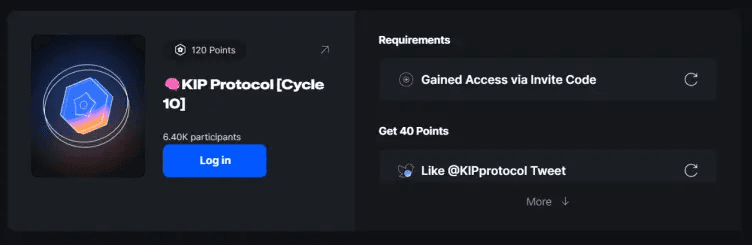
KIP has launched multiple cycle campaigns on X, with the 10th cycle recently concluded. Users complete tasks on Galxe to unlock and earn project points.
These points naturally evoke comparisons to the popular “points-based fair launch” trend. According to the KIP whitepaper’s $KIP tokenomics, 35% of the total supply will go toward the ecosystem fund—including community rewards based on “loyalty.” Thus, speculation around potential airdrops is far from unfounded. Despite minimal marketing efforts, total participation in KIP Cycles has exceeded 50,000—indicating strong overseas traction.
In fact, KIP has become a sought-after alpha project among crypto investors focused on the AI sector.
Prominent BTC investor and KOL Marco Johanning stated on X: “KIP is the first Web3 infrastructure protocol supporting decentralized AI RAG, and it’s still in its early stages.” He added that he has contacted the KIP team, noting that they’ve only reached out to early Bittensor investors—holders of $TAO who haven’t sold but instead share a common vision for the AI space.
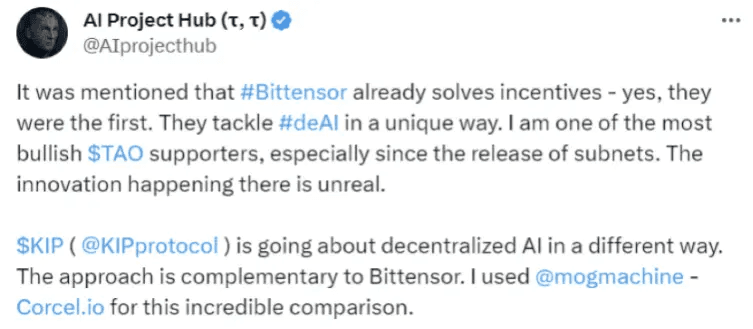
AI-focused crypto KOL AI Project Hub described “KIP Protocol” as “approaching decentralized AI research differently—and complementing Bittensor, the protocol incentivizing decentralized machine learning production.”
Another overseas influencer, Crypto Phoenix, commented positively on the post, stating after research that KIP appears well-thought-out—especially regarding its vesting schedule and growth plan—and openly predicted massive future success.

Meanwhile, @wauwda, a crypto influencer with nearly 50,000 followers, publicly revealed participation in KIP’s early funding round.

Renowned crypto blogger Tomb listed KIP as a potential next big wealth generator.
Currently, crypto investors in the AI space are rushing to be “first movers.” Yet, compared to the vibrant overseas scene, KIP remains relatively unknown in Chinese-speaking markets—presenting vast untapped potential and opportunity for Mandarin-speaking investors.
From the interactions between KOLs and the team, it’s clear this is a mature and visionary group with a well-defined roadmap and strong confidence in KIP Protocol’s future. This confidence is grounded in their deep understanding of AI and blockchain technologies and solid technical execution.
For the KIP team, early user selection is crucial. They seek long-term holders who share a genuine vision for AI. Such users provide stable, lasting support and help build strong consensus with the team—driving KIP Protocol forward together.
Conclusion
If “Crypto + AI = future of finance,” then KIP may be one of the strongest bets at the intersection of AI and crypto.
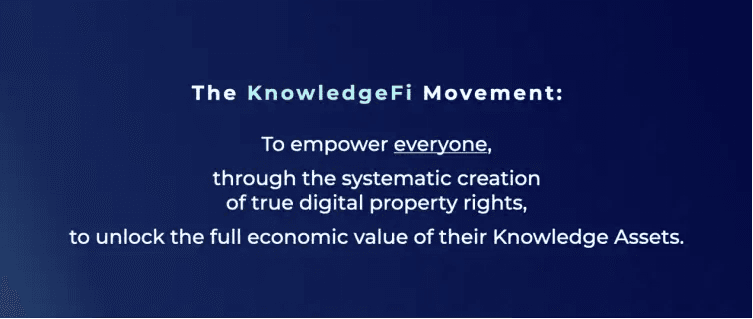
To date, KIP is the first decentralized infrastructure protocol entirely dedicated to AI within the “Crypto + AI” space. As an open-source Web3 base layer, KIP Protocol upholds the vision that “in the AI era, everyone should achieve KnowledgeFi”—promoting the creation, management, and monetization of decentralized digital property to realize KnowledgeFi. Recently, KIP Protocol was accepted into Google Cloud’s Startups Program, and its dapp KnowledgeFi is expected to launch in Q1 or Q2 of this year.
In my view, “Crypto + AI” remains a blue ocean with immense potential. Tracking early infrastructure developments is the first step to riding this new wave. While KIP’s journey ahead is long, its values and vision are already spreading from overseas communities to a global audience.
For more information, join our official Chinese community:
Join TechFlow official community to stay tuned
Telegram:https://t.me/TechFlowDaily
X (Twitter):https://x.com/TechFlowPost
X (Twitter) EN:https://x.com/BlockFlow_News
 @KIPprotocol






