








Storage sector sees broad gains—what are the leading projects preparing for recently?
TechFlow Selected TechFlow Selected
Storage sector sees broad gains—what are the leading projects preparing for recently?
Arweave to launch AO supercomputer testnet, FIL, AR and others surge over 70%.
 Navigating Web3 tides with focused insights
Author: Peng SUN, Foresight News
In the crypto space, data storage is closely tied to decentralization and user ownership, yet the storage sector has long remained lukewarm. Since October last year, the concept of AI + Web3 has gained widespread traction across the industry. AI-related tokens have seen remarkable price increases in recent months. Meanwhile, AI + computing and data storage (e.g., Aleph.im) have become key directions pursued by most teams. So, who will be next in rotation after the AI sector? The storage赛道 undoubtedly stands out.
Over the past month, the storage sector has experienced broad-based gains. Specifically:
-
Filecoin's token FIL rose from 5 USDT to 8.54 USDT, a maximum increase of over 70%;
-
Arweave's token AR reached a high of 16.09 USDT in the past half-month, currently quoted at 15.35 USDT, up 75.9%;
-
Siacoin's token SC surged as much as 162% before sharply dropping on February 24 and 25;
-
Storj's token STORJ rose to 0.73 USDT, gaining over 25% in the past month;
-
Chia's token XCH rose to 34.83 USDT, up over 11% in the past half-month;
-
BitTorrent's token BTT rose to 0.000001075 USDT, up over 25% in the past month;
-
Ocean Protocol's token OCEAN peaked at 0.8 USDT, up over 50% in the past half-month;
-
Holo's token HOT rose to 0.00237 USDT, up over 20% in the past half-month;
-
Crust's token CRU rose to 1.96 USDT, with a monthly gain of 48%;
-
Bluzelle Network's token BLZ peaked at 0.448 USDT, now at 0.36 USDT, up over 20% in the past half-month;
-
......
Given this, this article will examine several major storage projects, review their recent developments, and explore potential drivers behind the rise of storage category tokens.
Filecoin
In March 2023, Filecoin launched FVM on its mainnet, enabling developers to deploy smart contracts on the platform, making it possible to build lending markets for storage providers, perpetual storage deals, cross-chain bridges, Layer 2 solutions, data DAOs, and more on Filecoin. By December 2023, over 200 projects had been built on FVM, creating approximately 635,000 wallets and deploying more than 2,400 unique contracts. According to Starboard, as of February 26, net deposits in DeFi on Filecoin VM amounted to about $225 million.
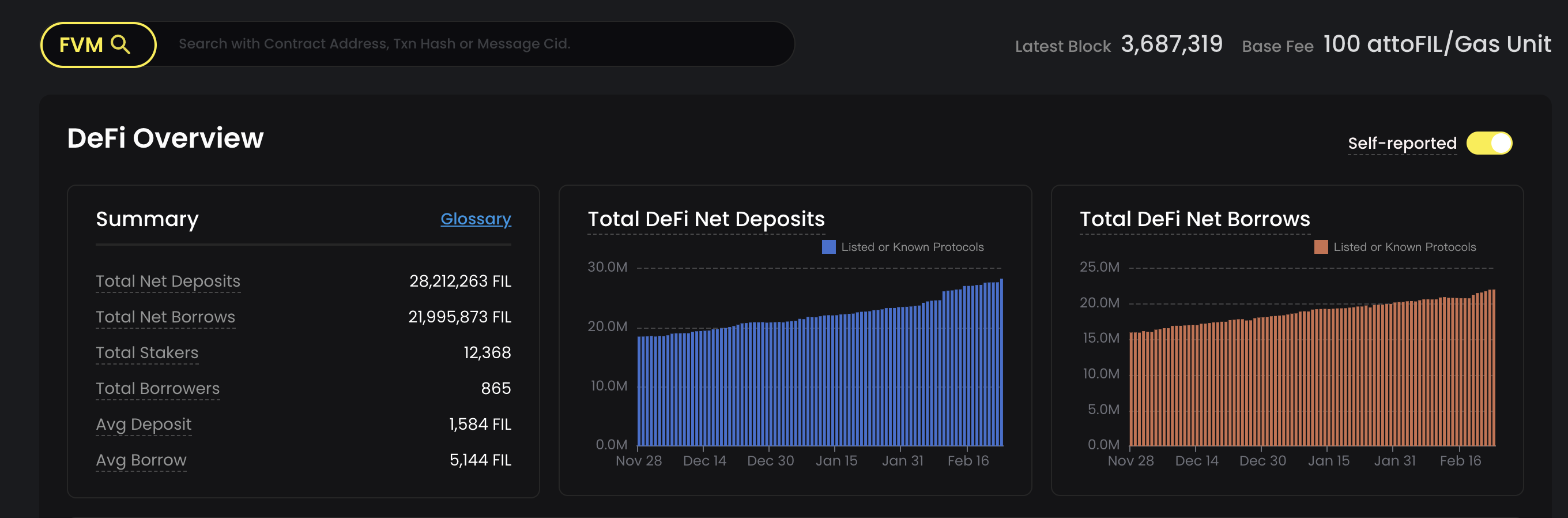
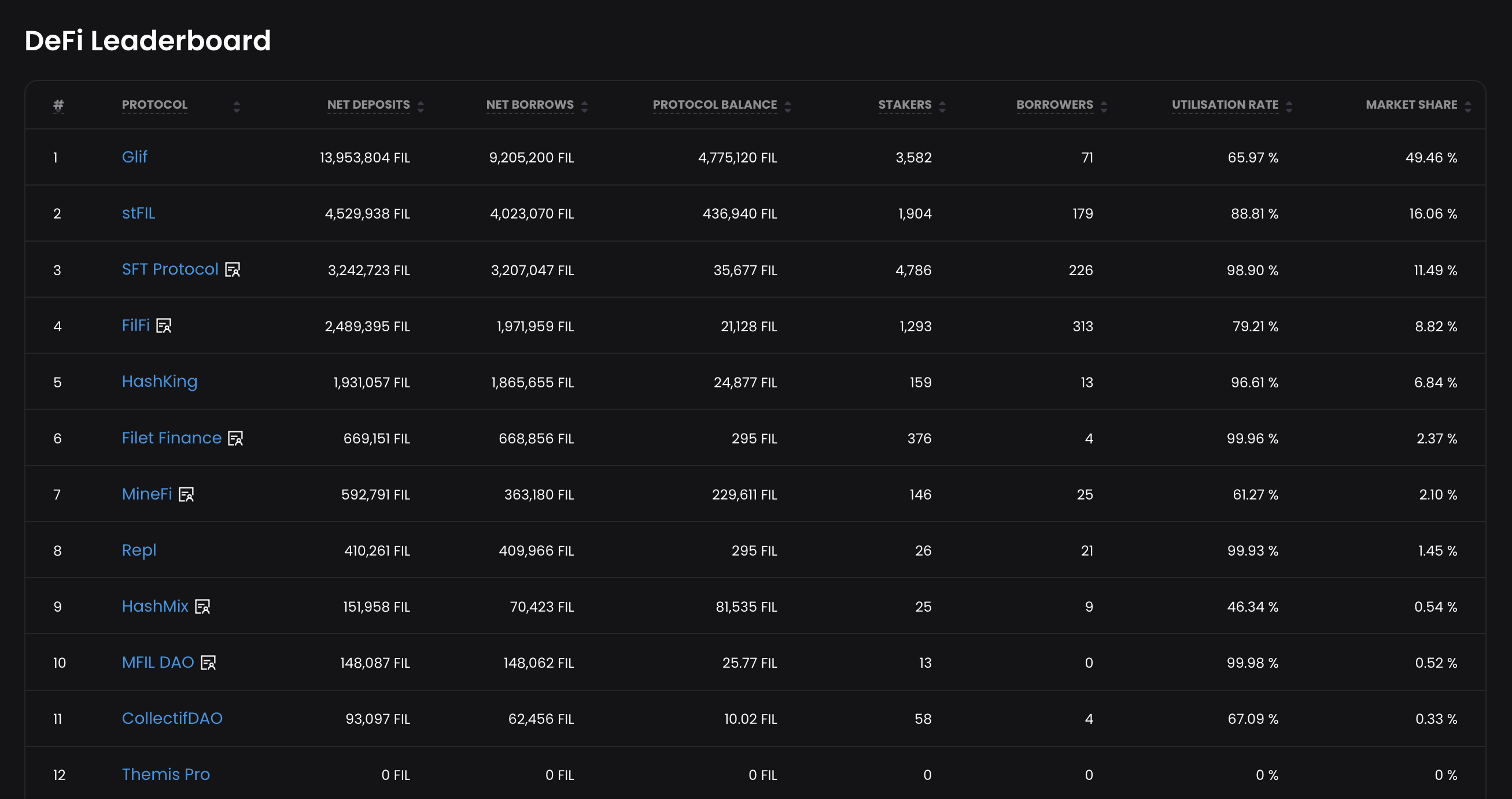
Among them, Glif, a liquidity leasing protocol, is currently the largest DeFi protocol on Filecoin VM, with net deposits of 13.95 million FIL (approximately $111 million). Launched in March 2023, the team previously developed the first Filecoin wallet. On February 7, 2024, Glif raised $4.5 million in funding led by Multicoin Capital, with participation from Zee Prime Capital, Fintech Collective, Big Brain Holdings, Protocol Labs, and other investors. This marks Multicoin Capital’s first investment in a Filecoin ecosystem project.
In the past two months, Filecoin has made additional progress. For example, Filecoin launched a new ecosystem browser; the Filecoin Foundation successfully deployed IPFS in space, using IPFS to send files from Earth into orbit and back. Filecoin VM integrated Pyth price feeds. Filecoin also completed integration with Solana, allowing infrastructure providers, explorers, indexers, and any users needing historical access to more easily access its block history, enhancing scalability and security through Filecoin’s decentralized storage capabilities.
Filecoin 2024 Roadmap
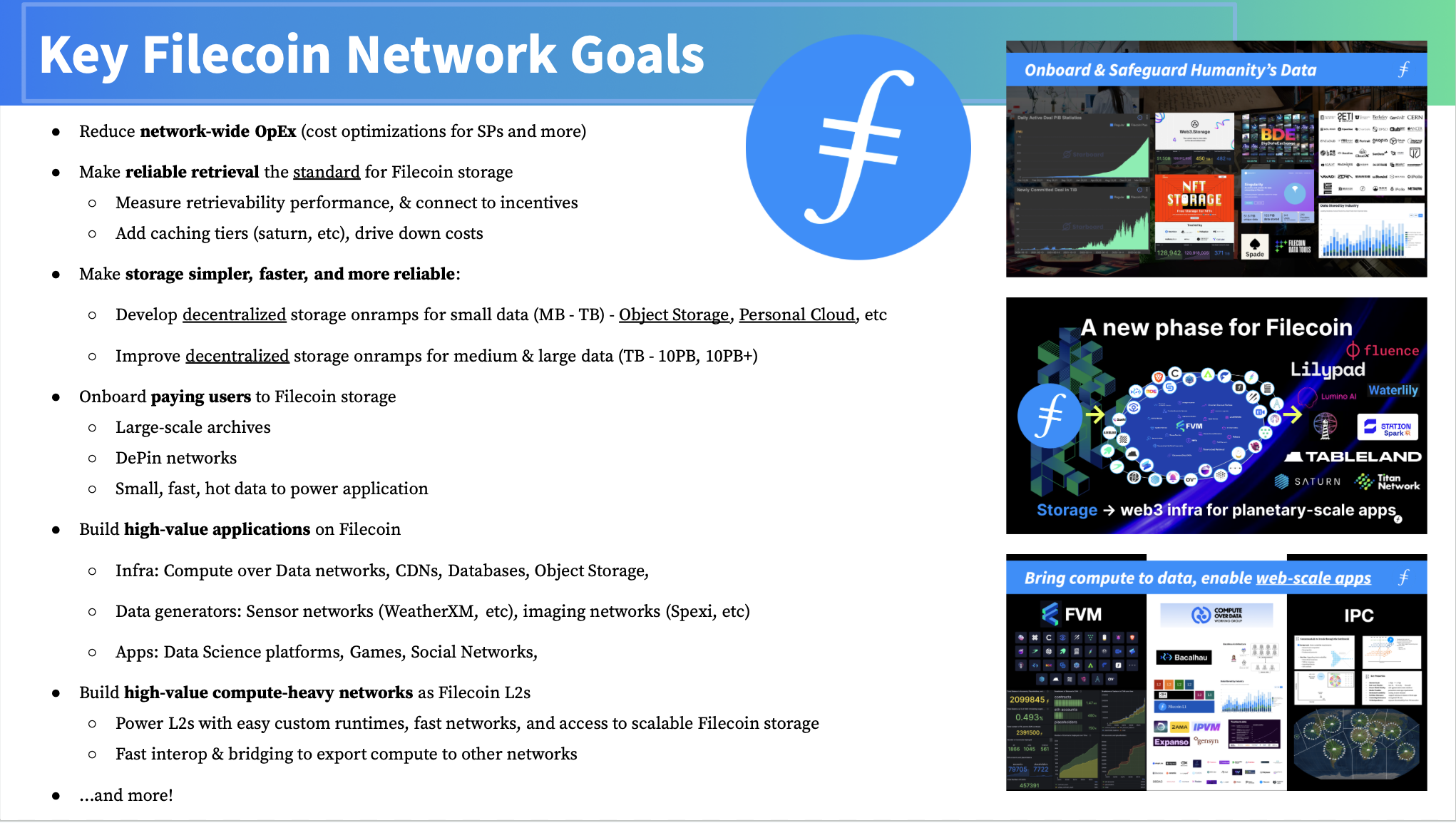
The launch of FVM allows developers to build various DApps on Filecoin. Increased on-chain activity leads to competition for block space, raising operational costs on the mainnet. Therefore, Filecoin chose to achieve scalability via the InterPlanetary Consensus (IPC) framework.
-
IPC: IPC is a framework that enables deployment and operation of subnets with different consensus mechanisms, achieving scalability for Filecoin and enabling DApps to process sub-second (less than one second) transactions. IPC can generate its own state, perform message validation, and interact with any subnet as well as the root of the Filecoin network. In March 2023, ConsensusLab launched a public InterPlanetary Consensus testnet on Filecoin Spacenet. IPC is expected to enter the M2 phase (functional demonstration on the Filecoin mainnet) in July this year, transitioning to Solidity actors and enabling anchoring with EVM parent networks and cross-network messaging.
-
Filecoin L2, including the first Filecoin L2 compute network Fluence and Lilypad, the Lambda network powered by Filecoin—Filecoin Station—and the first retrieval market, Filecoin Saturn, will go live.
-
Data Retrieval & DA: Filecoin launched projects such as Boost Lassie and Station in 2023 to support data retrieval and DA, which were previously unsupported. In 2024, Filecoin aims to promote retrieval as a standard for Filecoin storage clients and as a fundamental storage layer for Web3.
-
Filecoin DeFi: DeFi on Filecoin includes Glif, stFIL, SFT Protocol, HashKing, FilFi, Filet Finance, MineFi, HashMix, mFIL DAO, and CollectifDAO. Additionally, in November 2023, Sushiswap went live on FVM, and Uniswap v3 contracts have been deployed on FVM. The Uniswap v3 frontend is expected to launch in early 2024.
Arweave
Much of the momentum behind the current rally in the storage sector stems from Arweave. On February 13, Arweave founder Sam Williams announced via Twitter that the supercomputer AO would go live on testnet on February 27. AO can run an arbitrary number of processes in parallel and coordinate them via a messaging layer. This messaging standard connects these independent processes into a network. In short, Arweave, originally focused on decentralized storage, is entering the era of computation.
Unlike existing decentralized computing systems, AO supports computational operations without being constrained by protocol-enforced size or format limitations, while maintaining verifiability of the network itself. AO is built in a modular fashion rather than enforcing a single set of choices on all users: participants can choose their preferred virtual machine, ordering model, messaging security guarantees, and payment methods, with all data settling onto Arweave’s decentralized data layer.
AO’s decentralized operating system is AOS, functioning similarly to smart contracts, allowing developers to initiate command-line processes. These processes are not restricted to any specific location, enabling seamless cross-network user interactions.
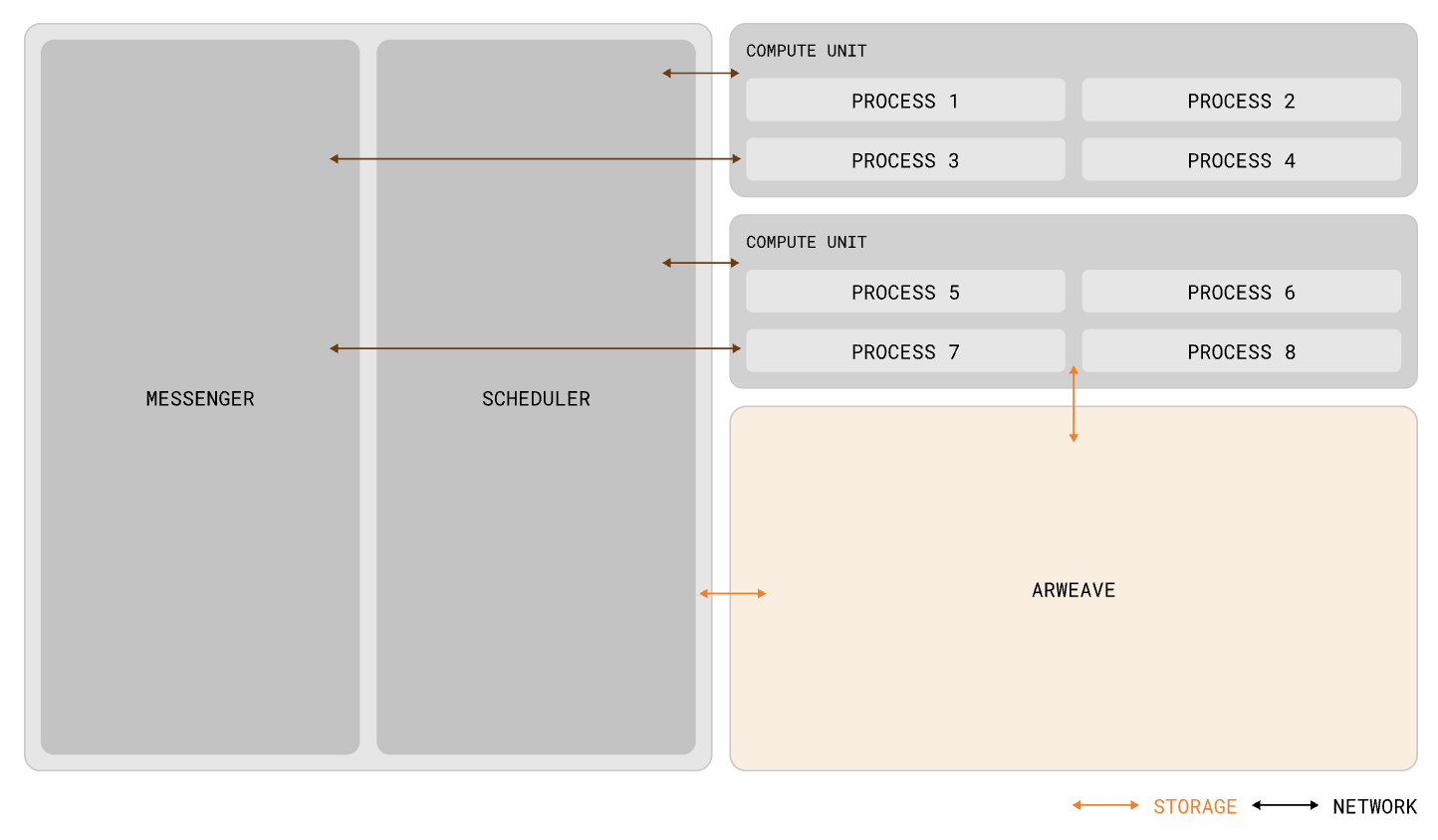
AO’s core architecture includes:
-
Processes: The computational units of the network, represented by interaction message logs stored on Arweave along with initial data items. Processes allow communication units to send messages to computational units, enabling users and processes to freely select sorters, etc.
-
Messages: Each interaction with a process is represented by a message. Users and processes can send messages to other processes on the network via scheduling units.
-
Scheduler Units: Responsible for assigning slot numbers to messages sent to processes and ensuring data is uploaded to Arweave.
-
Compute Units: Nodes used by users and communication units to compute the state of processes in AO. They compete in a peer-to-peer compute market to provide services that resolve process states and return signed proofs of specific message evaluations.
-
Messenger Units: Nodes that relay messages across the AO network based on cranking processes, delivering messages to compute units and coordinating output calculations.
Join TechFlow official community to stay tuned
Telegram:https://t.me/TechFlowDaily
X (Twitter):https://x.com/TechFlowPost
X (Twitter) EN:https://x.com/BlockFlow_News
 Foresight News











