









The Next Wave of Consumers: Web3 is the Internet's New Commercial Layer
TechFlow Selected TechFlow Selected
The Next Wave of Consumers: Web3 is the Internet's New Commercial Layer
Closed online commerce driven by large e-commerce platforms will shift toward Web3-supported open commerce systems.
 Navigating Web3 tides with focused insights
Written by: MARC BAUMANN AND JACY L. YOUN
Translated by: Luffy, Foresight News
Web3 will disrupt the foundation of the internet. Last week, I wrote an article about how the new social protocol Farcaster is transforming the relationship between social platforms, users, and data. Web3 shifts power from platforms back to users—and this shift is also happening in e-commerce.
Brands, buckle up for a wave of disruptive opportunities.
Empowering Users
In Web3, users own their data and control access to it across any platform they use.
Essentially, we're moving from closed platforms to open protocols. Farcaster is a social protocol, but this transformation affects not only social media—it impacts all platforms on today’s internet, including content protocols (Mirror, Paragraph, etc.), identity protocols, and even commerce protocols.
At an abstract level, today's internet is a collection of platforms hosting isolated silos of information.
Web3 returns ownership of that information to users, enabling interoperable, composable networks and more efficient value exchange.
Economists would say we’re shifting from oligopoly to free-market economics.
Marketers would say we're creating new consumer experiences through ownership incentives and co-participation.
Pragmatists would say we’re giving power back to the people.
One major “protocol” impacted by this change is e-commerce.
Just as the internet democratized access to information, Web3 is now democratizing e-commerce. We stand at the brink of potential mass adoption.
E-Commerce: Past and Present
The first e-commerce transaction occurred in 1994—a CD of Sting’s *Ten Summoner’s Tales*—making history and grabbing headlines.
The New York Times’ coverage of the event was astonishing. People worried about credit card privacy on the internet. E-commerce seemed like the strangest thing in the world.
Then the snowball started rolling:
-
1995: Amazon launched.
-
1998: PayPal launched, becoming the first e-commerce payment system.
-
2000: Google introduced online advertising.
-
2004: Shopify launched—the first shopping cart software of its kind, empowering millions of retailers to launch their own e-commerce stores.
-
2011: WooCommerce launched, rivaling Shopify by introducing the first way to build e-commerce sites on WordPress.
-
2017: Instagram rolled out e-commerce features.
-
2021: The pandemic drove e-commerce transaction volume up by 77%.
Now, we’re on the cusp of another transformation—history repeating itself.
In the 1990s, lack of tools and infrastructure made it extremely difficult for early internet users to start e-commerce stores.
Indeed, this very challenge turned e-commerce solutions into a multi-trillion-dollar business (Amazon).
While Amazon accounted for 39.5% of U.S. retail e-commerce sales in 2022, even basic internet users can now easily launch stores using tools like WooCommerce, Etsy, or Shopify.
Similarly, building web pages in the 1990s required experienced development teams. Today, my 80-year-old grandmother can create a website in minutes using tools like Squarespace or Wix.
What happened?
Standardization, infrastructure, and tools democratized the web. Power was returned to users.
Web3 Meets E-Commerce
Web3 is poised to play a significant role in the future of e-commerce and may fundamentally transform how we buy and sell products and services online.
A few months ago, WooCommerce partnered with Boson Protocol—an important milestone for e-commerce.
Why? WooCommerce is a free, open-source plugin that turns any WordPress site into a powerful online store, supporting over 3.9 million stores.
This partnership enables brands and sellers to easily sell physical goods tied to NFTs.
Once a physical product is linked to an NFT, it can be freely traded "on-chain"—without relying on centralized platforms—as long as someone guarantees the NFT can always be redeemed for the physical item.
That’s exactly what Boson Protocol does. It allows brands (or anyone) to sell physical items as NFTs online, in virtual worlds, or on NFT marketplaces, ensuring buyers receive either the product or a refund.
Here’s how it works in detail:
WooCommerce is a popular online selling tool. Boson Protocol uses blockchain to handle transactions. Together, they allow sellers to easily tokenize physical goods. When you make a purchase, you receive a digital token proving authenticity and ownership.
These tokens then become part of the Web3 economy, circulating freely until someone chooses to redeem them.
For users, this is fantastic. Their "assets" now exist online. Regardless of platform, they can prove ownership of physical items, use them as collateral for loans, or sell them without relying on centralized markets. The opportunities are immense.
For brands and sellers, they now gain easy access to a fully decentralized e-commerce system offering these benefits:
-
Authenticity and traceability: Ensures product provenance and authenticity, especially relevant in light of the upcoming European Digital Product Passport (DPP).
-
Limited authentic editions: Digital twins can transparently cap collectibles on-chain, eliminating reliance on brand promises.
-
Post-purchase marketing: Owning an NFT linked to a physical product unlocks unique post-purchase experiences and generates rich data via direct-to-consumer brand channels.
This is an unprecedented way to market and sell products.
E-commerce becomes inherently more transparent, trustless, and open. Especially for small businesses, there’s no need to be a tech expert or spend heavily to start selling.
Power is being returned to users. History repeating? Probably.
How big could this new model become?
-
In 2022, global retail e-commerce sales surpassed $5 trillion for the first time. Despite slowing growth, total spending is expected to exceed $7 trillion by 2025.
-
The compound annual growth rate (CAGR) from 2024 to 2028 is projected at 9.83%.
-
At least 2.14 billion consumers shop online (28% of the global population). By 2025, the U.S. alone is expected to have 291 million online buyers.
-
WooCommerce dominates the customizable e-commerce platform market with a 39% share (compared to 15% for Squarespace and 10% for Shopify).
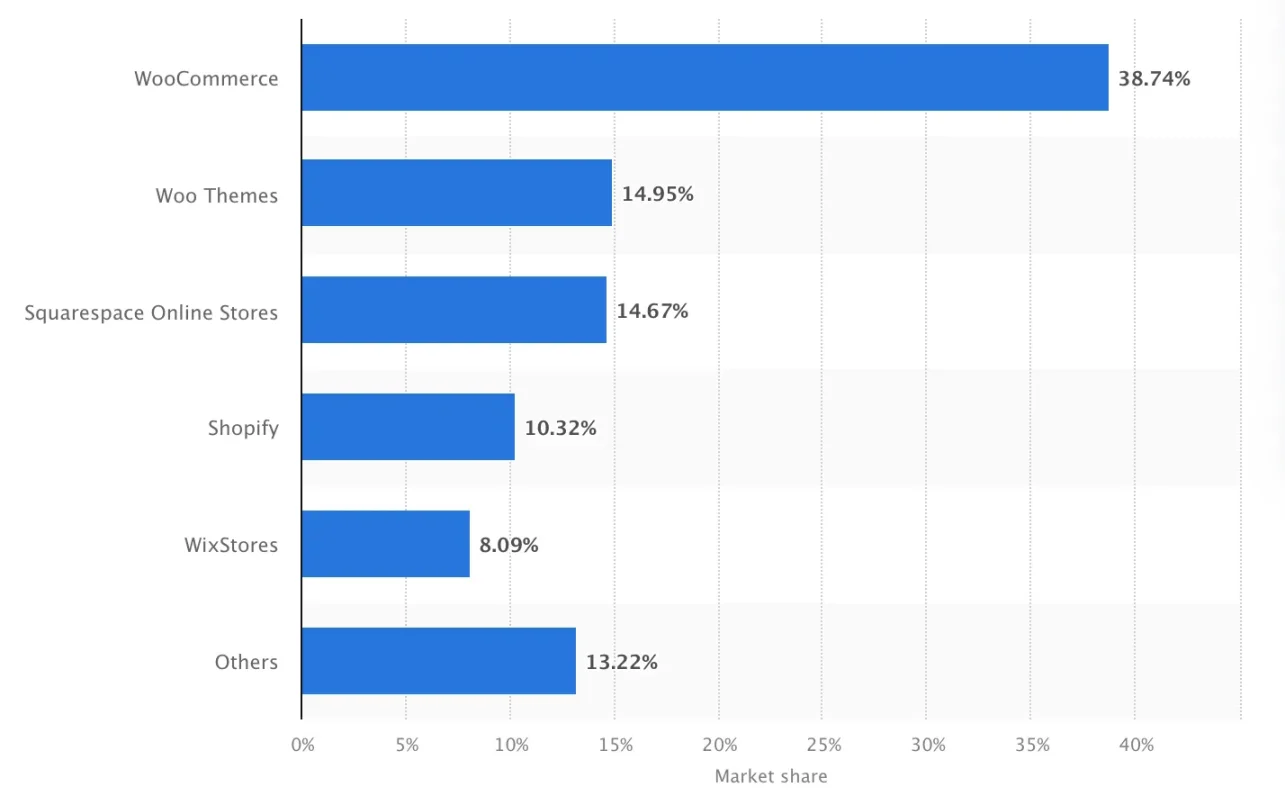
Market share of leading global e-commerce software platforms and technologies as of 2023, source: Statista
Meanwhile, established e-commerce companies like Visa, Shopify, PayPal, and Venmo have begun integrating cryptocurrency, NFTs, and blockchain into their offerings.
Now is the time to act.
Why Now? A New Super Cycle
What’s happening right now?
-
Web3 infrastructure is maturing.
-
A new cohort of Web3-native consumers is entering the market.
-
We are at the beginning of another Web3 adoption cycle.
Maturing Web3 Infrastructure
Since Bitcoin’s inception, we’ve spent 14 years building blockchain infrastructure. In the past three years, we’ve seen massive progress:
-
Better tools: Brands now have abundant solution providers across the entire value chain—from onboarding wallets (Magic, Dynamic, Privy, Tweed, Web3Auth, etc.) to full-stack user management (e.g., ThirdWeb, Venly, etc.).
-
Improved user experience: Embedded wallets, MPC (multi-party computation), and account abstraction are dramatically simplifying wallet UX.
-
Scalability: The number of Ethereum L2s will continue to grow. Meanwhile, highly scalable L1 chains like Solana, Sui, Aptos, or Near may become preferred alternatives to Ethereum for brands.
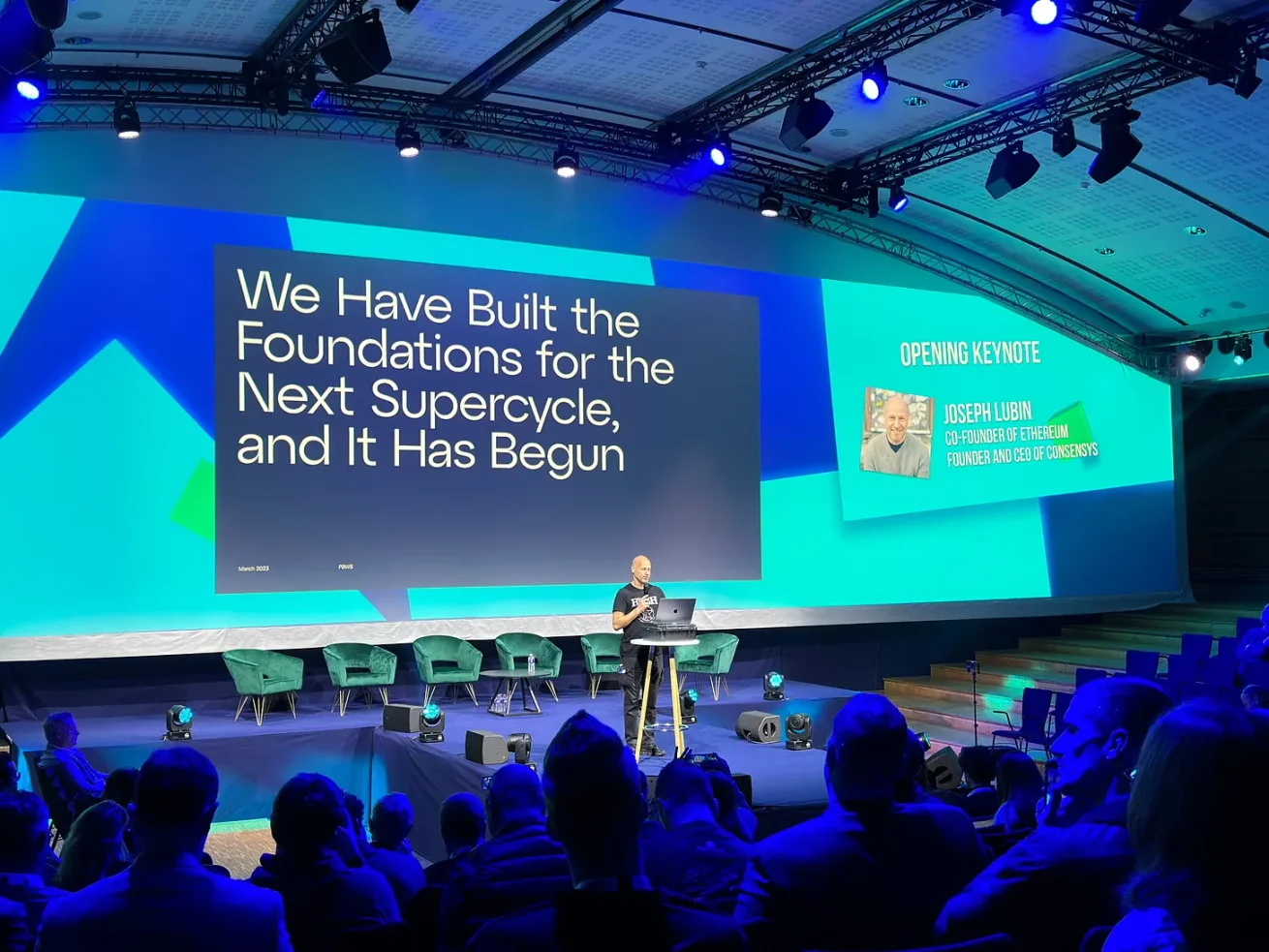
Joseph Lubin, co-founder of Ethereum and ConsenSys, described the state of Web3 infrastructure during his Beacon Talk at Paris Blockchain Week 2023:
“We’re no longer in a period akin to the dot-com boom—full of irrational exuberance around exciting ideas but lacking sufficient infrastructure. We’re now in a phase similar to the post-dot-com crash era, where economic and geopolitical challenges are severe and irrational exuberance is unlikely. Yes, our space will see more great innovations, but the difference between now and the previous decade is that back then we were building infrastructure; now we have enough scalability and ever-improving usability for real-world use cases to become compelling for many individuals and enterprises. With many major brands recently adopting our technology, we find ourselves in the age of Web3 commerce.”
Indeed, Web3 infrastructure development bears striking similarities to that of the internet. As a16z co-founder Marc Andreessen said:
“It’s not the first time I’ve said Web3 is like the internet. If you go back through all my historical statements, I’ve probably said that about 48 times.”
We are still in the early stages.
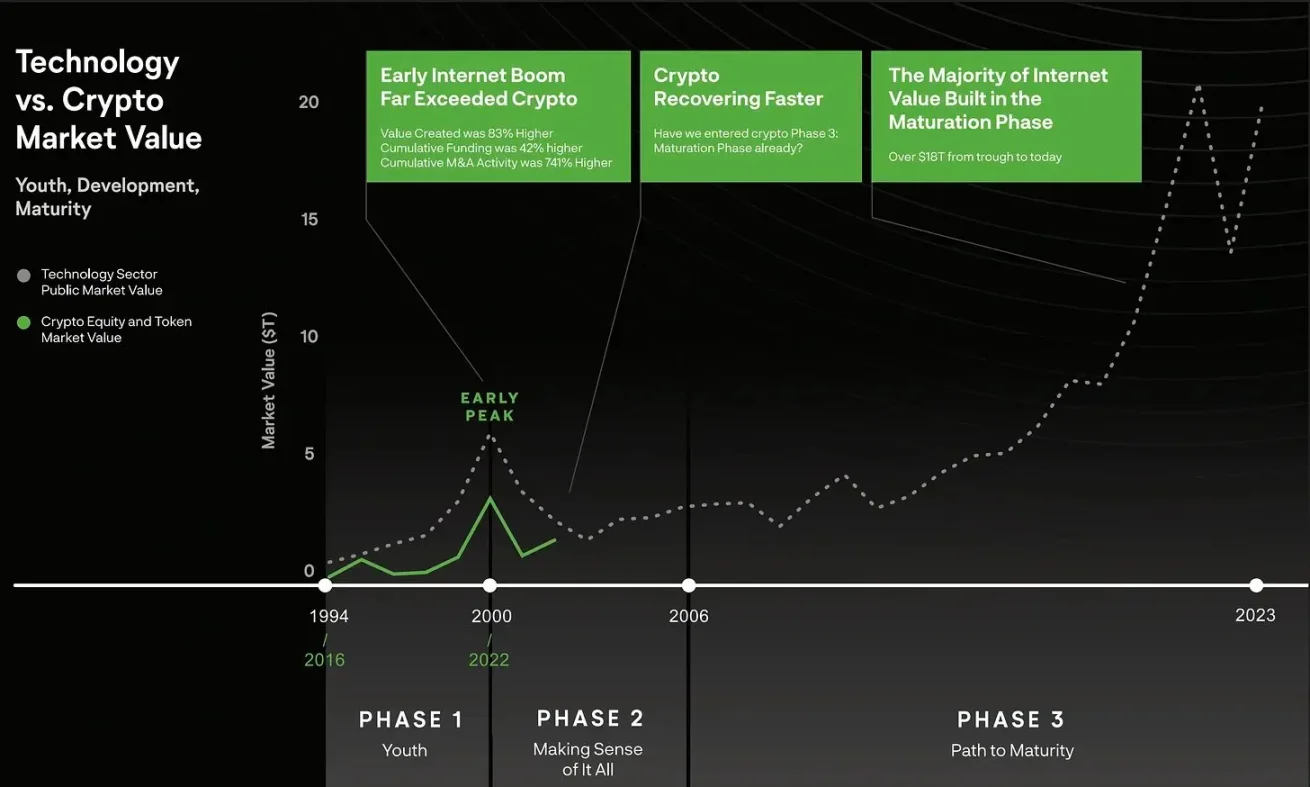
Technology and crypto market value, source: Architect Partners
Emerging Consumer Groups
The next cycle will attract a wave of crypto-savvy consumers eager for truly innovative Web3 experiences—seeking full utility for their digital assets, unbound by brands or platforms.
Time spent in virtual spaces is increasing, especially among Gen Z and Millennials:
-
45% of Gen Z and Gen Alpha are “almost constantly” online.
-
In the U.S., 38% of Gen Z spend over four hours daily on social media, dedicating much of that time to content or gaming. As of February 2022, Roblox had nearly 55 million daily users. Minecraft has around 140 million monthly active users, and Fortnite has about 80 million.
-
70% of Fortnite players say they’ve purchased special outfits and characters that serve no in-game purpose other than looking cool.
-
In the latest Roblox research, 56% of Gen Z users said shaping their avatar matters more than shaping their real-world self. 50% said they are “very” or “extremely likely” to consider a brand in real life after trying it virtually. In 2023, avatar updates grew 38% year-over-year to 165 billion, and nearly 1.6 billion digital fashion items and accessories were purchased—a 15% increase.
-
McKinsey estimates the metaverse could be worth up to $5 trillion by 2023, with e-commerce impact alone ranging from $2–2.6 trillion.
Today’s consumers, especially younger generations, shop across multiple channels simultaneously—social media, online platforms, in real life, mobile, laptops, etc.
The more time people spend online, the more digital value they create and consume—including virtual goods.
Of course, these consumers are Web3 natives:
-
We now have hundreds of millions of crypto owners globally.
-
By 2021, 94% of cryptocurrency buyers were Millennials and Gen Z under 40.
-
93 million U.S. adults own cryptocurrency.
It’s not just about the web—it’s about new wealth:
-
Gen Z holds $360 billion in disposable income, with ~25% owning stocks and 59% believing they can get rich by investing in crypto.
-
Of the 52+ million Americans who own crypto, Millennials and Gen Z make up 60%.
-
There are 88,200 crypto millionaires worldwide.
Now, excitingly, we appear to be at the beginning of a bull market potentially larger than any we've seen before.
Thanks to recently launched Bitcoin ETFs, we’re seeing record inflows. Meanwhile, the next Bitcoin halving is approaching, and investor sentiment is high.
For brands, this presents a huge opportunity to participate, stay relevant, and meet consumer demand.
The Next Web3 Adoption Cycle for Brands
While the 2021–2022 bull run brought many brands into NFTs, we didn’t see more mature Web3 use cases emerge.
In fact, nearly 50% of Interbrand’s Global Top 100 brands have already entered Web3. We’ve covered many examples (Starbucks, Nike, Lacoste, Gucci, Fiat).
We’ve identified six primary Web3 use cases for brands:
-
Post-purchase marketing
-
Physical experiences
-
Product verification and tracking
-
Community and co-creation
-
IP monetization
-
Loyalty programs
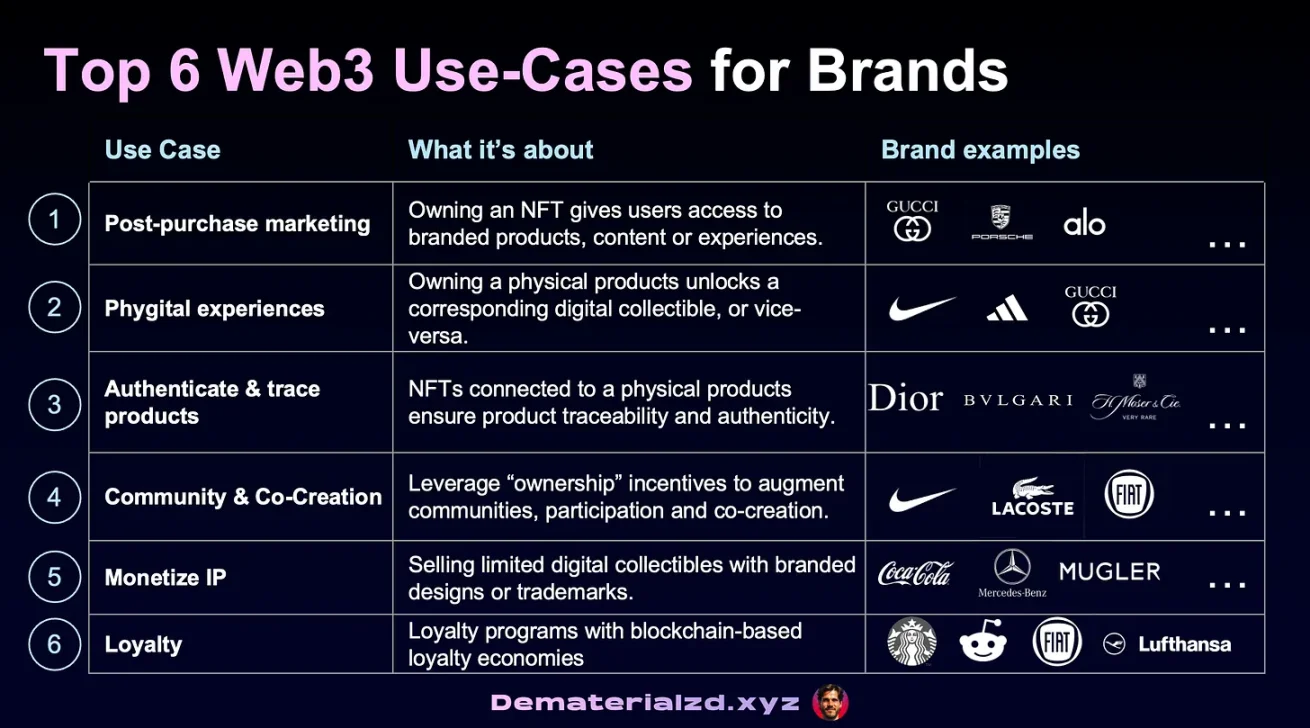
Often overlapping, these use cases fall into four broader categories:
-
Tokenization and digitization
-
Loyalty and rewards
-
Community and immersive commerce
-
Data and insights
By 2024, brands will become smarter and more strategic, seeking ways to embrace Web3 beyond mere NFT drops and marketing gimmicks.
Ultimately—at least in the short term—brands will integrate all four categories into a unified strategy deeply embedded within their ecosystem.
Web3 commerce will play a central role, delivering tangible business benefits:
-
Over 85% of U.S. merchants consider enabling crypto payments a top priority.
-
Merchants accepting crypto see a 327% ROI and 40% growth in new customers.
-
Crypto-using customers spend approximately $250 more per transaction.
What’s Next
In the coming years, we’ll shift from closed online commerce driven by large e-commerce platforms to open commerce systems.
This transition will be powered by converging macro trends, with mature Web3 infrastructure playing a pivotal role.
As I noted earlier:
Bitcoin has changed how we store and transact value over the internet for 14 years. It laid the foundation for a wave of innovation—Layer 1s, NFTs, DeFi, smart contracts, and DApps.
For the past 14 years, we’ve focused on infrastructure. Now, we’re ready for consumer applications. For brands, this is a golden opportunity to capture the spirit of the next generation of consumers. The future is arriving faster than you think.
Join TechFlow official community to stay tuned
Telegram:https://t.me/TechFlowDaily
X (Twitter):https://x.com/TechFlowPost
X (Twitter) EN:https://x.com/BlockFlow_News
 @51ventures










