








Huobi Research | Who Will Be the Ultimate Winner in the DA Race? Background, Ecosystem, and Outlook on the Data Availability War
TechFlow Selected TechFlow Selected
Huobi Research | Who Will Be the Ultimate Winner in the DA Race? Background, Ecosystem, and Outlook on the Data Availability War
This research report is Huobi Research Institute's analysis of the background, ecosystem, and future outlook of the Data Availability War.
 Navigating Web3 tides with focused insights
In the market, DA (Data Availability) projects have sprung up like mushrooms after rain, with highly competitive ones including Celestia, EigenLayer, Avail, NearDA, and Covalent.
According to Huobi Research Institute's analysis, core DA functionality isn't particularly difficult. The simplest setup can achieve DA on a single machine, while more complex systems like Celestia use sampling models for decentralization. Simply put, DA is about storage, which incurs high costs. If you don't strictly require Ethereum-level security services, choosing a DA solution becomes a trade-off between cost and security.
The most important principle when using a DA layer is: the higher the value of the service, the more secure its DA should be.
This research report by Huobi Research Institute analyzes the background, ecosystem, and future outlook of the Data Availability War, covering Vitalik Buterin's perspective on DA and a comprehensive review of various DA projects. Based on a thorough analysis of the DA sector, Huobi Research Institute believes the future of DA may be fragmented, with perhaps 7-8 major DA solutions sufficient for market needs.
1. The Emergence of Data Availability (DA)
1.1 What is DA
Simply put, data availability means block producers publish all transaction data from blocks onto the network, enabling validators to download it. If a block producer releases complete data allowing validators to download it, we say the data is available; if it withholds some data preventing validators from downloading complete data, we say the data is unavailable.
1.2 Two Key Aspects of DA: Security and Cost
Therefore, combining DA's definition, we see that DA involves two aspects:
|
First, ensuring secure validation mechanisms; second, reducing data publishing costs. |
· The issue of ensuring secure validation mechanisms
To ensure validation security, current L2 sequencers generally publish both L2 state data and transaction data on Ethereum, which has strong security, relying on Ethereum for settlement and achieving data availability.
Therefore, the data availability layer is essentially where L2 publishes transaction data, and currently mainstream L2s use Ethereum as their data availability layer.
· The issue of reducing data publishing costs
While L2s simply placing both data availability and settlement on Ethereum provides sufficient security, they also bear enormous costs. This is the second challenge facing L2s: how to reduce data publishing costs.
2. Cost Structure in DA & Directions for Cost Reduction and Efficiency Improvement
From the introduction in Chapter 1, we see that an important focus in DA is cost reduction.

To make L2s cheaper overall, data publishing costs must be reduced. How can this be achieved? There are mainly two methods:
· Reduce data publishing costs on L1, such as Ethereum's upcoming EIP-4844 upgrade.
· Mimic Rollup by separating transaction execution from L1; similarly, data availability can also be separated from L1 to reduce costs, meaning not using Ethereum as the data availability layer
Therefore, various parties have made significant efforts to reduce costs. Among current DA solutions, Near DA has the lowest cost at approximately $0.0016/block, followed by Celestia, EigenLayer, EIP4844, etc.

3. Vitalik Buterin's View on DA
3.1 Solutions not using Ethereum's DA are not true Layer2s—Ethereum Foundation and Vitalik's first counterattack
After Celestia gained popularity, Vitalik hinted that "Ethereum layer2 projects must use data availability on ETH." Subsequently, Ethereum Foundation member Dankrad Feist also commented. He stated that solutions not using ETH as the DA layer (data availability layer) are neither Rollups nor Ethereum Layer2s.
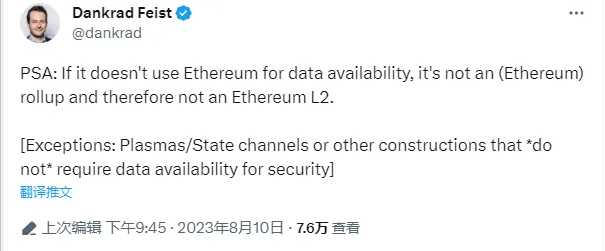
This would mean Arbitrum Nova and Mantle should be removed from the Layer2 list, as they only disclose transaction data outside ETH (on a chain-off DA network called DAC).
At the same time, Dankrad noted that schemes like Plasmas and state channels, which don't require on-chain data availability (Data Availability) for security, still qualify as Layer2s, but Validium (ZKRollup not using ETH as DA layer) does not count as a Layer2.
3.2 Using non-Ethereum for DA makes it an Ethereum Validium—Vitalik's compromise
Later, Vitalik tweeted in reply: "being a validium is a correct choice for many apps, and using good distributed DA guarantee systems can be a good way to increase the practical security of a validium"

Meanwhile, he believes the core of rollups is unconditional security guarantees: even if everyone is against you, you can still withdraw your assets. If data availability depends on external systems, this guarantee cannot be achieved.
3.3 About ENS and Data Availability — Vitalik wants to consolidate control over DA through ENS
ENS domain service defines an interaction logic where users need only input a short domain name to automatically connect to the long address associated with the ENS smart contract, solving the pain point of complex, hard-to-remember and identify EOA addresses. ENS's domain service clearly points toward a future expansion market with larger user traffic, especially mass adoption user groups. Meanwhile, layer2s are Ethereum's future for scaling and absorbing large traffic volumes.
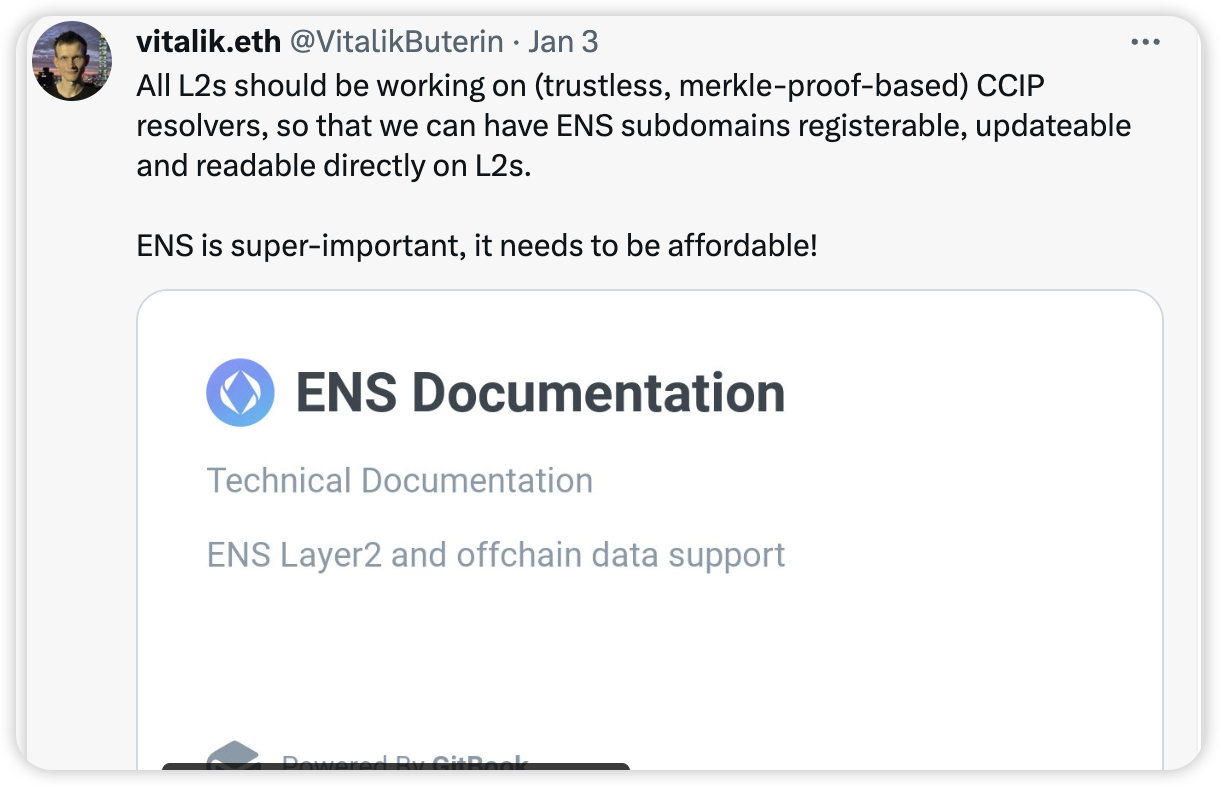
Vitalik believes if ENS's domain resolution scheme cannot cover layer2s and remains only at the Ethereum mainnet level, its potential will be limited. Against this backdrop, Vitalik emphasized ENS's importance on Twitter: "it needs to be affordable!". Naturally, ENS will consider providing a complete set of data resolution solutions for layer2s, enabling users to directly perform domain resolution and data lookup on layer2s, reducing their reliance on relatively centralized gateways of individual layer2s.
It's not hard to see that for users to normally use ENS domains on layer2s, they need to invoke and verify global data on the Ethereum mainnet. This means enjoying ENS's service requires adopting orthodox Ethereum Data Availability capabilities, making layer2s based on OP Stack shortcuts that place DA on third-party platforms like Celestia incompatible with ENS. At this point, Vitalik's intention becomes clear. In short, Vitalik's deeper meaning is to use ENS to establish interoperability standards for various layer2 platforms while consolidating control over DA.
3.4 Vitalik discusses Plasma's return
As Vitalik mentioned in his article, Ethereum's original layer2 scaling solutions included: Plasma, Rollup, Validium, Parallel, and others. The scaling direction Vitalik expected should have been balanced development, adapting diverse scenarios for varied layer2 constructions, but the reality is Rollup dominates the market, becoming increasingly competitive.

b. Plasma is equivalent to a sidechain solution, periodically synchronizing Merkle state data to the mainnet—a scaling approach where data and computation depend on the mainnet. This allows layer2s to expand efficiently using highly centralized methods with complex ledger models while reusing system capabilities like mainnet validators. Vitalik's new article revives Plasma and promotes a ZK+Plasma scaling solution, clearly signaling another strategic shift in the layer2 landscape.
3.5 Summary
To summarize Vitalik's various moves above:
|
Demand for DA is extremely high, yet he doesn't want to cede market share to Celestia. First emphasizing security, then invoking ENS issues, later realizing the market isn't buying it, seeing many still adopt third-party DAs, he concedes that using Validium counts too, and days later resurrects the old Plasma concept to intentionally guide the market toward exploring ZK+Plasma directions.In essence, his goal is continuously pulling the DA market back toward Ethereum. |
4. DA Solutions and Review of Various DA Projects
4.1 DA Solutions
From the above content, we can see there are many DA layer solutions. Broadly speaking, they can be divided into two major categories: on-chain and off-chain.
· On-chain solutions
Refers to L2s continuing to use Ethereum as the DA layer and relying on Ethereum to reduce data availability costs. This means Ethereum will function as a real-time bulletin board in the future, with posted data deleted after a period, requiring L2s to find their own ways to store backup copies of all data.
· Off-chain solutions
Means no longer using Ethereum as the DA layer, instead seeking more economical ways to achieve data availability. Depending on different levels of decentralization and security, off-chain solutions can be categorized into four types: Validium, Data Availability Committees (DAC), Volition, and general-purpose DA solutions.

4.2 Celestia
Celestia is the pioneer of modular blockchains, developed based on Cosmos SDK, focusing exclusively on data availability. It is already live on mainnet and stands as a leading, highly competitive DA project.
Technical Features
· Data Availability Sampling (DAS)
DAS enables light nodes to verify data availability without downloading entire blocks. Since light nodes cannot verify data availability by only downloading block headers, Celestia uses a two-dimensional Reed-Solomon encoding scheme to re-encode block data, enabling DAS for light nodes. The principle behind DAS is having light nodes randomly sample small portions of block data across multiple rounds. As light nodes complete more sampling rounds, their confidence in data availability increases. Once a light node reaches a predetermined confidence level (e.g., 99%), it considers the data available.
· Namespaced Merkle Trees (NMT)
NMT allows execution layers and settlement layers on Celestia to download only transactions relevant to them. Celestia divides block data into multiple namespaces, each corresponding to applications like rollups built on Celestia, so each application only needs to download related data, improving network efficiency.
· Celestia primarily generates revenue from applications in two ways:
· Paying blob space fees: Rollups pay $TIA to publish data into Celestia's blob space.
· Paying gas fees: Developers use $TIA as the gas token for rollups, similar to ETH for Ethereum-based rollups.
·Potential for Development
· Project is live with high technical maturity
· Potential for rich airdrops from $TIA staking—for example, projects like Dymension and Altlayer have chosen $TIA stakers as airdrop recipients, and many future Ethereum Layer2 projects, modular blockchains, and Cosmos ecosystem projects may follow similar airdrop strategies.
· Rich ecosystem: Collaborations with cross-chain bridges, settlement layer solutions, DeFi projects, games, sequencers, etc.
· Continuously growing list of DA partners including Manta, Eclipse, Caldera, Snapchain. Also integrated with Arbitrum Orbit, Polygon CDK, and derivative trading platform Aevo.
4.3 EigenDA
EigenLayer is a restaking protocol based on Ethereum, allowing users to restake ETH, lsETH, and LP Tokens on other sidechains, oracles, middleware, etc., serving as nodes and receiving validation rewards. This way, third-party projects can benefit from Ethereum mainnet security while ETH stakers earn additional returns, creating a win-win situation.
EigenDA is a decentralized data availability (DA) service built on Ethereum utilizing EigenLayer's restaking mechanism and will be EigenLayer's first active validation service (AVS). Unlike Celestia or Avail, EigenDA does not require bootstrapping a new validator set—Ethereum validators can freely choose to join.
· Technical Features:
· Enhanced Ethereum DA capability: Blob block data + KZG commitments
EigenDA leverages post-Cancun-upgrade Blob block data + KZG commitments. Rollup chains can generate erasure codes from Blob Data to create KZG commitments, then publish them to the EigenDA contract, with EigenDA nodes subsequently guaranteeing DA capabilities for following chains—effectively enhancing Ethereum's DA capabilities. Crucially, EigenDA's entire process revolves around existing Ethereum infrastructure like Blobs and KZGs, with node validation work involving Ethereum validators.
· No independent consensus or P2P network
EigenDA nodes must restake ETH (or more precisely, ETH derivatives) in the EigenLayer contract on Ethereum L1. EigenDA nodes are a subset of Ethereum validators. Then, DA buyers (e.g., rollups, also known as dispersers) receive data blobs, encode them with erasure coding, generate KZG commitments, publish and distribute them for node confirmation. Afterwards, dispersers collect these signatures one by one, generate aggregate signatures, and publish them to the EigenDA smart contract, which verifies the signatures.
· Uses proof-of-custody mechanism
EigenDA does not use data availability sampling to verify whether nodes actually stored data but instead implements a proof-of-custody method. Anyone can submit a proof to the EigenDA smart contract, which will be verified by the contract. If verification succeeds, lazy validators will be slashed.

· Potential for Development
· Multiple partner projects competing with Celestia: Already integrated with Celo, Mantle, Fluent, Offshore, OP stack, and other L2 projects;
· Backed by EigenLayer's diverse ecosystem including sequencers, cross-chain bridges, oracles, etc.
4.4 Other DA Projects
4.4.1 Avail
Avail efficiently orders and records transactions, provides data storage and verification of data feasibility, supports Ethereum Virtual Machine (EVM)-compatible blockchains, allowing rollups to publish data directly to Avail. Its lightweight client network verification mechanism (introduced below) enables rollups on Avail to verify states through lightweight client networks without relying on smart contracts and base layers. Moreover, due to its modular nature, developers can store data on Avail and choose other networks for settlement.
· Consensus mechanism: Inherits BABE and GRANDPA consensus mechanisms from Polkadot SDK
· Decentralization:
· Avail adopts Polkadot's Nominated Proof-of-Stake (NPoS), supporting up to 1,000 validator nodes. NPoS also features effective reward distribution, reducing risks of stake centralization.
· Avail has the ability to perform data sampling from its lightweight clients' P2P network, providing an efficient and reliable backup mechanism that ensures data availability even during failures.
· Validity proofs: Avail adopts KZG polynomial commitments
Status: Mainnet not yet launched
4.4.2 Near DA
On November 8, 2023, the NEAR Foundation announced the launch of NEAR Data Availability (NEAR DA) layer, providing powerful, cost-effective data availability for ETH rollups and Ethereum developers. Initial users include StarkNet's Madara, Caldera, Fluent, Vistara, Dymension RollApps, and Movement Labs.
· Security: Inherits NEAR network security
· Cost advantage: 100kB calldata on NEAR costs $0.0033
· Status: NEAR DA has been integrated with Polygon CDK for developers building Ethereum ZK Rollups.
4.4.3 Covalent
Blockchain data query service platform Covalent standardizes data from multiple blockchains, and its unified API allows developers to reuse queries across supported networks, solving the problem of blockchain data being hard to access.
After the Cancun upgrade, Ethereum mainnet will only retain state data submitted by L2s for one month before discarding it. To maintain network decentralization and the validity of DAS light node mechanisms, Celestia will also periodically discard state data submitted by L2s. However, Covalent launched its long-term DA service EWM (Ethereum Wayback Machine) at the end of last year, permanently preserving discarded L2-submitted state data from Ethereum. Covalent handles reading L2 state data.
Moreover, Covalent indexes and structures this data, integrating it into its on-chain data API services, providing support for specialized blockchain data websites, government regulators, and AI research teams.
· Status: As of December 2023, Covalent supports over 210 blockchains and plans to support over 1,000 by the end of 2024. According to a recent Covalent data availability report released by Messari, Covalent possesses billions of data points, making it currently best suited to serve applications needing universal, widely applicable data.
4.4.4 zkPorter
zkPorter is an off-chain data availability solution optimized for decentralization introduced by zkSync, Ethereum's scaling solution, handling data availability through a hybrid approach combining zkRollup and sharding concepts. zkPorter introduces an optional validator mechanism where zkSync token holders stake tokens to validate and sign blocks. Although zkPorter's product progress hasn't been disclosed externally for a long time, given that GRVT, a Layer3 application chain on zkSync, plans to launch on mainnet in Q1 this year and will store data on zkPorter, zkPorter is speculated to launch shortly before then.
4.5 Comparison of DA Projects
Technical aspects:

Performance aspects:

Conclusion
· Among the above DA projects, the strongly competitive ones are Celestia, EigenLayer, Avail, and NearDA, while Covalent takes an unconventional path, carving out unique demand in DA applications.
· Among all data availability implementation schemes, data availability sampling combined with KZG polynomial commitments is the most mainstream approach, capable of reducing node costs and improving proof efficiency while ensuring data availability.
· Technically speaking, Ethereum's Danksharding and Celestia are the most decentralized because they both use sampling techniques, lowering node performance requirements while achieving high bandwidth. EigenDA ranks next, also using sampling but parasitic on Ethereum, with its number of nodes being a subset of Ethereum's. Other DA projects likely don't use sampling—for instance, NearDA's degree of decentralization equals that of the Near Protocol.
· Celestia's chosen optimistic proof implementation has a lower entry threshold compared to KZG polynomial commitments, indicating higher technical maturity, though its future technological ceiling is lower than KZG polynomial commitments. Compared to similar projects like Avail and EigenDA, Celestia currently has faster development progress and will reach mainnet earlier. However, Celestia will face direct competition from Ethereum after the Cancun upgrade.
· For a Layer2 developer, the choice comes down to a trade-off between DA orthodoxy and chain-launching costs. DA orthodoxy is relatively passive in commercial markets—it suits comprehensive layer2 projects that care more about security consensus issues and have certain brand heritage and market foundation. In contrast, newer, smaller layer2s, especially those quickly launched via OP Stack one-click deployment, will try every means to minimize costs. For them, third-party DAs like Celestia are naturally better choices. EigenLayer still cannot reduce actual development costs for project teams launching L2s.
· However, for DA layer projects, their single-use case and B2B model mean these projects cannot attract significant liquidity like a comprehensive public chain (e.g., Solana) might by attracting DApps through consumer-facing scenarios. Without successfully attracting widespread adoption by Rollup projects, their ecosystem development will weaken. Additionally, Celestia seems to lack a powerful capital backer. While its technical narrative makes sense, if it fails to take root well within the Ethereum ecosystem, its grand vision could easily become castles in the air.
5. DA Layer and Blockchain Modularity
The DA layer has always existed, whether in BTC, ETH, or Solana. For example, in the Bitcoin network, data is directly stored on blocks. Fifteen years ago, Satoshi Nakamoto published the Bitcoin whitepaper and limited block size to 1MB, restricting the upper limit of transaction data each block could contain. Later innovations like SegWit, Taproot, and the Ordinal protocol were, to some extent, aimed at enhancing BTC network's data availability.
In pre-4844 Ethereum networks, data relayed from Layer2 to Layer1 was stored in Calldata. Although Rollups securely moved computation to L2, storage remained on L1. Due to L1's limited storage capacity, this constrained Rollup capacity on Ethereum. Ethereum blocks are about 150K–250K in size; even if all space were dedicated to Rollups, storage space would still be limited, constraining L2 throughput. Hence, Ethereum adopted Proto-Danksharding, introducing a new transaction type containing Blobs to enhance data availability.
Therefore, we can say the DA layer emerged abstractly alongside blockchain scalability demands and higher requirements for data availability—a refinement akin to societal division of labor during human development. Modular blockchains decouple specific functional layers from monolithic blockchains, outsourcing responsibilities to other blockchain networks, further specializing divisions and improving efficiency.
Celestia proposed modular blockchains
Traditional monolithic blockchain architectures typically consist of four functional layers:
· Execution Layer—responsible for processing transactions and executing smart contracts, including transaction validation, execution, and state updates.
· Data Availability Layer—in modular blockchains, responsible for ensuring network data is accessible and verifiable. It usually includes data storage, transmission, and verification functions to guarantee blockchain transparency and trust.
· Consensus Layer—responsible for protocols among nodes to achieve consistency of data and transactions in the network. It validates transactions and creates new blocks through specific consensus algorithms (e.g., Proof of Work (PoW) or Proof of Stake (PoS)).
· Settlement Layer—responsible for finalizing transaction settlements, ensuring asset transfers and records are permanently saved on the blockchain, determining the blockchain's final state.
Celestia first proposed the concept of modular blockchains, decoupling different functional layers from monolithic blockchains, allowing blockchains to focus on special functions at specific layers, reasonably dividing labor to maximize overall usability.
This isn't to say modular blockchains necessarily have advantages over monolithic ones, but rather encourages viewing blockchain's future development through a modular lens, opening up more possibilities and speculations.
6. Speculations About the Future
6.1 Viewing Blockchain Combinations Through a Modular Lens
The previous section discussed viewing blockchains modularly, dividing them into execution layer, data availability layer, consensus layer, and settlement layer.
Taking the Ethereum ecosystem as an example, the consensus layer is the Ethereum main chain,
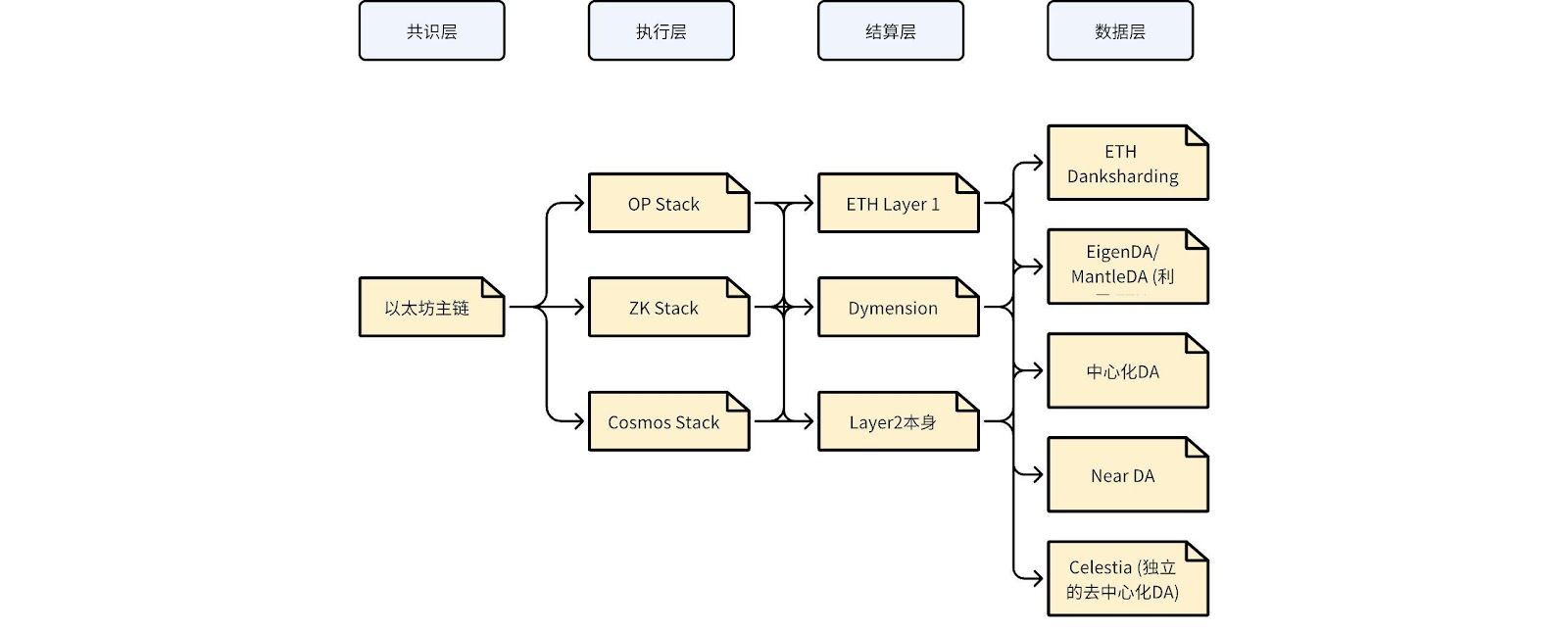
For the Ethereum ecosystem, the possible number of future modular blockchains equals: number of execution layer solutions * number of settlement layer solutions * number of DA layer solutions
6.2 The DA Layer Will Be Fragmented
DA layers have already sprung up like mushrooms after rain, and the core content of DA isn't particularly difficult. The simplest setup can achieve DA on a single machine, while the most complex setups like Celestia achieve decentralization through sampling. Decentralization via sampling benefits from network effects—the more nodes, the greater the bandwidth (imagine a P2P movie download network)—so I believe there won't be too many such "decentralized sampling DAs" in the end. However, other forms of DA face no such limits and could be infinite in number.
Here we can draw an analogy: DA is storage, which occupies high costs. If you don't strictly require Ethereum-level security services, choosing a DA solution becomes a trade-off between cost and security.
Principle: The higher the value of the service, the more secure its DA should be.
Therefore, the future of DA may be fragmented. Even so, perhaps 7-8 major DA solutions might suffice.
6.3 Ethereum might introduce a dedicated DA layer in ETH3.0
Ethereum upgraded from 1.0 to 2.0, splitting Ethereum into execution and consensus layers, with newly introduced Blobs hanging on the beacon chain's consensus layer.
In the future, during Ethereum's next upgrade, with technological advancements and increasing demands for data availability, Ethereum might add a dedicated DA layer atop execution and consensus layers; alternatively, the next upgrade might introduce dedicated data storage chains similar to shard chains. Of course, these are just speculations—we'll have to wait and see which direction it takes.
About Us
This article was written by the Research team under HTX Ventures. HTX Ventures is Huobi HTX's global investment arm, integrating investments, incubation, and research to identify the world's most outstanding and promising teams. As a pioneer in the blockchain industry for a decade, HTX Ventures drives cutting-edge technologies and emerging business models, providing comprehensive support—including fundraising, resources, and strategic consulting—to partnered projects to build a long-term blockchain ecosystem. Currently, HTX Ventures has supported over 200 projects across multiple blockchain sectors, with some quality projects already listed on Huobi Exchange. Meanwhile, HTX Ventures is one of the most active fund-of-funds (FOF) investors, collaborating with top global blockchain funds like IVC, Shima, and Animoca to build the blockchain ecosystem together.
References
1. Long thread: jianshu's analysis of DA
2. Long thread: A rising new narrative in the post-Cancun upgrade era—DA War
3. End of STARKNET Rollups war on Ethereum, new narrative DA
4. First Class Warehouse Research Report: Modular Blockchain Celestia
5. In-depth EigenLayer Research Report: Ethereum's Middleware Protocol Leading the Restaking Narrative
7. What is EigenDA, the flagship product of restaking protocol EigenLayer?
Join TechFlow official community to stay tuned
Telegram:https://t.me/TechFlowDaily
X (Twitter):https://x.com/TechFlowPost
X (Twitter) EN:https://x.com/BlockFlow_News
 HTX Research











