








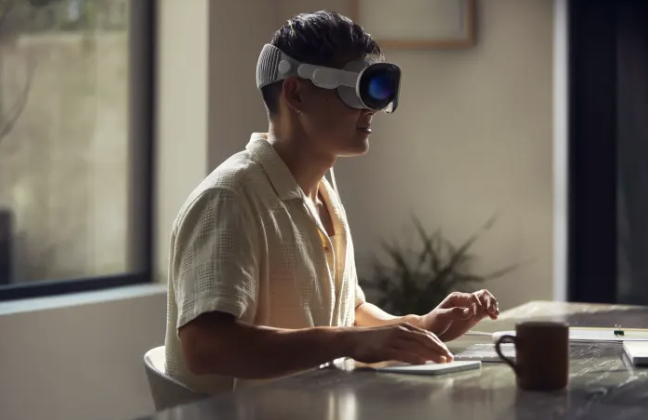
Vision Pro polarizes opinions as users return units and gray-market buyers suffer
TechFlow Selected TechFlow Selected
Vision Pro polarizes opinions as users return units and gray-market buyers suffer
High prices, discomfort from prolonged wear, and the inconvenience of gesture controls in work settings—these "hard flaws" have deterred many potential consumers.
 Navigating Web3 tides with focused insights
By Mu Mu
Apple's "spatial computer" Vision Pro has become a trending topic in tech circles since its launch. As early adopters begin receiving their units, surreal scenes have started appearing on American streets—tech enthusiasts wearing Vision Pro while walking, jogging, walking dogs, or even driving, sharing their experiences through demo videos on social media.
However, as the 14-day return window closes, some buyers are choosing to return the device. Public opinion on Vision Pro is sharply divided. While the product represents the highest standard among all consumer-grade headsets available today, its near-30,000 RMB price tag, discomfort during prolonged use, and inconvenient gesture controls for work tasks have deterred many potential customers.
On Chinese e-commerce platforms like JD.com and Taobao, third-party stores have begun selling Vision Pro. But as market enthusiasm cools, those who initially bought at premium prices via agents are now reselling secondhand on Xianyu or offering rental services.
Pinch to View—But Not for Long
Wearing Vision Pro while shopping, walking dogs, taking the subway, flying, or even driving—early users have showcased these scenarios on social media for hesitant consumers. Some treat Vision Pro as a smartphone or computer replacement; others use it as a personal cinema, while some even consider it a dog-walking tool.
 Some users wearing Vision Pro outdoors
The initial feeling for anyone wearing Vision Pro outside is likely awkwardness—others stare and react with curiosity. For a time, Apple’s new gadget captured massive attention online. But as more experience videos emerge, consumer sentiment has become polarized.
With 23 million pixels, just 12 milliseconds of delay, an 18-meter-wide virtual screen, and precise eye tracking, Vision Pro is undoubtedly the most powerful mixed-reality headset currently on the market.
Put it on, and you can watch 3D movies from home; surround yourself with multiple 360-degree workspaces; open any app without a controller—just look at it and tap your fingers together (a “pinch”)—even tiny icons respond instantly; see the real world clearly in bright light through the display, while simulated eyes allow others to see your full facial expressions.
These benefits were all demonstrated by Apple at launch. In terms of actual user experience, former Netflix, Disney, and Nickelodeon animator @Doctor_Peepee wrote on X: “I spend over seven hours daily on the system—it’s highly productive, and I’m completing tasks far faster than expected.”
Vision Pro also offers the best audiovisual experience among current consumer headsets. Tech reviewer “Tanwan Geji Xiaoningzi” noted in her review: “Vision Pro is the first headset I’ve used that’s suitable for reading and writing—text on most web pages and documents is sharp and legible.” She added that high resolution makes Vision Pro the first headset truly fit for movie watching—when the image fills your field of view, resolution approaches 4K.
Yet, despite awe at the revolutionary experience Vision Pro delivers, many early adopters chose to return the device within the 14-day window. The first-generation Vision Pro still has significant flaws—some of which stem directly from its groundbreaking features.
The most common complaint concerns wear duration. On one hand, a headset weighing over half a kilogram cannot be comfortably worn for long periods—the front-heavy design strains the neck, and the frame leaves marks on the face. On the other hand, under low-light conditions, the image inside the headset darkens significantly, dizziness sets in, precise eye tracking fails, and you may struggle to operate any application—even shutting down the device via settings becomes difficult.
“My mind wants to keep going, but my body says no”—this sentiment has turned off many consumers. Parker Ortolani, a product manager at The Verge, reported experiencing broken blood vessels in his eyes after using Vision Pro. Tech blogger @RjeyTech, who decided to return the device, said: “This is the most exciting technology I’ve ever tried—but I got headaches after just 10 minutes of use.”
Even if users overcome dizziness and fatigue, Vision Pro’s combination of eye tracking and gesture control introduces operational inconveniences. Typing is the most obvious example: when handling document tasks solely with Vision Pro, you must stare at a virtual keyboard and “pinch” each letter individually—a process reminiscent of learning to type all over again with one finger. The solution? Connect a physical keyboard.
Additionally, Carter Gibson, Senior Manager of Community and Moderation at Google, pointed out that Vision Pro doesn’t support certain specialized file types and struggles with interactions across multiple windows.
Designers note that Vision Pro’s spatial display relies on camera capture and optical projection, so it doesn’t yet fully meet professionals’ needs for color accuracy. Programmers attempting to code with Vision Pro report that many professional software tools aren’t compatible with visionOS yet.
In short, the first-generation Vision Pro isn’t perfect—something all new electronic products face upon release.
Flaws Turn Off Buyers—Agents Hit Hardest
Bugs in user experience combined with a nearly 30,000 RMB price point easily prompt buyers to question whether it’s worth it—this is the primary reason owners choose to return the device.
One U.S. consumer commented on social media that this might reflect a broader American shopping habit: people buy products mainly for fun or to create content for social media, then return them. At such a high price, few are willing to keep it permanently.
Moreover, some tech influencers aiming for a “zero-cost trial” are leveraging the 14-day return policy—using the device, publishing reviews, gaining traffic, then returning it.
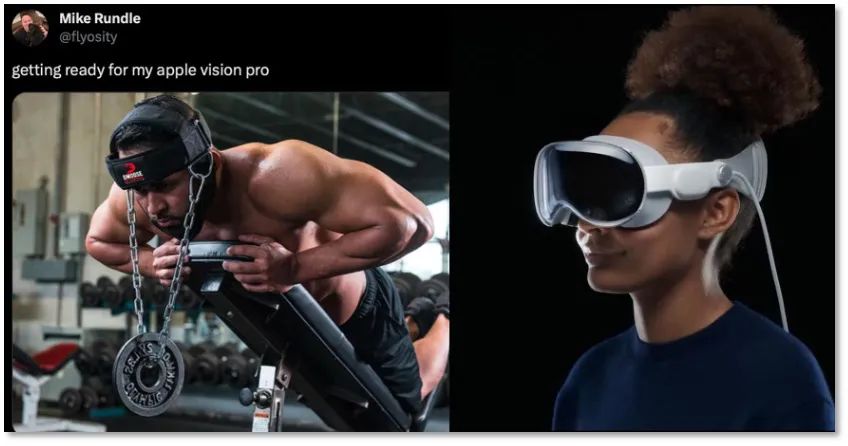 Netizens making memes about Vision Pro’s weight
Still, according to Bloomberg’s Mark Gurman, Vision Pro’s return rate likely falls between average and slightly above average compared to other Apple products. Apple Insider cited 24 Apple Store employees indicating Vision Pro’s return rate is comparable to other Apple devices, with no sign of a “mass return wave.”
However, it should be noted that the 24 Apple retail stores referenced in Apple Insider’s report do not represent the full picture. Apple hasn’t released official return rates, so it’s too early to conclude whether there’s been a true “return surge.”
Regardless, as first-wave user feedback spreads, unavoidable motion sickness has made many potential buyers hesitant. Google Trends shows declining or stable interest in Vision Pro among both U.S. and Chinese users. The initial launch failed to generate sustained momentum. From user feedback, price and comfort remain the core concerns.
As market excitement fades, those who stocked up for resale have become the biggest losers.
On one hand, domestic e-commerce channels are gradually listing Vision Pro, expanding access and driving prices down. Consumers are now comparing options, making reselling harder.
On the other hand, due to regional restrictions, some personally imported units may have missed the return deadline, leaving agents in a bind. On Xianyu, a reseller named Anan (pseudonym), who originally paid 35,000 RMB for a unit, had to relist it as a “new secondhand item” due to lack of orders.
“I secured two units during pre-orders, but now they’re stuck with me.” Currently, he’s discounting one for sale and renting out the other at 600 RMB per hour.
Given the split reviews, will previously interested consumers still choose Vision Pro?
Xiao Zhu (pseudonym), a tech enthusiast who was waiting for Vision Pro’s China release, told *Metaverse Daily*: “While Vision Pro’s capabilities are impressive, until usability issues are resolved, my expectations will remain tempered.” Still, Xiao Zhu believes some flaws are inevitable for a first-generation product. Overall, he’d rather wait for a second generation—or buy the first-gen at a lower price.
Join TechFlow official community to stay tuned
Telegram:https://t.me/TechFlowDaily
X (Twitter):https://x.com/TechFlowPost
X (Twitter) EN:https://x.com/BlockFlow_News











