








Starknet Airdrop Analysis: One User Farmed 1,358 Addresses, Profiting $3 Million—Is Early Entry Better Than High Interaction?
TechFlow Selected TechFlow Selected
Starknet Airdrop Analysis: One User Farmed 1,358 Addresses, Profiting $3 Million—Is Early Entry Better Than High Interaction?
As of 11:00 on February 22, more than 427 million tokens have been claimed. The largest single address received 1,532,750 STRK tokens—worth approximately $3 million—by aggregating tokens from 1,358 addresses.
 Navigating Web3 tides with focused insights
Author: Frank, PANews
On February 20 at 12:00 UTC, the Layer2 project Starknet officially launched its airdrop claim program. A total of 1.3 million addresses qualified for the airdrop. As of February 22 at 11:00 Beijing time, over 427 million tokens have been claimed. The largest single address aggregated tokens from 1,358 addresses and received 1,532,750 STRK tokens, worth approximately $3 million.
According to statistics by PANews, the top individual address received 180,650 STRK, worth about $360,000. There are 31 addresses that received more than 90,000 tokens, 93 addresses with over 40,000 tokens, and 217 addresses with over 20,000 tokens.
More Interactions Don’t Beat Early Entry? Early Community Members (ECMP) Gain Most
Since the official announcement of the airdrop plan, Starknet has consistently dominated community discussions and reignited debates on social media about "airdrop farming" as a path to wealth. However, according to PANews analysis, Starknet's distribution rules appear to prioritize early participation over frequency of interactions.
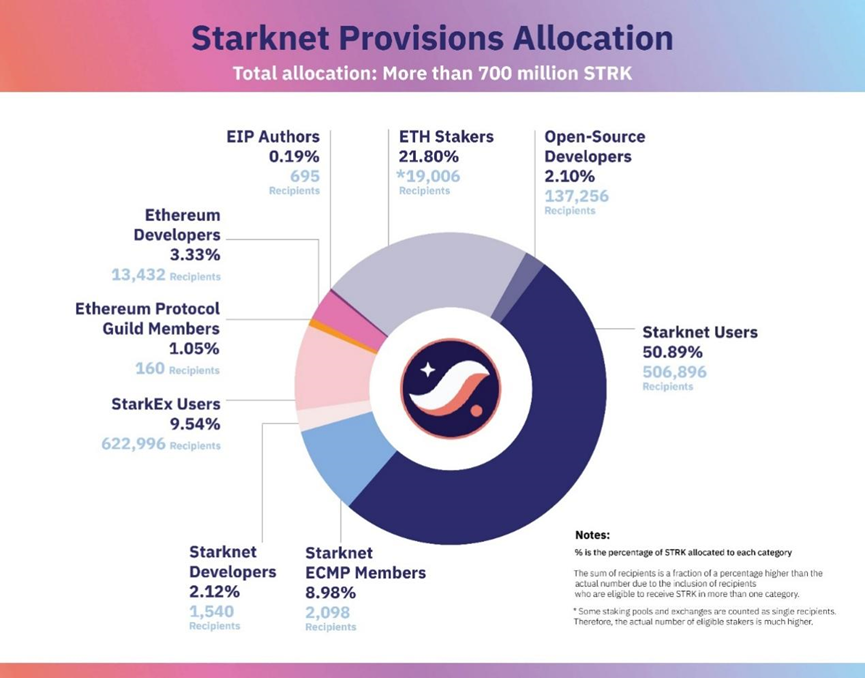
From an analysis of Starknet’s airdrop data, although the initial allocation table released by the team assigned 50.89% of tokens to Starknet users and 8.98% to the Early Community Member Program (ECMP), in actual distribution Starknet merged ECMP participants into the broader “Starknet user” category, bringing their combined share to 59.87%. One benefit of this approach is that it makes it impossible to distinguish, simply by checking the largest claiming addresses, whether they belong to regular interacting users or ECMP members.
Data from tokenflow.live shows that within the “Starknet user” category, the largest claimable amount was 180,650 STRK.
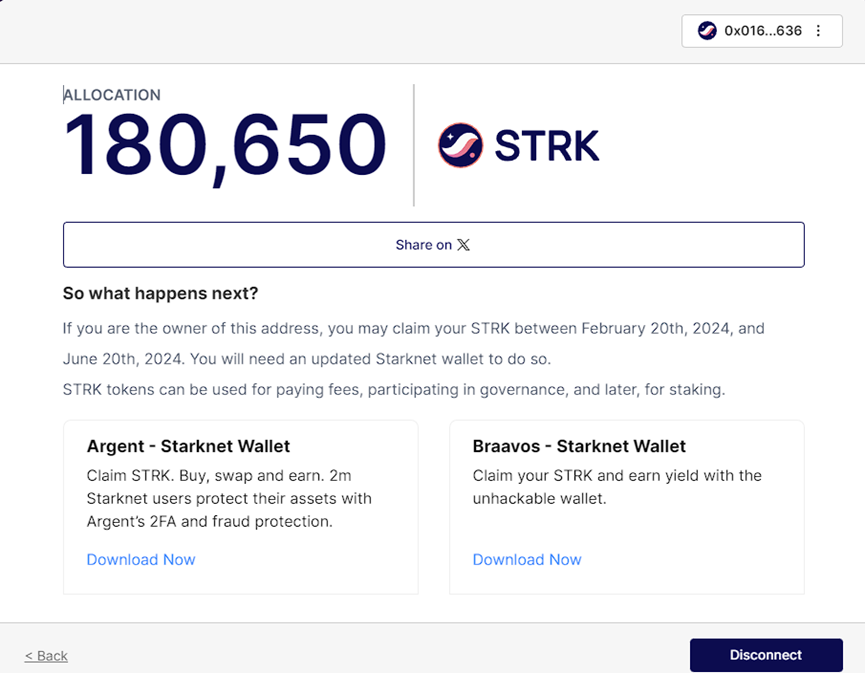
As previously reported by BlockBeats, as part of the Early Community Member Program (ECMP), over 2,000 individuals were eligible to receive Provisions. Those ranked highest in the allocation criteria received large allocations of up to 180,000 tokens, suggesting that ECMP participants may have received significantly more than typical early users who actively interacted with the network.
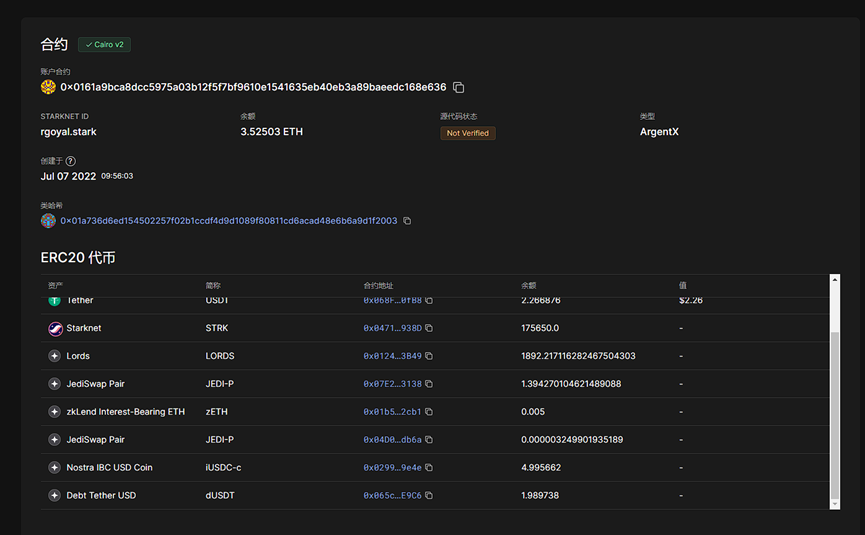
In fact, PANews’ analysis of the top receiving addresses found that these addresses did not have high volumes of on-chain activity.
Take the address 0x0161a9bca8dcc5975a03b12f5f7bf9610e1541635eb40eb3a89baeedc168e636 as an example. According to Starknet explorers, this address claimed 180,650 tokens—the highest single claim. However, its number of on-chain transactions and transaction value are relatively low. That said, this address began interacting on Starknet about two years ago, indicating the holder likely qualified under the Early Community Member Program (ECMP).
According to the Early Community Member Program published by the Starknet Foundation, the following individuals qualify as early contributors:
-
Individuals who made significant technical contributions to community discussions
-
Individual contributors listed on key ecosystem projects
-
Individuals who organized events globally (meetups, conferences, workshops)
-
Individuals who regularly published content promoting the Starknet brand
The evaluation criteria for contribution levels are as follows:
1. Reach / Impact: Measures how widely the contributor's work has spread within the community. This could include the number of people using or relying on their code, engaging with their content, or following their thought leadership.
2. Importance: Assesses the significance of the contributor’s work within the community or specific projects. This may relate to how critical their work was to a project’s success or their influence in shaping the ecosystem’s direction and development.
3. Effort: Evaluates the time and energy the contributor invested. This includes not only coding but also community support, mentorship, and knowledge sharing through engagement with others.
4. Originality: Examines how unique or innovative the contributor’s work is. This might involve creating new algorithms, methodologies, or tools not seen before, or solving existing problems in novel ways.
However, to date, Starknet has not disclosed which individuals were selected for the program nor revealed the specific metrics used for assessment.
“Airdrop Hunters” Scoop Up $3 Million
Even if individual addresses didn't maximize gains purely through interaction, airdrop farming groups clearly did not lose out in this round.
According to Lookonchain, one airdrop hunter aggregated tokens from 1,358 addresses and received 1.53 million STRK tokens, worth around $3 million. Another address pooled 1,800 addresses and collected 1.22 million STRK tokens, valued at approximately $2.4 million.
PANews analyzed some of these addresses and found that individual claims ranged from 600 to 1,200 tokens each, with most beginning interactions about seven months ago. After claiming, both addresses transferred all tokens to the same suspected exchange address:
0x0213c67ed78bc280887234fe5ed5e77272465317978ae86c25a71531d9332a2d
It remains unclear whether these two airdrop hunters belong to the same team. However, based on current outcomes, Starknet’s anti-Sybil measures appear to have had limited effectiveness.
Ongoing Community Criticism
Typically, after a billion-dollar-scale airdrop, social platforms are flooded with users sharing their claims. Yet such activity has been notably absent following the Starknet airdrop. Instead, widespread criticism has emerged under official accounts and KOLs’ social media posts.
Some users criticized Starknet’s requirement of holding at least 0.005 ETH in the wallet prior to the snapshot. One user commented: “I’m disappointed that the project decided to distribute to all minimal participants while bypassing those who, due to circumstances or needs, may not currently have funds in their wallets—like my situation. It’s truly unfortunate to see.”
Others expressed confusion over airdrops being given to GitHub developers who hadn’t performed any on-chain interactions. In reality, so far, the claim rate for Starknet users stands at 91.85%, while open-source developers’ claim rate is only 3.27%. According to the official announcement, unclaimed tokens will be reclaimed after four months and redistributed in future rounds or programs.
“After months of completing tasks and trading, I got nothing. Maybe airdrops should start being regulated, as these tasks are being used to attract capital (like ICOs), yet implemented without transparency or fairness,” a user lamented on the Starknet Foundation’s Twitter post.
Join TechFlow official community to stay tuned
Telegram:https://t.me/TechFlowDaily
X (Twitter):https://x.com/TechFlowPost
X (Twitter) EN:https://x.com/BlockFlow_News
 PANews










