









How to conduct OTC cryptocurrency business in Hong Kong compliantly?
TechFlow Selected TechFlow Selected
How to conduct OTC cryptocurrency business in Hong Kong compliantly?
For practitioners in the cryptocurrency industry, it may seem like policies have tightened, but in reality, the rules of the game have become clearer.
 Navigating Web3 tides with focused insights
Author: Liu Honglin
Hong Kong Grasps Both Sides of Virtual Currency Regulation
On February 2, 2024, Henry Tang, Secretary for Financial Services and the Treasury of Hong Kong, stated that the government believes there is a need to bring over-the-counter (OTC) virtual currency exchanges under regulation. A public consultation on the proposed regulatory framework will be launched in the short term, and the government encourages public participation and stakeholder input.
While we don't know exactly how short "the short term" is, one thing is certain: OTC virtual currency trading in Hong Kong is entering a new era of compliance.
As a long-established international financial center, Hong Kong has maintained a relatively open and inclusive attitude toward virtual currencies. Rather than recognizing them as legal tender or financial instruments, Hong Kong defines virtual currencies as "virtual assets," applying targeted regulatory measures based on the nature of activities involved and associated risks.
Currently, Hong Kong's regulation of virtual currencies focuses on two main areas: supervision of virtual asset service providers (VASPs), and oversight of over-the-counter (OTC) operators.
According to the licensing regime for virtual asset trading services issued by the Securities and Futures Commission (SFC) in June 2023 under the Securities and Futures Ordinance, all platforms offering virtual asset trading services in Hong Kong must apply to the SFC for a license and comply with relevant laws, regulations, and supervisory requirements. Currently, two licensed virtual asset trading platforms—HashKey and OSL—have upgraded their licenses to offer retail investors trading services for Bitcoin (BTC) and Ethereum (ETH). Several other platforms are either applying for licenses or operating during a transitional period. The SFC has indicated it will continuously review and refine the licensing system based on market developments and investor protection needs.
Previously, ManQin Law Firm published several articles discussing Hong Kong’s licensed exchange regulations, such as “A Comprehensive Guide to Hong Kong’s Virtual Currency Exchange Licensing System” and “How Can Virtual Currency Funds Operate Compliantly in Hong Kong?” This article will focus specifically on the regulation of virtual currency OTC operators.
How Many Virtual Currency OTC Operators Are There in Hong Kong?
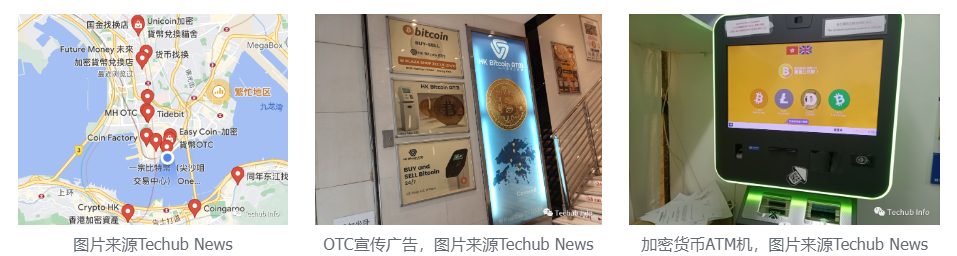
Virtual currency OTC operators refer to institutions or individuals providing over-the-counter (OTC) trading services. OTC trading involves buying and selling cryptocurrencies outside formal exchanges, typically using cash or fiat currency through alternative platforms or channels. OTC trading takes several forms:
-
Online platforms: Websites, social media, or messaging apps connect buyers and sellers, offering matching, escrow, and settlement services.
-
Physical stores: Brick-and-mortar outlets provide cash-to-crypto or crypto-to-cash services, often without requiring identity verification or other compliance procedures.
-
ATMs: Self-service kiosks placed in public areas allow users to buy or sell cryptocurrency using cash or bank cards.
Based on preliminary field observations by Hong Kong law enforcement agencies, approximately 200 physical OTC stores (including those operating via ATMs) are currently active across the city, alongside around 250 online service providers actively facilitating virtual asset transactions.
Most offline OTC stores and ATMs do not require KYC procedures, allowing transactions to be completed within minutes. This offers cryptocurrency users convenient, flexible, and private transaction methods—particularly popular among mainland Chinese users.
Why is this the case? Although China explicitly prohibits cryptocurrency exchange operations within its borders, remarkably, Chainalysis data shows mainland China remains the world’s fourth-largest cryptocurrency trading market. Due to domestic policies, however, an increasing number of experienced crypto users face frequent bank account freezes when buying or selling digital assets. As a result, many seasoned traders choose to travel to Hong Kong during visits to conduct deposits and withdrawals through OTC operators.
Why Regulate OTC Operators?
Every coin has two sides. While OTC operators provide convenient and private deposit/withdrawal channels, they have also been exploited by criminals. On September 5, 2023, Hong Kong police arrested six individuals linked to the JPEX case, including Chen Xiaolong, CEO of Crypto Leopard—an OTC service provider involved in the scheme.

Arrest of JPEX suspects by Hong Kong police. Image source: Techub News
Overall, the current OTC virtual currency sector faces three major issues:
-
Lack of effective regulation: There is currently no clear regulatory framework or requirements for OTC operators in Hong Kong, leading to unregulated and sometimes illegal practices. Some OTC operators are suspected of fraud, money laundering, terrorist financing, and other crimes, harming investor interests and social order. Fraud rings have used affiliated OTC shops to attract retail investors’ funds.
-
Lack of industry standards: OTC operators in Hong Kong lack unified industry standards and self-regulatory mechanisms, resulting in fragmented operations, market disorder, and unfair competition. Some operators lure customers with high returns, low fees, and unlimited transaction limits, encouraging irrational trading. Others suffer from opacity, poor service quality, and damaged market credibility and efficiency.
-
Lack of user protection: Current OTC operators fail to provide sufficient safeguards or remedies for users. When problems arise, users often cannot obtain timely or effective solutions. Many operators do not verify identities or provide risk warnings, nor do they have robust complaint handling or dispute resolution systems. Users facing fraud, delays, or errors struggle to hold operators accountable or claim compensation. Additionally, some operators inadequately protect user privacy and data, risking information leaks or misuse.
How Will Hong Kong Regulate Virtual Currency OTC?
On February 8, 2024, the Hong Kong government launched a public consultation on legislative proposals to establish a licensing regime for virtual asset OTC service providers. Below is a summary of key points drawn from the proposal.
1. Which OTC Activities Will Be Regulated?
(1) According to the proposal, all virtual asset OTC services—whether provided through physical storefronts (including ATMs) or online websites—will be subject to regulation.
(2) The types of virtual assets available for customer trading may include tokens listed on at least one SFC-licensed virtual asset trading platform accessible to retail investors, as well as stablecoins issued by entities licensed under the proposed HKMA stablecoin issuer licensing regime.
(3) Based on the principle of “same business, same risk, same rules,” operators providing fiat remittance services must also apply for a Money Service Operator (MSO) license. Licensed OTC operators are prohibited from offering other services, including any form of virtual asset advisory or referral services, or virtual asset derivatives and other financial products (such as staking, lending, or margin trading).
2. What Are the Requirements to Apply for an OTC License?
(1) To ensure strong local ties for effective supervision, applicants must be either (i) companies incorporated in Hong Kong with a fixed business location, or (ii) foreign-incorporated companies registered in Hong Kong under the Companies Ordinance.
(2) For OTC operators running physical stores, applicants must provide suitable operational premises. For online-only services, applicants must submit details such as the local management office address, correspondence address, and locations where books and records are stored locally.
3. Which Authority Oversees Compliance and Licensing?
(1) Any person conducting virtual asset spot trading services in Hong Kong must apply for a license from the Commissioner of Customs and meet fit-and-proper criteria and other factors deemed relevant by the Commissioner. Licensed OTC operators must comply with anti-money laundering (AML) and counter-terrorist financing (CFT) requirements under the Anti-Money Laundering and Counter-Terrorist Financing Ordinance (AMLO) and other regulatory obligations.
(2) Wallet Registration System: Licensees must register all wallets used in their operations with the Commissioner of Customs and keep the list updated. To mitigate AML/CFT risks, transfers of virtual assets are only permitted from registered wallets to wallets where customers can prove ownership or control.
(3) License Duration: Successful applicants will receive a two-year license, renewable for another two years upon approval by the Commissioner of Customs.
4. What Are the Penalties for Violations?
(1) Operating a regulated virtual asset OTC service without a license is a criminal offense. Upon conviction on indictment, offenders may face a fine of HK$1 million and up to two years’ imprisonment.
(2) Knowingly advertising OTC services provided by unlicensed operators is a crime punishable by a Level 5 fine (currently HK$50,000) and up to six months’ imprisonment.
(3) Licensees who knowingly violate statutory AML/CFT requirements may, upon conviction on indictment, be fined HK$1 million and face up to two years in prison. In addition, administrative penalties may be imposed for misconduct (e.g., breaching other regulatory requirements), including temporary suspension or revocation of license, public censure, corrective orders, and/or fines of up to HK$500,000.
(4) Existing offenses under the AMLO related to fraud and misleading activities will apply to licensed OTC operators. Anyone committing fraudulent or deceptive acts in virtual asset transactions is guilty of a crime punishable by a fine of HK$10 million and up to ten years’ imprisonment. Furthermore, making fraudulent or reckless false statements to induce others into virtual asset transactions is also a criminal offense, punishable by a fine of HK$1 million and up to seven years’ imprisonment.
Conclusion
As an innovative financial instrument, virtual currency regulation in Hong Kong seeks to balance market development with investor protection. By establishing a reasonable and effective regulatory framework, Hong Kong aims to foster healthy growth in the virtual currency industry while safeguarding public interest and financial stability.
The recent legislative proposal on OTC virtual currency regulation marks just the beginning of compliance oversight. While it may appear to practitioners that policies are tightening, in reality, it brings greater clarity to the rules of the game. After all, no industry can sustain healthy development while remaining hidden in dark corners. Letting sunlight in allows everything to flourish.
Join TechFlow official community to stay tuned
Telegram:https://t.me/TechFlowDaily
X (Twitter):https://x.com/TechFlowPost
X (Twitter) EN:https://x.com/BlockFlow_News











