









In-depth Research on Jupiter, an Innovative DEX Aggregator on Solana
TechFlow Selected TechFlow Selected
In-depth Research on Jupiter, an Innovative DEX Aggregator on Solana
Jupiter's mission is to build the most comprehensive and reliable exchange infrastructure on Solana, serving the needs of both individual users and projects.
 Navigating Web3 tides with focused insights
Author: Greythorn
- Project Name: Jupiter
- Network: Solana
- Project Type: Decentralized Exchange (DEX)
- Token Symbol: $JUP
- Cryptocurrency Rank: #98
- Market Cap: $718.6 million
- Fully Diluted Valuation (FDV): $52.9 billion
- Circulating Supply: 1.35 billion tokens (13.50% of total supply)
- Total Supply: 10 billion tokens
Executive Summary
On January 15, 2024, a report by Binance Research revealed that the crypto market experienced significant recovery in 2023, with total market capitalization growing by 109%. Concurrently, the decentralized finance (DeFi) sector also saw strong growth, with its Total Value Locked (TVL) increasing by 38.9% year-on-year to reach $53.4 billion.

Source: Binance Research
Amid the broader revival of the DeFi space and the launch of the JUP token on January 31, Jupiter has established a prominent position within Solana's DeFi ecosystem.
Project Overview
The Jupiter project began as an experimental initiative by a team focused on enhancing stablecoin functionality within the Solana ecosystem. By integrating with Mercurial and Serum, they successfully launched the first cross-protocol liquidity swap feature on Solana. This early success motivated the team to officially launch Jupiter as an independent project in November 2021.
In short, DEX aggregators like Jupiter aim to streamline the trading process. By aggregating liquidity from multiple decentralized exchanges, they find the best exchange rates for users. This model differs from traditional DEXs that rely on a single source of liquidity. By comparing quotes across multiple platforms, DEX aggregators minimize slippage and transaction fees, making trades more efficient and user-friendly. This innovation effectively addresses the issue of fragmentation in the DeFi market, ensuring users can operate under optimal trading conditions.
Jupiter’s mission is to build the most comprehensive and reliable swap infrastructure on Solana to serve both individual users and projects. To achieve this goal, Jupiter has introduced several innovative trading features:
- Dollar-Cost Averaging (DCA):This feature enables automated investing, allowing users to spread investments over time to mitigate the impact of market volatility.
- Cross-chain Bridging:Provides bridge services for transferring assets between Solana and other blockchains, expanding users’ access to different ecosystems.
- Perpetual Contracts Trading:Supports perpetual contract trading, enabling users to speculate on asset price movements without expiration dates and use leverage.

Source: Jupiter
These features reflect Jupiter’s commitment to optimizing seamless and advanced trading experiences on the Solana blockchain.
Jupiter LFG Launchpad
Jupiter’s LFG Launchpad Beta adopts an innovative approach to support new projects, emphasizing a community-driven and transparent model. Unlike traditional launchpads with complex incentive structures and isolated price discovery mechanisms, this platform embraces an open market and community participation model.
The core of the LFG Launchpadlies in its strong community backing, customizable anti-bot measures, user-friendly tools for liquidity management, and comprehensive trading functions. This setup ensures users discover fair prices and immediate liquidity while receiving enterprise-grade technical support.
The LFG Launchpad’s innovative mechanism, including a fair airdrop system and Dynamic Liquidity Market Maker (DLMM), provides stable market entry points for new tokens. By involving community DAO voting in project selection, it ensures launched projects receive robust support and clear pathways to success.
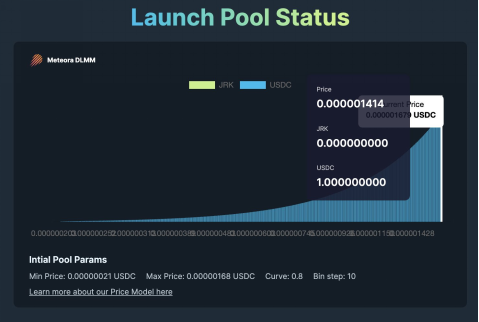
Source: Jupiter
Tokenomics Model
While the JUP token plays a central role in ecosystem governance—granting holders voting rights on key decisions about the platform’s direction—according to repeated statements from founder Meow,JUP’s value is not primarily driven by utility. In a recentReddit post, Meow stated:
“I think the idea that token utility drives value is a myth created either to explain why things have value or by project founders eager to justify their token’s worth. I believe most people don’t actually care about utility—they care about value.” Meow further discussed this concept on the Lightspeed podcast.
“We definitely want JUP holders to be able to use their JUP more broadly over time, such as participating in key ecosystem initiatives, but that shouldn’t be conflated with the value of JUP,” he added.
Token Supply and Distribution
The total supply of JUP tokens is capped at 10 billion.
Team Allocation (50%)
- Team Members (20%): 2 billion JUP tokens are reserved for existing team members, with gradual unlocking starting two years after the Token Generation Event (TGE), emphasizing long-term team commitment.
- Strategic Reserve (20%): Another 2 billion tokens are allocated to future team members, strategic investors, and stakeholders from historical initiatives,stored in a secure multi-signature cold wallet controlled by the team, requiring majority approval for transactions. These tokens are locked for at least one year, with at least six months' notice before any liquidity event.
- Liquidity Provision (10%): 1 billion tokens are dedicated to liquidity provision,managed via a multi-signature hot wallet controlled by the team.
Community Allocation (50%)
- Airdrops (40%): 4 billion tokens will be distributed annually to the community through airdrops, with the first airdrop distributing 1 billion tokens. The remaining 3 billion tokens are stored in acommunity cold walletcontrolled by a 4/7 multi-signature wallet.
- Community Contributor Grants (10%): 1 billion tokens are reserved for community contributors, managed through acommunity multi-signature wallet, with allocation overseen by the Jupiter DAO.
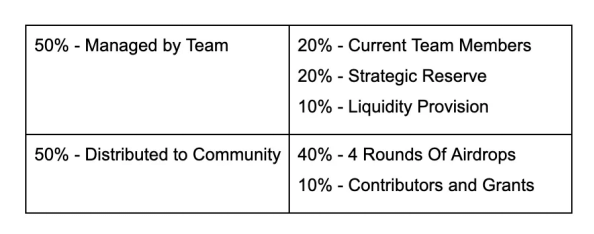
Source: Jupiter Research
Initial Circulating Supply
At launch, the circulating supply of JUP tokens was adjusted to 1.35 billion, down from the initially planned 1.7 billion. This adjustment includes tokens allocated to community airdrops, launch pools, market maker loans, and liquidity provision.
Growth Potential Outlook
The rapid expansion of the DeFi market, coupled with technological advancements in Solana, creates a favorable environment for Jupiter to capture a larger market share.
Notably, in December 2023, Solana surpassed Ethereum to become the leader in weekly DEX trading volume—a milestone that cannot be overlooked. As the first on-chain swap aggregator on Solana, Jupiter is uniquely positioned—not only because high-profile projects like Render, Helium, and Hivemapper are migrating to it, but also because its DEX trading volume has exceeded Ethereum’s (Solana reached $10 billion versus Ethereum’s $8.8 billion), demonstrating strong market momentum.
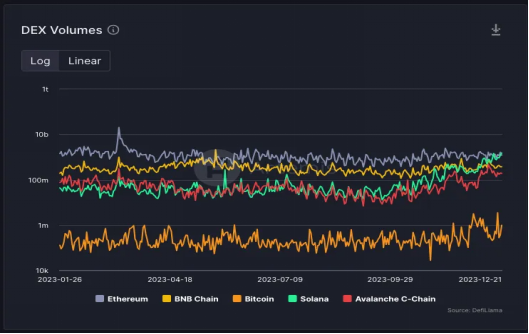
Source: DeFiLlama
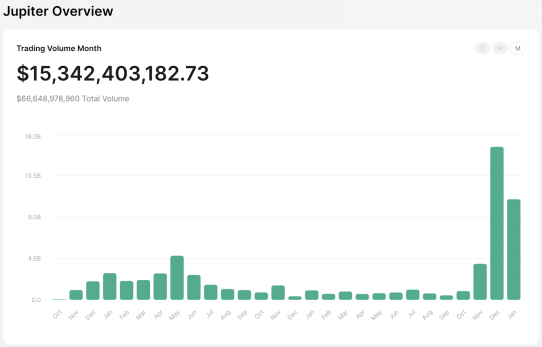
As one of the most popular DeFi trading platforms among independent wallet users across all major blockchains—and particularly dominant on Solana—Jupiter drives 80% of trading activity and accounts for 65% of total volume, solidifying its central role within the ecosystem.
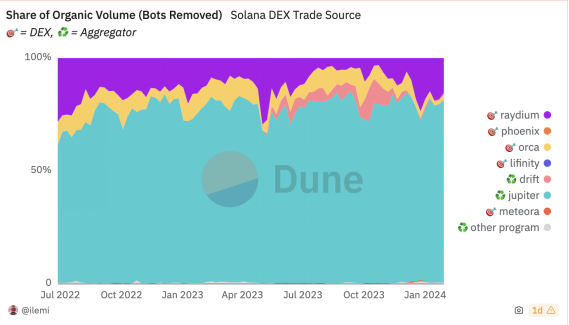
Source: Dune Analytics
Source: Jupiter Station
It is reasonable to infer that Jupiter’s success is closely tied to Solana’s widespread adoption. According to Messari’s latest Solana report, several key growth indicators stand out:
- Solana’s Virtual Machine (SVM) and tech stack are gaining attention and adoption from external developers.
- Quarter-over-quarter growth in compressed NFT (cNFT) mints surged by 316%.
- DeFi’s Total Value Locked (TVL) rose to $368 million.
- Despite potential concerns, market cap grew by 17%, reaching $8.4 billion.
For more Solana metrics, refer to the fullMessari report.
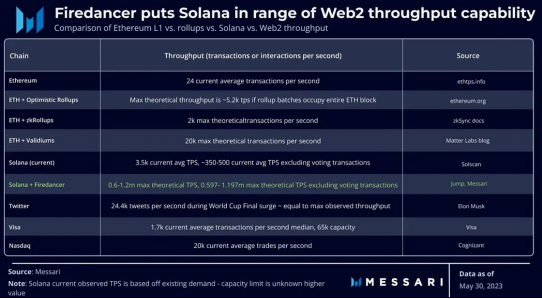
Additionally, Jump Crypto’s Firedancer client is being developed to handle up to one million transactions per second, which would significantly enhance Solana’s scalability and performance.
Source: State of Solana Q3 2023 Report
These developments, combined with growing traction among new users, suggest that under effective management and leveraging Solana’s technological advances and rising market influence, Jupiter is well-positioned for significant growth in the coming years.
Competitive Analysis
Jupiter is not the only successful trading platform in the Solana ecosystem; Orca and Raydium emerge as its main competitors, both being decentralized exchanges (DEXs) built on Solana.
Raydium:
- Market Capitalization: $260.11 million
- Rank: #188
- Fully Diluted Valuation (FDV): $564.27 million
- Circulating Supply: 255.76 million (46.08% of total supply)
- Total and Max Supply: 555 million
Orca:
- Market Capitalization: $203 million
- Rank: #227
- Fully Diluted Valuation (FDV): $411.1 million
- Circulating Supply: 49.38 million (49.38% of total supply)
- Total and Max Supply: 100 million
Orcahas built its reputation in the Solana DeFi space through its user-friendly interface and the introduction of “Whirlpools.” These innovative liquidity pools offer concentrated liquidity, delivering higher yields for liquidity providers and better pricing with minimized slippage for traders.
In contrast,Raydiumfunctions both as an Automated Market Maker (AMM) and a liquidity provider for Serum, integrating AMM liquidity with Serum’s centralized order book. This integration expands trading possibilities and enhances liquidity on the platform.
Orca primarily focuses on simplifying the DeFi experience to make it more accessible and user-friendly for average users. Raydium, on the other hand, targets advanced traders and liquidity providers, offering a suite of sophisticated tools and features to meet their needs.
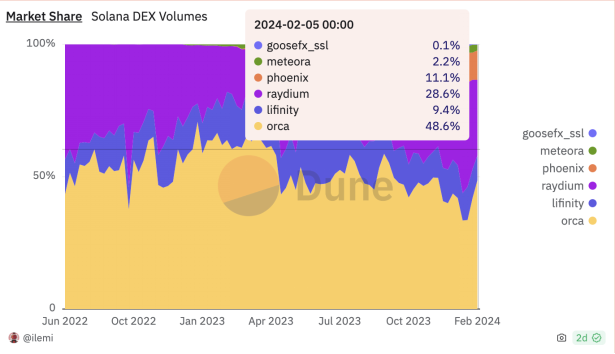
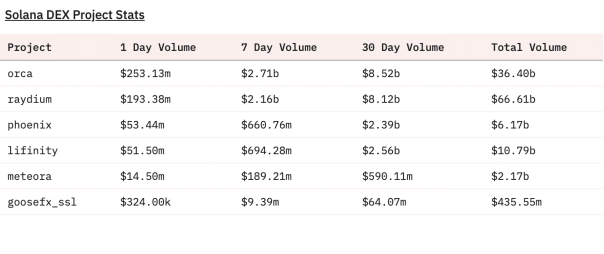
To date, Orca holds a larger market share in Solana DEX trading volume at 48.6%, compared to Raydium’s 28.6%. However, Raydium leads in total trading volume, reaching $66.6 billion, while Orca has generated $36.4 billion. Notably, Orca, as a relatively newer project, has shown impressive growth, generating $852 million in the past 30 days compared to Raydium’s $820 million.
Source: Dune Analytics
Source: Dune Analytics
Jupiter differentiates itself by aggregating liquidity from leading projects such as Orca, Raydium, and Drift. This strategy allows Jupiter to deliver optimized trading routes, ensuring users get the best possible exchange rates. Additionally, Jupiter offers a wide range of trading options and financial tools through a simple and intuitive platform, potentially making it more convenient and efficient than Orca or Raydium.
Beyond the Solana network, Uniswap stands as the largest DEX, known for its high trading volume and extensive user base. Recently, Jupiter drew attention by surpassing Uniswap v2 and v3 in daily trading volume by $10 million.
Despite Jupiter’s strong performance, Uniswap remains the leading DEX on Ethereum and in the broader DeFi space, renowned for its deep liquidity and vast user base. Uniswap’s founder, Hayden Adams, emphasized that the platform’s daily trading volume of $700 million demonstrates its significant influence.He argued that Jupiter’s recent volume surge reflects short-term trading trends rather than enduring value.
Currently, Jupiter and Uniswap have similar market valuations, with fully diluted valuations (FDV) ranging between $5 billion and $6 billion.
Bullish Fundamental Factors
- The DeFi market’s share increased from 4.1% to 4.5% in 2023, alongside a recovery in DeFi token prices, creating favorable conditions for Jupiter to further expand trading volume in 2024.
- Jupiter ranks second only to Uniswap in trading volume on CoinGecko, far exceeding PancakeSwap, cementing its status as thesecond-largest decentralized exchange (DEX).
- Solana, hailed as an “Ethereum killer” blockchain with a significant role in DeFi, strengthens Jupiter’s growth potential given its position as the primary DEX aggregator.
- The LFG Launchpad reflects Jupiter’s commitment to innovation by enhancing launchpad functionality and introducing new concepts, attracting diverse projects and community participation, thereby boosting trading volume and engagement.
- Jupiter’s founder Meow brings extensive experience in DeFi, having advised major projects such as Kyber and Blockfolio, and co-founded wBTC,demonstrating Jupiter’s team’s broad and diversified network of partnerships.
Bearish Fundamental Factors
- The functionality and reputation of the Solana blockchain, on which Jupiter relies, are critical. Frequent network outages—including today’smajor disruptionand a near 20-hour outage in February 2023—challenge claims of its robustness and affect Jupiter’s ability to succeed in the competitive DeFi market.
- Given the dynamic and highly competitive nature of the DeFi space, there is uncertainty regarding the long-term sustainability of Jupiter’s technology.
- Post-airdrop periods often see surges in speculative trading, amplifying market volatility. This situation is further complicated by skepticism from influential figures like Uniswap’s founder regarding the long-term viability of Jupiter’s trading volume, who argue that volumes are artificially inflated by airdrop-related speculation.
- The emergence of meme coins and speculative airdrops within the Solana ecosystem increases uncertainty around Jupiter’s short-term potential, signaling a risk-laden environment.
Conclusion
Greythorn remains committed to rigorous research, focusing on on-chain analysis, liquidity shifts, and exclusive proprietary data. We invite you to join our community if you find our insights valuable. You can connect with us viaLinkedIn, visit ourwebsite, or follow ourXprofile for deeper insights into the world of cryptocurrency.
We also encourage you to explore our latest research, including detailed analysis of AI agents powered byAutonolas, a comprehensive review of the Magpie ecosystem and its latest EigenPie sub-DAO integration,and our January market update.
Join TechFlow official community to stay tuned
Telegram:https://t.me/TechFlowDaily
X (Twitter):https://x.com/TechFlowPost
X (Twitter) EN:https://x.com/BlockFlow_News
 Greythorn







