








DeSci: Exploring Business Models and Feasible Paths for Biotech Projects Entering Web3
TechFlow Selected TechFlow Selected
DeSci: Exploring Business Models and Feasible Paths for Biotech Projects Entering Web3
DeSci is still in its early stages, with only a few research projects and scientific DAOs launched on the blockchain.
 Navigating Web3 tides with focused insights
Author: Will Wang
In January 2023, VitaDAO, a decentralized organization focused on longevity research and drug discovery, secured $4.1 million in funding led by Pfizer, a traditional pharmaceutical giant. This marked a milestone event for the DeSci biotech sector and brought DeSci into mainstream awareness for the first time.
Unlike DeFi, which can achieve a closed-loop business model solely through crypto-native assets, DeSci’s underlying assets originate off-chain and require close integration with the real world. This involves not only transforming traditional science using Web3 technologies and token economic models (such as scientific collaboration, funding acquisition, data sharing,成果转化, technology transfer, product commercialization), but also addressing numerous off-chain challenges including privacy protection, data security, IP rights, product commercialization, and compliance between the on-chain crypto world and regulatory frameworks.
Given the broad scope of the DeSci field, this article will explore feasible pathways for biotech projects entering Web3 through the lens of two landmark Biotech initiatives in the DeSci space—Molecule and VitaDAO—from both a biotech entrepreneur's perspective and a legal framework designer’s viewpoint on Web3 project structuring.
1. What is Decentralized Science (DeSci)
Decentralized Science (DeSci) is a movement aiming to build public infrastructure using the Web3 tech stack equitably and openly to fund, create, review, verify, store, and disseminate scientific knowledge and research. The goal is to create an ecosystem that incentivizes researchers to publicly share their findings, gain recognition for their work, while enabling anyone to easily access and contribute to scientific progress.
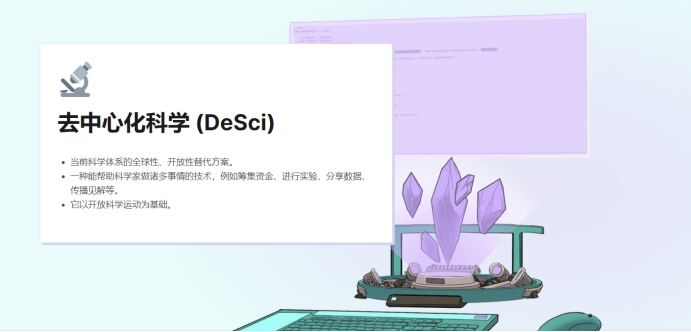
(ethereum.org/zh/desci)
DeSci is not intended to, nor can it solve all problems related to scientific R&D. Currently, DeSci leverages the Web3 tech stack to address early-stage research funding (on-chain DeFi liquidity), organizational governance structures (decentralized autonomy, open permissionless participation), and transparency in the scientific process (openness of research data and results).
DeSci is creating a more decentralized and distributed model for scientific research (e.g., autonomous execution via smart contracts and decentralized governance via DAOs), making it more resistant to central institutions’ control and censorship over funding and research outcomes. It enables diversified research funding through decentralization, breaks down silos in research data and communication channels, provides incentives for reproducibility, and fosters an environment where scientific discovery can thrive.
2. Biotech Practices in DeSci
In the biotech field, early-stage basic research is often the lifeline for subsequent clinical trials and drug development. However, such research is frequently constrained by limited funding sources, complex legal ownership issues, and pressure for rapid commercialization—leading promising projects to stall or fail at inception. Academia refers to this gap between basic research and clinical application as the "valley of death."
Additionally, intellectual property (IP) and data assets associated with research are highly illiquid, centralized, bureaucratic, and opaque categories of assets, which restrict the advancement of scientific inquiry.
Amid these systemic inefficiencies, Molecule has built a fundraising platform for early-stage life science projects using the Web3 tech stack, establishing a transparent marketplace for funding, collaborative R&D, and IP trading.
Molecule’s slogan: The future of medicine belongs to everyone.
(molecule.xyz/)
2.1 Molecule
Molecule AG is a European-based company that has developed the decentralized Molecule Protocol platform to provide funding, collaborative R&D, and IP transaction services for early-stage life science projects. To date, approximately 12 research projects have received funding through the platform.
The Molecule Protocol platform is built on Ethereum and consists of a two-layer system: Marketplace Discovery and Molecule Finance.
A. Marketplace Discovery
Within the Marketplace, researchers can publicly showcase their projects, find global funders, and collaborators to advance their work. Investors and funding organizations can also engage directly with early-stage life sciences projects to provide financial and technical support.
One notable example is the University of Copenhagen longevity research project, which was later transferred via IP-NFT to VitaDAO.
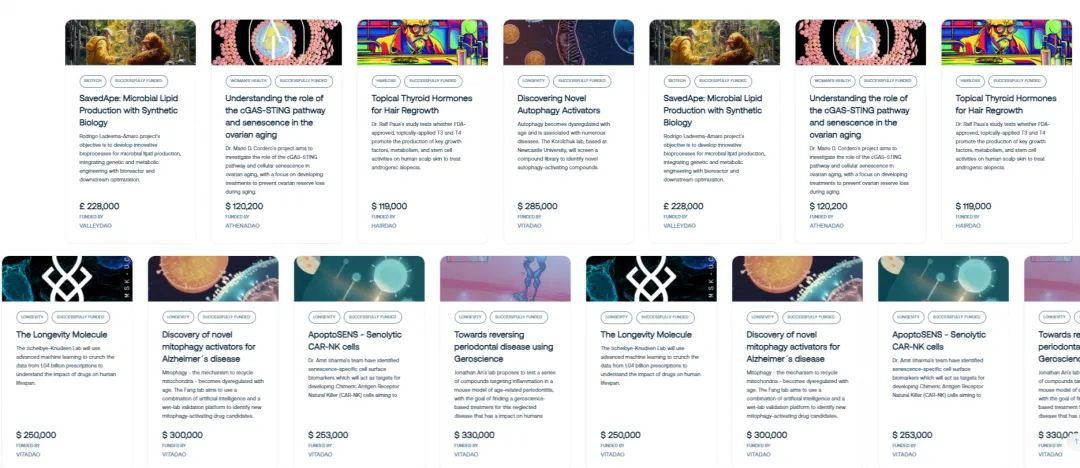
(molecule.xyz/)
B. Molecule Finance
The Molecule Protocol brings off-chain research agreements (Sponsored Research Agreements) onto the blockchain by converting them into IP-NFTs. Funders can then purchase these IP-NFTs to finance projects or integrate them into DAO-managed portfolios targeting specific therapeutic areas.
By purchasing and holding IP-NFTs, funders provide capital and liquidity to research projects. Holders of IP-NFTs gain rights to the research IP and future outputs (e.g., patents, royalties, data).
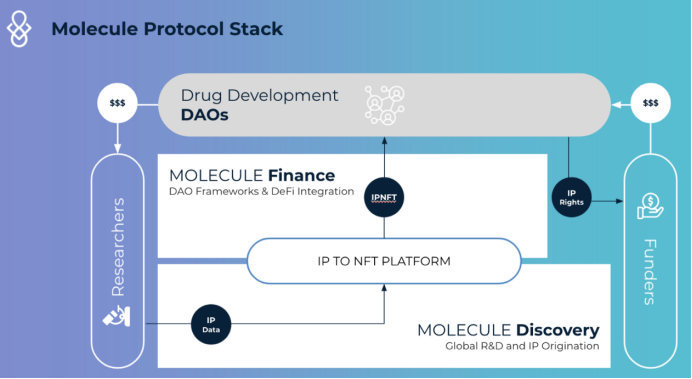
(An Open Bazaar for Drug Development: Molecule Protocol)
C. Molecule Ecosystem
To date, Molecule Protocol has established a relatively comprehensive on-chain/off-chain DeSci ecosystem using modular open-source stacks. It leverages various DeFi components (Balancer, Gnosis) to generate liquidity for project funding, governance tools (Moloch) to enable collective decision-making among patient communities, scientists, and investors, DAO launchpad infrastructure (Bio.xyz) to raise early community funds and establish community frameworks, open research lab tools (The LAO) to accelerate R&D, and legal frameworks (OpenLaw) to protect off-chain IP rights and safeguard the interests of on-chain investors and participants.
On June 13, 2022, Molecule completed a $13 million seed round led by Northpond Ventures, with participation from Backed VC, Shine Capital, Speedinvest, and former Coinbase CTO Balaji Srinivasan.
D. Summary
DeSci does not aim to—and cannot—solve all scientific R&D challenges. Building upon the Web3 tech stack, Molecule focuses on solving early-stage research funding (via on-chain DeFi liquidity), organizational governance (decentralized autonomy, permissionless participation), and scientific transparency (openness of research data and results).
Some view Molecule as the OpenSea of the DeSci space. However, unlike OpenSea—which trades purely on-chain native assets—the core value of DeSci lies in off-chain foundational research projects and their IP/data assets. These still require active incubation, governance, and development.
Thus, VitaDAO, a longevity-focused initiative incubated by Molecule, emerged naturally.
2.2 VitaDAO
Officially launched in June 2021 and initiated by Molecule, VitaDAO aims to build a decentralized, community-governed platform dedicated to anti-aging therapeutics and longevity research, accelerating innovation to extend human lifespan and healthspan.
Within the Molecule ecosystem, VitaDAO acts as a funder—raising capital through community contributions to finance longevity projects and acquire IP and data rights—while employing DAO governance, becoming the world’s first longevity-focused DAO.
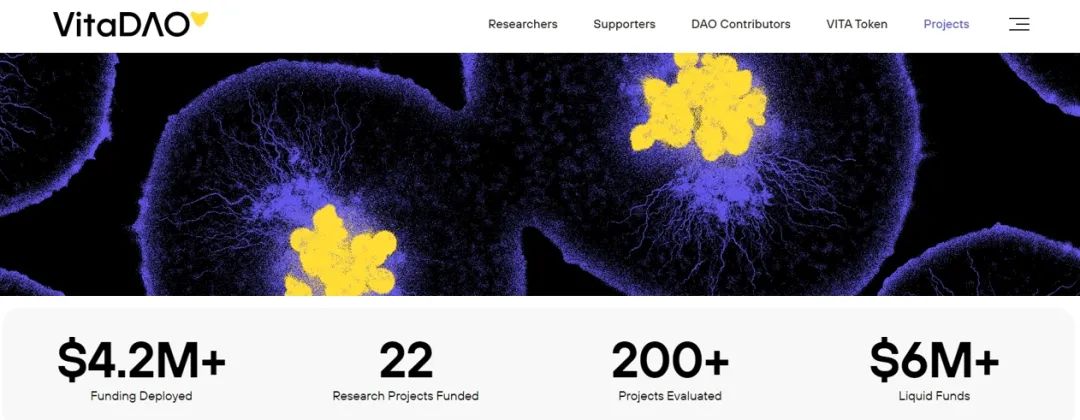
(VitaDAO.com)
A. Community Funding & Governance
On June 23, 2021, VitaDAO launched its community funding round, allowing anyone to obtain VITA tokens either by purchase or active contribution, and participate in governance through token holdings.
Currently, VitaDAO operates multiple working groups to support decentralized operations—including governance, tokenomics, communications, legal, aging science, and operations—with primary responsibilities including funding early research or investing in startups to acquire IP/data and equity.
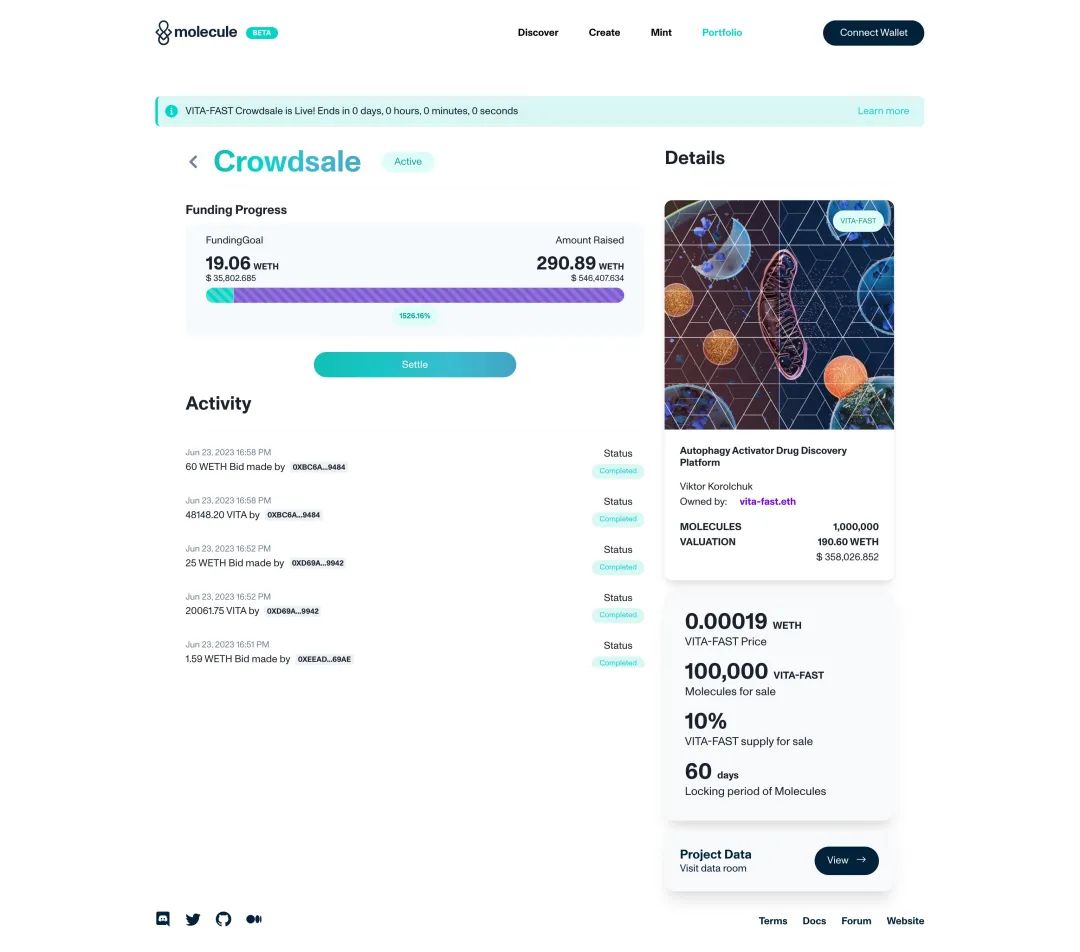
(VitaDAO.com)
B. Business Model
Although VitaDAO achieves on-chain fundraising and governance, its primary revenue model remains off-chain.
VitaDAO must commercialize acquired IP and data assets (e.g., licensing research data, transferring/licensing IP, co-developing with pharma entities) to generate returns, which are then reinvested into the DAO treasury to fund additional projects—creating a sustainable cycle.
In August 2021, VitaDAO acquired the first IP-NFT on the Molecule Protocol platform—the anti-aging longevity project from the University of Copenhagen.
To date, VitaDAO has successfully funded 22 projects, investing over $4.2 million.
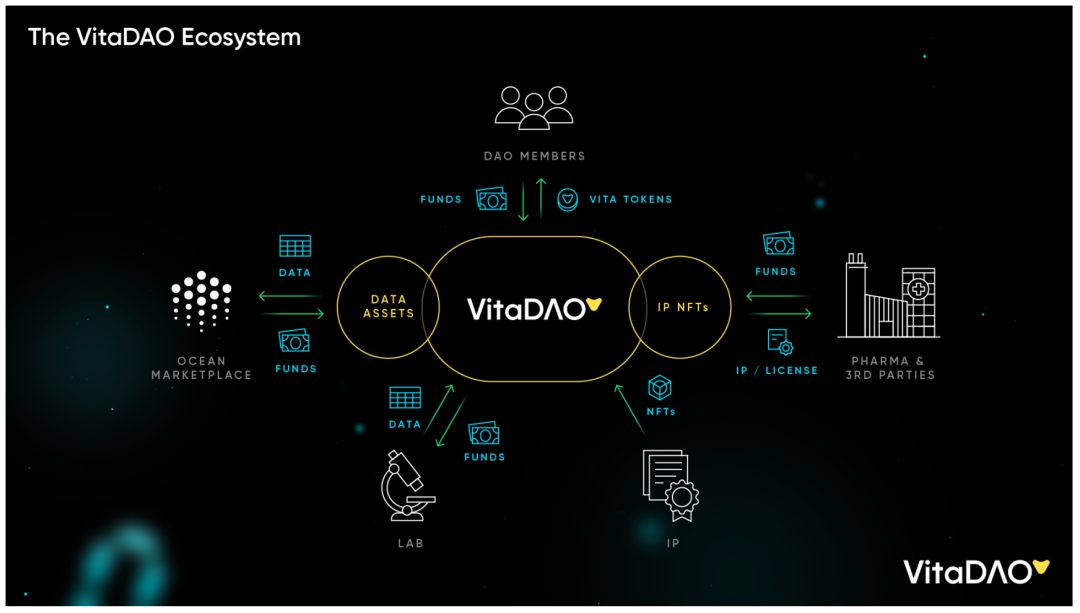
(VitaDAO Whitepaper)
C. Token Economics
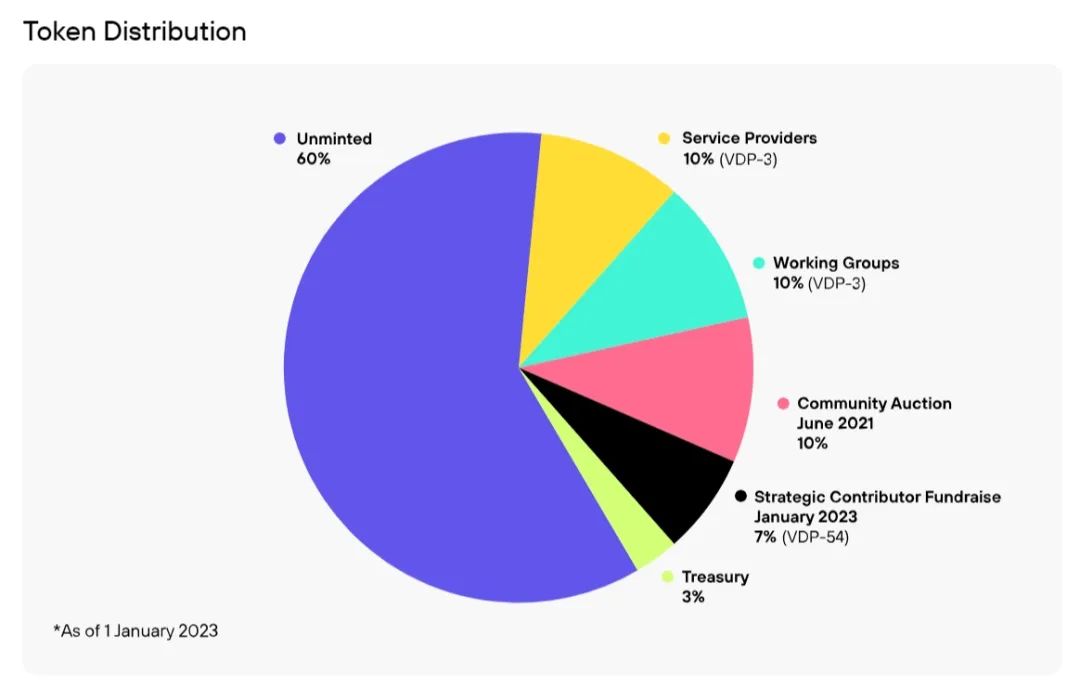
According to VitaDAO data, as of January 2023, 60% of its tokens had not yet been minted. At launch (June 2021), 10% of tokens were auctioned to the community. In the $4.1 million financing round led by Pfizer in January 2023, 7% of tokens were issued via token sale. Service providers, working groups, and the treasury received 10%, 10%, and 3% respectively. Unminted tokens are released quarterly at a rate of 0.4%.
VITA token holders have governance rights, not direct ownership of IP-NFTs. However, the value of VITA tokens reflects the growing worth of assets held in the VitaDAO treasury (IP-NFTs, biotech project equity, research data), increasing as more projects are funded—offering significant potential upside.
(VitaDAO.com)
D. Summary
VitaDAO represents the first successful biotech DAO incubated by Molecule after establishing its broader biotech ecosystem. Its validation by traditional pharmaceutical leader Pfizer marks a symbolic milestone worthy of emulation by other DeSci projects.
Compared to Molecule’s broad life sciences discovery marketplace, VitaDAO’s focused, niche approach makes it easier to attract targeted funding and consolidate domain-specific resources, thereby cultivating a dedicated community.
A specialized community like VitaDAO—dedicated to longevity research—can: (1) attract attention and support from both on-chain and off-chain funding sources; (2) encourage patients to voluntarily contribute data in exchange for hope of future cures; (3) foster open science that draws global talent and resources to help research projects navigate basic research, clinical trials, and commercialization stages.

(VitaDAO Longevity Biotech Conference at Zuzalu 2023)
3. Exploring Feasible Paths for Biotech Projects Entering Web3
Many real-world-integrated projects do not begin fully decentralized but instead follow a gradual path from centralized entity to protocol-based decentralization.
Especially for biotech projects in DeSci, IP and data assets still need to be held, operated, and patented by off-chain legal entities, complying with jurisdiction-specific regulations regarding IP and data governance.
The Web3 journeys of Molecule and VitaDAO offer valuable lessons.
3.1 Molecule—Gradual Decentralization Path from Platform to Protocol
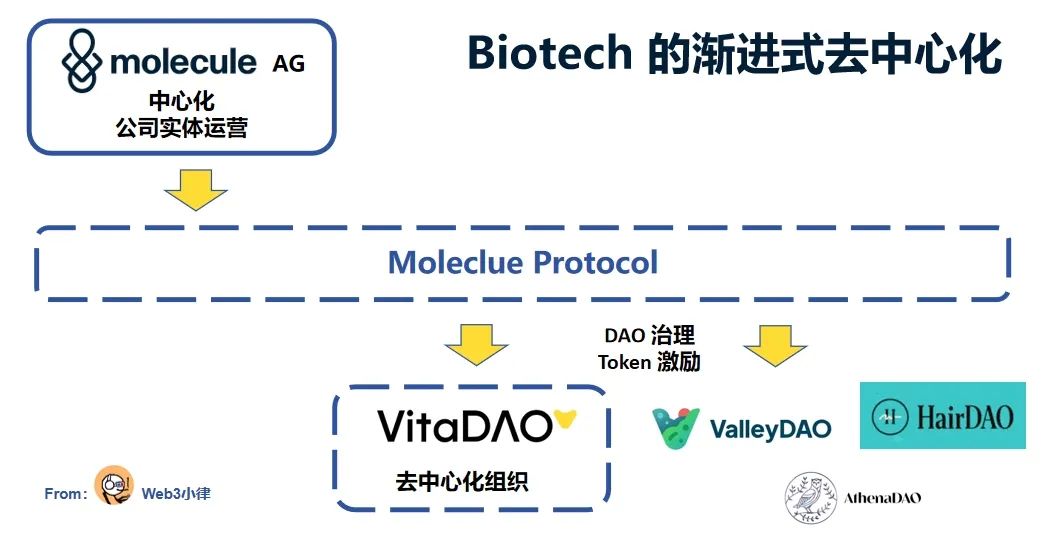
As illustrated above, Molecule AG is a European operating company that evolved from centralized management toward building the Molecule Protocol platform on Ethereum.
The centralized Molecule AG embedded various protocol components—such as Balancer, Gnosis, Moloch, The LAO, OpenLaw, Bio.xyz—into the Molecule Protocol platform, establishing its on-chain/off-chain biotech ecosystem before transitioning into the decentralized Molecule Protocol, eventually incubating VitaDAO and securing investment afterward.
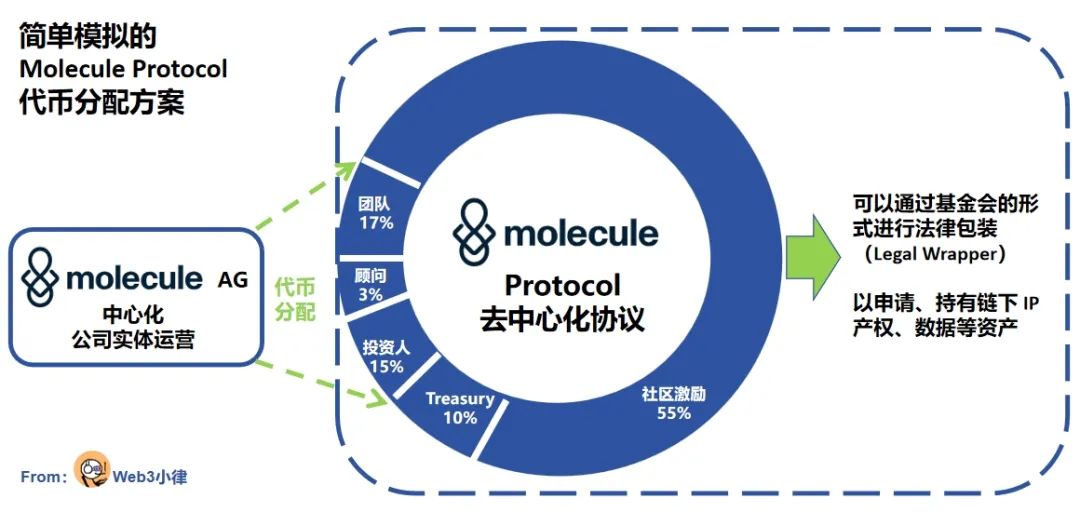
While there has been no official announcement about a Molecule Protocol token economy, it is foreseeable that after the gradual transition to full decentralization, the Molecule AG corporate entity will shift from operator to core contributor within the Molecule Protocol, potentially receiving 15%–20% of future token allocations as incentive.
3.2 VitaDAO—Community-Led Decentralized Organization Path
In contrast, VitaDAO was initiated and advocated by Molecule, though Molecule plays more of a founding role rather than ongoing operator. Actual operations are carried out by community-elected working groups, leveraging the existing architecture established by Molecule.
In essence, VitaDAO is a decentralized organization built atop the Molecule community foundation, initially funded by the community and subsequently self-governed.
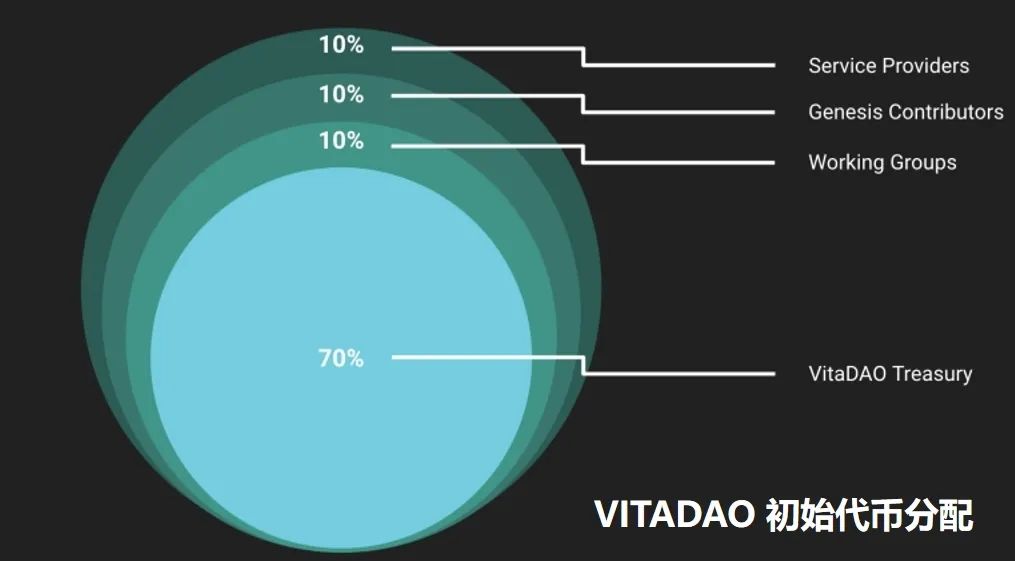
Due to VitaDAO’s community-originated decentralized nature, its token distribution excludes large allocations typically reserved for centralized founders or investors (compared to hypothetical Molecule token allocation), favoring broader community ownership.
(VitaDAO.com)
3.3 Feasible Paths for Biotech Projects to Enter Web3
Since biotech projects still require off-chain legal entities to hold and manage IP and data assets, and because token economies depend on participant ecosystems, immediate full decentralization upon entering Web3 is unrealistic—even for companies like Molecule.
Biotech projects should first operate centrally to build a participant ecosystem and design a token distribution plan to incentivize contributors.
The token design must clearly answer: What does Web3 bring to biotech projects?
In short, Web3 enables low-cost, token-based incentives for community contributors, rapidly generating network effects.
In Web2, such effects were only achievable after massive VC/PE funding allowed user subsidies. But this "To VC, not To User" operational model may no longer suit today’s market dynamics.
For a specialized community like VitaDAO focused on longevity research, well-designed token economics can quickly launch the project, incentivize all ecosystem participants, and rapidly scale network effects: (1) rewarding research investors and liquidity providers; (2) incentivizing patients who contribute personal data; (3) motivating individuals supporting projects across basic research, clinical trials, and commercialization phases.
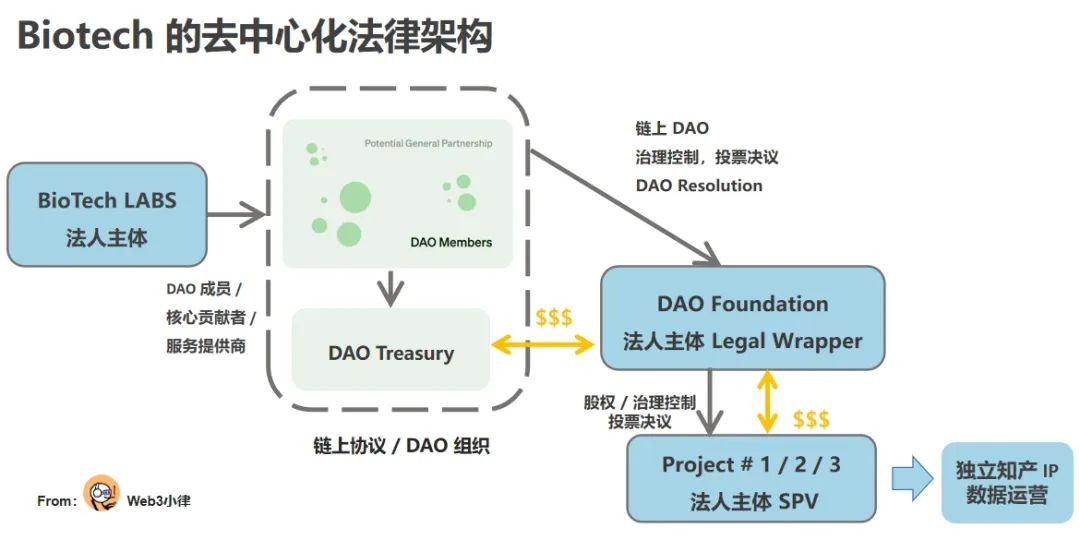
Once the ecosystem is established and a clear token economy is designed, the project can gradually transition to a DAO-governed operational model. Thus, we see that after Molecule AG—a centralized entity—built its participant ecosystem, it progressively evolved into the decentralized Molecule Protocol or spun off VitaDAO, demonstrating viable paths for biotech projects entering Web3.
Thereafter, following RWA models, the DAO could establish dedicated foundations or SPVs to independently manage IP and data, ensuring compliance with off-chain regulatory requirements.
4. Final Thoughts
DeSci may not be the sole solution to current challenges in scientific research, but it offers a potentially viable alternative.
Like any technological innovation, DeSci carries risks—such as legal uncertainties around DAO status, ownership of IP and data rights, and protections for on-chain investors and off-chain researchers. Yet we must remember:
DeSci is still in its infancy, with only a few research projects and scientific DAOs launched on blockchains. However, with growing attention from crypto leaders like Vitalik Buterin, Coinbase Brain, Balaji, and recognition from traditional pharmaceutical giants like Pfizer, the vast potential of this field is beginning to unfold.
Join TechFlow official community to stay tuned
Telegram:https://t.me/TechFlowDaily
X (Twitter):https://x.com/TechFlowPost
X (Twitter) EN:https://x.com/BlockFlow_News
 0xWillmfer







