DePIN and AI in Web3: Emerging Trends from Rising Star Meson
TechFlow Selected TechFlow Selected
DePIN and AI in Web3: Emerging Trends from Rising Star Meson
Meson does not require users to purchase mining machines like other DePIN projects, significantly reducing user investment costs.
 Navigating Web3 tides with focused insights
Author: Riyue Xiaochu
1 Bandwidth is the Foundation of Everything, Including DePIN and AI
Bandwidth represents data transmission capacity—it is the connectivity power of networks. Practically speaking, bandwidth can be thought of as a highway connecting two cities. When the highway flows smoothly, everything runs efficiently; but when it becomes congested, transportation between the two cities faces delays, response times increase, efficiency drops, and perishable goods like fruits and vegetables may spoil before reaching their destination.
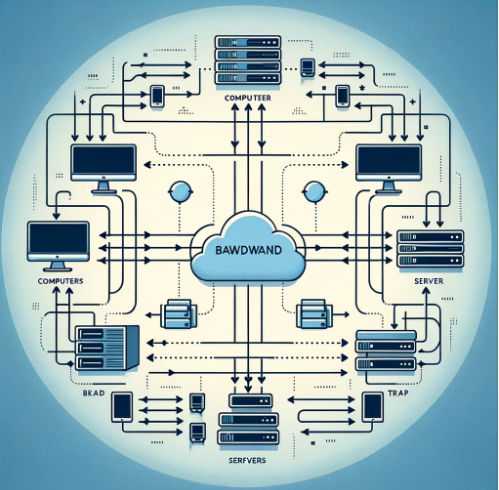
In the digital world, bandwidth serves as the highway linking computers, computing power, data centers, and personal devices. Whether for today’s internet or the Internet of Things (IoT), bandwidth is fundamental. Many people mistakenly assume that bandwidth belongs solely to traditional internet infrastructure and has little relevance to current trends. This view is incorrect. Even in our blockchain ecosystem, bandwidth is critically important. Consider several use cases from Meson:
-
Over 100,000 decentralized nodes on the Meson Network collectively provide highly available, decentralized RPC services for Arbitrum, helping make Arbitrum more decentralized while improving speed and data privacy.
-
Meson dCDN supports Arweave by reducing gateway load demands. The decentralized network enables caching closer to end users, shortening request times from original sources and solving issues such as slow loading of small images.
-
BNB Chain handles massive transaction data, with full network synchronization snapshots previously taking about 20 hours. By leveraging Meson Network's globally distributed nodes, this time has been significantly reduced to just one hour.
2 The Foundation of AI Development
With OpenAI's GPT making a stunning debut, AI has become a central focus of human technological advancement. We know that AI relies on massive datasets combined with advanced algorithms. Companies like OpenAI and Google have already captured most of the dominant data from the existing internet. To achieve another leap in data volume, AI must access physical-world data. DePIN can supply AI with real-world data, and DePIN powered by blockchain technology overlaps significantly with IoT. Regardless of whether projects collecting physical-world data adopt blockchain, they all require decentralized bandwidth services—because the physical world is geographically dispersed, unlike internet data concentrated in data centers. Only widely distributed bandwidth infrastructure can meet the demand for continuous data transmission.
3 Introduction to Meson
Meson is an emerging force in the DePIN space, aiming to build a decentralized bandwidth network. It operates over 350,000 nodes across 150 countries and regions, achieving a total bandwidth capacity exceeding 20 Tb/s. Its user base includes prominent projects such as Filecoin, Arweave, Arbitrum, Greenfield, OKX Chain, and BNB Chain.
Meson is highly accessible to ordinary users, supporting a wide range of existing hardware including personal computers, servers, and IoT devices. Crucially, unlike other DePIN projects, there is no need to purchase specialized mining equipment upfront—greatly lowering the barrier to entry. This design allows Meson to rapidly scale and aggregate long-tail bandwidth resources, empowering fields such as AI, big data, and DePIN.
Meson Product Line Breakdown
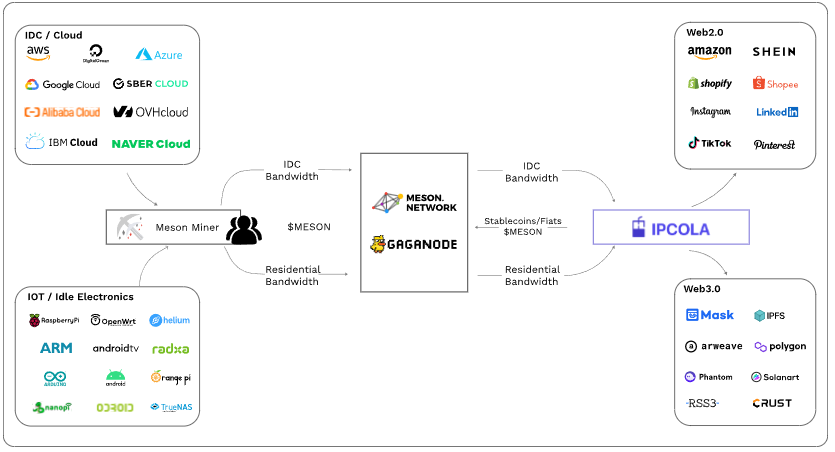
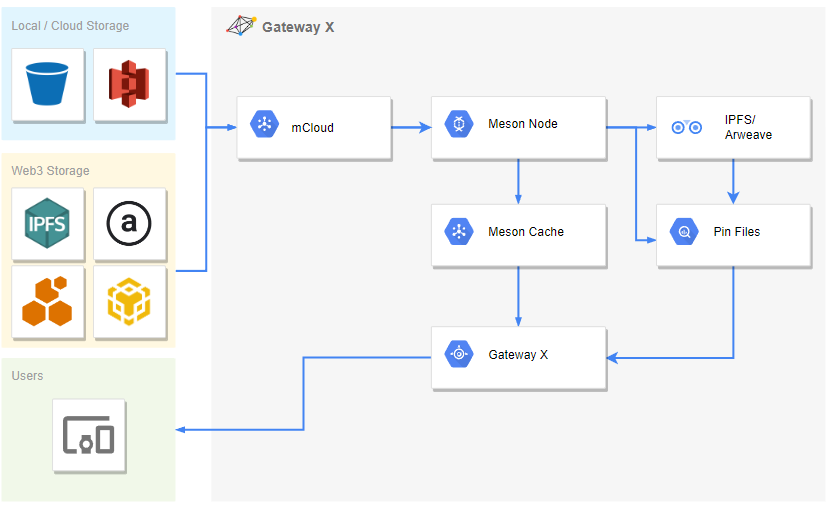
Gateway X, provided by Meson Cloud Services, acts as a bridge between Web3 and traditional Web2 systems. Gateway X primarily aggregates bandwidth suppliers with substantial capabilities, including:
-
Stable bandwidth providers
-
Home users with static IPs
-
Owners of IoT devices
-
Dedicated server owners
-
IDC server owners (companies / organizations / schools)
Compared to GaGaNode, Gateway X focuses more on aggregating stable, professional, and high-capacity bandwidth suppliers—effectively utilizing their idle or underused resources during specific periods.
GaGaNode is designed to help individuals leverage their unused home bandwidth. Users do not need a public IP address and can participate in the Web3 network from home using idle electronic devices. GaGaNode software runs on Mac, Linux, Windows, Android, TV boxes, and Raspberry Pi. Unlike other DePIN networks such as Helium, users are not required to buy mining hardware or make upfront investments—significantly reducing participation costs. Clearly, Meson has invested heavily in enabling widespread inclusion of long-tail idle bandwidth resources.
IPCOLA If Gateway X and GaGaNode focus on gathering IP addresses and bandwidth, IPCOLA carries the key revenue-generating role. IPCola is a customizable big data solution offering support for both static and dynamic IP data products. According to information disclosed by the Meson Network team, although IPCola has not yet reached the annual revenue of over $100 million achieved by established players like Brightdata, its growth is rapid—generating over $1 million in total revenue within six months of launch.
4 Current Status of Meson
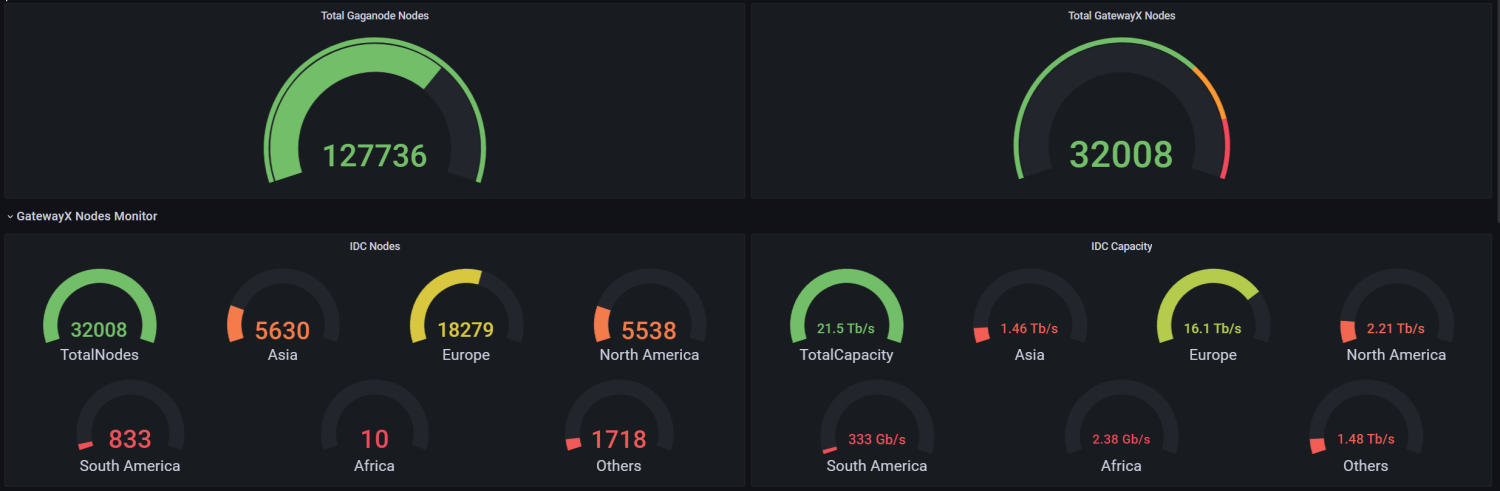
According to official dashboard data, Gateway X currently has 32,000 nodes representing professional bandwidth providers, while GaGaNode has 127,000 nodes. Over 100,000 nodes from 150 countries are active daily. The bandwidth capacity of Gateway X reaches 21.5 Tbps. For context, typical household internet speeds range from tens of Mbps to a few hundred Mbps. At 21.5 Tbps, Meson's bandwidth is tens of thousands of times faster—capable of simultaneously supporting thousands of high-demand applications such as large-scale cloud computing, high-performance computing, and big data analytics. Meson’s current bandwidth now amounts to one-tenth of Akamai Technologies, the world’s largest distributed computing company.
From a geographical perspective, Europe is the largest supplier of Gateway X bandwidth, contributing 18,000 nodes (56%) and 16.1 Tbps of capacity (75%). North America and Asia follow, while Africa contributes the least.
5 Market Positioning and Outlook for Meson
The bandwidth market that Meson operates in is vast, valued at billions annually, with a strong growth rate of approximately 12% per year. The explosive rise of AI is driving surging demand for bandwidth, especially among developers needing enhanced data retrieval and web scraping capabilities.
In the traditional centralized bandwidth market, mature and large-scale companies dominate, divided into:
-
Enterprise-grade bandwidth providers such as Cisco and Akamai Technologies
-
Consumer-focused bandwidth providers such as Brightdata (reportedly generating over $100 million in annual revenue in 2023)
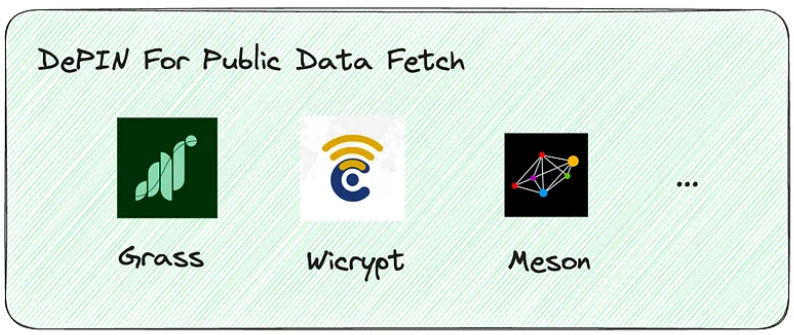
In the decentralized bandwidth market, Meson’s closest competitor is Grass, backed by Polychain:
-
Includes enterprise nodes (32,000) and personal nodes (127,000)
-
Testnet has run stably for over two years; mainnet launch is imminent
-
Already generating revenue (over $1 million in first six months)
-
Established partnerships in both Web2 and Web3 (as mentioned above)
-
Over 80,000 personal nodes (based on desktop browser downloads)
-
Testnet launched in June (though community feedback indicates instability)
-
No revenue generated yet
-
Limited Web3 integrations, e.g., Solana’s Saga phone
Meson holds a first-mover advantage in the decentralized market and has successfully aggregated vast bandwidth resources through its token economics—achieving greater efficiency than centralized firms requiring cold-start resource acquisition. Meson is already profitable, demonstrating the viability of its business model. In the coming months, competition between Meson and Grass, along with Meson’s revenue trajectory, will be worth watching closely.
6 Token Economics
Total MSN supply: 100 million tokens, allocated as follows:
Private Sale: 26,000,000 MSN (26%)
-
Linear unlocking monthly after TGE, over 12–36 months.
Public Community Sale: 5,000,000 MSN (5%)
-
Linear unlocking monthly after TGE, over 6 months.
Ecosystem: 27,000,000 MSN (27%)
-
Fully locked at TGE, linear unlocking monthly over 8 years.
Foundation Reserve: 20,000,000 MSN (20%)
-
Fully locked at TGE, linear unlocking monthly over 8 years.
Core Team: 15,000,000 MSN (15%)
-
Fully locked at TGE, linear unlocking monthly starting from the 6th month after TGE, over 8 years.
Partnerships: 6,000,000 MSN (6%)
-
Fully locked at TGE, linear unlocking monthly over 6 years.
-
Testnet Mapping: 1,000,000 MSN (1%)
-
Immediately circulating after TGE.
Since the private sale unlock schedule lacks detailed specifics, initial circulation is estimated at around 5%.
MSN undergoes annual inflation to reward miners: 5% in Year 1, 4.5% in Year 2, 4% in Year 3, decreasing gradually until ending in Year 10.
Functions of the MSN token include:
-
Enables access to bandwidth and big data services previously available only to large corporations like Google and Akamai.
-
Rewards for Meson network miners.
-
Miners can stake MSN to increase rewards.
-
Governance participation in Meson’s decision-making processes.
Join TechFlow official community to stay tuned
Telegram:https://t.me/TechFlowDaily
X (Twitter):https://x.com/TechFlowPost
X (Twitter) EN:https://x.com/BlockFlow_News
 @riyuexiaochu