








Two months after the "reconciliation," Binance finally "recovers"
TechFlow Selected TechFlow Selected
Two months after the "reconciliation," Binance finally "recovers"
Although Binance's outflow in November created an opportunity for competitors to capture market share, market conditions have since provided Binance with support to maintain its core position. Meanwhile, the platform has been actively fighting to defend its territory.
 Navigating Web3 tides with focused insights
The first month of 2024 has passed, and centralized exchanges (CEX), the most profitable segment in the crypto asset market, have released their most comprehensive annual data report.
According to aggregated data from TokenInsight’s "Crypto Exchange 2023 Annual Report," DeFiLlama, and CoinGecko, the global Top 10 cryptocurrency exchanges generated a total trading volume of $34.26 trillion in 2023, down approximately 16% compared to 2022. In both spot and derivatives markets, Binance ranked first in annual trading volume, followed by OKX and Bybit in second and third place respectively.
In terms of market share, Binance decreased from 54.2% at the beginning of the year to 48.7%. Despite this drop of over 5 percentage points, it still maintained its dominant position. OKX captured 16.1%, while Bybit held 12.3%; both increased from年初 levels, but combined they still fall short of Binance's share. Data from Kaiko shows that in the past two months, Binance’s market share has recovered to 49%.
Looking at shifts in trading volume and net fund inflows, Binance's declining market share correlates with enforcement actions taken by U.S. regulators such as the SEC and Department of Justice. Particularly after November 21 last year, when Binance reached a settlement with the U.S. DOJ and was fined $4.3 billion, the exchange experienced 13 consecutive days of net outflows, totaling $2.865 billion leaving Binance.
There has also been ongoing speculation about whether Binance still possesses strong financial foundations.
On December 4, capital began flowing back into Binance. During December last year and January this year—coinciding with rising expectations around Bitcoin ETF approvals—Binance recorded a net inflow of $5.4 billion. The lost ground was regained, and the total value of assets across Binance addresses on various blockchains reached $80.9 billion by the end of January, an increase of 28.25% compared to the same period last year—surpassing all other platforms in both scale and growth rate.
These figures have helped stabilize confidence internally and externally at Binance. Its market foundation built over the past six years hasn’t been easily shaken, aligning well with the overall upward trend in the crypto market over the past two months. And this “global leader” isn’t resting on its laurels—it’s maximizing its "will to win" in user acquisition and retention.
Among CEXs, Binance Still Leads Across Multiple Metrics
It’s been two months since Binance settled with the U.S. Department of Justice. Beyond the memorable $4.3 billion fine, another striking aspect was the DOJ’s description of the platform as the “world’s largest,” without even adding “one of.” While this may reflect regulatory strategy—placing higher scrutiny on entities deemed more significant—the label “world’s largest” is not exaggerated.
In 2023, Binance remained the leading crypto trading platform by market share. Although this figure dropped from 54.2% at the start of the year to 48.7%, according to TokenInsight’s "Crypto Exchange 2023 Annual Report," it still accounted for nearly half of the total market. The remaining 51.2% was shared among nine major crypto exchanges, with only three surpassing a 10% market share.
Analysis of Crypto CEX Market Share (Source: TokenInsight)
Since Mt. Gox launched the crypto exchange business in 2010, rise and fall have become constant themes—change is always central. For Chinese-speaking users, one noticeable shift has been the evolving definition of the so-called “Big Three.” Today, while “B” and “O” remain active, “H” is being replaced by a new “B.”
While TOP 3 refers to ranking order, there remains a substantial gap between the leader and those following.
Using trading volume as a metric and referencing data compiled by CoinGecko (for the first 11 months of 2023 and January 2024), in the spot market, Binance recorded $3.77 trillion in trading volume, compared to OKX’s $0.54 trillion and Bybit’s $0.43 trillion—combined less than one-third of Binance’s volume. Derivatives trading on CEXs contributed even larger volumes: Binance achieved $14.32 trillion, followed by OKX at $4.96 trillion and Bybit at $3.69 trillion.
Top 3 Cryptocurrency Exchanges’ Trading Volumes Over 12 Months
Measuring the total value locked (TVL) within exchange addresses across chains, DeFiLlama data shows that as of January 31, Binance’s total asset value stood at $80.9 billion. Second-placed OKX had $15.5 billion, while Bitfinex ranked third with $13.7 billion—still several times smaller than Binance.
Both Binance and OKX saw monthly inflows exceeding $1 billion. Among other exchanges, only five—including Robinhood and Bybit—recorded monthly inflows above $100 million.
Turning Negative to Positive: Binance Sees Over $5 Billion in Inflows Over Two Months
From a data perspective, Binance’s TVL remained relatively stable throughout 2023, hovering around $60 billion, with high liquidity reflected in frequent inflows and outflows.
Last June and September saw two notable declines in Binance’s TVL, dropping to $58.8 billion and $58.1 billion respectively, with outflows of $3.8 billion and $1 billion during those months.
These dips were somewhat linked to regulatory or partner-related developments. June coincided with the SEC suing Binance entities for offering unregistered securities; in September, Binance’s euro banking partner Paysafe terminated their cooperation.
Binance TVL and USD Value Inflow Data Over the Past 12 Months (Source: DeFiLlama)
Clearly, external factors significantly influence users’ decisions regarding fund movements on Binance, though funds often return the following month. The event that widely put Binance in headlines was its settlement with the U.S. Department of Justice on November 21, after which capital flowed out continuously for 13 days. In November alone, blockchain data confirmed a total outflow of $1.635 billion.
Interestingly, Binance’s TVL did not decline during this time—it actually rose from $64.6 billion in October to $67 billion in November—a testament to Binance’s resilience that many can only envy.
Then, in December and January, Binance’s TVL broke previous highs, reaching $79.6 billion and $80.9 billion respectively—an increase of 18.80% and 20.74% compared to November. January’s TVL was up 28.25% year-on-year. These two months continued the pattern of “outflow followed by inflow,” with net inflows turning positive again—$3.113 billion in December and $2.359 billion in January. During these two months, Binance’s market share also climbed back to 49%.
Binance’s Market Share Recovered to 49.44% in the Last Two Months (Source: KaikoData)
Entering 2024, the impact of the U.S. Department of Justice penalty on Binance continues to diminish—not only evident in improved fund retention but also in trading volume.
Over the past two months, Binance has maintained its lead in both spot and derivatives markets. According to CoinGecko data on February 1, Binance’s 24-hour spot trading volume reached $14.872 billion, exceeding its 12-month daily average of $10.332 billion; its 24-hour derivatives trading volume hit $39.719 billion, slightly above its 12-month average of $39.246 billion.
External Tailwinds and Internal Drive at Full Throttle
Faced with what some call the “largest fine in U.S. financial regulatory history,” Binance has indeed demonstrated the solid foundation it has built over six years in the crypto trading space. This hurdle, while seemingly unlucky, turned out to be fortunate.
The two months following the DOJ settlement coincided with growing anticipation for Bitcoin ETF approval—also the period when Binance’s total trading volume kept breaking upward, reaching $1.95 trillion and $1.93 trillion respectively.
Some analysts even argue that resolving legal entanglements between the world’s largest crypto exchange and a regulator with criminal authority may have accelerated the approval of Bitcoin ETFs. While causality remains debatable, chronologically, events unfolded exactly this way.
The DOJ-Binance settlement was reached on November 21 last year; the Bitcoin ETF was approved on January 10 this year. In December and January, Bitcoin climbed to recent highs of $44,000 and $48,000 respectively, while fund retention and trading volume on Binance rebounded sharply during these months.
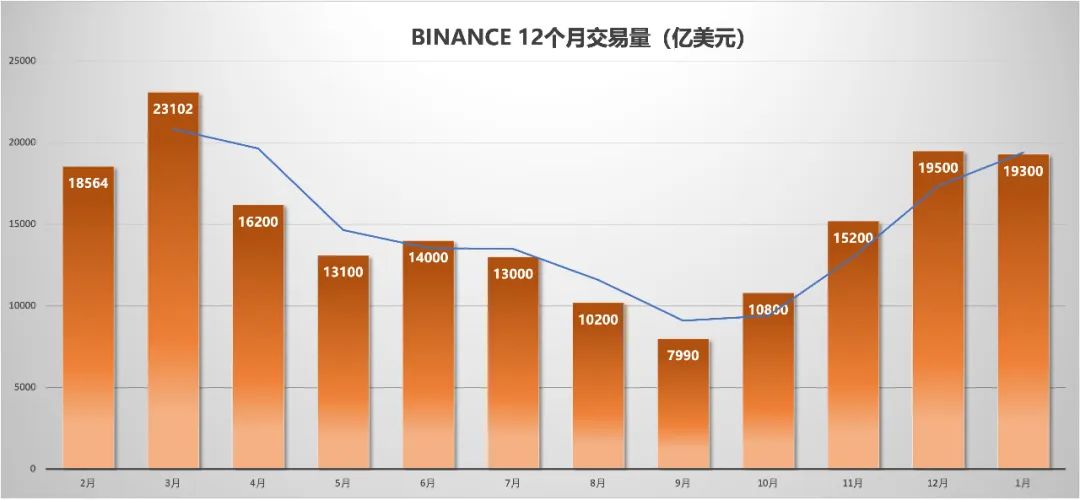
Binance’s Total Spot + Derivatives Trading Volume Over the Past 12 Months
Within the past 12 months, Binance’s highest monthly trading volume occurred in March last year, with spot volume at $559.47 billion and derivatives at $1.75073 trillion, totaling $2.3102 trillion for the month. Both last February and this January rank as the second-highest months in the past year.
Although Binance’s outflows in November gave competitors opportunities to capture market share, broader market dynamics helped Binance defend its core user base. Meanwhile, the platform actively fought to retain users.
Even as the undisputed “global number one,” Binance maintains an intense “survival instinct”—or rather, a high sensitivity toward acquiring and retaining users. The most visible manifestation of this is activity in Binance Launchpool’s new token mining section.
Binance Launchpool Launched 4 Projects in January
This product has long been seen as having the strongest wealth and traffic effects. In just January 2024, Binance Launchpool launched four new projects—compared to ten for the entire year of 2023 and five in 2022. Through this rapid, frequent rollout, Binance keeps $5–6 billion in capital circulating within its platform, with each event attracting around 200,000 participants.
Following Binance’s lead, similar sections on other platforms have also accelerated their launch schedules. For crypto holders, competition among exchanges is always welcome. That Binance remains ahead despite adversity raises curiosity about what new “big moves” it might unveil next to attract users and capital.
In 2024, regulatory pressure on crypto exchanges won’t cease, and competition in the CEX space will continue. Year after year, the landscape evolves—rise, decline, disappearance—all recurring themes. One thing becomes clear: only platforms that maintain relentless drive and deep respect for users and the market can endure as long-term players. As long as the crypto market keeps expanding, the finish line remains endless.
Join TechFlow official community to stay tuned
Telegram:https://t.me/TechFlowDaily
X (Twitter):https://x.com/TechFlowPost
X (Twitter) EN:https://x.com/BlockFlow_News








