









Fed Chair Cools Hopes for March Rate Cut, Bitcoin Falls Below $42,500
TechFlow Selected TechFlow Selected
Fed Chair Cools Hopes for March Rate Cut, Bitcoin Falls Below $42,500
Bitcoin will become more sensitive to interest rate decisions.
 Navigating Web3 tides with focused insights
By Mary Liu, TechFlow
Crypto markets plunged on Wednesday as hawkish remarks from Federal Reserve Chair Jerome Powell dashed investor hopes for a March rate cut, sending Bitcoin (BTC) below $42,500.

Fed: Rate cuts inappropriate until more confident inflation is near 2% target
Following its first Federal Open Market Committee (FOMC) meeting of 2024, the Federal Reserve kept the benchmark federal funds rate unchanged in the range of 5.25%-5.5%, in line with market expectations.
Market participants were more focused on clues regarding when the Fed might begin cutting rates. Prior to this meeting, many observers expected a potential cut as early as the next meeting in March.
However, the Fed stated in its policy statement today that rate cuts would be inappropriate until it gains "greater confidence" that inflation is moving sustainably toward its 2% target.
Powell poured cold water on March rate cut speculation during his press conference: "Based on this meeting, I want to tell you that I don't think it's likely that the committee will reach that level of confidence by the time of the March meeting. That remains to be seen. March is not the most likely scenario [for a cut]."
Timing rate cuts involves a delicate balance. Several FOMC members have warned about the risks of waiting too long to cut, which could harm the strong labor market. On the other hand, acting too hastily also carries risks, potentially reigniting inflation.
When asked about the timing of rate cuts during the press conference, Powell emphasized that labor market and inflation data would remain key indicators to watch.
"If we see... particularly unexpected weakness in the labor market, that would certainly influence faster rate cuts," Powell said. "And of course, if we see inflation being stickier or higher, then those kinds of things would support taking action later."
Following these comments, risk assets including cryptocurrencies dropped sharply. BTC fell from a daily high of $43,700 to $42,300, down 2.3% over the past 24 hours.
Other major cryptocurrencies such as ETH, Cardano’s ADA, Avalanche’s AVAX, and Polkadot’s DOT declined 3%-4%, while Solana’s SOL dropped over 6% on the day, falling below $100.
In traditional financial markets, the S&P 500 posted its largest single-day drop since September 21 last year, the Nasdaq recorded its biggest one-day fall since October 25, and the Dow Jones saw its worst single-day performance since December 20.
Will rate cuts be delayed until after May?
Alex Krüger, macro analyst and co-founder at Asgard Markets, said in an X post: "Markets were ahead of themselves on rates. Cuts starting in May or June, not March."
David Kelly, chief global strategist at JPMorgan Asset Management, indicated the Fed has laid out a rate cut schedule beginning in June.
Speaking to CNBC after the Fed's statement was released, he said: "It seems to me they're thinking about June, September, December—three cuts this year—provided the economy continues to grow, which it currently appears poised to do. There are no signs right now that the U.S. economy is about to collapse into recession. They will only shift their risk balance more toward sticky inflation rather than recession if they believe that strong market gains pose greater (or potential) harm to the economy."
Oliver Rust, head of product at economic data aggregator Truflation, said: "The decision on when to start cutting rates is arguably more important and more nuanced than the decision to hike, so economic data over the next two months will be critical."
Ruslan Lienkha, market lead at Web3 fintech platform YouHodler, said, 'Any hawkish commentary suggesting higher rates will last longer than expected could trigger stock market corrections, leading capital to flow out of risk assets such as Bitcoin.'
Bitcoin to become more sensitive to interest rate decisions
However, Swissblock analysts noted in a market report on Wednesday that Bitcoin's downside may be limited, as it appears to be consolidating between $44,000 and $42,000 without a clear direction. The report added that the $42,000 zone and levels below $40,000 could serve as key support areas where buyers might step in.
James Butterfill, research director at CoinShares, said that as financial institutions increasingly participate in the market through multiple spot Bitcoin ETFs, Bitcoin will become more sensitive to interest rate decisions.
"Bitcoin prices have re-priced in line with futures market rate expectations, indicating that Bitcoin will become more responsive to rate-sensitive macro data such as employment and consumer price index figures, especially as the excitement around ETFs begins to fade," Butterfill said.
Indeed, according to data from CME's FedWatch tool, market odds for a March rate cut have dropped from around 65% before the Fed's decision to 34.5% currently.
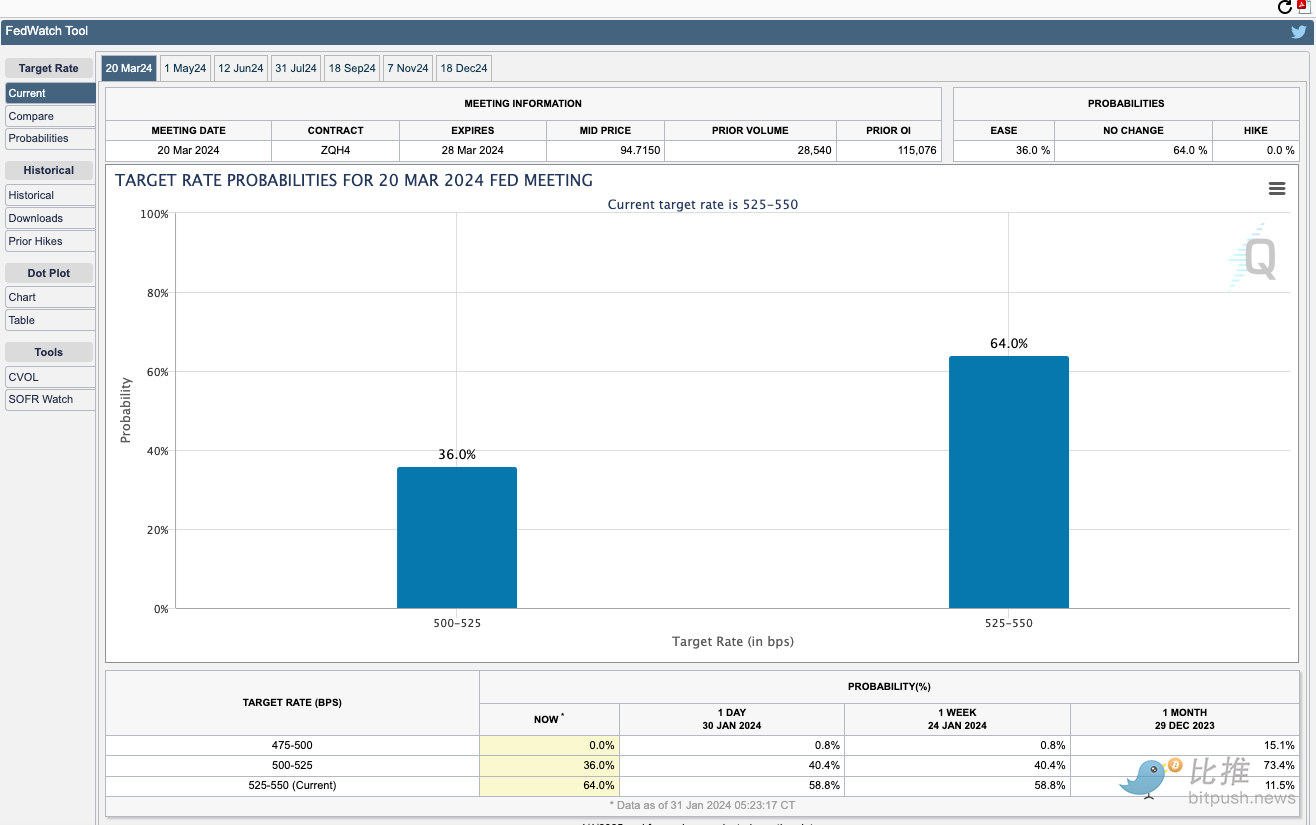
Upcoming data releases will provide policymakers with clearer guidance. The key U.S. manufacturing index will be updated on Thursday, followed by the January jobs report on Friday. Additionally, there will be two inflation reports before the Fed's March meeting.
Join TechFlow official community to stay tuned
Telegram:https://t.me/TechFlowDaily
X (Twitter):https://x.com/TechFlowPost
X (Twitter) EN:https://x.com/BlockFlow_News
 比推 BitpushNews










