








Understanding Monad: A Potential Disruptor in the Layer1 Arena
TechFlow Selected TechFlow Selected
Understanding Monad: A Potential Disruptor in the Layer1 Arena
The "Top Player of 2024" in the Eyes of Paradigm's CTO
 Navigating Web3 tides with focused insights
Author: Azuma, Odaily Planet Daily
The highly anticipated new contender in the Layer 1 space, Monad, is finally on its way.
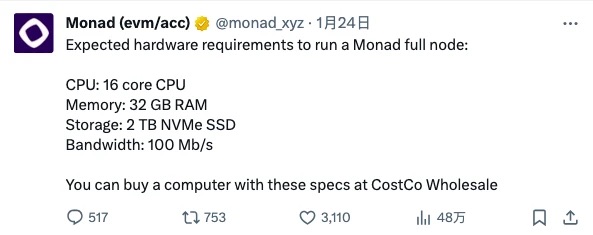
Earlier this month, Monad—known for its "Parallel EVM" technology—announced it will soon launch its internal testnet. Shortly after, the official Monad team disclosed the full node hardware requirements for the network on X (formerly Twitter).
The Scaling Vision of Jump's Former "Brain"
In April 2022, Keone Hon, former research lead at market-making giant Jump Trading, announced his departure to found Monad. Unlike mainstream Layer 2 scaling approaches, Monad aims to dramatically improve EVM execution efficiency at the Layer 1 level through "parallel processing," unlocking the full potential of the EVM ecosystem.
According to Keone, thanks to extensive user education around Ethereum, the EVM has become the de facto standard in Web2, much like JavaScript. However, he believes Ethereum’s current scaling path has flaws. The Layer 1 + Layer 2 layered approach fragments blockchains into isolated execution environments, undermining composability across chains. A higher-performance base layer is therefore needed.
Keone initially estimated that Monad could achieve over 1,000 times the performance of Ethereum and support more complex applications, enabling broader adoption.
In February 2023, Monad raised $19 million in a funding round led by Dragonfly Capital, with participation from Placeholder Capital, Lemniscap, Shima Capital, Finality Capital, Naval Ravikant, Cobie, and Hasu.
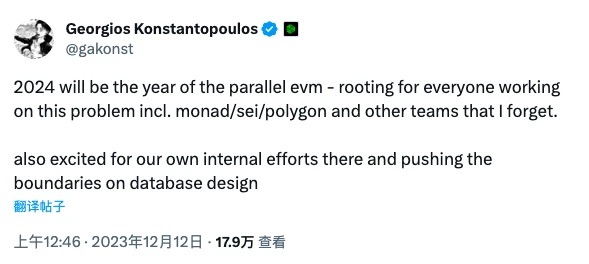
In December 2023, Georgios Konstantopoulos, CTO of top-tier VC Paradigm, offered high praise for the future of "Parallel EVM." He predicted 2024 would be the year of Parallel EVM and named Monad—the longest-standing project in this space—as the first representative example.
What Exactly Is “Parallel EVM”?
“Parallel EVM” fundamentally rethinks how transactions are executed within the EVM environment.
In traditional EVM environments, transactions are executed sequentially (a clear example being when a user submits multiple transactions—only after the first one is confirmed does the next begin processing). We can refer to this mechanism as “Single-threaded EVM.”
The design of “Single-threaded EVM” ensures deterministic execution order for transactions and smart contracts, making blockchain state easier to manage and predict—enhancing network security. However, it also limits transaction execution efficiency and constrains scalability options at the Layer 1 level.
Monad’s proposed “Parallel EVM” seeks to break this bottleneck. It partitions or groups pending transactions and uses scheduling algorithms to coordinate their concurrent processing. The ultimate goal is to allow independent transactions to execute in parallel, significantly boosting execution efficiency at the Layer 1 level.
The Monad team has used vivid analogies to explain the difference between “Parallel EVM” and “Single-threaded EVM,” such as the laundry example shown below.
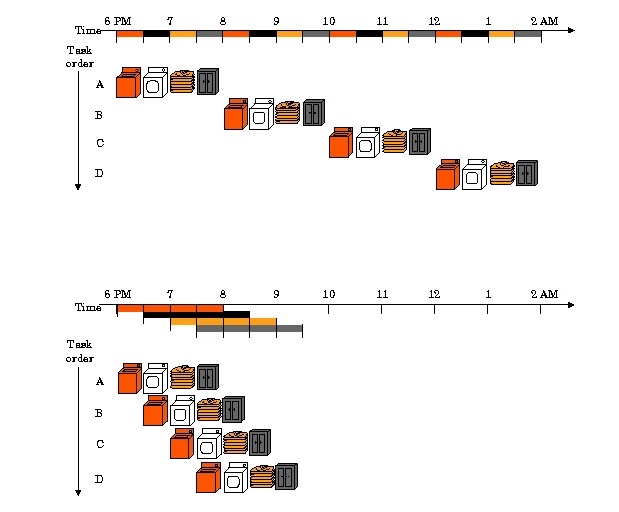
Suppose someone has four loads of laundry to wash, each requiring four steps: washing, drying, folding, and putting away.
Under the “Single-threaded EVM” model, since each step (representing a transaction) must be completed sequentially, all four loads go through each phase one after another, totaling 16 time units.
Under the “Parallel EVM” model, however, independent operations (i.e., independent transactions) can proceed simultaneously. While one load moves to the next step, the next load can immediately start the previous step. This reduces total time to just 7 units—a more than twofold improvement in efficiency.
Another Marketing Genius?
Unlike some more conservative teams, Monad has adopted a refreshingly down-to-earth—or even quirky—marketing strategy.
Every morning, the Monad team posts variations of “gmonad” (Monad’s community-specific version of “gm”) on X.

The team has also hosted meme contests on X, inviting the community to submit creative and humorous Monad-themed memes. The contest is now in its 17th week. If you see strange purple creatures popping up on X, chances are it’s Monad spreading its cultural influence.

This marketing style is reminiscent of Solana, which similarly mastered meme-driven growth and built a fiercely loyal community.
Given that both Monad and Solana are believers in pushing Layer 1 scalability to its limits, many wonder whether Monad can follow in Solana’s legendary footsteps—a unique aspiration shared by the Monad community.
Token Information & Interaction Strategy
Regarding Monad’s future token, the official team has not yet disclosed substantial details.
In September 2023, Monad briefly published technical documentation for its upcoming PoS chain, mentioning that its native token would be named MON and used to pay gas fees on the Monad chain. However, this information was later removed from the document.
Since Monad has not yet launched its mainnet or testnet, ordinary users currently have limited ways to interact. Those interested in early participation are advised to join the official Discord channel and await updates regarding the testnet.
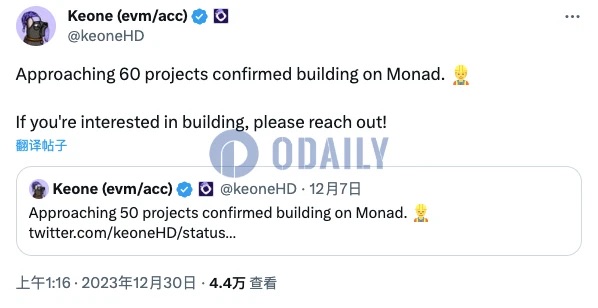
At the end of last year, Keone mentioned on X that nearly 60 projects had committed to building on Monad. When the testnet launches, a number of these projects are expected to go live simultaneously, offering users early interaction opportunities.
Notably, many phishing accounts impersonating Monad have appeared beneath social media posts. The official team has repeatedly issued warnings (e.g., they will never ask users to connect wallets), so please remain vigilant.
Join TechFlow official community to stay tuned
Telegram:https://t.me/TechFlowDaily
X (Twitter):https://x.com/TechFlowPost
X (Twitter) EN:https://x.com/BlockFlow_News
 Odaily







