









A Look at the Current Rollup Market: The Battle for Legitimacy, Sovereignty, Modularity, and Restaking
TechFlow Selected TechFlow Selected
A Look at the Current Rollup Market: The Battle for Legitimacy, Sovereignty, Modularity, and Restaking
Entering 2024, Rollups began to diverge into four types.
 Navigating Web3 tides with focused insights
Author: NingNing
One of the key themes in the 2023 scalability competition was Rollups consuming the TVL, users, and ecosystem Dapps of alternative L1s. Arbitrum, Optimism, Zksync, Starknet—acting as knightly guardians of the Ethereum ecosystem—have made significant contributions to Ethereum's expansion.
However, things started to feel off when Arbitrum attempted to establish a hub-and-spoke rollup scalability architecture centered around an L1-L2-L3 structure, aiming to solidify its dominant position and protect its vested interests.
Fortunately, both Optimism and Zksync refrained from following Arbitrum’s aggressive path. Instead, they embraced a parallel Stacks-like architecture, positioning themselves as the first instances within such a stack framework.
Even Polygon—a so-called Ethereum sidechain that isn’t truly one—opted not to follow Arbitrum, instead aligning with Optimism and Zksync by launching its own Stacks-like parallel architecture via the Polygon CDK. The only difference is that Polygon CDK uses the Polygon PoS mainnet, rather than Ethereum, as its settlement layer.
However, most Rollups deployed using the Stacks SDK still share data availability and settlement layers, failing to achieve true parallelism or sovereignty.
This remains far from the decentralized scalability vision of Ethereum’s Danksharding proposal: 1024 shards plus one consensus shard serving thousands of Rollups.
Entering 2024, driven by new primitives like modularity and restaking, Rollups have begun to diverge into four distinct types: Canonical Rollups, Sovereign Rollups, Modular Rollups, and Restaking Rollups:
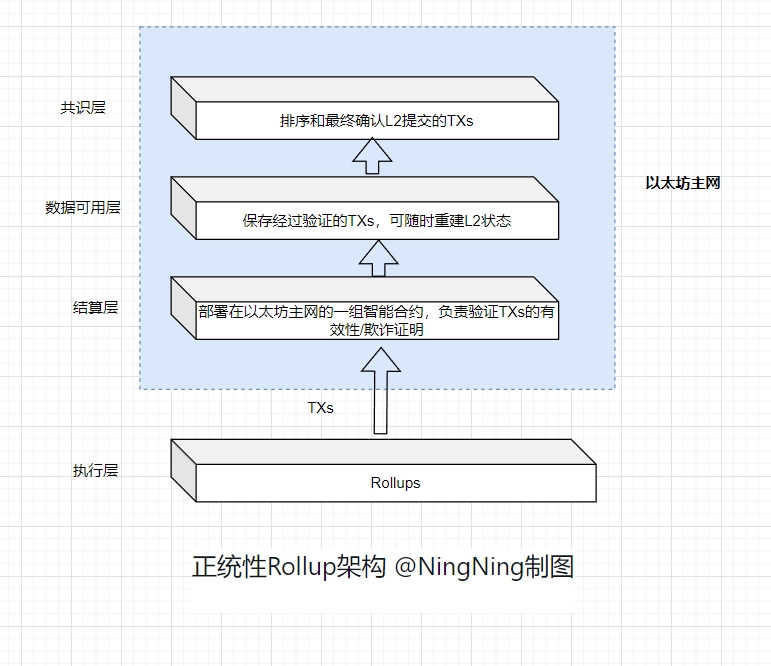
Canonical Rollups
Canonical Rollups actively position themselves as outsourced execution layers for Ethereum, pursuing EVM equivalence—or even full Ethereum equivalence. Examples include Optimism, Linea, and Scroll. Arbitrum shares a similar architecture but is less aggressive than these three in pursuing Ethereum equivalence, focusing more on developer experience instead.
Sovereign Rollups
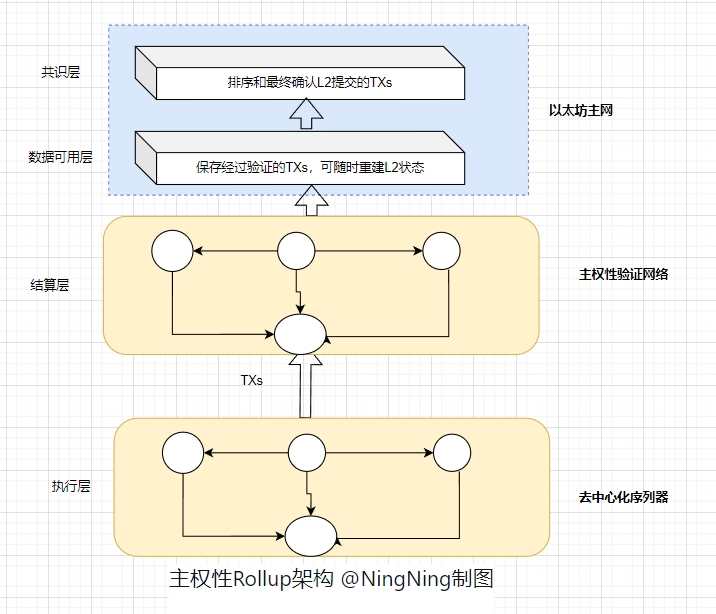
Sovereign Rollups are best represented by Metis (jokingly referred to as "Vitalik's mom's project") and Starknet, co-founded by Vitalik Buterin and Eli Ben-Sasson.
Their shared architectural trait is a decentralized sequencer network and a sovereign verification network (settlement layer).
Because Metis uses an Optimistic Rollup mechanism while Starknet employs a ZK-Rollup mechanism, their sovereign verification network architectures differ slightly despite both adopting the PBS (Proposer-Builder Separation) design principle. Starknet adds additional node roles, such as Provers responsible for generating ZKPs (zero-knowledge proofs).
Moreover, due to lower costs associated with submitting ZKP validity proofs to Ethereum compared to fraud proofs, Starknet continues to use Ethereum as both its consensus and data availability layer.
Metis, on the other hand, goes all the way—using Ethereum solely as a memo storage or bulletin board. Its relationship with Ethereum resembles that between most Bitcoin L2s and the Bitcoin mainnet today, representing maximal sovereignty.
Modular Rollups
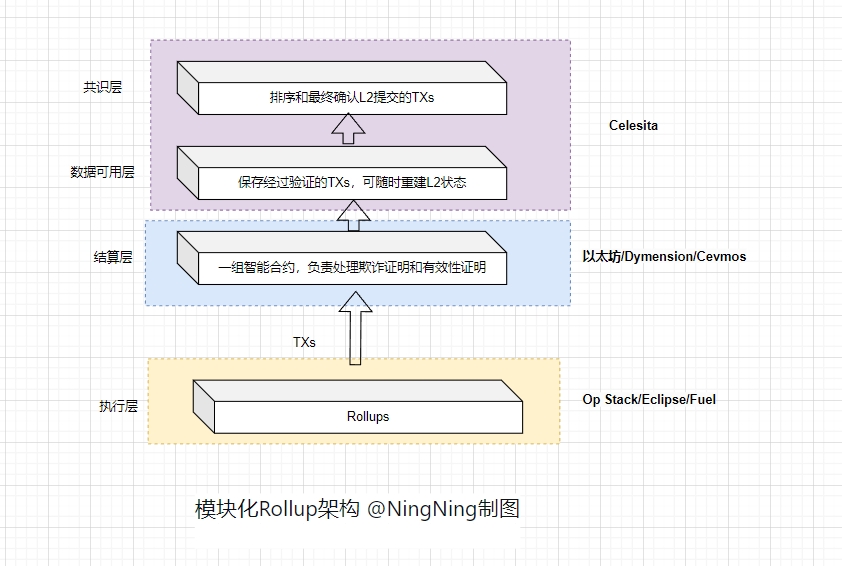
Currently, Modular Rollups fall into two subcategories: general-purpose Rollups like Manta, and Dapp-specific Rollups such as Aevo and Lyra.
At present, Modular Rollups may seem merely like replacing Ethereum’s DA layer with modular blockchain DA solutions like Celestia or Avail.
But this view overlooks the deeper significance: Modular Rollups represent a fundamental innovation and challenge to the prevailing hub-and-spoke Rollup model.
Modular Rollups empower Dapp developers to escape the control of Ethereum and generic L2s, helping correct the current imbalance where Rollups are built primarily for Ethereum Foundation approval or VC interests, shifting back toward user-centric product paradigms.
Restaking Rollups
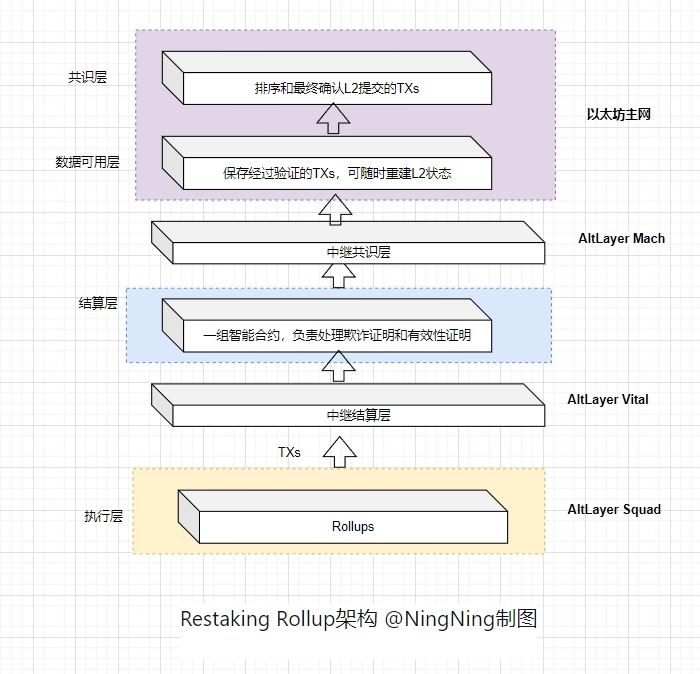
Restaking Rollups are a new primitive jointly introduced by AltLayer, a Rollup-as-a-Service provider, and EigenLayer.
Compared to Sovereign Rollups like Metis, Restaking Rollups derive their validation and consensus networks from EigenLayer’s AVS node network. Their economic security comes from restaked ETH and liquid staking tokens (LSTs), offering higher security than native L2 protocol tokens.
Restaking Rollups insert an intermediate relay layer called AltLayer Vital before the settlement layer, and another named AltLayer Mach before the consensus and data availability layers. These layers handle partial functions of settlement, consensus, and data availability respectively.
This architecture enhances Rollup security, finality, and reduces data availability verification costs.
Furthermore, Restaking Rollups drastically lower the barrier and cost of deploying Rollups—AltLayer currently supports zero-code deployment of a Rollup in under five minutes.
Among these four types, Canonical and Sovereign Rollups dominate the market as general-purpose solutions. However, their high deployment and operational costs make them unsuitable for most Dapp developers.
In contrast, lightweight protocol models—Modular Rollups and Restaking Rollups—are offering Dapp developers compelling new options in 2024.
Join TechFlow official community to stay tuned
Telegram:https://t.me/TechFlowDaily
X (Twitter):https://x.com/TechFlowPost
X (Twitter) EN:https://x.com/BlockFlow_News
 @0xNing0x







