








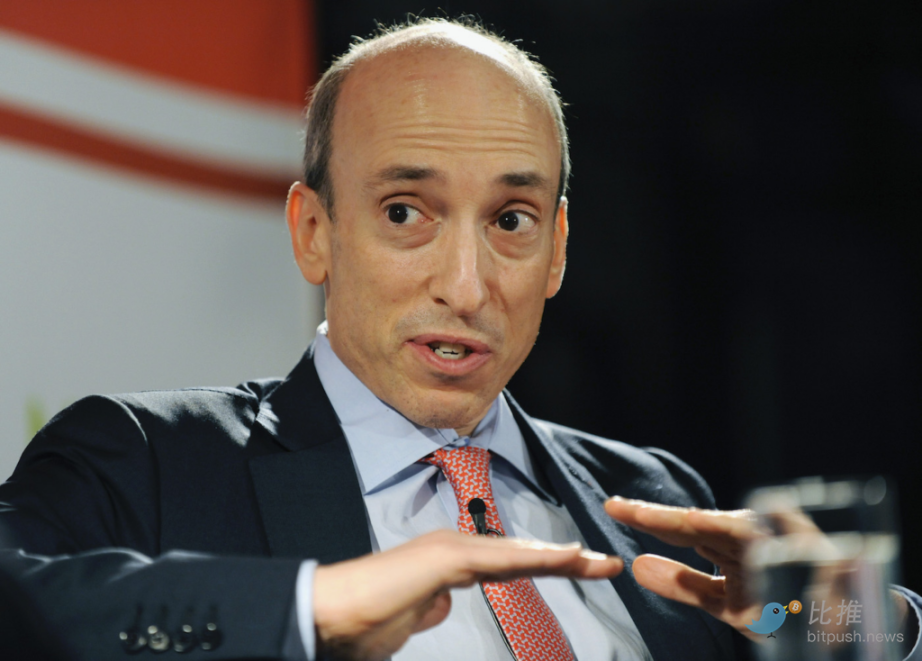
Gary Gensler Takes on Wall Street, SEC's Do-or-Die Battle Looms
TechFlow Selected TechFlow Selected
Gary Gensler Takes on Wall Street, SEC's Do-or-Die Battle Looms
Whether dealing with cryptocurrencies or many other issues, Gensler's approach has failed to fully satisfy everyone.
 Navigating Web3 tides with focused insights
Source: Bloomberg
Translation: BitpushNews Yanan
Wall Street’s fierce backlash against SEC Chair Gary Gensler is shaking the very foundation of the Securities and Exchange Commission. In this high-stakes battle against time and financial titans, he must go all in to accomplish his mission as quickly as possible. Every item on his agenda—from market regulation to climate change—has become a target, drawing relentless attacks.
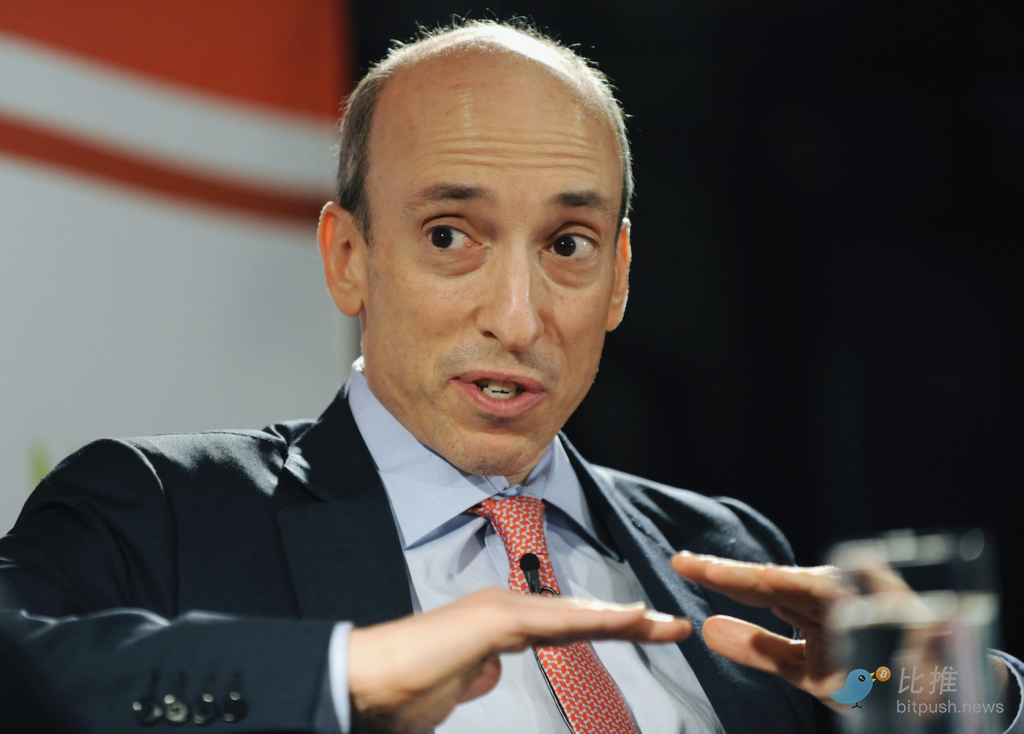
At 4:11 p.m. on January 9, a fake message claiming the U.S. Securities and Exchange Commission (SEC) had approved a Bitcoin ETF suddenly surfaced. Just 15 minutes later, SEC Chair Gary Gensler himself stepped in to reveal the truth.
Through his personal account, the SEC chair calmly informed the public that the agency’s official X account had been hacked. A prior post on @SECGov had claimed the commission had approved several Bitcoin investment products—but it was false news, likely an attempt to manipulate the crypto market.
“Dude, if you can’t even protect your own Twitter account, how can you protect cryptocurrency investors?” someone replied to @garygensler.
As a long-time skeptic of cryptocurrencies, Gensler never wanted things to unfold this way. Yet cybersecurity and digital assets are just two of many thorny issues he now faces. When Gensler took over the SEC in 2021, he did so with great ambition, determined to transform the financial world. He fearlessly ventured into every domain—stock trading, Treasury clearing, executive pay, private equity, cryptocurrencies, short-selling, even climate risk and artificial intelligence. To him, no area seemed off-limits.
But the honeymoon didn’t last. Over nearly three years, Wall Street’s counteroffensive has surged like a tidal wave, using lawsuits as weapons to strike at the heart of the SEC and its leadership. Major financial institutions argue that Gensler has overreached, that his ambitions have grown too vast to be sustainable. They firmly believe the SEC chair will eventually pay a price for his boldness.
In this fight, Gensler finds himself in a difficult position. Other federal agencies have grown uneasy about the assertive posture of the SEC under his leadership, feeling sidelined. Meanwhile, support from Republicans continues to erode. Even former SEC staff who once stood beside him are beginning to waver, fearing that the rules they painstakingly crafted could be overturned by a single court ruling—leaving the SEC in unprecedented jeopardy.
The SEC stated that Chair Gensler’s goal is to enhance the efficiency, competitiveness, and resilience of U.S. capital markets while reinforcing their integrity. The commission emphasized it has maintained “close working relationships” with other regulatory bodies across the government, recently collaborating with multiple agencies to establish new Treasury clearing rules. The SEC insists that the regulations enacted under Gensler’s leadership have already delivered tangible benefits to investors and issuers alike.
Yet the January 9 hacking incident—and the ensuing social media turmoil, despite Gensler’s swift clarification—was further intensified when the SEC soon after formally announced its approval of Bitcoin ETFs, fueling outside skepticism. After all, the SEC has long pushed for stronger corporate cybersecurity among public companies.
On January 16, Ripple CEO Brad Garlinghouse, speaking to CNBC, was blunt: “I do think SEC Chair Gary Gensler has become a political liability in the U.S. He doesn’t seem to be acting in the interest of citizens or long-term economic growth, which puzzles me.” Notably, Ripple has been locked in a legal battle with the SEC over cryptocurrency products since late 2020—before Gensler even took office.
Garlinghouse’s criticism underscores the immense challenge facing Gensler as head of a regulatory body that maintains a clear stance against the crypto industry, believing it openly and recklessly violates established rules and standards. “Crypto firms must operate within the legal framework—or cease operations entirely,” the SEC emphasized in a statement.
The dramatic collapse of crypto giant FTX at the end of 2022 lent strong support to Gensler’s argument that the industry urgently needs greater compliance. Andrew Park, senior policy analyst at consumer advocacy group Americans for Financial Reform, said public backlash against Gensler isn’t surprising. “Enforcers are trying to close long-standing loopholes,” he said, “many of which have generated substantial profits for certain players.”
At 66, Gensler still carries the lean frame of a marathon runner, sitting in his sunlit Washington office adorned with black-and-white photos and family artwork. He remains unfazed by criticism and doubts about the future. Since becoming the face of Wall Street regulation in the Biden era, he has consistently stressed one point: protecting investors benefits the nation.
“Ultimately, we exist for investors and issuers, striving to improve competition and efficiency in the markets,” Gensler said.
Nearly everyone who supports Gensler believes he aims to become the most influential SEC chair since Joseph Kennedy—the father of John F. Kennedy and the commission’s first chairman. During the Great Depression, Kennedy cracked down hard on fraud and get-rich-quick schemes, restoring public confidence in Wall Street.
Gensler repeatedly insists he isn’t in a rush. But after decades navigating Wall Street and deepening his roots in Washington politics, time is running short.
Meanwhile, other distinguished alumni of Goldman Sachs—such as Hank Paulson, Lloyd Blankfein, and Gary Cohn—have already retired to enjoy comfortable lives. Only Gensler remains, still driven by the ambition to make history.
If former President Trump or another Republican candidate wins the November presidential election, Gensler may face forced departure, along with many fellow Democrats. If Biden wins re-election, Gensler might stay at the SEC until 2026—by which time he would be entering his seventies.
Either way, Gensler will eventually leave Washington’s political stage. And he may never fulfill what many suspect is his ultimate dream: becoming U.S. Treasury Secretary.
Not because he lacks ambition or experience. After nearly two decades at Goldman Sachs, Gensler served as Treasury Undersecretary, then chaired the Commodity Futures Trading Commission, and now leads the SEC. He moves deftly between Wall Street and Washington, shaping the rules that govern financial services.
Regarding widespread speculation that Gensler seeks the Treasury role, the SEC dismissed it as a tactic by opponents to discredit his policy agenda. “Chair Gensler has repeatedly made clear he is deeply honored to serve as SEC Chair,” the agency added.
To former employees, Gensler is a rigorous and efficient leader. He pushes his team relentlessly, shuts down backdoor channels used by financial lobbyists—many of whom are ex-SEC staff—and combats gossip and leaks to uphold integrity in Washington.
Yet a 2022 report from the SEC’s general counsel noted that Gensler’s intense pace has placed significant strain on the agency, leaving staff exhausted. It warned that continued burnout and employee turnover could leave SEC rules vulnerable to legal challenges. The good news, however, is that a follow-up report showed external hiring at the SEC in 2023 far exceeded departures, injecting fresh talent. Additionally, a leading nonprofit ranked the SEC as the third-best midsize federal agency to work for—a testament to Gensler’s effective leadership.
Gensler firmly believes the SEC must respond swiftly to the “major, existential” challenges posed by the pandemic to the financial sector. In recent interviews, he emphasized this point, adding that any SEC chair would feel equally compelled to act.
And indeed, he has acted. Gensler launched an agenda of more than 50 rules, over half of which have already taken effect—with most surviving without legal challenge.
Looking ahead, Gensler says the SEC will proceed cautiously within boundaries set by courts, while fully leveraging the strong powers granted by Congress. In rulemaking, the SEC will strictly follow statutory authority and administrative procedures, ensuring every decision is lawful. It will also vigorously defend its rules against any legal challenges.
Wall Street has long complained about regulations, arguing they hinder profitability. Industry lobbyists routinely warn that excessive oversight could stifle the vitality of capitalism.
“What will the market look like once all these new rules take effect?” asked Bryan Corbett, CEO of the Managed Funds Association (MFA). This hedge fund trade group has, for the first time in its history, sued the SEC to block a series of new regulations—including one requiring greater disclosure from short-sellers.
The MFA is not alone in its frustration with heavy-handed regulation. Today, major U.S. corporations increasingly share conservative legal scholars’ concerns about federal overreach. An emerging Supreme Court case involving fisheries regulation could profoundly affect federal agencies like the SEC and their regulatory authority in finance, healthcare, and consumer safety.
Jill Fisch, a law professor at the University of Pennsylvania, pointed out that the current SEC could easily be swept up in this broader backlash.
“Our courts have expressed concern about the administrative state,” Fisch said. She added that the Supreme Court has signaled it may curtail federal agencies’ discretion and regulatory power.
If courts limit the SEC’s authority to protect investors, enforce disclosures, and promote transparency, it could have massive implications for U.S. capital markets, Fisch warned.
Take Gensler’s push for carbon emissions disclosure: he wants every company—from Walmart to oil giants—to provide fuller reporting. But such demands could trigger major legal battles. He’s also questioned the mechanics of stock trading. The SEC has proposed rules aimed at preventing Wall Street firms from exploiting retail investors. These rules would require ordinary investors’ trades to go through more open, transparent auctions, rather than being routed through opaque channels like Citadel Securities, led by Ken Griffin.
Gensler’s allies agree that market reform has long been overdue.
“The best regulatory strategy is to spot problems before they turn into full-blown crises—and fix them early,” said Stephen Hall, legal director at Washington advocacy group Better Markets, a frequent supporter of Gensler’s initiatives.
Unsurprisingly, Griffin and his peers see things differently.
At an industry conference last November, Griffin described one proposal as “a living example of how a so-called solution that doesn’t solve anything gets created.”
In Washington and on Wall Street, some are already speculating about Gensler’s future—and what the SEC might become if he leaves.
Throughout his tenure at the SEC and earlier roles, Gensler has tended to recruit young lawyers and staff who share his vision—idealists eager to change the status quo and increase market transparency. For these newcomers, it’s a rare opportunity. But insiders say this approach often sidelines experienced professionals skilled in policy implementation and legal defense.
Given today’s legal landscape and the political climate ahead of the November election, Gensler must work doubly hard to ensure his agenda survives.
The Bitcoin ETF hoax was absurd. Frankly, whether dealing with crypto or other complex issues, Gensler’s approach hasn’t fully satisfied anyone.
But Gensler himself believes his reform agenda has yielded significant victories. “I’m truly pleased to see the progress we’ve made,” he said.
Join TechFlow official community to stay tuned
Telegram:https://t.me/TechFlowDaily
X (Twitter):https://x.com/TechFlowPost
X (Twitter) EN:https://x.com/BlockFlow_News
 @Bloomberg









