









Bitcoin's Summer Approaches: 10 Major Developments "Picking Low-Hanging Fruits" from Ethereum's Ecosystem?
TechFlow Selected TechFlow Selected
Bitcoin's Summer Approaches: 10 Major Developments "Picking Low-Hanging Fruits" from Ethereum's Ecosystem?
Is Bitcoin following Ethereum's path to ecosystem prosperity, or will it end up in disarray after all the hype?
 Navigating Web3 tides with focused insights
Author: Joyce
From the ICO craze of 2017 to DeFi Summer in 2020 and the NFT explosion in 2021, each bull market cycle has been driven by a new narrative. If we were to identify the dominant narrative for the upcoming bull run, the surge in Bitcoin ordinals—epitomized by BRC20—cannot be overlooked.
Looking back at 2023 from the beginning of 2024, the Bitcoin ecosystem has seen remarkable growth—from the historic approval of spot ETFs at the start of the year to developments in BRC20 protocols, Bitcoin NFTs, Layer2 solutions, and foundational infrastructure. Indeed, it has been a year of blossoming innovation and widespread activity.
Approval of Bitcoin Spot ETFs
One of the most historic moments in recent crypto history occurred on January 10 this year, when the U.S. SEC approved Bitcoin spot ETFs.
After years of speculation and debate, the approval of Bitcoin spot ETFs finally came to pass, marking the dawn of a new era where Bitcoin truly connects with traditional capital. In just three days after launch, Bitcoin ETFs recorded nearly $10 billion in trading volume, making them among the best-performing ETFs in history.
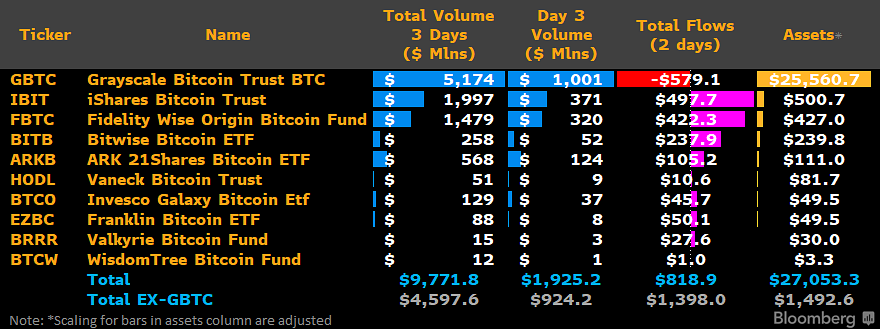
Bitcoin spot ETF data during first 3 days before listing, source: Bloomberg
Although Bitcoin's price declined from around 48,000 USDT to over 38,000 USDT following the ETF launch—sparking claims such as "sell the news" or "Grayscale Bitcoin ETF dumping"—the net inflow data clearly shows that spot ETF approvals have become a major channel for off-exchange capital entering the crypto market, and this channel’s value will grow increasingly significant over time.
Moreover, the approval signifies that Bitcoin is no longer a niche asset confined to a small circle but has formally connected with global capital markets like gold, gaining gradual recognition from mainstream finance. Regulatory legitimacy and large inflows of institutional capital may stabilize Bitcoin’s price, reducing extreme volatility. This stability benefits not only the Bitcoin ecosystem but also the broader crypto industry by mitigating talent and capital flight during bear markets, fostering healthier long-term development.
Ordinals Protocol Ignites a New Narrative
Beyond the spot ETF approval, the most significant event in the Bitcoin ecosystem over the past year was the launch of the Ordinals protocol.
The subsequent rise of BRC20 tokens and Bitcoin NFTs are all built upon the foundation laid by the Ordinals protocol. Without Casey Rodarmor’s creation of the Ordinals protocol, there would be no BRC20-driven resurgence of Bitcoin’s underlying ecosystem.
Launched in January 2023, the Ordinals protocol is an asset issuance framework built on Bitcoin.
Bitcoin lacks Turing-complete smart contracts and cannot natively issue tokens or NFTs like Ethereum. However, upgrades such as SegWit and Taproot made it possible to store arbitrary data (under 4MB) within Bitcoin blocks. Leveraging this, Ordinals founder Casey assigned serial numbers to individual satoshis (the smallest unit of Bitcoin) and inscribed images, text, audio, and even video onto these numbered sats, enabling the issuance of NFTs—and even fungible tokens—on Bitcoin.
Since its debut in January 2023, over 55 million inscriptions have been created via the Ordinals protocol, generating more than 5,700 BTC in fees for block producers. As Bitcoin block rewards diminish over time, the emergence of Ordinals inscriptions provides renewed economic incentives for miners, significantly enhancing both the security and vitality of the entire Bitcoin network.
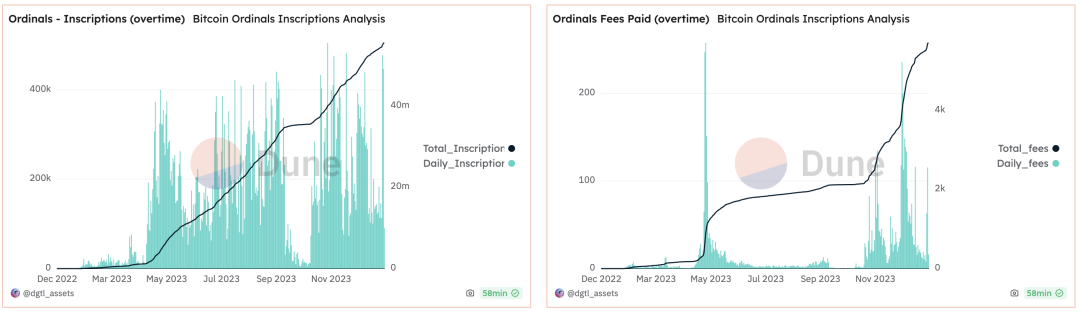
Trends in Ordinals inscription count and transaction fees, source: Dune @dgtl_aasets
While newer protocols like Atomicals, Runes, and Pipe have since emerged in the Bitcoin ecosystem, the Ordinals protocol remains the clear leader in terms of market capitalization and community engagement.
It is fair to say that the Ordinals protocol ignited the current wave of activity in the Bitcoin ecosystem—or even triggered the current bull market.
BRC20 Explosion
If there was one term from the Bitcoin ecosystem that broke into the mainstream in 2023, it was undoubtedly “inscriptions.”
While “inscriptions” technically refer to NFTs or tokens minted through the Ordinals protocol, during the viral热潮 of “minting inscriptions,” most users were actually referring to BRC20 tokens.
Initially focused on NFTs, the Ordinals protocol gained new momentum two months later when an anonymous developer named Domo proposed that it could also support fungible tokens: when inscriptions follow a standardized format during minting, they become interchangeable tokens—now known as BRC20 tokens.
Since its emergence in March last year, the BRC20 space has experienced explosive growth. The total market cap of BRC20 tokens now exceeds $3.3 billion, with leading projects Ordi and Sats quickly listing on top-tier exchanges and climbing into the global Top 60 by market cap.
From obscure meme coins to darlings of venture capital, BRC20 tokens have undeniably captured the spotlight.
Bitcoin NFTs Surpass Ethereum NFTs
Bitcoin NFTs are not entirely new, but they only began gaining real traction after the launch of the Ordinals protocol.
That said, their popularity remains relatively niche compared to Ethereum and other ecosystems. Current Bitcoin NFTs are still largely confined to a tight-knit community and haven’t attracted the same level of external capital and talent as the previous Ethereum NFT boom.
Overall, the NFT sector remains subdued. Since the last bear market, blue-chip Ethereum NFTs have struggled with declining prices, and despite occasional projects creating brief excitement, no sustained revival of the NFT market has occurred on Ethereum.
According to data from Cryptoslam, Bitcoin NFT trading volume over the past 30 days has far surpassed that of Ethereum and other blockchain NFTs—reaching more than double Ethereum’s volume. Additionally, hit collections like Bitcoin Frogs and Bitmap have emerged, showing strong potential to challenge established blue-chip NFTs.
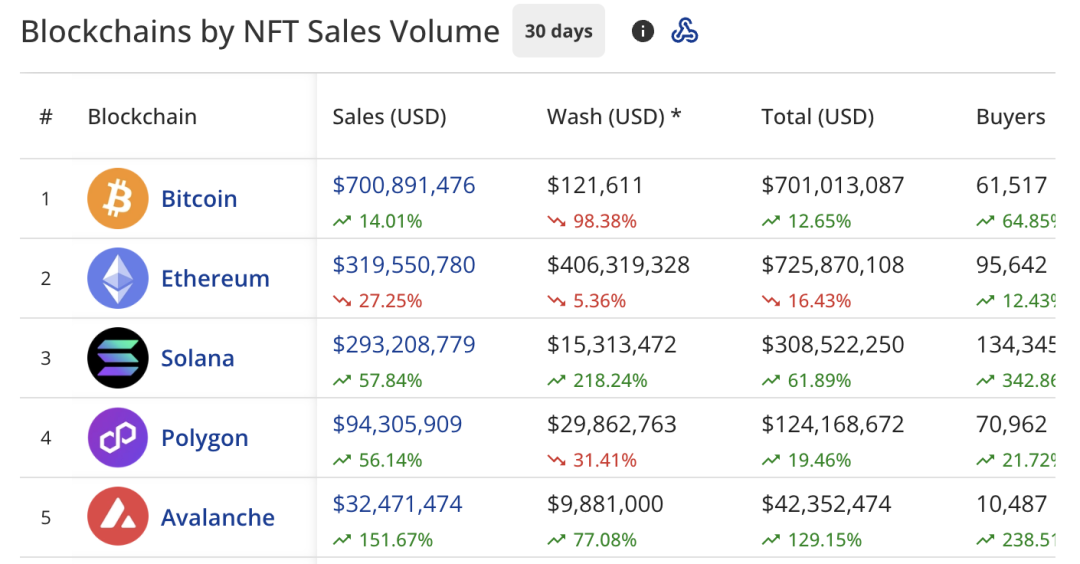
Source: Cryptoslam.io
In just one year, Bitcoin NFTs have overtaken Ethereum NFTs in volume and scale. While not yet achieving the mainstream breakout seen in 2021, their growth can rightfully be described as “red-hot.”
Diverse Protocols Emerge: A Flourishing Ecosystem
No new technology is perfect—neither Ordinals nor BRC20 are exceptions. Following the success of the Ordinals protocol, numerous new protocols rapidly emerged in the Bitcoin ecosystem, including Atomicals, Runes, PIPE, Stamps, and BitVM, each claiming improvements over Ordinals and contributing to a vibrant, competitive landscape.
Compared to Ordinals, the Atomicals protocol offers greater decentralization by eliminating reliance on third-party orderbook operators for asset trading. Earlier, Atomicals saw limited adoption due to technical complexity and fewer supporting platforms. However, with backing from Unisats and rumored interest from major players, its popularity is now rising noticeably.
The Runes protocol, proposed by Ordinals creator Casey, aims to address inefficiencies in BRC20. However, its development remains slow, and it has yet to establish its own ecosystem like Ordinals or Atomicals. Instead, inspired by Runes, Bitcoin developer Benny created the PIPE protocol, skillfully combining strengths from both Ordinals and Runes.
In contrast to concerns about redundant data from Ordinals potentially being pruned, the Stamps protocol emphasizes data permanence—ensuring inscribed content cannot be removed from Bitcoin’s public ledger. Amid debates over data deletion risks, attention has increasingly turned toward Stamps.
Despite this proliferation of innovative protocols, the spotlight remains firmly on Ordinals. Moreover, interoperability between different protocols is currently lacking—each often requiring separate wallets and marketplaces. Coupled with occasional token loss during transfers, the user experience presents a steep learning curve for newcomers.
Rise of Bitcoin Smart Contract Layers
As the Ordinals protocol surged, Bitcoin’s mainnet became increasingly congested, driving up transaction fees. In response, Bitcoin smart contract layers designed to alleviate congestion and reduce costs began gaining momentum.
Several smart contract projects exist on Bitcoin, but Stacks and RSK remain the most widely recognized.
In terms of TVL, RSK leads the Bitcoin ecosystem with over $100 million locked. However, during this latest wave of ecosystem growth, RSK has not launched any standout projects or made notable moves.
Although Stacks’ TVL is modest, the project boasts strong fundamentals and promising ecosystem development, positioning it as the most anticipated star in the Bitcoin ecosystem. According to official updates, the Nakamoto upgrade—aimed at boosting network performance and launching SBTC, a BTC-pegged stablecoin—is expected before Bitcoin’s halving, which could significantly enhance BTC liquidity. As the first token officially recognized by the SEC, Stacks brings several compelling advantages.
Of course, with growing interest in the Bitcoin ecosystem, many new smart contract initiatives have recently emerged. Whether any will achieve meaningful traction remains to be seen.
Revival of the RGB Protocol
First proposed in 2016, the RGB protocol remained dormant for years until April 2023, when version 0.1 was released—marking its official commercial launch.
This release brought key advancements—including removing prior limitations on smart contract development, integrating with the Lightning Network, and improving wallet compatibility—bringing RGB back into the spotlight alongside the broader Bitcoin ecosystem boom. In particular, integration with the Lightning Network has led many to compare RGB with Taproot Assets. Leveraging Bitcoin’s base-layer security while utilizing existing Lightning Network channels is a strategic advantage.
However, most RGB-based projects are still in development or private testing. Their real-world impact will depend on future progress.
Lightning Network Propels Bitcoin Into the Multi-Asset Era
The launch of Taproot Assets on the Lightning Network signifies that Bitcoin, like Ethereum, has entered the multi-asset issuance era.
While protocols like BRC20 are popular, Bitcoin’s base layer merely records data passively. Once issued, tokens cannot be revoked, burned, or repurchased by the issuer. While this makes token distribution fairer and more accessible to retail users, the lack of centralized team involvement often hinders long-term project growth.
With Taproot Assets, issuers can create and destroy assets, and transactions seamlessly integrate with over 14,000 existing Lightning Network nodes worldwide. Combining Bitcoin’s base-layer security with the Lightning Network’s fast, low-cost transactions, Taproot Assets presents a superior model for asset issuance on Bitcoin.
Nostra Assets platform introduced Taproot Assets functionality in November 2023 and already supports four assets. While adoption is still limited, the user experience rivals centralized payment systems—smooth and seamless.
Globally, there are now 14,658 Lightning Network nodes, with over 4,900 BTC locked in the network. Even during the prolonged bear market of the past two years, the amount of BTC in the Lightning Network has grown steadily rather than fluctuating wildly.

BTC locked in the Lightning Network since inception, source: bitcoinvisuals
Currently, both node count and locked BTC remain relatively low, with mostly small-value transactions occurring in isolation from other Bitcoin ecosystem assets. However, as Taproot Assets, RGB, and other asset frameworks mature, the Lightning Network’s full potential is likely to be realized.
BitVM Sparks New Hope for Bitcoin Smart Contracts
Though Bitcoin has long been positioned as “digital gold,” efforts to unlock its programmability have never ceased.
In October 2023, the BitVM whitepaper titled *BitVM: Compute Anything On Bitcoin* was published, proposing a way to achieve Turing-completeness without altering Bitcoin’s existing consensus rules. This breakthrough opens the door to running complex smart contracts on Bitcoin, rekindling hopes for a richer, more functional ecosystem.
For now, however, BitVM remains theoretical, and practical implementation may take considerable time.
If solutions like Taproot Assets and RGB, combined with the Lightning Network, can be deployed quickly and meet expectations, they may offer a faster path to a thriving Bitcoin ecosystem.
Emergence of Other Ecosystem Infrastructure
Beyond these developments, 2023 saw the rise of numerous promising infrastructure projects within the Bitcoin ecosystem.
Examples include Thorchain, focused on cross-chain swaps involving Bitcoin; Multibit, a rising star enabling BRC20-to-ETH/BNB bridging; IDO platforms like Bounce, Bakery, and Turtsat; and BSSB, a stablecoin platform for the Bitcoin ecosystem—all standout contributors to Bitcoin’s expanding infrastructure.
Given the maturity of Ethereum and other ecosystems, emerging Bitcoin projects benefit from proven models. In a bullish market environment, this enables faster consensus formation and rapid market cap growth.
Regardless, the rise of BRC20 and other inscriptions has undeniably drawn more capital and resources toward building foundational infrastructure on Bitcoin.
Conclusion
2023 was a monumental year—not just for the Bitcoin ecosystem but for the entire crypto industry—a year of preparation and momentum-building ahead of the next major bull market.
What lies ahead for the Bitcoin ecosystem in 2024? After the speculative frenzy around BRC20 and Bitcoin NFTs, will substantial capital and resources shift toward sustainable infrastructure development—mirroring Ethereum’s ecosystem growth—or will it end in disappointment?
The former seems more likely. Beneath the short-term hype, we’ve already witnessed genuine enthusiasm—from developers, communities, and investors—toward building the future of Bitcoin.
This bull market cycle, the Bitcoin ecosystem is poised to play an indispensable role.
Join TechFlow official community to stay tuned
Telegram:https://t.me/TechFlowDaily
X (Twitter):https://x.com/TechFlowPost
X (Twitter) EN:https://x.com/BlockFlow_News
 白话区块链
白话区块链










