Resisting Institutional Capture of Bitcoin: Entrepreneurial Opportunities and Current Ecosystem Analysis in Bitcoin L2
TechFlow Selected TechFlow Selected
Resisting Institutional Capture of Bitcoin: Entrepreneurial Opportunities and Current Ecosystem Analysis in Bitcoin L2
This article compares Bitcoin L2s with earlier work and discusses some of the most promising Bitcoin L2 projects.
 Navigating Web3 tides with focused insights
Author: Mohamed Fouda, Alliance DAO
Translation: TechFlow
Spot Bitcoin ETFs have been a hot topic over the past few weeks. As those discussions settle, the community’s focus is shifting back to building on Bitcoin. This means addressing one key question: “How can we enhance Bitcoin’s programmability?”
Currently, Bitcoin Layer 2 (L2) solutions are the most promising answer to this question. This article compares Bitcoin L2s with earlier approaches, discusses several of the most promising Bitcoin L2 projects, and then explores interesting entrepreneurial opportunities associated with Bitcoin L2s.
Defending Permissionless Bitcoin
As many investors can now access Bitcoin through regulated products, they can trade BTC within traditional finance (TradFi) instruments such as leveraged trading and collateralized loans. However, these products do not use native BTC. Instead, they rely on TradeFi versions of BTC controlled by issuers, while native BTC remains locked by custodians. Over time, these TradeFi variants of BTC could become the dominant way to hold and use Bitcoin, transforming it from a decentralized, permissionless asset into another instrument controlled by Wall Street. The only path to resist such financial system control is through Bitcoin-native, permissionless innovation.
Building Bitcoin-Native Products
L1 Applications
Developers have repeatedly attempted to implement additional functionality directly on Bitcoin’s L1 by leveraging its ability to embed arbitrary data in transactions. This arbitrary data can be used to enable features such as asset issuance and NFT transfers. However, these functionalities are not built into the Bitcoin protocol itself and require external software to interpret and act upon the data fields.
Efforts include Colored Coins, the Omni protocol, Counterparty, and more recently, Ordinals. Omni was initially used to issue and transfer USDT on Bitcoin’s L1 before expanding to other chains. Counterparty underpins Bitcoin Stamps and SRC-20 tokens. Ordinals has become the standard for issuing NFTs and BRC-20 tokens on Bitcoin via inscriptions.
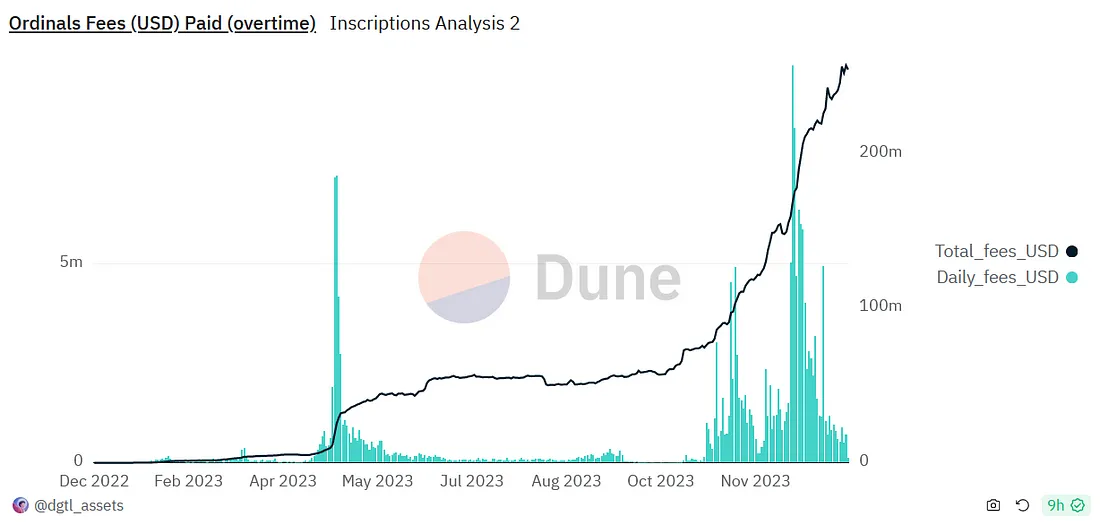
Since its launch, Ordinals has achieved significant success, generating over $200 million in fees. Despite this, Ordinals is limited to asset issuance and transfers and cannot support general-purpose applications on L1. Due to the limitations of Bitcoin’s native scripting language, Bitcoin Script, building more complex applications—such as AMMs or lending protocols—is nearly impossible at the base layer.
BitVM
One attempt to extend Bitcoin’s L1 capabilities is BitVM. This concept builds upon Bitcoin’s Taproot upgrade. BitVM enables off-chain execution of programs while guaranteeing that their execution can be challenged on-chain via fraud proofs. Although BitVM appears capable of implementing arbitrary logic off-chain, the on-chain cost of verifying fraud proofs grows rapidly with the size of the off-chain computation. This limitation restricts BitVM’s practicality to specific use cases, such as trust-minimized BTC bridges. Many upcoming Bitcoin L2s leverage BitVM for bridging purposes.
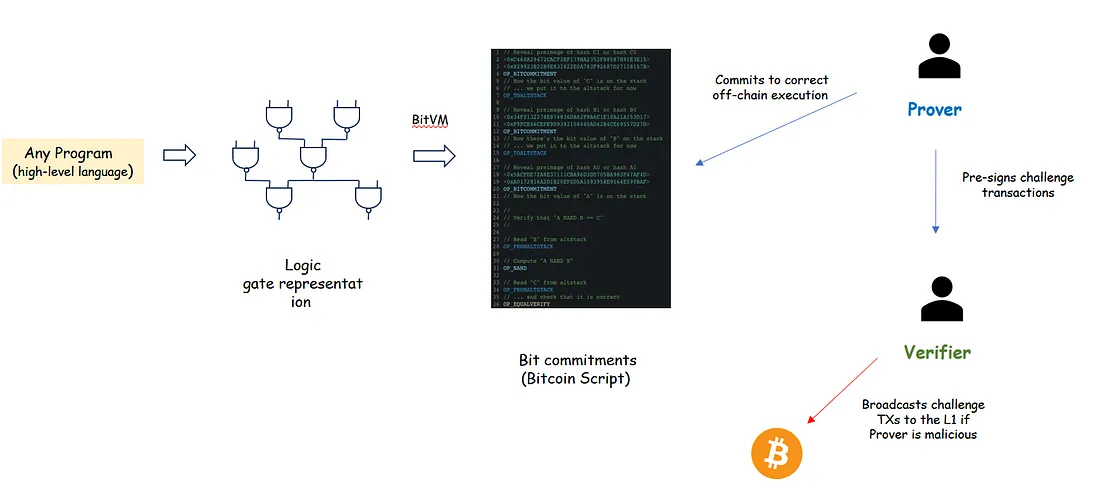
Simplified diagram of BitVM operation
Sidechains
Another approach to overcoming Bitcoin’s limited programmability is sidechains. These are independent, fully programmable blockchains compatible with EVM, aiming to align with and serve the Bitcoin community. Examples include Rootstock, Blockstream’s Liquid, and Stacks V1.
Bitcoin sidechains have existed for years but have seen limited success in attracting Bitcoin users. For example, fewer than 4,500 BTC are bridged onto the Liquid sidechain. Nevertheless, some DeFi applications built on these chains have achieved notable traction, such as Sovryn on Rootstock and Alex on Stacks.
Bitcoin L2s
Bitcoin L2s are emerging as the focal point for building permissionless, BTC-based applications. They offer similar advantages to sidechains but inherit security guarantees from Bitcoin’s base layer. There has been ongoing debate about what truly qualifies as a Bitcoin L2. In this article, we will sidestep that debate and instead discuss key design considerations for achieving strong coupling between L2 and L1, along with several promising L2 projects.
Requirements for Bitcoin L2s
Security from L1
The most critical requirement for a Bitcoin L2 is deriving its security from L1. Bitcoin is the most secure chain, and users expect this security to extend to L2s. For instance, the Lightning Network achieves exactly this.
This is why sidechains are categorized separately—they possess their own security models. For example, Stacks V1 relies on the STX token for security.
Achieving this security requirement in practice is extremely challenging. To ensure L1 can securely support an L2, the base layer must be able to perform certain computations to validate L2 behavior. For example, Ethereum rollups derive security from L1 because Ethereum can verify zero-knowledge proofs (zk rollups) or fraud proofs (optimistic rollups). Currently, Bitcoin’s base layer lacks the computational capability to perform such verifications. Proposals exist to add new opcodes to Bitcoin to allow L1 to verify ZKPs submitted by rollups. Additionally, proposals like BitVM aim to implement fraud proofs without modifying L1. However, BitVM faces challenges as fraud proofs may incur very high costs (hundreds of L1 transactions), limiting practical adoption.
To achieve L1-level security, the L2 must maintain an immutable record of transactions on L1. This is known as the data availability (DA) requirement. It allows observers monitoring only the L1 chain to verify the state of the L2. With inscriptions, L2 transaction records can be embedded into Bitcoin L1. However, this introduces scalability issues. Given Bitcoin L1’s block size limit of 4MB every 10 minutes, its data throughput is capped at approximately 1.1 KB/s. Even if L2 transactions are highly compressed to around 10 bytes per transaction, assuming all L1 transactions are used solely for storing L2 data, L1 could only support an L2 throughput of roughly 100 transactions per second.
Trust-Minimized L1-to-L2 Bridging
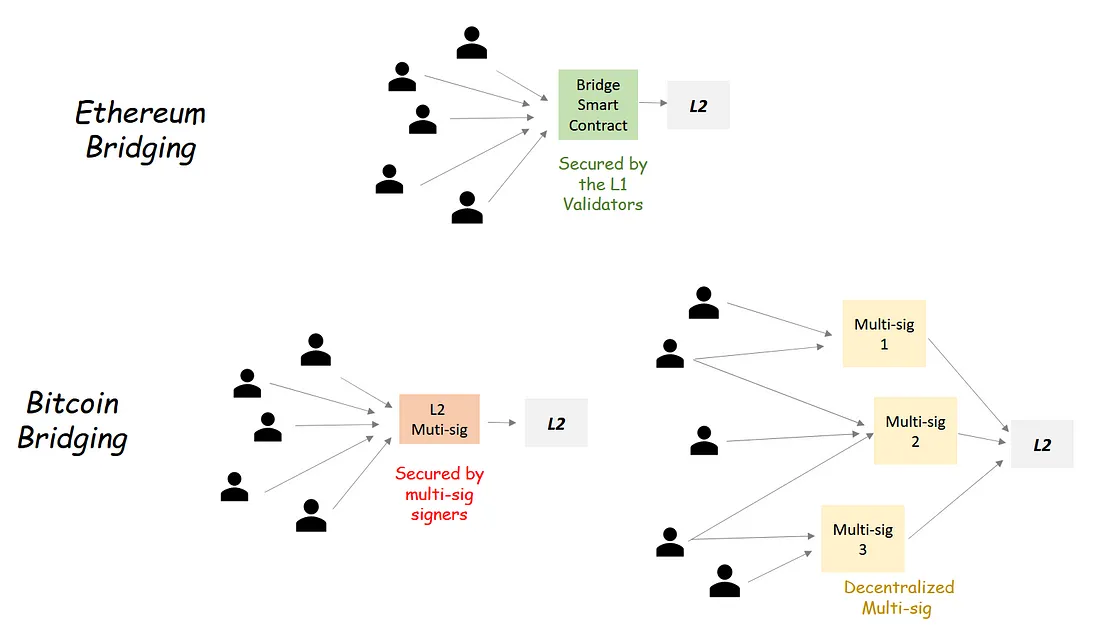
In Ethereum L2s, bridging between L1 and L2 is governed by L1. Pegging into an L2 involves locking assets on L1 and minting equivalent representations on L2. On Ethereum, this is handled by native bridge smart contracts on L1, which securely track all bridged assets. The contract’s security is derived from L1 validators, making the peg-in process secure and trust-minimized.
On Bitcoin, there is no mechanism for a bridge secured by the entire set of L1 miners. Instead, the best available option is using multi-signature wallets to hold L2 assets. Thus, the security of the L2 bridge depends on the multi-sig setup—number and identity of signers, and how peg-in and peg-out operations are protected. One way to improve bridge security is using multiple multi-sig wallets rather than a single one to hold all bridged assets. Examples include TBTC, where multi-sig signers must post slashable collateral. Similarly, proposed BitVM bridges require signers to provide security bonds. In such setups, any signer can initiate a peg-out transaction, but interactions are protected by BitVM fraud proofs. If a signer acts maliciously, other signers (validators) can submit a fraud proof on L1, resulting in the slashing of the malicious party.
Current State of Bitcoin L2s
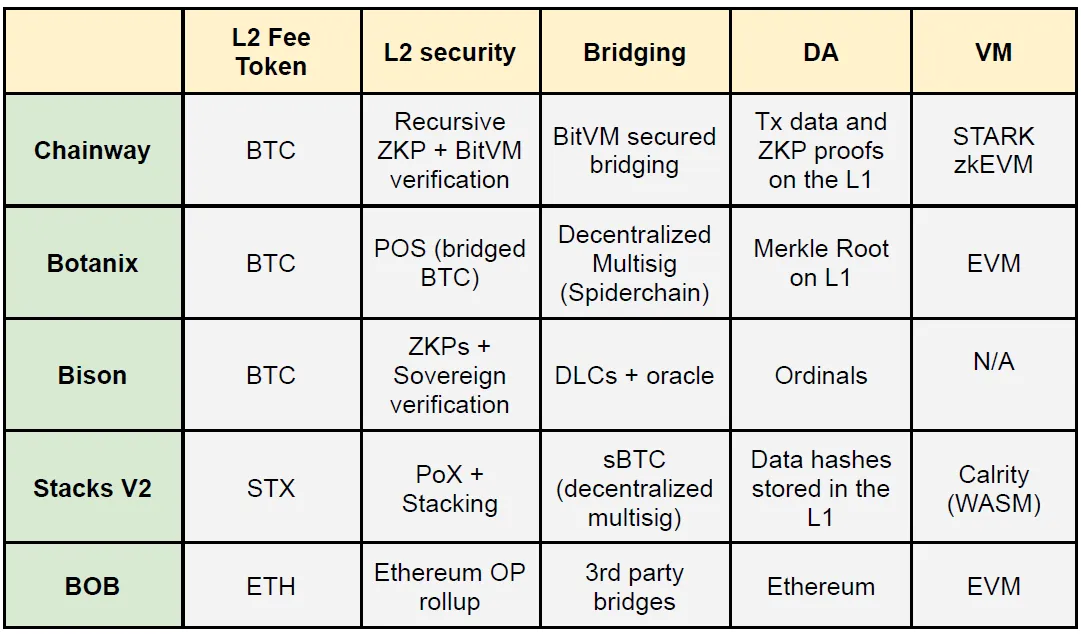
Summary comparison of Bitcoin L2 projects
Chainway
Chainway is building a zk rollup on top of Bitcoin. The Chainway rollup uses Bitcoin L1 as a DA layer to store ZKPs and state differences. Additionally, it employs proof recursion, allowing each new proof to aggregate previously published proofs from prior L1 blocks. The proofs also incorporate “forced transactions”—L2-related transactions broadcast on L1 to guarantee their inclusion in the L2. This design offers several advantages:
-
Forced transactions prevent the rollup sequencer from censoring L2 transactions, empowering users to force inclusion by broadcasting transactions on L1
-
Proof recursion ensures that each prover must verify the previous proof, creating a chain of trust and guaranteeing invalid proofs cannot be accepted on L1
The Chainway team is also exploring BitVM to ensure correct validation of proofs and peg-in/out transactions. Using BitVM to verify bridge transactions could reduce the multi-sig trust assumption to an honest minority model.

Botanix
Botanix is building an EVM-based L2 for Bitcoin. To increase alignment with Bitcoin, Botanix uses Bitcoin itself as a PoS asset for consensus. Validators earn fees from executing transactions on the L2. Additionally, the L2 uses inscriptions to store the Merkle root of all L2 transactions on L1. This provides partial security, ensuring L2 transaction logs cannot be altered, though it does not guarantee full data availability (DA).
Botanix handles L1-to-L2 bridging through Spiderchain, a decentralized network of multi-signature systems. Signers are randomly selected from a group of coordinators. Coordinators lock user funds on L1 and sign attestations to mint an equivalent amount of BTC on L2. Coordinators must post security bonds to qualify. In case of malicious behavior, these bonds are slashed.
Botanix has launched a public testnet, with mainnet planned for the first half of 2024.

Bison Network
Bison adopts a sovereign rollup approach for its Bitcoin L2. It implements a zk rollup using STARKs and leverages Ordinals to store generated ZKPs and transaction data on L1. Since Bitcoin cannot natively verify these proofs on L1, verification is delegated to users who run ZKP checks on their own devices. In this sense, Bison resembles an optimistic rollup—but without fraud proofs.
For BTC bridging, Bison uses Discrete Log Contracts (DLCs). DLCs are secured by L1 but depend on external oracles. These oracles read the state of the L2 and relay information to Bitcoin’s L1. If the oracle is centralized, it could potentially misuse assets locked on L1. Therefore, transitioning to a decentralized DLC oracle is crucial for Bison’s long-term security.
Currently, Bison does not support a specific virtual machine (VM). Its operating system implements certain contracts, such as token contracts, which can be proven by Bison provers.

Stacks V2
Stacks is one of the earliest projects focused on extending Bitcoin’s programmability. It is undergoing a major overhaul to better align with Bitcoin L1. This article focuses on the upcoming Stacks V2, expected to launch on mainnet in April 2024. Stacks V2 introduces two key innovations to strengthen its alignment with L1: Nakamoto Consensus and sBTC, an improved BTC bridging mechanism.
Under Nakamoto Consensus, Stacks blocks are mined by participants who post Bitcoin as collateral on the L1 network. When a Stacks miner creates a block, it is anchored to Bitcoin’s L1 and confirmed by Bitcoin’s PoW miners. After receiving 150 confirmations on L1 (approximately one day), a block becomes final and cannot be forked without forking Bitcoin L1. At that point, the miner receives STX rewards, and their BTC collateral is distributed to Stackers on the network. Thus, any Stacks block older than 150 confirmations derives its security from Bitcoin L1. For newer blocks (<150 confirmations), the chain can only fork if 70% of Stackers support the change.

The second major upgrade is sBTC, which enables a more secure method of bridging BTC to Stacks. Users deposit BTC into an L1 address controlled by Stackers on the L2. Once the deposit is confirmed, sBTC is minted on L2. To secure the bridged BTC, Stackers must lock STX worth more than the value of the bridged BTC as collateral. Stackers also handle redemption requests from L2, which are broadcast as L1 transactions. Upon confirmation, Stackers burn sBTC on L2 and collaboratively sign an L1 transaction to release the user’s BTC. For this work, Stackers receive the BTC collateral posted by miners as a reward. This mechanism is known as Proof-of-Transfer (PoX).
Stacks strengthens its alignment with Bitcoin by requiring key L2 operations—such as miner PoX deposits and redemption transactions—to be executed as L1 transactions. While this improves security and alignment, it may degrade user experience due to L1 volatility and high fees. Overall, the upgraded Stacks design resolves many issues present in V1, but weaknesses remain—including the use of STX as the native L2 asset and limited data availability, where only hashes of transactions and smart contract code are stored on L1.
BOB
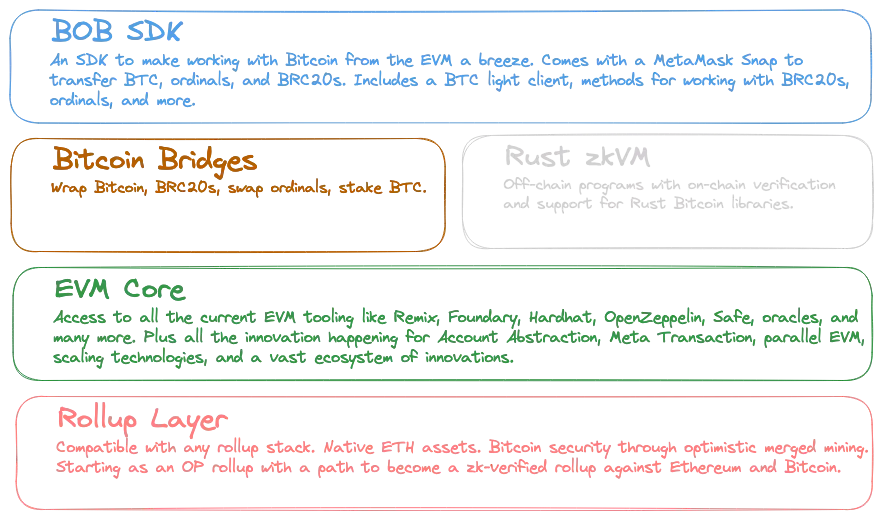
Build-on-Bitcoin (BOB) is an Ethereum L2 designed to align with Bitcoin. BOB operates as an Optimistic rollup on Ethereum and uses the EVM execution environment for smart contracts.
Initially, BOB accepts various bridged BTC types (e.g., WBTC, TBTC V2), but plans to adopt a more secure bidirectional bridge using BitVM in the future.
To differentiate itself from other Ethereum L2s that also support WBTC and TBTC, BOB is building features that allow direct interaction with Bitcoin L1. The BOB SDK provides a suite of smart contract libraries enabling users to sign transactions on Bitcoin L1. Execution on L1 is monitored by a Bitcoin light client, which adds block hashes to BOB to enable simple payment verification (SPV), confirming that submitted transactions were executed and included in L1 blocks. Another feature is an independent zkVM, enabling developers to write Rust applications for Bitcoin L1 whose correct execution can be verified on the BOB rollup.
Currently, BOB’s design resembles a sidechain more than a true Bitcoin L2, primarily because its security depends on Ethereum L1, not Bitcoin’s security model.
SatoshiVM
SatoshiVM is another project planning to launch a zkEVM Bitcoin L2. The project emerged suddenly in early January and launched a testnet shortly after. Little technical detail is publicly available, and the identity of the developers remains unclear. Limited documentation mentions using Bitcoin L1 for data availability (DA), censorship resistance through L1 transaction broadcasts, and BitVM-like fraud proofs to verify L2 zero-knowledge proofs.
Due to its anonymous nature, the project has sparked controversy. Some investigations suggest ties to Bool Network, an earlier Bitcoin L2 initiative.
Entrepreneurial Opportunities in Bitcoin L2
The Bitcoin L2 space presents numerous entrepreneurial opportunities. Beyond building the best Bitcoin L2, several other promising areas exist.
Bitcoin Data Availability (DA) Layer
Many upcoming L2s aim to increase alignment with L1, including using L1 for DA. However, given Bitcoin’s strict block size limits and long block intervals, L1 cannot store all L2 transactions. This creates an opportunity for a Bitcoin-specific DA layer. Existing networks like Celestia could be extended to fill this gap. Alternatively, developing an off-chain DA solution secured by Bitcoin’s security or BTC staking would enhance alignment with the Bitcoin ecosystem.
MEV Extraction
Beyond using Bitcoin L1 for DA, some L2s may delegate transaction ordering to BTC-staked sequencers—or even to L1 miners. This implies MEV extraction would be delegated to these entities. Since Bitcoin miners are ill-suited for this role, there is an opportunity for a Flashbots-like company focused on MEV extraction and private order flow for Bitcoin L2s. MEV extraction is closely tied to the VM used, and since no single VM dominates the Bitcoin L2 landscape yet, multiple players may emerge, each focusing on different Bitcoin L2s.
Bitcoin Yield Instruments
Bitcoin L2s will likely require BTC-denominated staking for validator selection, DA security, and other functions, creating yield opportunities for BTC holders. Currently, tools like Babylon allow users to stake BTC to secure other chains. As the Bitcoin L2 ecosystem grows, platforms aggregating native BTC yield opportunities will represent a significant market opportunity.
Conclusion
Bitcoin is the most well-known, secure, and liquid cryptocurrency. With the launch of spot Bitcoin ETFs, Bitcoin is entering an era of institutional adoption. Preserving BTC’s core properties as a permissionless and censorship-resistant asset is now more important than ever.
This goal can only be achieved by expanding the ecosystem of permissionless applications built around Bitcoin. Bitcoin L2s—and the entrepreneurial ecosystem supporting them—are essential components in realizing this vision.
Join TechFlow official community to stay tuned
Telegram:https://t.me/TechFlowDaily
X (Twitter):https://x.com/TechFlowPost
X (Twitter) EN:https://x.com/BlockFlow_News
 Alliance