ABCDE: Why Invest in Bitcoin L2 Project B² Network?
TechFlow Selected TechFlow Selected
ABCDE: Why Invest in Bitcoin L2 Project B² Network?
Gas fees for BTC asset transactions are expected to significantly decrease in the near future.
 Navigating Web3 tides with focused insights
Author: Kris, ABCDE
Bsquared Network (B² Network) is a leading Layer 2 project on BTC, successfully bringing smart contracts to Bitcoin and unlocking the potential value of BTC’s $832 billion market cap. The project provides a new platform for innovative applications in the BTC ecosystem such as DeFi, NFTs, and BTC-based derivative assets.
1. Unlocking Value in the BTC Ecosystem
Current issues with Bitcoin:
Bitcoin's performance limitations: Bitcoin was originally designed primarily for decentralization and security, not peak performance. Due to its 10-minute block interval and limited block size, Bitcoin's throughput is severely constrained, allowing only a small number of transactions per second. As the Bitcoin user base continues to grow, this issue becomes increasingly prominent, leading to network congestion, transaction delays, and surging transaction fees.
Bitcoin's lack of Turing completeness: Bitcoin's scripting language was intentionally designed to be non-Turing complete to enhance network security and simplicity. This means Bitcoin cannot natively execute complex smart contracts, limiting its potential in the decentralized application space.
Transaction fee issues: As network traffic increases, users must pay higher fees to ensure their transactions are prioritized. This dynamic makes small or frequent transactions economically impractical.
B² Network is an EVM-compatible Layer 2 on BTC, enabling developers and users to directly experience a native Bitcoin Layer 2 network:
- Provides an off-chain trading platform supporting Turing-complete smart contracts, improving transaction efficiency and reducing costs.
- Integrates zero-knowledge proof (ZKP) technology with Bitcoin's Taproot to enhance transaction privacy and security.
- Aims to transform Bitcoin into a dynamic platform that enables innovative applications like DeFi and NFTs, supporting not only traditional Bitcoin assets but also emerging Bitcoin derivatives.
2. B² Network’s Design and Advantages
B² Network’s technical architecture, shown below, consists of two layers: the Rollup layer and the Data Availability (DA) layer. B² Network aims to redefine how users perceive Bitcoin Layer 2 solutions.
B² uses ZK-Rollup as the Rollup layer. The ZK-Rollup layer employs a zkEVM solution responsible for executing user transactions on the second layer and generating corresponding validity proofs. User transactions are submitted and processed within the ZK-Rollup layer, where user states are also stored. Batched transaction proposals and generated zero-knowledge proofs are forwarded to the DA layer for storage and verification.
The data availability layer includes distributed storage, B² nodes, and the Bitcoin network. This layer is responsible for permanently storing copies of Rollup data, verifying the Rollup’s zero-knowledge proofs, and ultimately finalizing confirmation on Bitcoin.
Distributed storage is a key component of B² Network, serving as the repository for ZK-Rollup user transactions and associated proofs. By decentralizing storage, the network fundamentally enhances security, reduces single points of failure, and ensures data immutability.
To ensure data availability, B² also writes a Tapscript to the Bitcoin network in each Bitcoin block, as shown below. This script anchors the valid data path and zero-knowledge proofs of the Rollup during that period within the decentralized storage. This process is cost-effective, generating only six transactions per hour. During verification, users can cross-check transactions against the Taproot script data on Bitcoin Layer 1 to ensure the final trustworthiness of Rollup data.
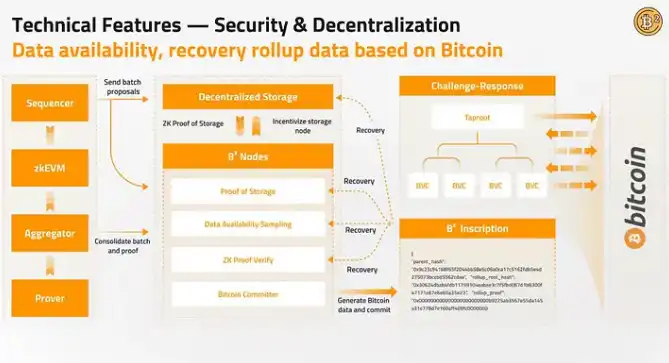
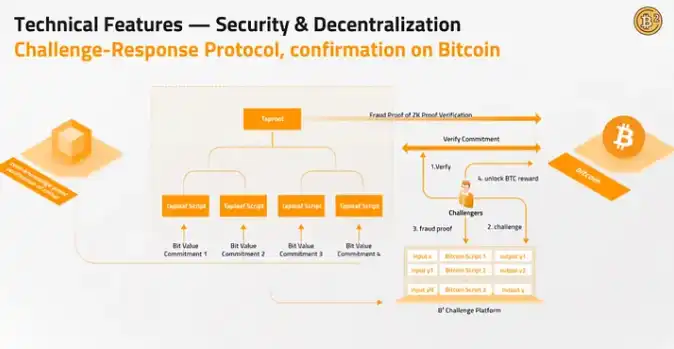
Additionally, B² Network converts the zero-knowledge proof verification process performed by B² nodes into bit commitments, writing these commitments into the Bitcoin network. Challengers can compare the results of ZKP verification with the bit commitments and, upon detecting malicious behavior, initiate challenges to unlock rewards, as illustrated below.
Through this design, B² Network achieves the following advantages:
- Reduces transaction costs by 50x and increases speed by 300x
- Compatible with familiar wallets such as Unisat, Xverse, Metamask, and OKX
- Leverages account abstraction, allowing access via native BTC (bc1p…) or ETH (0x) addresses
- Low fees:
-> The cost of the B² Rollup Layer covers operational expenses; when demand increases, RPC services and ZK-EVM provers can be scaled horizontally.
-> The cost of the B² DA Layer covers node operation costs for B² Nodes. Increased Rollup transactions do not impact B² Node costs.
-> Layer 1 costs refer to Bitcoin’s own transaction fees. Since one Layer 1 transaction is included in every Bitcoin block, this cost remains fixed.
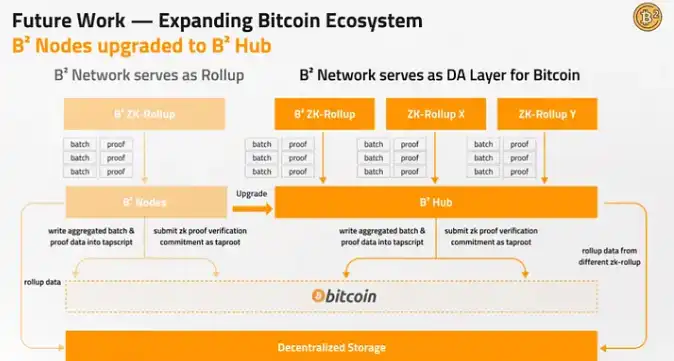
Notably, B² Network plans future upgrades: B² Nodes will evolve into B² Hub, which will serve all developers and projects building Layer 2 Rollups on Bitcoin by providing a data availability layer and state transition verification/proof system based on the Bitcoin network.
3. How B² Network Uses Economic Incentives to Activate the BTC Ecosystem
● Sequencer Staking: Sequencers participate in validator elections by staking BSQ, and users can delegate their BSQ to sequencers.
● Bitcoin Miner Incentives: Bitcoin miners receive BSQ tokens for contributing computational power. Miners participating in zk-proof generation earn BSQ (miner rewards will generate new income streams post-halving).
● Cross-chain Asset Incentives: When users bridge assets such as BTC, ETH, or BRC20 tokens to B² Rollup, they earn BSQ rewards (higher yields if assets are locked in Layer 2 DeFi protocols to provide liquidity).
● Storage Node Incentives: Storage nodes store copies of Rollup data and submit zk-proofs of storage to earn BSQ rewards.
● B² Hub Fees: BSQ will be the native token of B² Hub. Deploying ZK-Rollups using B² Hub will require paying transaction fees in BSQ.
● Governance: BSQ holders can vote on future protocol upgrades.
● Transaction Fee Discounts: Users paying gas fees with BSQ receive discounts.
● Revenue Sharing: Users staking BSQ can share in platform gas fee revenues.
4. Looking Ahead
B² Network introduces smart contracts to BTC, creating a new platform for innovative applications like DeFi, NFTs, and BTC derivative assets within the BTC ecosystem. In the near future, BTC transaction gas fees are expected to drop significantly, and the programmability of Layer 2 will bring richer use cases to Bitcoin.
Join TechFlow official community to stay tuned
Telegram:https://t.me/TechFlowDaily
X (Twitter):https://x.com/TechFlowPost
X (Twitter) EN:https://x.com/BlockFlow_News
 ABCDE
ABCDE