Understanding Polygon's upcoming blockchain aggregation layer, AggLayer: What are its advantages and use cases?
TechFlow Selected TechFlow Selected
Understanding Polygon's upcoming blockchain aggregation layer, AggLayer: What are its advantages and use cases?
AggLayer aims to unify liquidity, enabling developers to connect blockchains using ZK proofs.
 Navigating Web3 tides with focused insights
Compiled by: Felix, PANews
On January 25, Polygon Labs announced the upcoming release of AggLayer v1 in February, designed to connect blockchains with ZK proofs, enabling developers to link chains for unified liquidity and ensuring unified security across both modular and monolithic chains—including those within the Polygon ecosystem.
AggLayer will serve as a key component of the next-generation network Polygon 2.0. Unlike typical interoperability solutions, AggLayer aggregates ZK proofs from all connected chains. PANews explores the advantages and use cases of AggLayer.
Key Points:
-
Monolithic → Modular → Aggregated
-
AggLayer combines the benefits of integrated (monolithic) and modular architectures using ZK technology
-
AggLayer brings unified security and composability to aggregated chains without sacrificing sovereignty
-
Developers can connect any L1 or L2 chain to AggLayer, building a unified system that behaves like a single chain with unified liquidity and near-infinite scalability
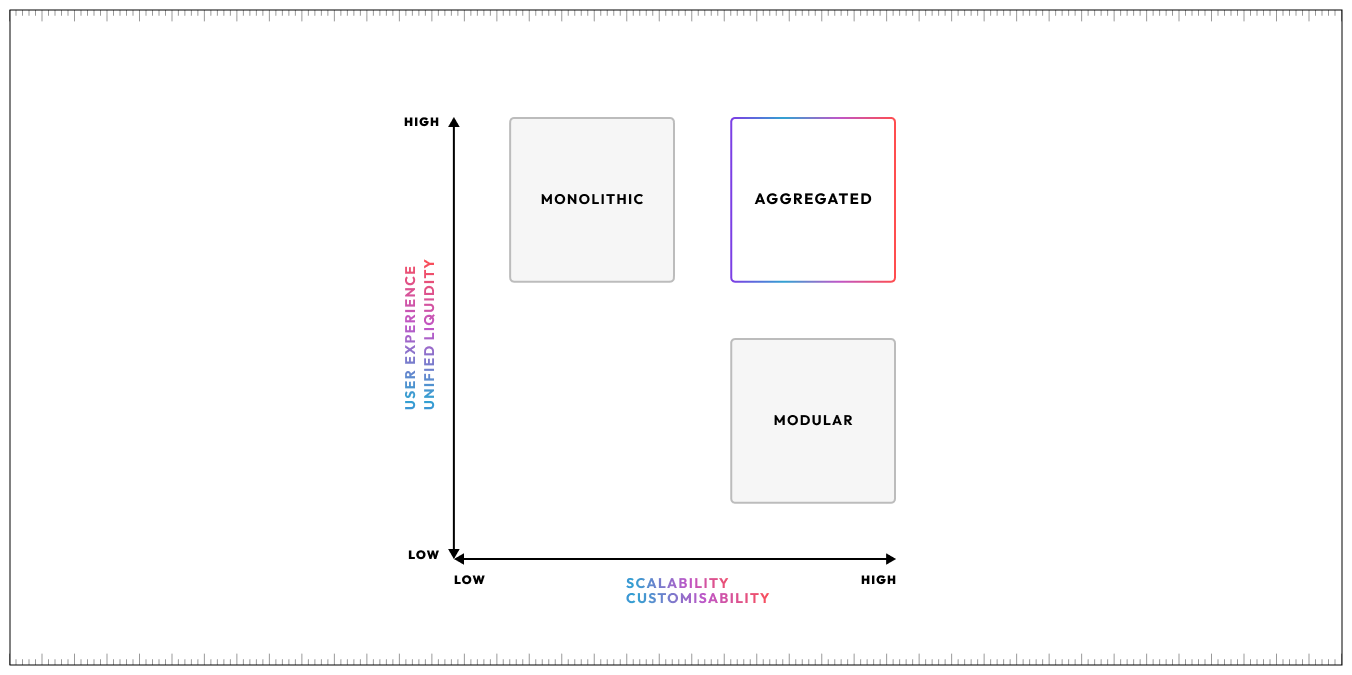
Current blockchains are not unified or highly scalable networks. Due to fragmented liquidity and state, users face scalability limitations and poor user experiences. The continuous emergence of new blockchains further complicates the issue. This environment resembles the pre-internet era—fragmented and lacking interoperability. Looking ahead, reviewing the history of blockchain architecture suggests that aggregated blockchains may be the answer for the next stage of blockchain evolution.
Monolithic and Modular
Monolithic chains are operated by nodes responsible for consensus, data availability, and execution, also serving as settlement layers. Such ecosystems are inherently unified and interoperable but have fundamental limitations. As scalability increases, so do hardware requirements for validators, leading to higher centralization and reduced security. Even the most efficient blockchains eventually suffer from state bloat (excessive data storage) and state contention, meaning chain performance degrades over time. Additionally, monolithic chains cannot offer meaningful customizability or sovereignty to ecosystem participants.
To address these challenges, developers have turned to modular architectures—for good reason. Modular frameworks resolve many inherent issues of monolithic systems, allowing multiple chains to operate independently and in parallel while maintaining sovereignty, enabling greater scalability and design diversity.
However, as an evolution from monolithic chains, modularity itself leads to fragmentation of liquidity and users, creating a multi-chain ecosystem that either requires cumbersome and inefficient bridging or sacrifices chain sovereignty. As a result, widespread adoption remains unattainable due to scattered liquidity and user bases.
Aggregation
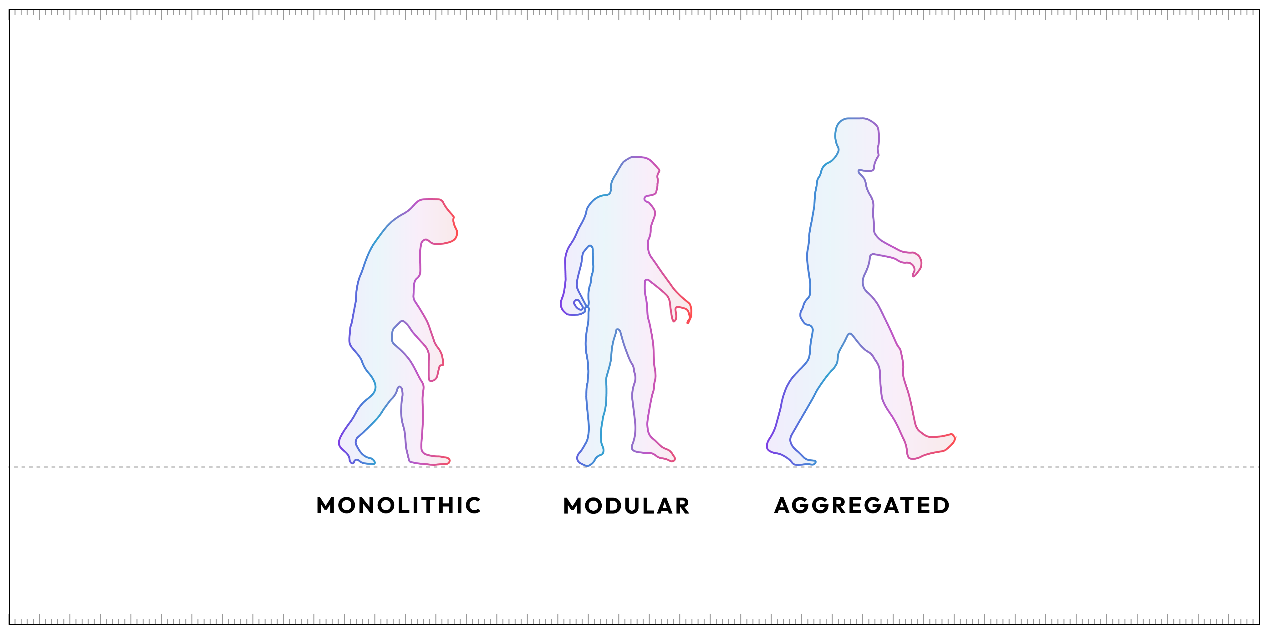
Aggregation delivers the sovereignty and scale of modular architectures along with unified liquidity and user experience, combining both approaches into a new paradigm. The decentralized protocol AggLayer unifies a fragmented blockchain environment into a network of ZK-secured L1 and L2 chains. Its core functions include:
-
Aggregating ZK proofs from all connected chains.
-
Securing near-instant atomic cross-chain transactions.
Advantages
As a core component of Polygon 2.0, AggLayer uses ZK proofs to create a seamless, aggregated environment that feels like a single chain—even though each chain in the ecosystem retains full sovereignty.
This enables near-instant atomic cross-chain transactions, unifies liquidity across the entire ecosystem, enhances capital efficiency, and significantly improves user experience.
For L1s and L2s connected to AggLayer: They maintain full sovereignty while gaining access to unified liquidity pools, helping bootstrap their own liquidity.
For dApp developers: Aggregation expands user reach. Users from other chains can interact with dApps regardless of which chain they're on, eliminating the need for complex bridging. Seamless cross-chain transactions mean real growth and broader access for dApp users across the aggregated network.
For end users: The experience is internet-like, without the hassle of frequent and complex bridging. In its final form, AggLayer will allow end users to execute cross-chain atomic transactions in under one second.
Use Cases
With AggLayer, a user X1 holding DAI can purchase an NFT on Polygon zkEVM without first bridging funds to Polygon zkEVM (Note: OKX and Polygon Labs recently launched "X1," a ZK Layer2 network). From the end user’s perspective, it feels like using a single chain—users can interact with dApps without even knowing they’re accessing another chain.
Users can also send assets to participate in activities on another chain. Suppose Alice is on a gaming chain built using Polygon CDK and connected to AggLayer. Alice’s wallet on the gaming chain holds ETH and DAI, and she wants to provide liquidity for these tokens on a DEX on X1. Alice can create a single transaction that bridges DAI and ETH and calls the LP function on X1 (paying all associated fees).
Future versions of AggLayer, starting with v2, will support asynchronous cross-chain transactions, expected to launch later this year.
Polygon primarily operates sidechains and Layer2 networks based on ZK-Rollups, such as Polygon zkEVM, and offers a software development kit called CDK. Many Layer2 networks have been built using this CDK toolkit, including Immutable, OKX, Astar, Canto, Palm Network, Aavegotchi, and IDEX. AggLayer is expected to facilitate the integration of all these chains under Polygon 2.0.
Join TechFlow official community to stay tuned
Telegram:https://t.me/TechFlowDaily
X (Twitter):https://x.com/TechFlowPost
X (Twitter) EN:https://x.com/BlockFlow_News
 PANews