Understanding Covalent Network: The Hidden Gem in the Decentralized Infrastructure Sector
TechFlow Selected TechFlow Selected
Understanding Covalent Network: The Hidden Gem in the Decentralized Infrastructure Sector
Covalent is a leading project in a rapidly growing sector, with all business metrics on a fast upward trajectory and revenue scaling rapidly.
 Navigating Web3 tides with focused insights
Author: Alex Xu
1. Report Highlights
1.1 Core Investment Thesis
Covalent is a leading project in a rapidly growing sector, with key business metrics on a steep upward trajectory and revenue scaling quickly. In terms of income level, Covalent generates several times more revenue than The Graph, the current market leader in this space, suggesting it may have achieved stronger product-market fit (PMF). However, since its revenue streams are not yet on-chain, there may be significant information asymmetry among market investors.
On the new product front, Covalent is developing the Ethereum Wayback Machine—a long-term solution for blob data availability (blobs being a new data structure introduced by Ethereum's EIP-4844 upgrade, used to store non-permanent data off the main chain)—which aligns closely with current market trends.
The founding team has relevant professional experience and entrepreneurial background aligned with the sector. The investor base includes nearly all major industry players such as public blockchain foundations, top-tier exchanges, and key customers.
1.2 Key Risks
-
If larger centralized blockchain data service providers—such as Alchemy, Infura, or QuickNode—expand from their RPC services downstream into the data indexing space and offer similar indexing solutions, they could pressure Covalent’s market share and pricing power. For example, Alchemy acquired the data indexing platform Satsuma in September 2023.
-
Data indexing remains a relatively niche sector with low visibility among mainstream investors. This lack of attention may persist unless the sector sees new narrative catalysts.
1.3 Valuation
Compared to The Graph, the category leader, Covalent offers significantly more attractive valuation metrics.
2. Project Overview
2.1 Business Positioning
Covalent provides blockchain data indexing services, offering a unified API that allows developers to query data across multiple blockchains.
Before diving into data indexing, it's important to briefly explain its upstream components—blockchain nodes and blockchain RPCs.
Blockchain Nodes:
Blockchain nodes are the foundational elements of a blockchain network. Each node maintains a full (or sometimes partial) copy of the blockchain. Through consensus mechanisms, nodes synchronize and validate all transactions and blocks, ensuring data consistency and security across the network.
Blockchain RPC:
RPC (Remote Procedure Call) is an interface that enables external clients to interact with blockchain nodes. It acts as a middleware layer, providing standardized commands or function calls that allow developers to read data, send transactions, execute smart contract functions, etc.
Blockchain Indexing:
Blockchain indexing is a data service built atop blockchain nodes and RPCs. It retrieves raw blockchain data via RPC, processes and organizes it, and builds an optimized query database. This allows users and applications to retrieve needed information quickly without performing complex direct queries on the blockchain.
In short, the relationship between nodes, RPCs, and indexing services is: blockchain nodes are the source of data, RPCs are the access channel, and indexing services are the data processing layer that optimizes retrieval and usability.
In the blockchain indexing space, there are both centralized providers—such as @Bitquery_io, @etherscan, @MoralisWeb3, @blockvisionhq—and decentralized ones, with The Graph being the most well-known.
Additionally, in Messari’s 2023 DePIN sector mapping, data indexing was included under the “Digital Resource Networks” category of DePIN, with both The Graph and Covalent featured as representative projects.

Image Source: Messari
2.1.1 Target Users
Covalent primarily serves B2B clients, including DApps (e.g., various DeFi protocols), as well as centralized crypto companies such as Consensys (dashboard), CoinGecko (asset pricing), Rotki (tax tools), NFTX (NFT curation), and Rainbow (crypto wallet).
2.1.2 Value Proposition
The economic scale of the blockchain world is growing exponentially: more ecosystems, more L1s, and more rollups.
More users and economic activity mean more transactions and more data—all of which is stored in a distributed manner across blockchain nodes. While this ensures decentralization, openness, and accessibility, it also results in complexity, volume, and inefficient data retrieval. Ethereum’s blockchain data alone exceeds 1TB, facing scalability issues in "reading and parsing."
This becomes even more complicated when applications (like wallets, NFT markets, or complex Web3 products) need data from multiple chains, each with different output formats. Covalent addresses this by building a protocol that standardizes data from various blockchains—the so-called "Unified API." This allows users and dApps to access structured on-chain data seamlessly and integrate it into existing products without handling complex data processing themselves.
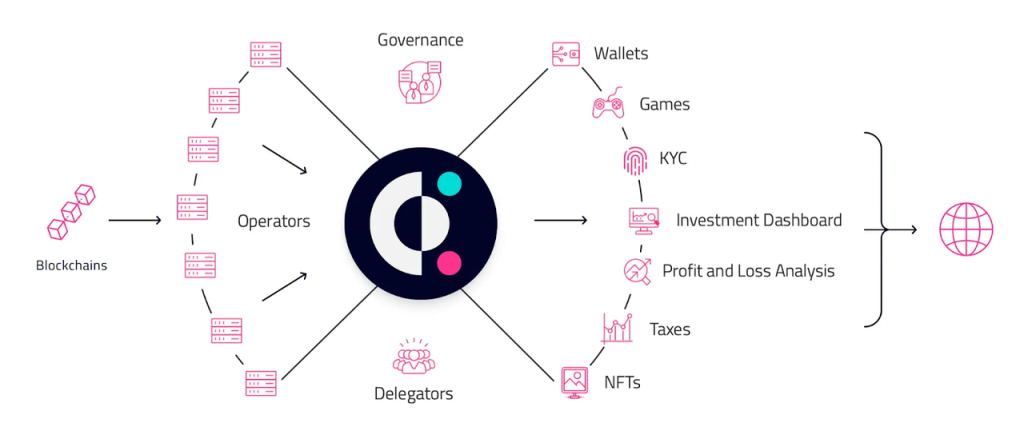
Image Source: Covalent Documentation
The blockchain indexing layer should be maximally flexible to accommodate diverse future products and services, while minimizing trust assumptions. Covalent’s value proposition includes:
-
Verifiable Data: Cryptographic proofs enable trustless verification. Covalent allows anyone to become a Block Specimen producer (a new data structure derived from raw chain data), secured through staking and slashing mechanisms, enabling infrastructure decentralization.
-
Scalability: Covalent is a plug-and-play solution for new EVM chains and appchains, requiring less than a week to onboard. For non-EVM chains, only adherence to the Block Specimen standard for extracting data from chain clients is required.
-
Data Composability: Covalent’s standardized data model allows developers to wrap, mix, and fork data like assets, regardless of the source chain.
-
No-code Solution: Covalent’s Unified API offers no-code capabilities, empowering analysts, developers, and non-technical users to work at the visualization layer. Users can create pivot-table-like views on raw data to extract insights such as 24-hour trading volume, NFT floor price history, and aggregated cross-chain wallet balances.
-
Flexibility: Covalent follows the Extract-Load-Transform (ELT) data integration pattern—extracting data from blockchains and loading it into data warehouses, where customers transform it during queries as needed. In contrast, The Graph’s subgraph-based indexer uses Extract-Transform-Load (ETL), transforming data upfront for specific use cases, resulting in lower flexibility.
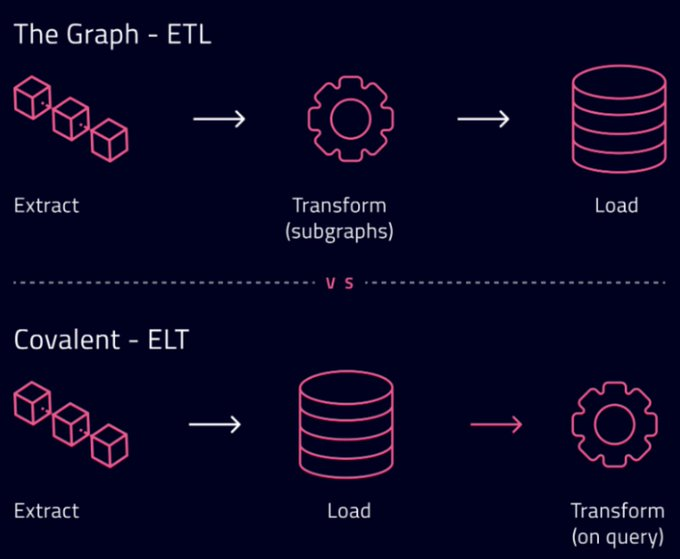
Image Source: Covalent Documentation
2.2 Business Logic
2.2.1 Product Mechanism
Covalent’s core product is the Unified API, which transfers data between two modules: client and server. Through the API, servers control their systems and respond to client requests. Users (e.g., application developers or analytics firms) extract data from the API, while data providers (currently mainly Covalent itself, but will open to third parties later) retain ownership. While many companies have built server-side infrastructure to provide blockchain data access, most proprietary solutions only reach the RPC layer, often retrieving unprocessed raw blockchain data.
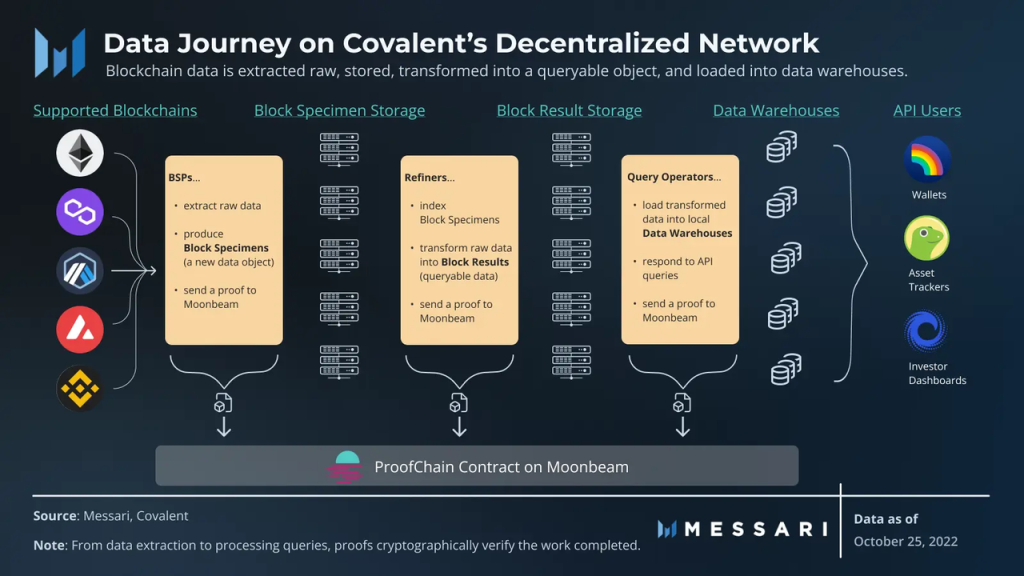
Covalent’s business flow, Image Source: Covalent: A Unified API for Retrieving Blockchain Data
“Raw blockchain data” refers to information directly queryable via RPC from the blockchain. In contrast, deeper analysis—complex queries, relational data analysis, historical trend analysis—requires advanced data processing and indexing services like those provided by Covalent and The Graph.
Covalent’s protocol goes deeper: it extracts data from various blockchains, uploads it to storage instances*, indexes and transforms the stored data objects, and loads it into local data warehouses for API users to query. Throughout this process, it sends proofs to the Moonbeam network to verify each step. In short, Covalent cryptographically secures and standardizes all extracted blockchain data, enabling developers to query any chain uniformly—hence the term “Unified API.”
Storage Instance: A data instance includes database software and associated memory structures and background processes. A database server can run multiple instances, each managing its own data and processes.
Based on the Unified API, Covalent has developed toolkits to facilitate customer integration and frontend presentation.
GoldRush
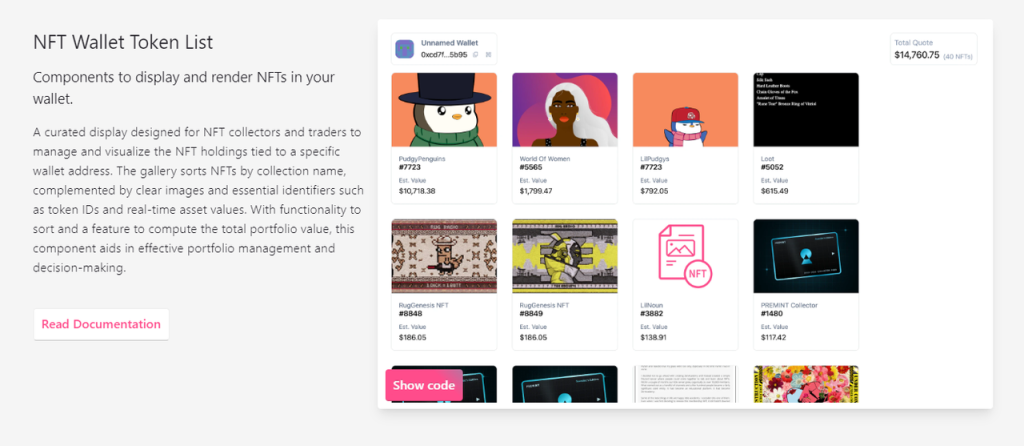
GoldRush is Covalent’s open-source, modular blockchain explorer and toolkit, designed for integration into various DApps and Web3 applications.
Use Cases:
-
NFT marketplaces like Blur or NFTx. Every NFT transaction on these platforms currently links out to explorers like Etherscan, redirecting users away from the platform, interrupting user experience, and exposing them to overly technical interfaces.
-
Web3 games face similar challenges: users shouldn’t need to pause gameplay to check transactions on a blockchain explorer. Many in-game transactions are unique and complex, details that standard explorers fail to capture or display intuitively.
In such scenarios, platforms like Blur or Web3 games can directly integrate Covalent’s GoldRush module into their apps, presenting data in a user-friendly way and improving interaction.
Now that we’ve clarified Covalent’s industrial mechanism, let’s examine how it integrates with its tokenomics.
2.2.2 Decentralized Design
Covalent’s decentralized network involves multiple participants called “operators.” Currently, two operator roles are active: Block Specimen Producers (BSPs) and Refiners. As of December 2023, Covalent had 15 BSPs, including Chorus One, Woodstock, StakeWithUs, and 1kx.
BSPs extract raw blockchain data and create a data object called a Block Specimen. The BSP standard ensures blockchain data is composable and reusable outside execution environments. Then, BSPs upload the Block Specimen to a storage instance, generate a hash (or proof) of the stored specimen, and publish the proof to Covalent’s ProofChain smart contract on Moonbeam. Once recorded on Moonbeam, other network nodes can verify the BSP’s work.
The Moonbeam-based proof and storage solution is temporary. Covalent plans to launch its own L1 for accounting and migrate CQT staking to Ethereum, with migration expected to begin by the end of February this year.
Four operator roles are defined in Covalent’s decentralized data indexing network:
-
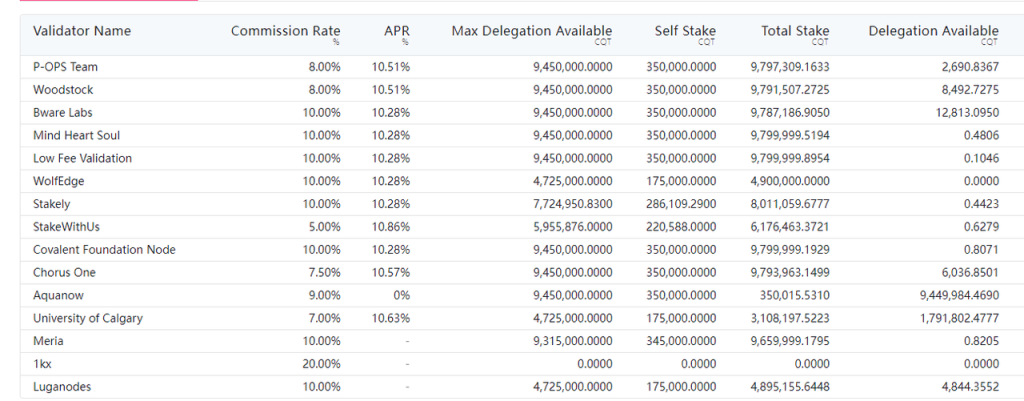
Block-Specimen Producer (BSP): Live. When BSPs upload raw blockchain data to storage instances, they can either run the instance locally or pay a storage operator to do so. Storage operators should increase data availability by loading and storing data via IPFS. Below is the current list of BSP stakers, with APR above 10%.
-
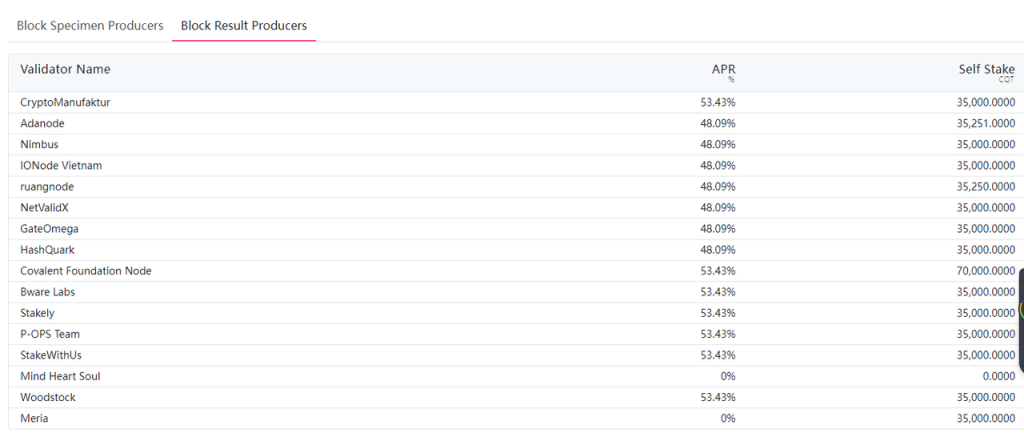
Refiner: Live. Refiners retrieve Block Specimens from storage instances, convert raw data into query-ready objects called Block Results, and publish proofs validating their work. Below is the list of current Refiner stakers:
-
Query Operator: Before responding to API queries, Query Operators load transformed data into local data warehouses.
-
Delegator: After each proof is confirmed by a Delegator for a given period, network operators receive payment for fulfilling their duties. Prior to payout, a set of Delegators is randomly selected from the overall pool of operators to serve as auditors for that period.
Currently, all operators are whitelisted by the Covalent Foundation, but the network will gradually open to more applicants:
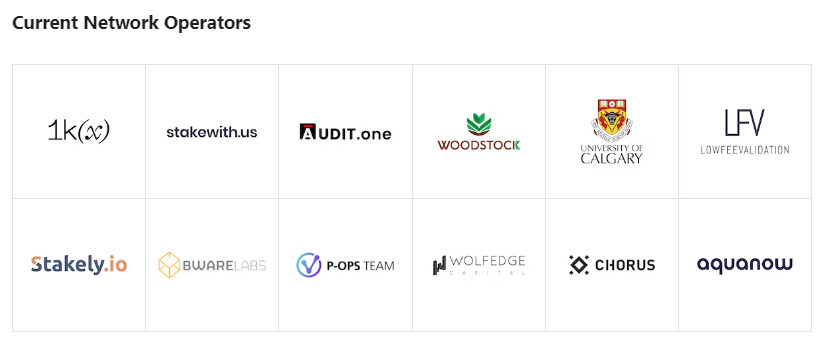
All these operator roles collaborate in a distributed, censorship-resistant manner to achieve data storage, classification, query response, and accountability. In the final network design, each role will have corresponding token incentives.
2.2.3 Other Services
Ethereum Wayback Machine (EWM)
After Ethereum’s EIP-4844 upgrade, a new data structure called “blob” will be introduced. Blobs are used to store information that doesn’t need permanent on-chain storage but must be temporarily available across the network. Examples include:
-
Batch Transaction Data: Applications processing large volumes of transactions (e.g., CEXs batching withdrawals) can include this data in blobs for efficient bulk processing.
-
Zero-Knowledge Proofs: Complex cryptographic proofs like zk-SNARKs may require auxiliary data. Blobs can store this supporting information, enabling verification without consuming excessive main chain space.
-
Off-Chain State: Scalability solutions like state channels or sidechains may periodically submit snapshots or proofs of off-chain state to Ethereum. Blob data can contain these state records.
-
Large Datasets: DApps handling large datasets—such as decentralized social media or data markets—can use blobs to store user-generated content or other large files.
-
Batch Signature Information: In cases requiring validation of many signatures—e.g., multi-sig or batch authorization—blob data can store the signature bundle.
As temporary data stored on Ethereum, blobs’ retention duration and whether they are preserved at all are determined by individual nodes—leading to the “long-term data availability problem” for blob data.
Covalent’s Ethereum Wayback Machine is an open-source solution designed to solve this long-term data availability issue. Its goal is to provide decentralized, cryptographically secure historical data for blob consumers—an effective DA (data availability) solution.
Due to space constraints, a detailed technical explanation of the Ethereum Wayback Machine is omitted here. What’s important to know is that it leverages Covalent’s network and indexing mechanisms to ensure the accessibility and availability of historical blockchain data. Using the Wayback Machine, anyone can reconstruct a complete representation of the blockchain and build databases with normalized schemas.
For more information about the Ethereum Wayback Machine, visit this link.
The product is currently under development and not yet live.
Notably, Ethstorage, another project targeting decentralized blob storage, raised $7 million at a $100 million valuation in a seed round in July 2023.
Based on the above discussion of product mechanics and decentralization design, we can now summarize Covalent’s business model.
2.2.4 Business Model
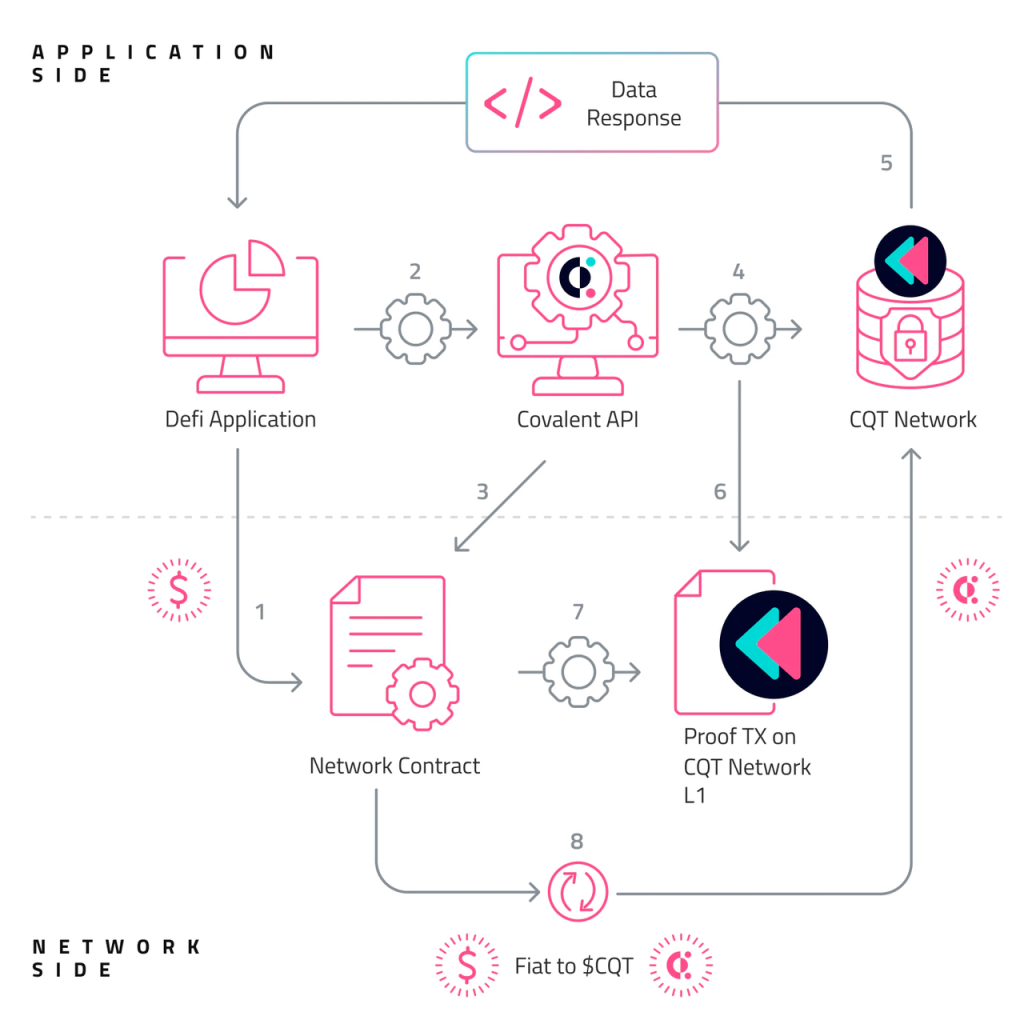
Covalent’s business model relies on demand-side users paying for data access (initially processed through Covalent), with fees distributed to network operators who must stake the project’s token, CQT, to provide services. The process works as follows:
When individuals make API calls, they pay in stablecoins priced in USD, such as USDC. The contract then uses these USDC to buy CQT on the secondary market, creating demand for the token. The purchased CQT is then distributed to node wallets as rewards for fulfilling API queries.
-
Applications/developers deposit stablecoin assets into Covalent’s protocol smart contract.
-
The application queries the Covalent API.
-
Before sending the query request to operators, the system checks if the account has sufficient funds.
-
The query request is sent to Query Operators to fulfill.
-
Requested data is returned to the application.
-
Moonbeam ledger records which data was used, which operators fulfilled the request, and their costs.
-
Reconciliation occurs between network contracts, CQT, and completed work.
-
USD funds are deducted from the developer’s account, converted into CQT via market purchase, and settled against validators’ pending balances.
The higher the network’s profits, the greater the incentive for operators to join, increasing demand for CQT staking. This creates buying pressure on CQT. However, operators selling CQT for stablecoins also create selling pressure.
Clearly, Covalent’s business performance depends entirely on external demand for data indexing—the more developers and institutions demanding data, the better its growth.
Note: The mechanism of “converting revenue into CQT purchases for distribution to operators” has not yet been activated. However, according to official statements, this switch will be turned on soon and the process will be visible on-chain. Buybacks will occur on Sushiswap, where CQT currently has the deepest liquidity, allowing public oversight.
So, what is Covalent’s current business status? Let’s analyze based on supported chains, user metrics, pricing, and customer base.
2.3 Business Status
2.3.1 Number of Blockchains Supported
Covalent currently provides comprehensive historical transaction data for over 211 blockchains.
2.3.2 User Count
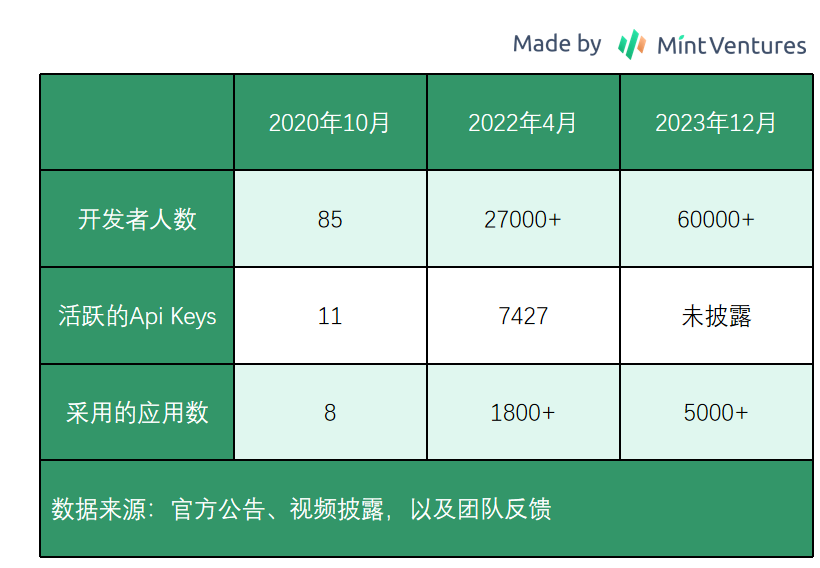
2.3.3 Pricing and Revenue
1. Pricing Model
According to Covalent’s pricing sheet, the smallest billing unit is “credits,” with different query types consuming different credit amounts.
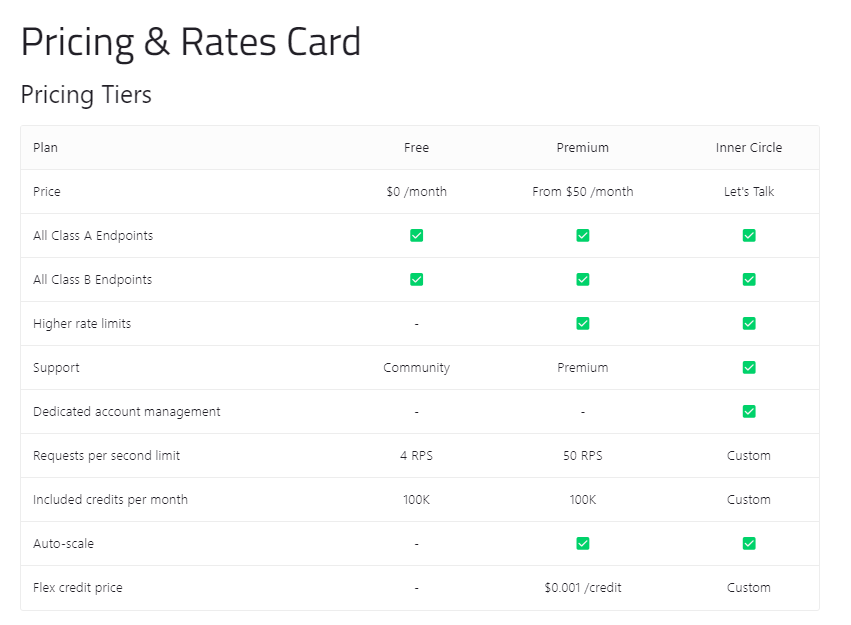
Let’s estimate the monthly indexing cost for a small wallet project:
This wallet supports three chains: Ethereum, Polygon, Optimism, with daily active users as follows:
-
Ethereum (7,000 daily active users)
-
Polygon (3,000 daily active users)
-
Optimism (1,000 daily active users)
The app uses the balances_v2 endpoint to show balance data, consuming 1 credit per call.
Total consumption: 11,000 credits/day → 330,000 credits/month.
Assuming it’s a premium user: $50/month + (330,000 - 100,000) × $0.001 = $230/month.
2. 2023 Revenue and Comparison with The Graph
Regarding Covalent’s 2023 revenue, I verified with the official team, and received the following data:
-
Covalent generated $600K in data indexing revenue in 2023—the first full commercialization year, starting from $0 in January.
-
Over 150 paying users, with institutions and projects forming the majority.
-
Expected 100% revenue growth in 2024.
In comparison, The Graph, the leader in decentralized indexing, has a trailing 3-month annualized revenue of just over $100K.
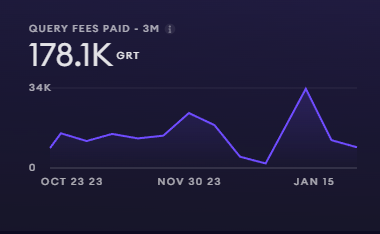
Additionally, the team stated that Covalent’s revenue stream data will go live in the coming weeks, allowing users to observe real-time revenue flows.
2.3.4 Customer Base
Covalent’s customers are primarily B2B, including:
-
Wallets & Dashboards: Popular wallets and dashboards like Rainbow and Zerion use Covalent API to aggregate historical DeFi and NFT asset balances and P&L for users.
-
Market Data: Platforms like CoinGecko display price trends, liquidity, and asset ROI.
-
Cross-chain Projects: Cross-chain liquidity aggregators (e.g., Li Finance) use it to access asset prices across networks.
-
Crypto Tax Tools: Portfolio trackers (e.g., Rotki) extract cross-chain historical balances and pricing for tax reports.
-
DeFi Protocols: Aave, Balancer, Paraswap, Curve, Lido, Frax, Yearn use it to consolidate user data across chains.
-
CEXs: Exchanges extract historical transaction data for compliance reporting.
-
Traditional Finance & Custodians: Fidelity (top wealth manager), EY (Big Four accounting), Jump Crypto.
-
AI Training & Decision-Making: Provides on-chain data to AI models for projects like Nomis.cc (multi-chain identity/reputation) and Network3 (distributed computing), aiding model training and decision-making.
-
Other Internet Services: Financial websites wanting to display NFT/DeFi positions across networks. These clients can leverage Web3 without investing in infrastructure (running nodes, writing contracts), simply accessing data via SQL.

-
Analysts: Covalent’s no-code solution reduces friction for analysts building complex dashboards for compliance, risk, or tax purposes. In analyst mode, requests and responses resemble Excel, exportable to CSV or Tableau.
Additionally, Consensys—the parent company of MetaMask, Infura, and Linea—is also a Covalent customer.
Beyond direct sales, Covalent has partnered since last year with upstream RPC providers like Chainstack, QuickNode, and Infura, offering indexing services through their channels. Revenue from the Infura channel alone has already reached six figures.
2.3.5 Business Flywheel
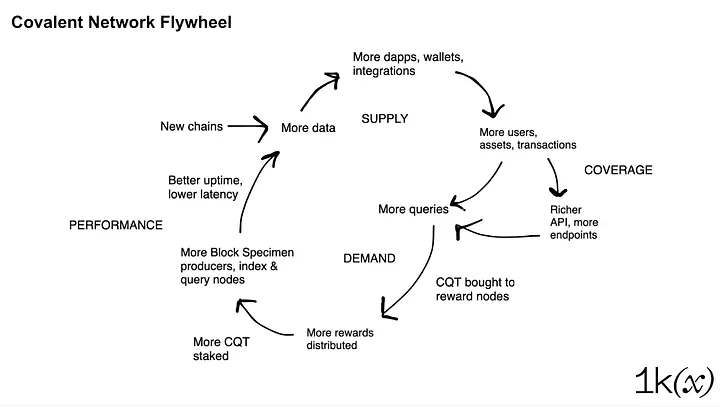
In a report by 1KX—one of Covalent’s investors—the firm envisioned a self-reinforcing flywheel for Covalent: Low-latency, rich data indexing → More B2B clients, dApps, wallets, and institutions integrating → More C-end user queries → Higher indexing volume and richer indexing needs → More CQT buybacks and rewards → More network nodes and CQT staking → Better, richer data services and lower latency.
2.4 Team, Funding, and Partnerships
2.4.1 Founders and Team
Covalent was founded and is led by Ganesh Swami and Levi Aul.
Ganesh is a physicist-trained data expert with over 10 years of analytics experience. His first company went public on the NYSE, and he is also a professional Everest climber. Levi established Canada’s first Bitcoin exchange and was part of the IBM team that built CouchDB. The team currently numbers around 40–60 members, including network architects, data scientists, and software engineers.
Overall, the founders’ backgrounds are highly aligned with the project, with strong prior entrepreneurial success.
2.4.2 Funding History
The project has raised four rounds totaling approximately $15.5 million.
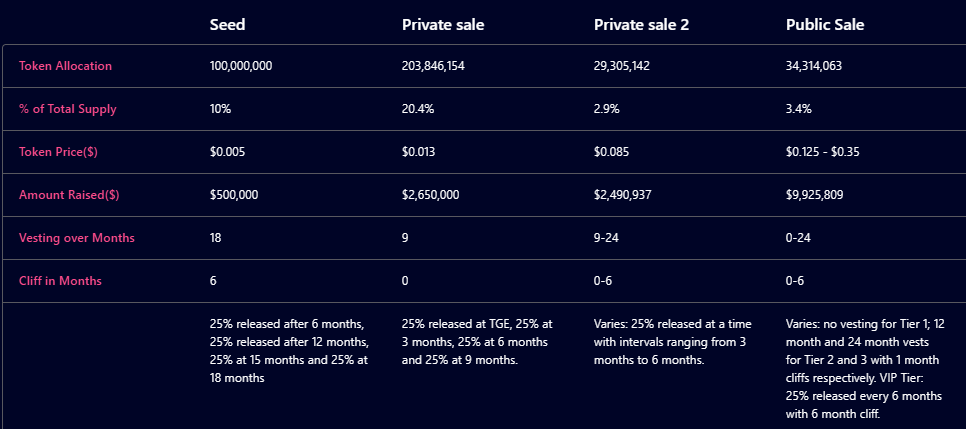
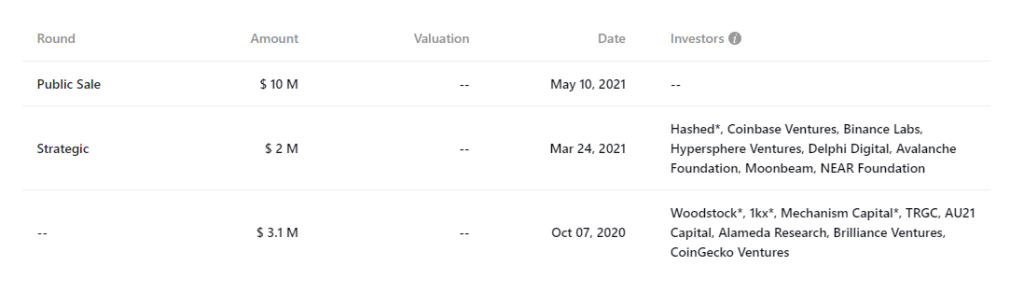
Image Source: rootdata
The investor roster is impressive, including top Web3 firms like Hashed, Delphi Digital, and major exchanges Binance and Coinbase.
However, the last funding round was in May 2021, over two years ago.
2.4.3 Key Partnerships
Beyond public chains and customers, Covalent announced a partnership with Infura at the Istanbul Decentralized RPC Summit in November 2023. Other partners include Microsoft, Tencent, and Pocket Network.
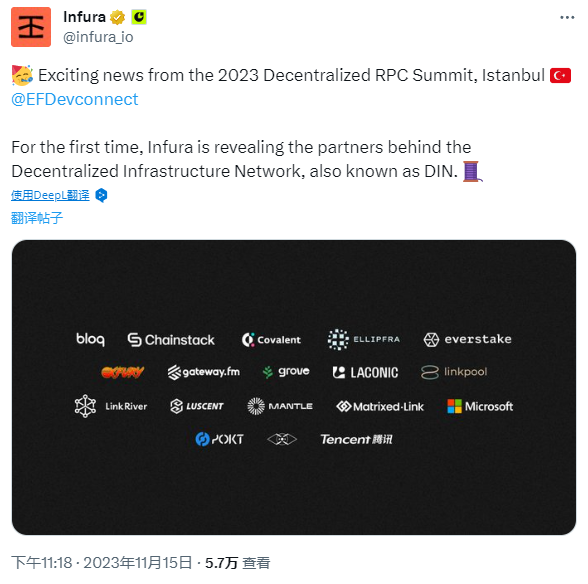
Through this collaboration, Infura will integrate Covalent’s API into its existing suite, giving developers seamless, efficient access—lowering barriers and accelerating development cycles.
2.5 Project Summary
Overall, Covalent is a leading project in a high-growth sector, with rapidly rising business metrics and expanding revenue. In terms of revenue, Covalent earns several times more than The Graph, the current category leader, suggesting superior product-market fit. However, because its revenue streams are not yet on-chain, there may be significant information asymmetry among investors.
On the innovation front, its Ethereum Wayback Machine—a long-term blob data availability solution—aligns perfectly with current market trends.
The founding team has relevant expertise and entrepreneurial background, and the investor base includes nearly all major industry players—public chain foundations, top exchanges, and key customers.
3. Token Model
3.1 Token Supply and Distribution
Covalent has a total token supply of 1 billion CQT, allocated as follows:
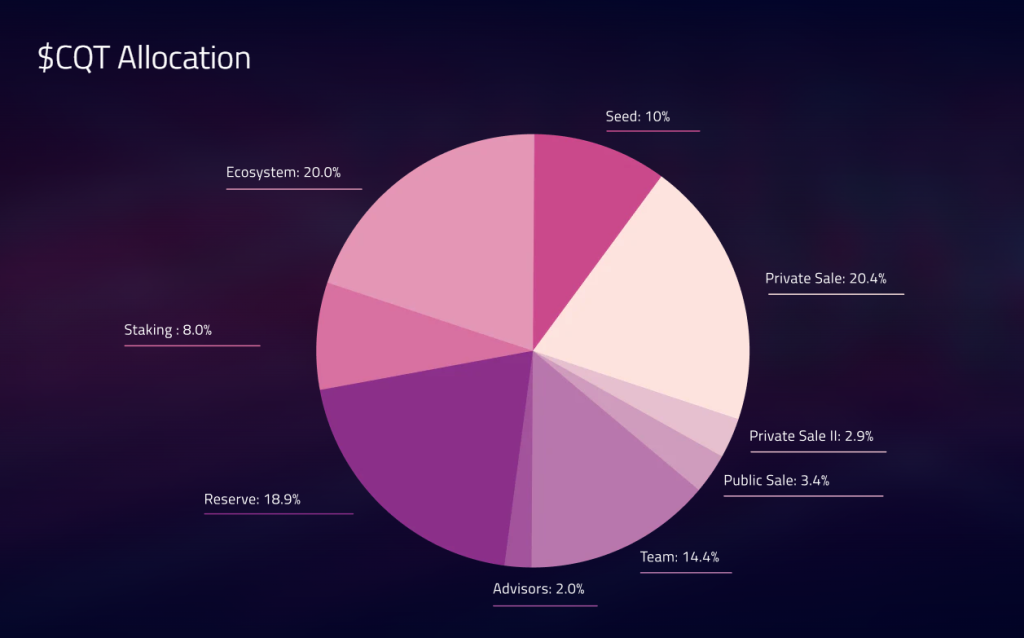
-
Token Sale: 33.4%
-
Team & Advisors: 16.4%
-
Reserve: 18.9%
-
Staking Rewards: 8%
-
Ecosystem: 20%
Current circulating supply is 62.5%, at the following release stage:
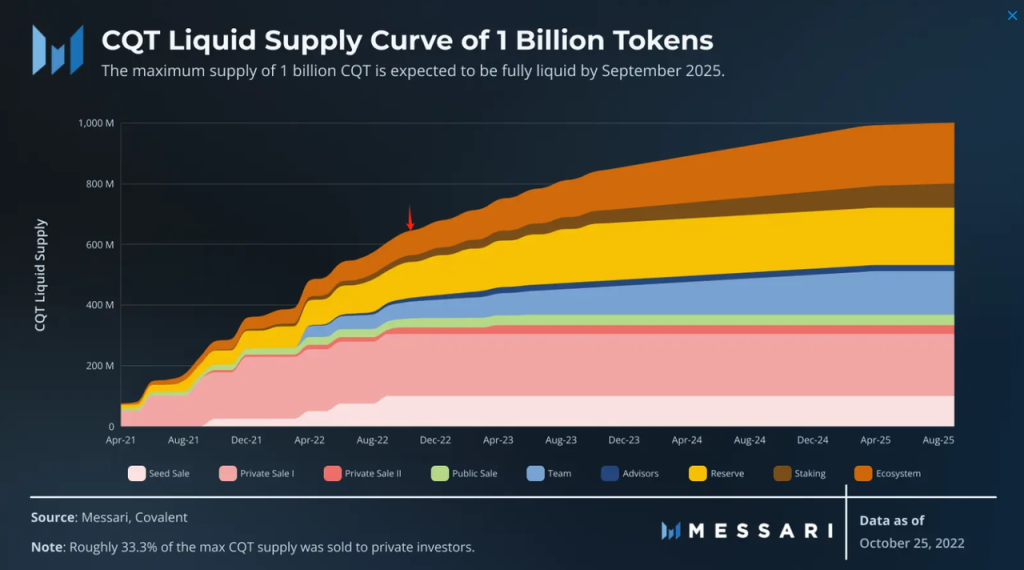
3.2 Token Use Cases and Demand
-
Governance: Token holders vote on proposals to change system parameters, such as new data sources, geographic requirements, and data modeling rules.
-
Staking & Validation: $CQT is a staking asset. Validators earn fees by ensuring data integrity. Token holders can delegate to validators and earn yield through security participation.
-
In-system Economic Settlement: Paying users buy data services with stablecoins, which are then swapped for CQT on the open market and distributed to staked, operating network nodes.
-
Staking Rewards: Staking CQT earns additional rewards, though this incentive lasts only four years—designed to bootstrap early network participation. Long-term operations will be funded by real user demand and payments.
Overall, the tokenomics design is sound, especially considering enterprise clients’ preferences: corporate users prefer not to hold volatile tokens like CQT on their balance sheets.
4. Market and Competitive Landscape
4.1 Market Segmentation
The on-chain data market has many participants and layers, requiring segmentation.
Providers offering basic, native on-chain data via RPC include centralized players like Infura, Alchemy, QuickNode, and decentralized ones like Pocket Network. These are upstream of Covalent—Covalent’s operators also source raw data from them.
Covalent operates at the data indexing layer—processing and re
Join TechFlow official community to stay tuned
Telegram:https://t.me/TechFlowDaily
X (Twitter):https://x.com/TechFlowPost
X (Twitter) EN:https://x.com/BlockFlow_News
 Mint Ventures