Modular Blockchain "Division of Labor" Scaling: Who Will Be the Next TIA?
TechFlow Selected TechFlow Selected
Modular Blockchain "Division of Labor" Scaling: Who Will Be the Next TIA?
Many modular blockchains have received ecosystem investments from CEXs.
 Navigating Web3 tides with focused insights
Author: Weilin
Ethereum Layer2 networks, known for their efficiency and scalability, have become crucial underlying infrastructure in the Web3 world. Meanwhile, another group of Layer1/Layer2 networks based on modular architectures is emerging as a promising solution for scalability, claiming an increasingly important place within Web3 infrastructure and demonstrating strong vitality.
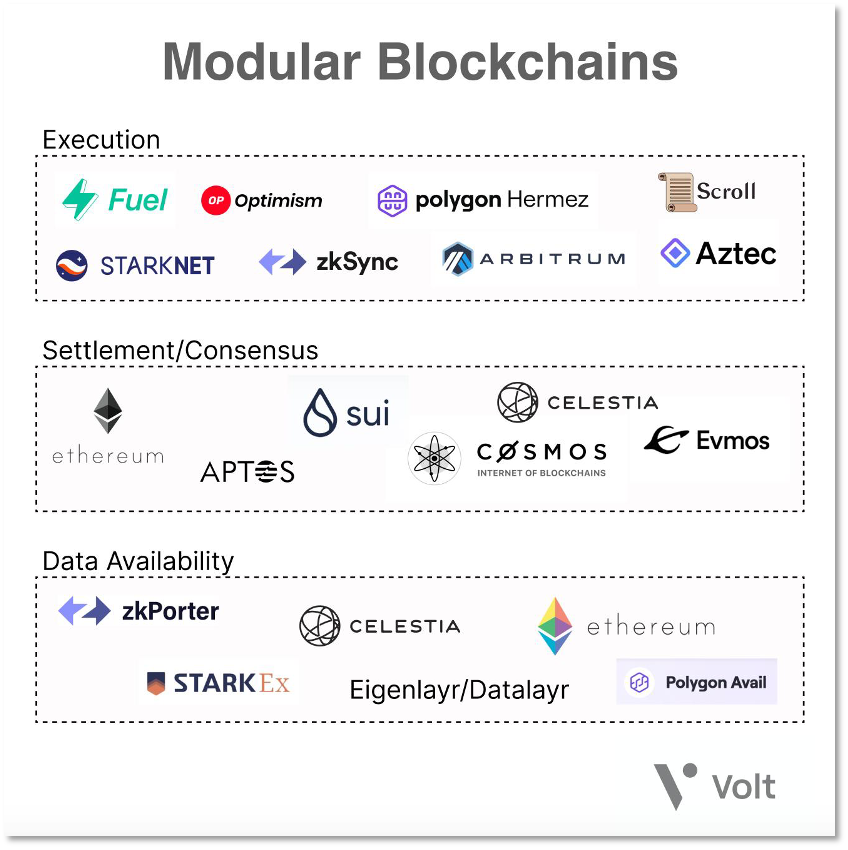
Modular blockchains aim to achieve decentralized scaling by outsourcing at least one of the four layers—execution, settlement, consensus, or data availability—to external chains, without compromising network security.
Since its mainnet launch on October 31 last year, Celestia—the first modular blockchain network—has seen its native gas token TIA rise from around $2 to nearly $16 by January 22. In less than half a year, it achieved a stable increase of 717%. With a market cap of $2.5 billion, Celestia ranks 37th on the cryptocurrency market capitalization list, becoming the only modular blockchain to enter the Top 50 and revealing the sector's potential to investors.
In 2023, several modular blockchain projects secured new funding, including Eclipse, AltLayer, Sovereign, and Dymension. Today, we will introduce the concept and application scenarios of modular blockchains and review high-potential projects attracting significant attention.
Modularity Solves the "Impossible Triangle" Problem
From the original design perspective, both Bitcoin and Ethereum are monolithic blockchains—distributed ledger networks that record valid transactions in blocks and achieve decentralization, trustlessness, and immutability through specific consensus mechanisms, with each transaction serving as the basic unit.
A monolithic blockchain can be divided into four functional layers:
-
Consensus: Validates the content and order of transactions
-
Execution: Enables transaction execution and supports deployment and interaction with smart contracts
-
Settlement: Finalizes transactions, resolves disputes, verifies proofs, and bridges across different execution layers
-
Data Availability (DA): Ensures transaction data is accessible
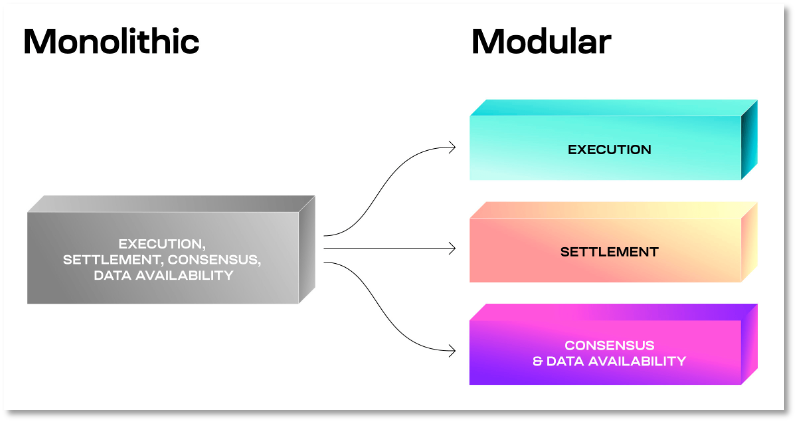
Modular blockchains address functional needs through layered architecture
For monolithic blockchains, all four functional layers reside on a single chain, meaning the network must handle every task independently. This leads to the so-called "impossible triangle," where scalability, decentralization, and security can satisfy at most two of these properties simultaneously. Most current Layer1 networks sacrifice decentralization to maintain security and scalability, while Ethereum prioritizes decentralization and security, delegating scalability to compatible Layer2 networks.
However, as blockchain transaction volumes grow and decentralized applications multiply, monolithic blockchains still frequently suffer from transaction congestion. This drives up transaction costs, hampers application performance, and degrades user experience.
To resolve the "impossible triangle" issue, developers have proposed the "modular blockchain" solution—re-architecting blockchain infrastructure through aggregation and decomposition. By modularizing functions and recombining the four layers as needed, this approach safely enhances performance and scales the network without compromising the foundational principle of decentralization, thereby supporting diverse application scenarios.
The concept of modular blockchains dates back to a 2018 whitepaper co-authored by Mustafa Al-Bassam and Vitalik Buterin titled "Data Availability Sampling and Fraud Proofs." The paper described methods to solve blockchain scalability issues without sacrificing security or decentralization—by enabling light clients to receive and verify fraud proofs from full nodes and designing data availability proof systems to reduce trade-offs between on-chain capacity and security.
Currently, Rollups and sharding technologies represent examples of Ethereum’s transition toward modular blockchains.
Rollups provide a separate execution layer that extends Ethereum’s monolithic architecture. Before periodically submitting compressed data back to the Ethereum mainnet for verification, rollups use powerful computers to bundle and execute multiple transactions.
Sharding implements scaling at Layer 1 by dividing the Ethereum main chain into multiple shards and randomly rotating validators among them. Each shard operates essentially as a mini-blockchain running in parallel with the beacon chain. Through sharding, Ethereum significantly improves transaction throughput and scalability to meet growing user demands.
Which Modular Blockchains Are Potential "Dark Horses"?
To date, Web3 asset data platform RootData has cataloged 36 modular blockchain projects. Aside from Cube and Assembly, which are considered "dead," the rest continue steady development.
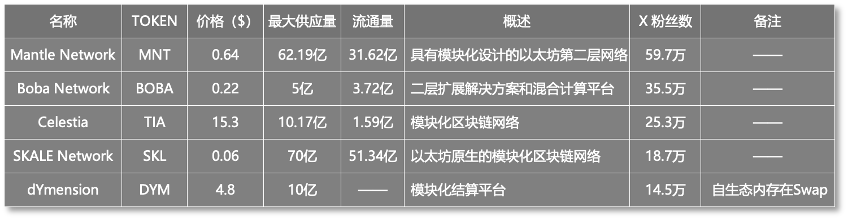
Five modular blockchain projects have already had their tokens tested in the circulating market and ecosystem.
Celestia (TIA)
Celestia is the first modular blockchain project, focusing specifically on data availability. Celestia proposes that Ethereum Layer2 scaling solutions can publish newly generated data onto the Celestia chain instead of directly onto Ethereum, potentially saving over 90% in transaction fees.
Data Availability Sampling (DAS) is a key feature of Celestia, allowing users to confirm the existence of large data blocks without downloading the entire blockchain. This technology greatly enhances scalability and security.
Additionally, Celestia facilitates the creation of independent, self-governed blockchains known as sovereign rollups, which benefit from the security provided by the Celestia network.
The Blobstream feature integrates Celestia’s modular data availability layer with Ethereum, enabling Ethereum developers to build efficient, high-throughput Layer2 solutions.
-
Circulating Supply: 159,016,130 TIA
-
Total Supply: 1,017,972,603 TIA
-
Current Price: $15
-
All-Time High: $20.26
-
All-Time Low: $2.03
Mantle Network (MNT)
Mantle Network is an EVM-compatible, modularly designed L2 scaling solution based on Optimistic Rollup technology. Incubated by BitDAO, it leverages roll-up technology and a decentralized data availability layer (Mantle DA) to deliver high throughput, low fees, and fast finality, while maintaining Ethereum-level security.
-
Circulating Supply: 3,162,441,863 MNT
-
Total Supply: 6,219,316,795 MNT
-
Current Price: $0.64
-
All-Time High: $0.8488
-
All-Time Low: $0.3136
SKALE Network (SKL)
SKALE Network is a Layer2 scaling solution that uses sidechain environments to boost the performance of decentralized applications (dApps) on the Ethereum network. SKALE enables developers to run smart contracts at high speed, high throughput, and extremely low cost.
Deeply compatible with Ethereum and unbound by Ethereum's storage and computation limits, SKALE supports thousands of independent blockchains with linear scalability, as well as various elastic sidechains, storage chains, and other sub-chains.
-
Circulating Supply: 5,134,227,671 SKL
-
Total Supply: 5,447,166,667 SKL
-
Current Price: $0.06
-
All-Time High: $1.22
-
All-Time Low: $0.01
The economic models and tokens of many other modular blockchain projects remain in testing phases, with some preparing for mainnet launches and others beginning to attract ecosystem applications. Below is information about active modular blockchain networks:
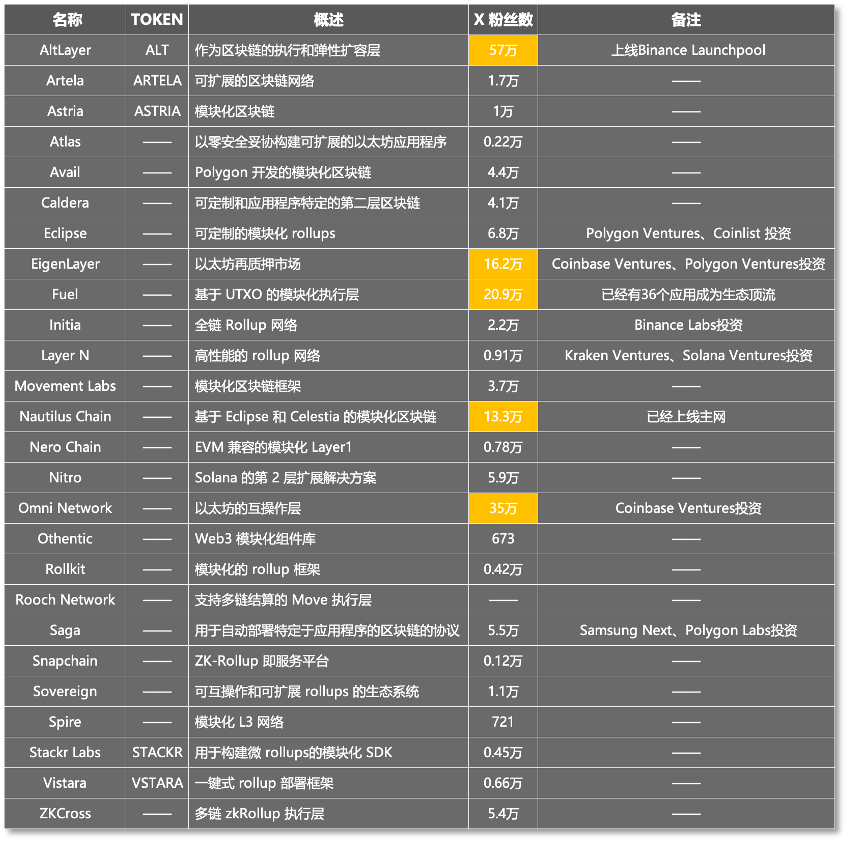
It's evident that highly watched modular blockchains often attract investments from CEXs. Moreover, some have gained attention or even funding from major blockchain ecosystems, while others have already launched their mainnets and fostered numerous applications.
For example, AltLayer, recently listed on Binance Launchpool, is a highly scalable, application-specific execution layer system featuring multiple execution layers (called Flash Layers) similar to optimistic rollups. All transactions derive their security from underlying L1/L2 chains. Designed as a modular and pluggable framework for multi-chain and multi-VM environments, AltLayer enhances network scalability.
Meanwhile, Fuel was among the earliest Optimistic Rollups deployed on the Ethereum mainnet, launching its V1 version at the end of 2020. As a UTXO-model-based blockchain, Fuel’s greatest advantage lies in its ability to execute transactions in parallel. By using an execution model different from the EVM, it offers a minimal, highly parallelizable execution system based on UTXO. It supports ETH and all ERC-20 standard tokens. Currently, 36 applications have emerged as leaders within its ecosystem, spanning DeFi, DEXs, stablecoins, gaming, NFTs, and Web3 domains.
Join TechFlow official community to stay tuned
Telegram:https://t.me/TechFlowDaily
X (Twitter):https://x.com/TechFlowPost
X (Twitter) EN:https://x.com/BlockFlow_News