From Bitcoin to EigenLayer, Exploring a New Era of Crypto Anarchism
TechFlow Selected TechFlow Selected
From Bitcoin to EigenLayer, Exploring a New Era of Crypto Anarchism
EigenLayer introduces a new concept of trust to the crypto-anarchist world.
 Navigating Web3 tides with focused insights
Author: DoganEth
Translation: Luccy, BlockBeats
Editor's Note: Crypto researcher DoganEth offers an in-depth analysis of EigenLayer from the perspectives of trust and crypto-anarchism. He highlights how innovative technologies like Bitcoin, Ethereum, and EigenLayer play a crucial role in building decentralized trust systems, while also emphasizing the challenges and trade-offs involved.
Through his exploration of DA layers and EigenDA, DoganEth illustrates the future possibilities of cryptoeconomic trust. BlockBeats presents the full translation below:
"Trust is a fundamental aspect of human relationships and society, rooted in the belief in the reliability, truth, ability, or strength of someone or something."
ChatGPT’s response to “What is trust?”
Since the beginning of human history, trust has been a foundational concept underpinning societies and human relationships. Initially essential for survival, then for hunting and gathering, and later for social structures, trust today has become a core element of modern society—primarily provided by governments, especially in economic and legal domains.

Dall-E — The Evolution of Trust
From the earliest days of trade, trust has been central to commerce. People initially trusted that their barter counterpart was not selling counterfeit goods and that the value of exchanged items was equal. Later, they trusted gold, believing its supply could not be arbitrarily increased, making it suitable as primary currency. Today, we trust government-issued money—a piece of paper (or increasing numbers on our mobile apps)—which we collectively assign value to and use in daily transactions.
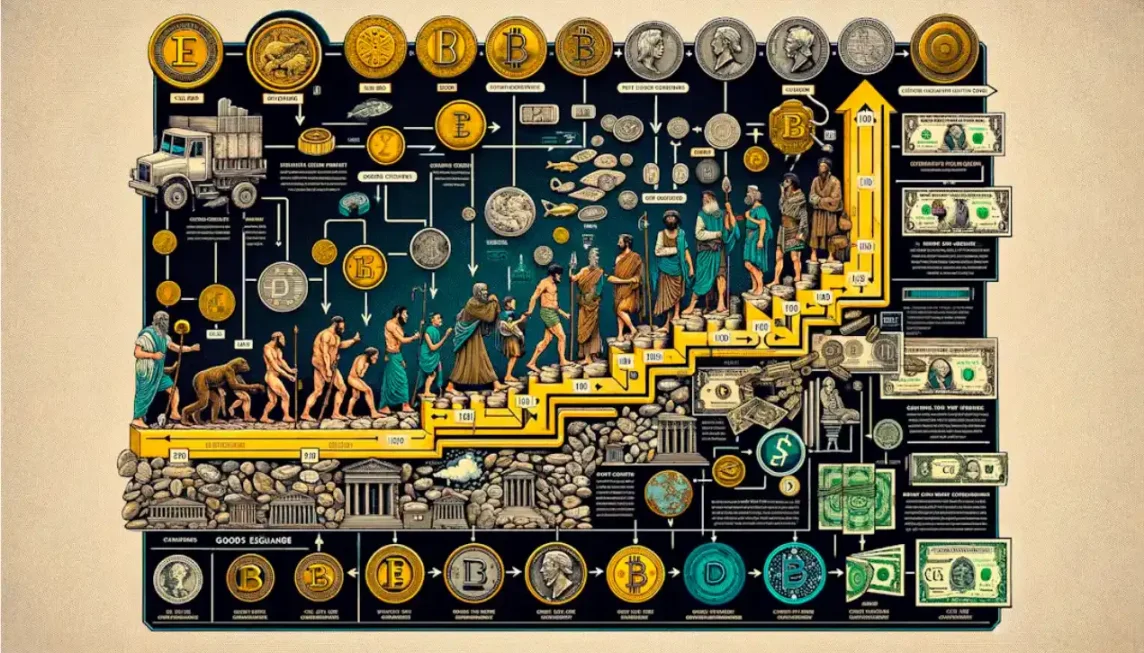
The Evolution of Money — Dall-E
Trust in the Digital Age: Blockchain and Game Theory
It is undeniable that for centuries, governments have served as the primary authority providing trust. "Anarchists," who reject this authority and do not recognize governmental existence, have long attempted to dismantle it and create alternative trust models. In the digital age—with growing surveillance and expanding state power—a wave of activism emerged, giving rise to "crypto-anarchism."
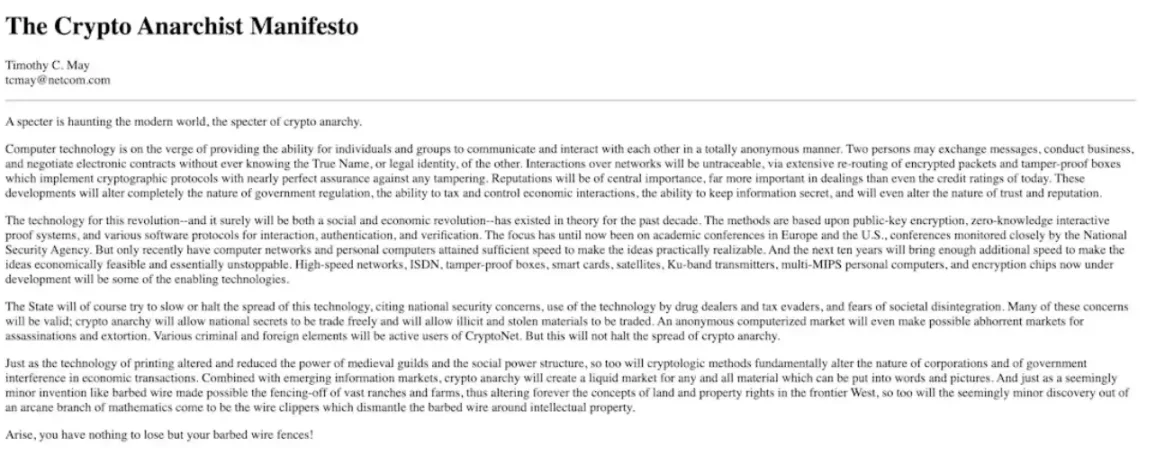
Crypto-Anarchist Manifesto
Crypto-anarchism posits that people can now communicate via systems based on mathematics and computers without revealing their identities—potentially revolutionizing known social structures. Crypto-anarchists proposed ideas ensuring that society, rather than centralized entities, benefits from these evolving frameworks.
For years, crypto-anarchists researched systems requiring no human trust—but only with Bitcoin did they succeed. A brilliant engineer named Satoshi—whose name, identity, location, and even gender remain unknown—developed Bitcoin and blockchain, introducing them to the digital era. Since then, our understanding of trust has never been the same.

Bank vs. Bitcoin — Dall-E
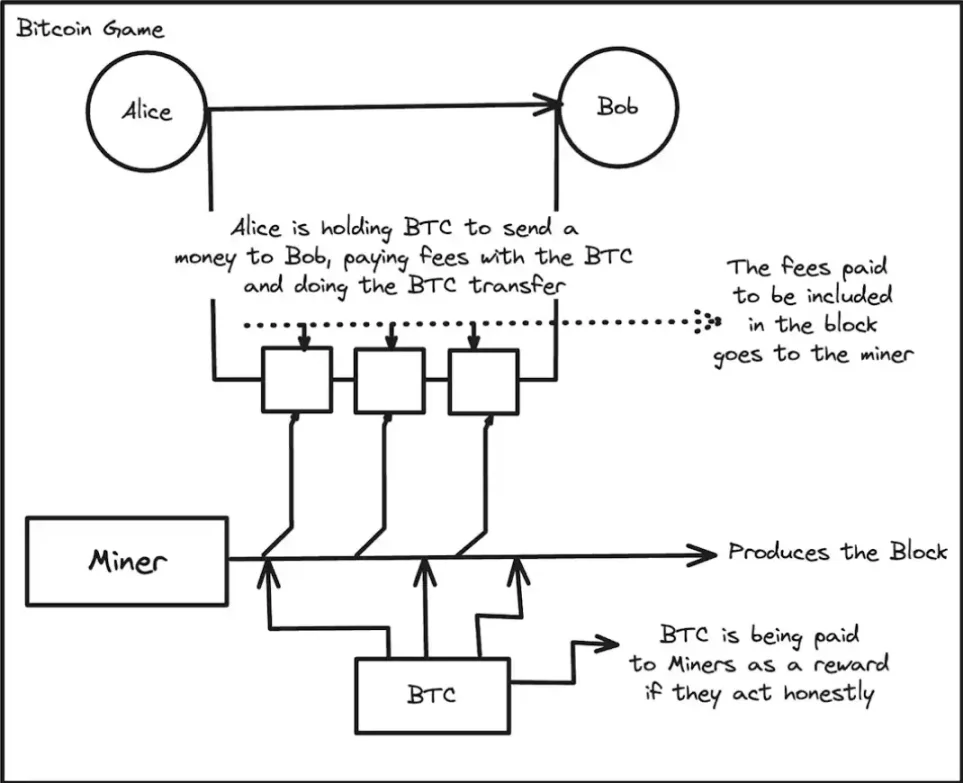
Bitcoin created an infrastructure that transferred trust from central institutions to mathematics and game theory. Briefly, it works as follows: Alice wants to send BTC (Bitcoin’s native currency) to Bob. She broadcasts a transaction to the network, including a BTC fee.
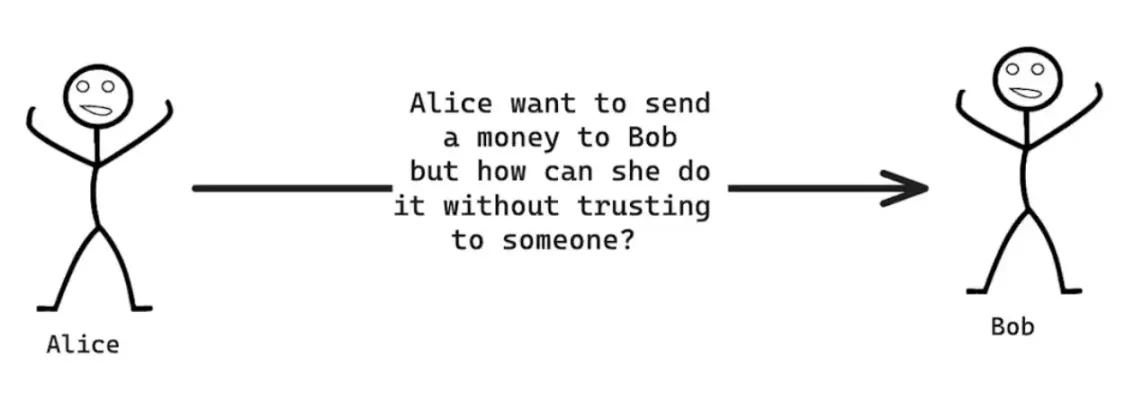
In this network, if miners see the transaction and act honestly, they earn the BTC transaction fee plus additional BTC rewards. They include the transaction in a block and broadcast it to other participants. If everyone agrees, the miner receives the reward and continues searching for the next block.
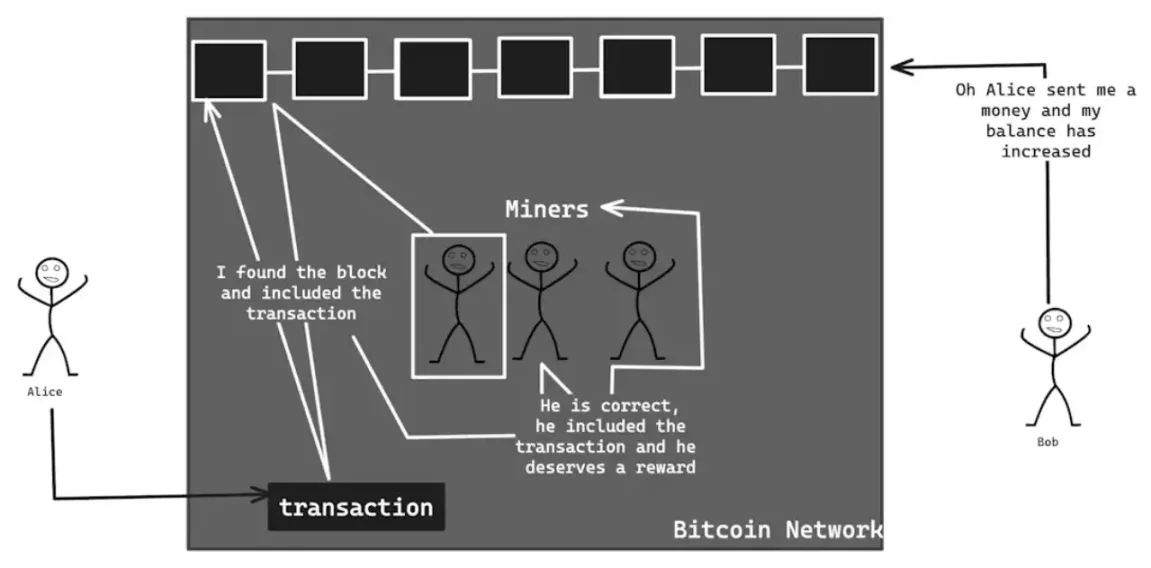
The key point here is not how Bitcoin functions technically, but how its trust mechanism operates. Miners solve computationally difficult math problems on their machines; the first to solve earns the right to mine a block. If a miner includes invalid transactions or behaves maliciously, the rest of the network detects it, and the dishonest miner forfeits the block reward. Bitcoin’s trust is grounded in game theory—miners act honestly to receive rewards.
While Bitcoin paved the way for decentralized trust and payment systems, it had limitations: it was primarily useful only for payments and offered limited programmability.
For Ethereum, the game changed. Validators are required to stake a certain amount of ETH upfront. If they behave honestly, they receive ETH rewards. Unlike Bitcoin, misbehavior—not only results in lost rewards but also leads to partial or full slashing (burning) of staked ETH. This introduces stronger economic disincentives.
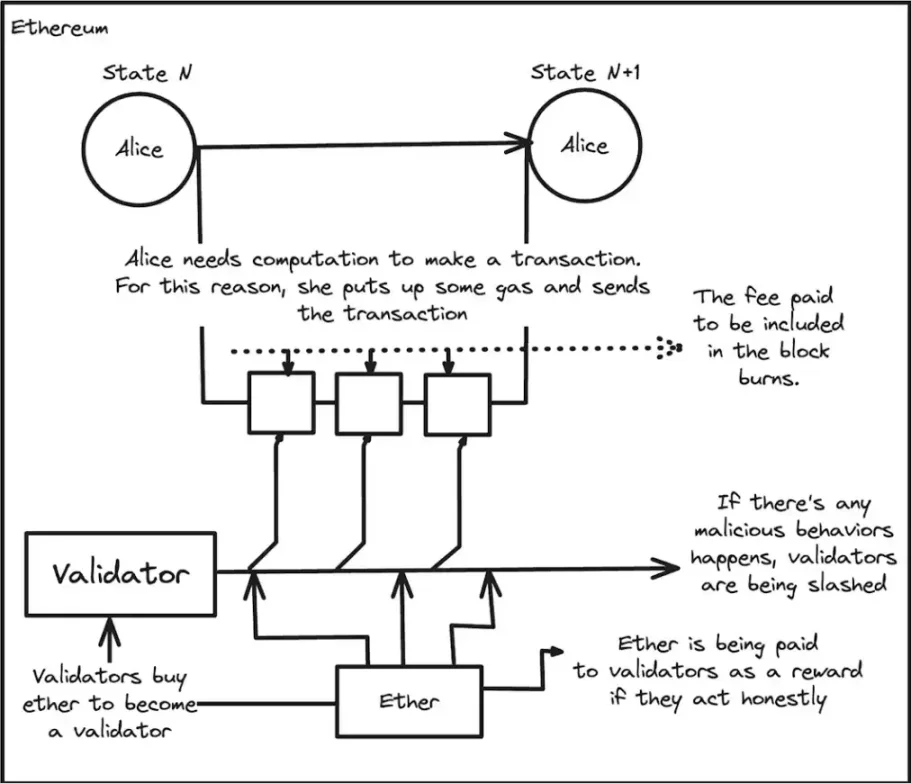
Both Bitcoin and Ethereum’s trust mechanisms gave birth to a new concept of trust in the digital age: “cryptoeconomic trust.”
Programmable Cryptoeconomic Trust: EigenLayer
PoS (Proof-of-Stake) systems like Ethereum essentially offer trust through this model: validators stake assets, earn rewards for honest behavior, and face penalties (slashing) for dishonesty.
The biggest issue with these systems is that every application needing cryptoeconomic trust must build its own security from scratch. This leads to several problems:
-
Each app creating its own economic security leads to “fragmentation of economic security.”
-
Not every application can launch a token, and poorly designed or useless tokens make it impossible to establish sound network-level game theory.
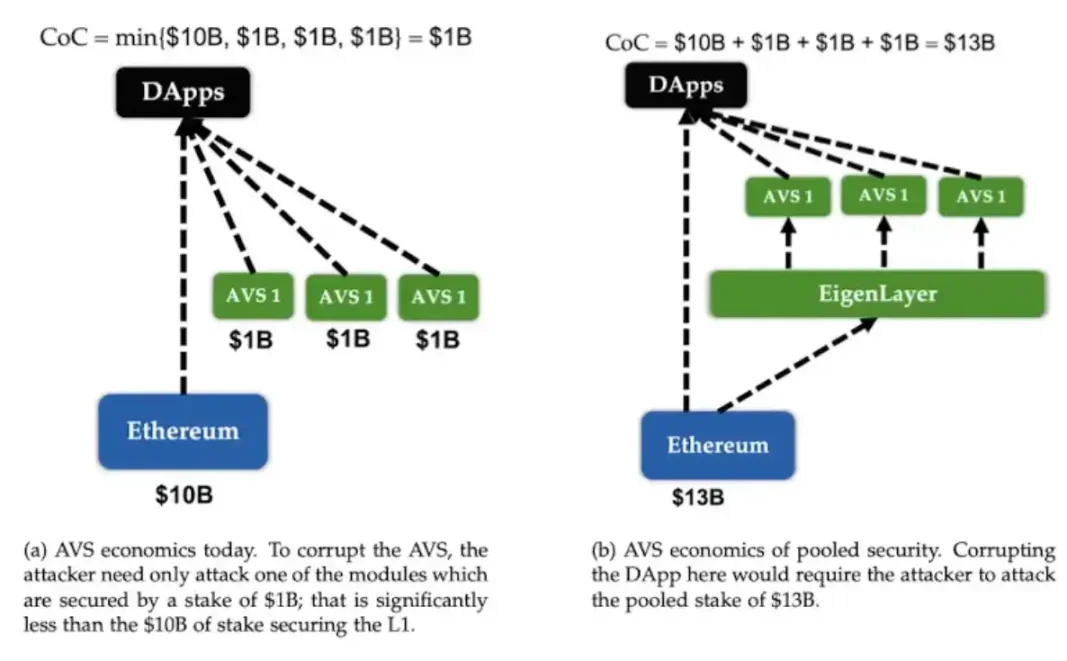
EigenLayer provides an infrastructure enabling partial leasing of Ethereum’s cryptoeconomic security through restaking tokens. (I’ll explain why this is partial in the next section.) With this infrastructure, developers can build applications by leasing security from Ethereum without issuing new tokens. This can be used to securely store data in any database, enable decentralized ordering, support bridge projects, or develop new chains.
What Exactly Is EigenLayer?
EigenLayer is simply a set of smart contracts deployed on Ethereum. These contracts support depositing, withdrawing, and slashing tokens. I want to emphasize one critical point: everything is executed off-chain by participants called operators.
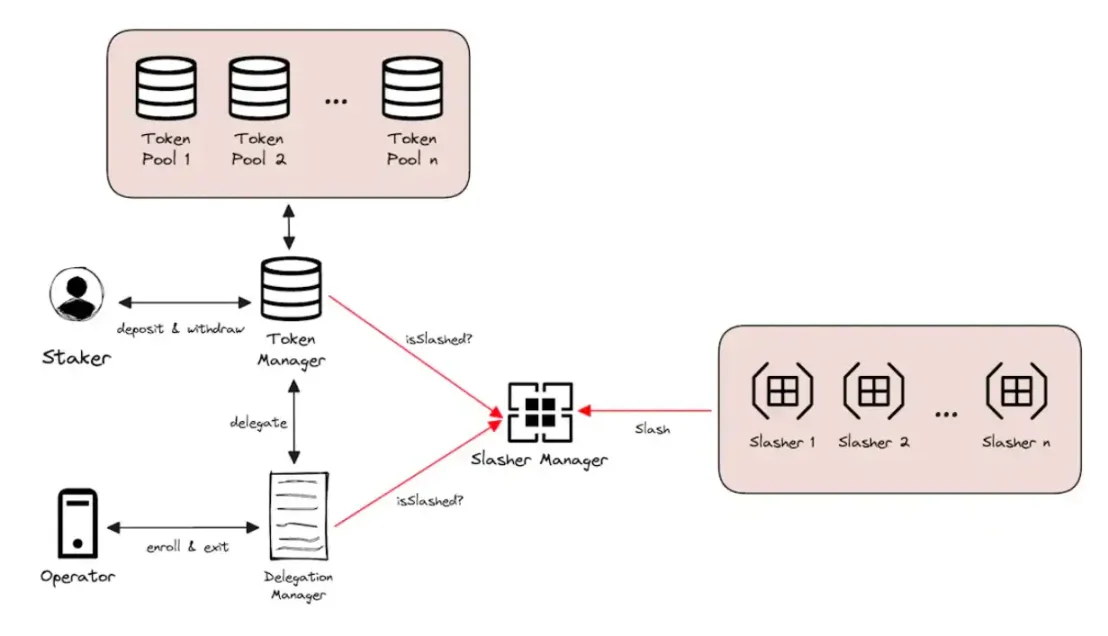
Therefore, when you re-stake tokens in EigenLayer, you are trusting your delegated operator to act honestly—because any misbehavior by your operator will result in your staked ETH being slashed. This is actually a common problem in most dPoS (delegated Proof-of-Stake) systems, but it introduces additional risks not present in Ethereum’s base protocol. The same applies to Liquid Staking Tokens (LSTs).
Blockchain security isn’t just about cryptoeconomics—you can’t rent community governance. In both Ethereum and Bitcoin, true security comes not only from cryptoeconomic incentives but also from the off-chain community’s dominance over on-chain protocols. Even if most validators or miners act dishonestly, or if there’s a software flaw, the community can fork the chain and invalidate previous transactions. This kind of community-driven security cannot be rented or transferred via EigenLayer.
Vitalik addressed this in his article “Don’t Overload Ethereum Consensus.” He advises that double-staking and restaking applications should not rely on Ethereum for slashing enforcement, nor add extra complexity to Ethereum’s streamlined consensus mechanism.

It’s important to recognize the trade-off: the off-chain community’s influence cannot be leased, and what EigenLayer offers is purely cryptoeconomic security. That said, EigenLayer opens a revolutionary door for innovation on Ethereum. Many applications have already begun building on EigenLayer.
EigenDA
I won’t re-explain rollups and blockchains from scratch here, but I will discuss data availability (DA) layers, their market strategies, “which is better,” and their differences.
Blockchains are more powerful than you might think. Even if all validating participants approve an invalid transaction, your own full node can detect it as invalid and confirm—without trusting anyone—that the chain’s contents are correct.

My Node vs. Malicious Actors
Despite their power, setting up a full node from scratch is highly inconvenient and expensive for end users. Thus, we use light clients. However, they trust that most full nodes are honest—so unfortunately, they introduce a trust assumption.
Data Availability Sampling (DAS) allows users to verify that data on-chain is available and valid without downloading the entire blockchain. Celestia currently implements this using fraud proofs, while Avail uses zero-knowledge proofs. Both aim to leverage DAS and robust light clients to produce larger blocks and increase data throughput.
This is particularly evident in the context of Sovereign Rollups on Celestia. Users can participate in the blockchain by running light nodes for both the rollup and Celestia—without trusting anyone. Sounds great, right? But how many Sovereign Rollups are currently live on Celestia?
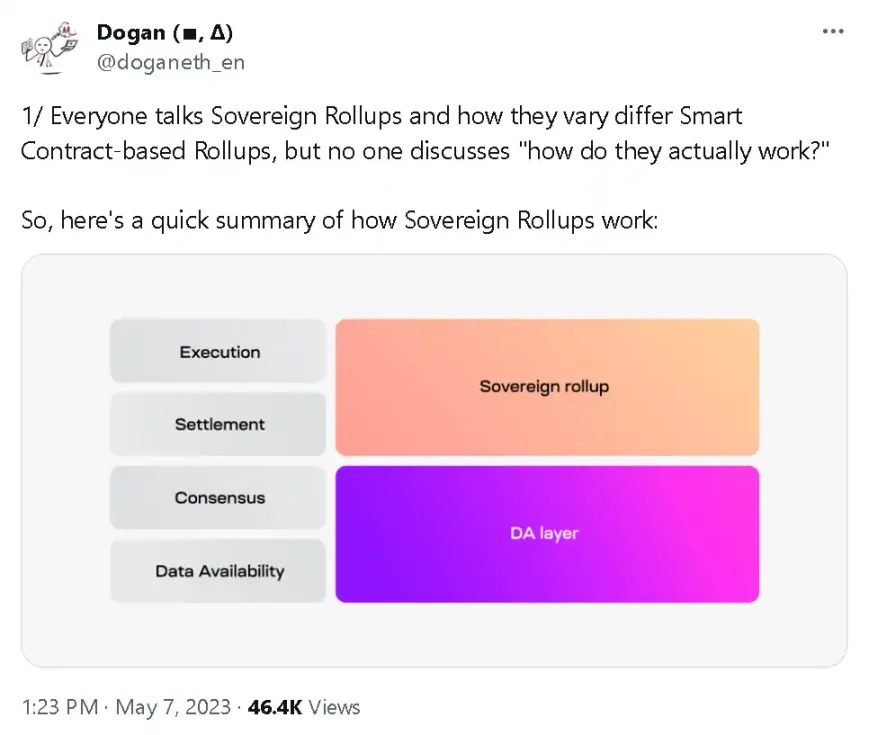
So where is Celestia currently being used? Primarily, Celestia serves as a low-cost data availability layer for Ethereum rollups. While this sounds promising, it has a major drawback: Ethereum L2s using Celestia cannot directly benefit from Celestia’s DAS. The main reason is that DAS cannot be verified on Ethereum. Bridges proving Celestia data to Ethereum only check whether 66% of Celestia validators signed the transaction, meaning Ethereum rollups cannot leverage Celestia’s innovative technology.
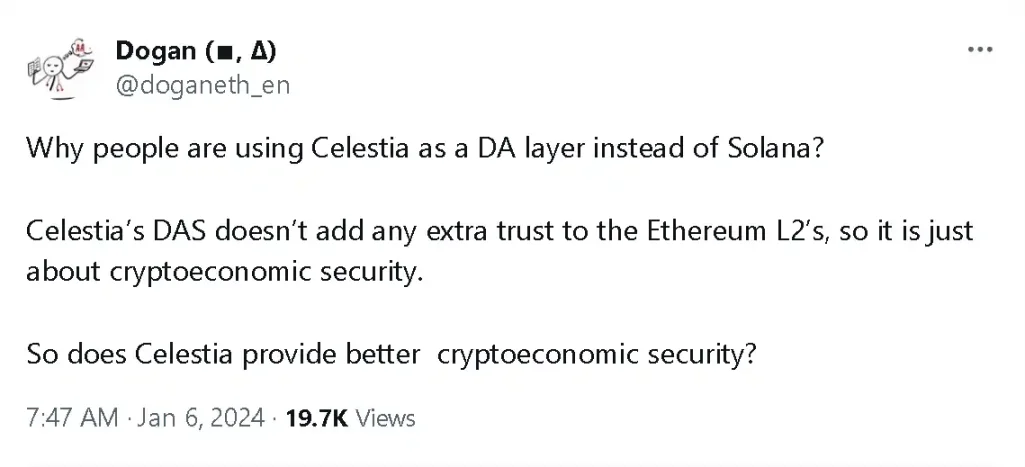
The same issue applies to Avail, though I know they have plans to address it—I won’t elaborate since they haven’t publicly shared details yet.
EigenDA: EigenDA is an application leveraging EigenLayer to provide Data Availability (DA) services to Ethereum rollups. Yes, I refer to EigenDA as an application because it is not a blockchain, but rather an efficient database. This database acts as a data availability oracle, serving rollups and any application requiring DA on Ethereum. Because it is not a blockchain, concepts like light clients do not apply to EigenDA. I won’t dive into technical specifics, but compared to competitors, it offers higher efficiency and cost-effectiveness. As previously mentioned, EigenLayer only provides cryptoeconomic security to applications. In this regard, EigenDA appears comparable to Celestia and Avail in terms of cryptoeconomic security. However, EigenDA may offer stronger security through restaking—but with an important caveat:
Users running Sovereign Rollups and light clients on Celestia can directly challenge and penalize validator misconduct, whereas in EigenDA, such enforcement depends entirely on operators. Therefore, punishing bad behavior is easier in Celestia, while I don’t see a similar improvement in EigenDA.
Each of these three projects has significant strengths, and I’m actively working to understand and further explore the innovations they bring.
The new concept of trust introduced by the crypto-anarchist world: EigenLayer. I believe the importance of EigenLayer in advancing cryptoeconomic trust will become increasingly evident in the future.
Join TechFlow official community to stay tuned
Telegram:https://t.me/TechFlowDaily
X (Twitter):https://x.com/TechFlowPost
X (Twitter) EN:https://x.com/BlockFlow_News
 @doganeth_en