"Will Web3 Games Be the Next 100x Sector?" Theme Space Event Summary
TechFlow Selected TechFlow Selected
"Will Web3 Games Be the Next 100x Sector?" Theme Space Event Summary
Fully on-chain games and Web2.5 games are merely two different forms, both aiming to carry assets.
 Navigating Web3 tides with focused insights
Author: PKU Web3 Alumni Club
With ETF approvals signaling the arrival of a bull market, new GameFi launches on Binance and OKX are gaining momentum. As a key application layer within Web3, what extraordinary potential will the gaming sector demonstrate in this cycle? And how can Chinese entrepreneurs participate in this Web3 revolution?
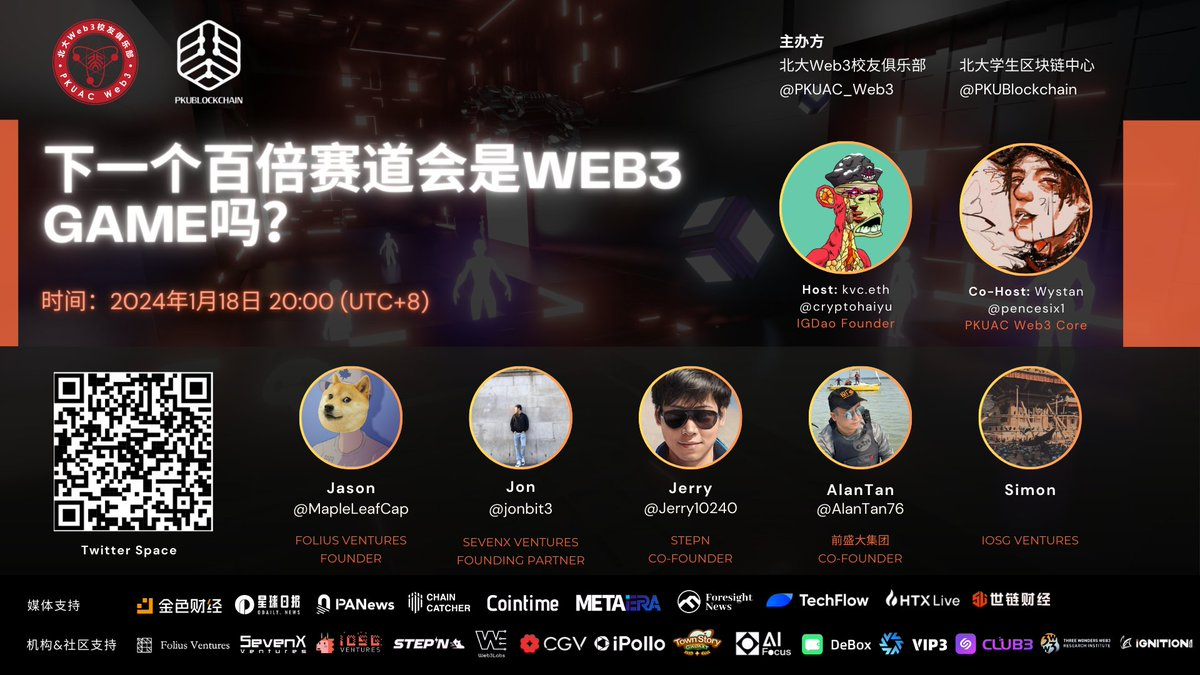
At the cusp of a Web3 gaming boom, PKU Web3 Alumni Club & Peking University Blockchain Association seized the moment to host a Space titled “Will Web3 Gaming Be the Next 100x Sector?” The event featured industry leaders including: Jason | Founder, Folius Ventures | @MapleLeafCap, Jon | Founding Partner, SevenX Ventures | @jonbit3, Jerry | Co-Founder, STEPN | @Jerry10240, AlanTan | Former Co-Founder, Shanda Group | @AlanTan76, and Simon | Partner, IOSG Ventures. This Space attracted over 110,000 total listeners with peak concurrent attendance reaching 1,800, drawing significant market attention!
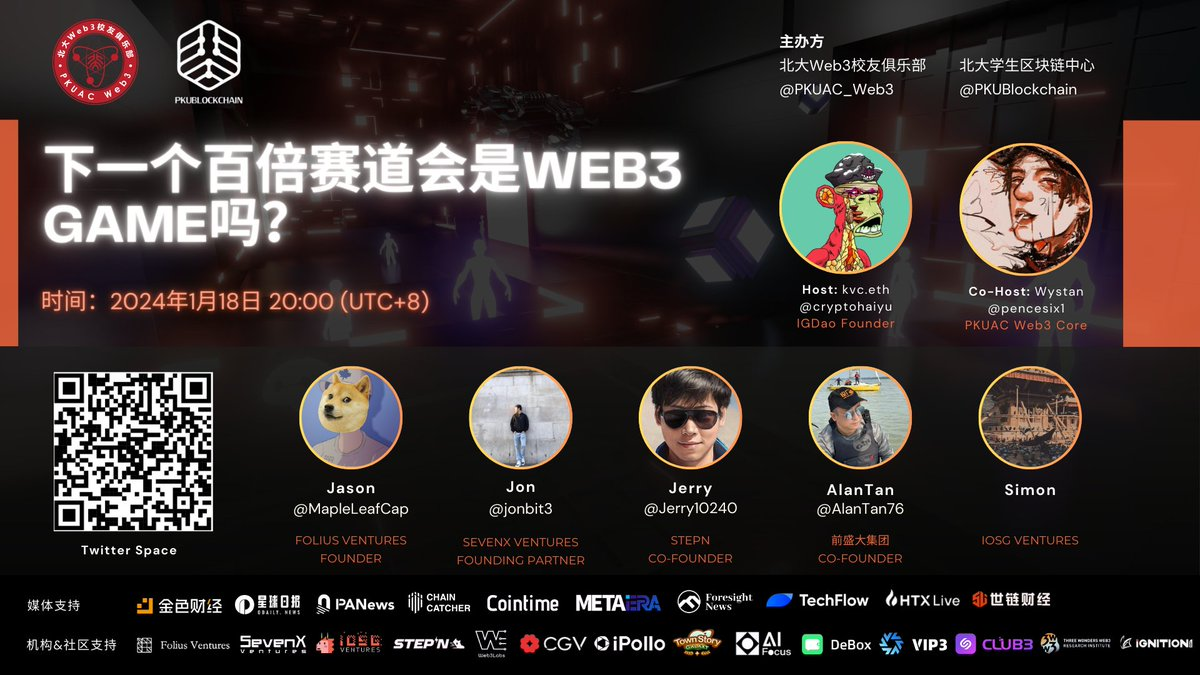
Figure 1: Event Poster

Figure 2: Total Listeners
Let’s review the highlights from our distinguished guests:
Question 1:
With the recent bull market and ETF approval, the gaming sector—a major Web3 application layer—has seen new projects ignite market excitement. Emerging narratives such as Game+AI, Game+Metaverse, and Game+inscriptions are gaining traction. How do you view these latest trends and narratives in the Web3 gaming space?
Jerry:
Looking back at STEPN, we still have around 300,000 monthly active users, with over 1,000 people running simultaneously every day. Although token prices have dropped significantly, many users continue because exercise has become a habit—even without high returns, people are still engaged. We’re proud that STEPN helped early users build this habit. When combining gaming with new narratives, if novel mechanics or stories serve as user acquisition tools and ultimately deliver lasting value, that’s truly meaningful.
Meanwhile, the new game Gas Hero has introduced many innovations, particularly in its economic model, aiming to create a broader social experiment where players experience gameplay unlike anything before. I believe Gas Hero will see its peak moment soon. And if, after that peak, it retains a strong community like STEPN does today, forming an active in-game ecosystem, then that would be mission accomplished.
Jason:
Over the past 12 months, we’ve seen a surge of talented Chinese developers entering the Web3 space. The overall industry standard has risen significantly—teams are now far more sophisticated across all dimensions, including user acquisition, retention, product quality, and international strategy, compared to just two or three years ago. These founders have deeply studied Web3 and mastered clever techniques leveraging external financial attributes for user growth, using subtle financial mechanisms to guide users toward consumption-driven contributions to the ecosystem. Therefore, I’m optimistic that within the next 12 months, these teams will deliver high-DAU, high-ARP products deeply integrated with Web3’s financial characteristics.
Jon:
I’ve followed Metaverse closely and invested in several projects. Personally, I feel AI integration in gaming is still premature—while many developers are adopting AI tools, true transformation hasn’t fully arrived yet. Right now, I focus more on what ultimately remains after the game ends. From today’s perspective, what matters most may be the assets left behind—assets that, through one or multiple games, form an economic system moving toward composability. This is perhaps the biggest shift blockchain gaming brings—a new business model fueled by asset explosion.
AlanTan:
There’s no such thing as a standalone Metaverse. Games are the best path to Metaverse, because if you have a virtual asset, where does its value come from? It comes from its location—and a location with no traffic is meaningless. Games are the core engine driving traffic. Therefore, games are the only viable way to build a Metaverse.
Question 2:
Gaming has always been a hot sector in traditional Web2, and the last wave of GameFi brought some user growth to Web3. In your opinion, what types of products are Chinese teams better suited to build? What advantages do they have?
Jason:
First, under limited budgets (say, below $10–15 million), it’s unwise to pursue AAA-level mega-projects with 2–5 year development cycles. Instead, focus should be on mass-market games that launch within one to two years and target high DAU and ARP.
For Chinese entrepreneurs, the advantage lies in refined product execution, rapid iteration, and proven methodologies for launching and scaling products. Additionally, a domestic team enjoys operational costs that are just a fraction of those in other countries globally.
However, a disadvantage is that APAC founders often lack familiarity with financial mechanics—how to leverage momentum, boost valuations, and secure more resources. This makes it difficult for Chinese projects to achieve top-tier valuations and compelling narratives.
Moreover, while domestic competition trains founders in large-scale user acquisition within a single market, such tactics don’t always translate globally. Therefore, Chinese founders who choose sectors where they have deep local resources, address their weaknesses, and possess strong distribution and traffic acquisition capabilities will be rare and valuable over the next one to two years.
Jon:
In this cycle, the gap between Chinese and Western entrepreneurs—whether in infrastructure or applications—is narrowing across areas like infra, Layer 2, DeFi, and gaming. Three key aspects deserve attention:
First, capital access: Most Chinese founders struggled last year. Fundraising in APAC markets became much harder, limiting capital availability and making AAA projects nearly impossible. In contrast, Western game studios enjoy larger funding pools and easier fundraising. Second, distribution: Most Chinese teams rely on Web2 gaming experience and networks but lack unique blockchain-native distribution skills—such as leveraging public chain ecosystems, exchanges, Western fund endorsements, or KOLs. Third, user understanding: Many Chinese teams focus on China, Japan-Korea, and Southeast Asia, limiting their grasp of global, especially Western, user bases. Since most core infrastructure and ecosystem influence resides in the West, close engagement with these systems is crucial.
Jerry:
Reflecting on the past two years, I believe Chinese developers have a significant edge in gaming. Web3 essentially puts assets on-chain, transforming in-game asset distribution—from NFTs to tokens. STEPN was an early experiment: taxing user transactions and recycling revenue back into the ecosystem for self-sustaining growth. Chinese founders excel here. Gas Hero’s economic system and distribution mechanism are far more complex than STEPN’s. So let me sneak in a quick plug—you should definitely try it out.
High-quality graphics and AAA production are great, but not directly tied to blockchain integration. Blockchain fundamentally changes wealth distribution. Teams should build according to their strengths. But the core lies in gameplay and how blockchain technology regulates the ecosystem—it’s critically important.
AlanTan:
I strongly agree with previous speakers—Chinese teams do have advantages in game development. Different games vary in their readiness for Web3 adoption. AAA titles, which sell experiences, stories, and narratives, may not suit blockchain well. Web3 games primarily sell assets and privileges—the closer a game is to asset ownership, the more suitable it is for blockchain. The item-based monetization model was pioneered by Chinese companies; Shanda was among the first innovators.
Simon:
Overall, engineering & art talent红利 + strong project management = faster iteration. Rather than focusing on specific product types, success hinges on a particular approach—launching hit products with agile marketing and operations, staying sensitive to market shifts, and doing the right thing at the right time. Of course, deep understanding of China/SE Asia/Japan-Korea markets and mobile development experience remain classic advantages. This cycle, APAC/mobile will become increasingly vital markets.
Question 3:
You’ve all emphasized the asset and financial nature of Web3 games. For Web3 gaming, economic design often determines a game’s success ceiling. What traits define a healthy in-game economy and a sustainable asset circulation flywheel?
AlanTan:
MMOs like Legend, World of Warcraft, and Dream Westward Journey have always had in-game economies—they simply lacked blockchain’s open, reliable platform. But in practice, designing economic loops in Web3 differs greatly from Web2. The hallmark of Web3 economics is the seamless fusion of game economy and tokenomics, meeting diverse player needs while ensuring long-term, stable ecosystem growth.
Jason:
First, wherever assets generate yield or returns, that yield must be tied to initial investment, ongoing operational costs, and depreciation—users must pay a cost for any asset output. Second, long-term asset returns should stem from hidden yet sustainable consumption driven by human psychology, not investment demand. While these points may sound abstract, economic models satisfying both tend to endure longer.
Jerry:
I believe the first is asset management, the second is human behavior management. Together, they determine the health and sustainability of your economic model.
Regarding asset management, in Gas Hero, we introduced community and Web3 elements from the start—the creation of Genesis Heroes was crowd-sourced from the entire community; each hero was drawn by users. After creation, a significant portion of transaction fees flows back to creators. Thus, we embedded community and economic systems into game content creation. With 1,000 Genesis Heroes, we received 800,000 submissions—this is the power of community and Web3. We also return control over asset lifecycle management to users—that’s understanding human nature. This evolution marks our journey from STEPN to Gas Hero.
Simon:
A good economic model serves two purposes: first, retention—to extend the game’s lifespan so it continues even after core content is exhausted, sustained by player-driven micro-economies. Second, monetization—using a solid business system to anchor in-game item values and establish pricing.
We’ve seen successful cases where, even as wealth-generation effects fade, the game endures—thanks to retention-focused design. On monetization, I hope the next cycle sees economic systems that anchor asset value so strongly that beyond financial utility, players willingly spend more on content consumption.
Question 4:
Fully on-chain games once gained massive attention, but during the small bull run starting November last year, this segment didn’t see much momentum. Many developers love the concept, but it hasn’t won broad capital support. What are your thoughts on fully on-chain games?
Jerry:
Fully on-chain gaming is undoubtedly a trend, because Web3 aims to put assets, transparency, and governance on-chain—only full on-chain ensures trustworthiness. Gas Hero is already a fully on-chain game: all user actions are recorded on-chain, including how the $3 million prize pool accumulates—all data is publicly verifiable. Users analyze every in-game parameter. In this sense, fully on-chain games usher in an era of全民 participation.
AlanTan:
I’ve long focused on fully on-chain games. From an idealistic standpoint, this is what we should build. However, current infrastructure and user experience remain highly limited. For me, creating a fun game with appreciating assets is a higher priority—I hope to achieve true mass adoption this year. Long term, fully on-chain games will grow in importance. But fully on-chain, Web2.5, and other game types serve different markets, meet different needs, and all contribute to the broader gaming ecosystem.
Question 5:
What are your outlooks for the future of the Web3 gaming sector and the broader crypto industry?
Jason:
Portfolios I’ve led or participated in may see concentrated breakthroughs this year. I’m confident there are abundant opportunities in today’s market. We must recognize that Web3 could be the defining capital market of this decade for APAC and Chinese entrepreneurs, akin to China’s stock markets in the 2000s or NASDAQ-listed Chinese stocks in the 2010s. For Chinese founders, it offers the best liquidity and clearest exit paths. Given current geopolitical complexities, crypto stands out as a more accessible capital market for Chinese entrepreneurs—this is our generational opportunity. It favors those with global vision and genuine ambition to go international.
Jon:
I’m highly optimistic about Chinese entrepreneurs and the crypto sector—it’s a massive opportunity. Blockchain’s permissionless nature provides inherent liquidity advantages, enabling truly global trading markets. For gaming, fully on-chain and Web2.5 games are simply different forms serving the same goal: asset enablement. From an asset-centric view, different founders use different tools to leverage content. Though current on-chain and Web2.5 games lag behind traditional AAA titles in content depth, they’ll organically evolve from asset logic into breakout phenomena. I firmly believe that changes in production relationships driven by assets will reshape how production adapts—unlocking greater imagination for blockchain gaming and ultimately transforming the entire industry.
We thank all our guests for their insightful discussions, delivering cutting-edge perspectives and practical guidance for aspiring Web3 entrepreneurs. The bull market for crypto has only just begun—stay tuned! Follow the organizers PKUAC Web3 and PKUBA for more exciting events ahead!
Join TechFlow official community to stay tuned
Telegram:https://t.me/TechFlowDaily
X (Twitter):https://x.com/TechFlowPost
X (Twitter) EN:https://x.com/BlockFlow_News
 @PKUAC_Web3