10+ projects about to airdrop that you might have missed?
TechFlow Selected TechFlow Selected
10+ projects about to airdrop that you might have missed?
OP, Sui ecosystem, LST, LRT, wallet, RWA, Bitcoin ecosystem...
 Navigating Web3 tides with focused insights
Author: Peng SUN, Foresight News
The 2024 airdrop season has begun. Beyond major potential airdrops from Cosmos, EigenLayer, Renzo, and Berachain, Foresight News has selected over ten promising airdrop projects worth watching recently, covering areas such as Layer2, DeFi, Sui, Bitcoin, wallets, RWA, and Cosmos gaming chains. Check which of these projects still offer opportunities for participation.
OP Mainnet
According to community user OP Michael, up to 20 million OP tokens may be allocated for airdrops before April 2024. So far, three rounds of airdrops have taken place, distributing a total of 19,411,313 OP.
To qualify for the fourth OP airdrop, users might still need to delegate their OP to an active delegate. However, since the last airdrop focused entirely on OP staking, the fourth round could adopt different criteria—such as interactions with the OP Mainnet, Base, Zora, or other OP superchains.
Scallop
The Sui ecosystem has seen explosive growth over the past six months, with TVL exceeding $300 million, surpassing Bitcoin to become the third-largest non-EVM chain. SUI also surged recently, peaking at 1.45 USDT on January 15.
For deeper insights into the Sui ecosystem, see Haotian’s article: Behind Sui's Success: The Lineage Advantage of Move-Based Public Chains and the Promising New DeFi Ecosystem.
Scallop is a lending protocol on Sui and one of the most anticipated upcoming airdrops within the Sui ecosystem. With a TVL of $61.4 million, Scallop ranks first in the Sui ecosystem. It was the first DeFi project to receive funding from the Sui Foundation and has also been backed by investors including Comma 3 Ventures and OtterSec.
The Scallop token SCA will be used for governance, voting, liquidity mining, and interest fee discounts. The total supply of SCA is 250 million, with 45% allocated to liquidity mining, 18.5% to contributors, 4% to development and operations, 2% to advisors, 11% to strategic partners, 7.5% to ecosystem/community/marketing, 5% to liquidity, and 7% to the treasury.
On January 1, 2024, Scallop launched its airdrop points system and completed the first phase snapshot to reward early supporters. Users earn points based on activity and engagement on Scallop, which can then be used to generate Mysterious Pearls. These pearls come in various tiers—Bronze, Silver, Gold, Platinum, Diamond, and Legendary—and can be redeemed for tokens upon launch.
However, the second-phase airdrop appears more valuable. The project team noted that points earned in the first and second phases differ, with varying quantities and values of redeemable pearls between the two. Additionally, the majority of airdropped tokens will go to users participating in the second phase. Scallop began its second airdrop phase on January 16, lasting two weeks.
-
First, eligible lenders who provided a time-weighted value greater than $100 on Scallop prior to the start of the second phase will receive point rewards;
-
Second, starting January 16, users providing liquidity or borrowing on Scallop during the second phase will earn points. Snapshots are taken daily, and points are updated every 48 hours;
-
A few days after the event ends, users can exchange their points for Mysterious Pearls.
Additionally, Scallop migrated from Solana to Sui. Early voters and NFT holders from the original Scallop dApp on Solana will receive separate rewards through a dedicated pool but cannot participate in the Mysterious Pearls program.
NAVI Protocol
NAVI Protocol is another lending protocol on Sui, currently holding a TVL of $54.55 million, ranking second behind Scallop. NAVI Protocol was featured as part of OKX Web3 Wallet’s Cryptopedia Season 4. On December 8, OKX Web3 Wallet launched a yield-boosting campaign for NAVI, attracting significant liquidity.
NAVI Protocol has not yet announced details about its token airdrop but has launched a leaderboard that distributes points weekly based on total liquidity provided, borrowing volume, weekly activity, and Zealy points. According to the roadmap, NAVI, the utility and governance token, is expected to launch in Q1 or Q2 of 2024.
StakeStone
Recently, under the leadership of EigenLayer, AltLayer, and Renzo, LSTs and LRTs have once again become hot topics. In this space, StakeStone stands out as a noteworthy project.
StakeStone is a full-chain LST staking protocol aiming to bring native staking yields and liquidity to Layer2s, comparable to Lido. It supports top-tier staking pools, enables restaking, and plans to integrate with EigenLayer. StakeStone supports ETH beacon chain restaking and LST restaking, positioning itself to become a leading protocol in the restaking sector.
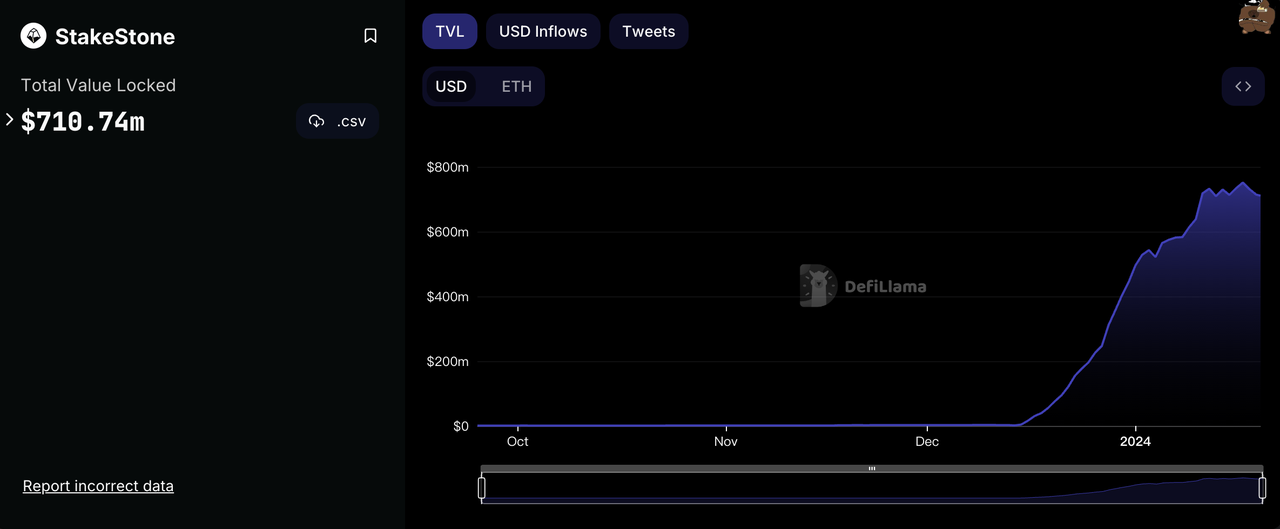
According to DefiLlama data, StakeStone’s TVL skyrocketed from $4.17 million on December 15, 2023, to $542 million by January 3, 2024—a surge achieved in just three weeks. Its current TVL stands at $710 million. StakeStone has also deeply participated in Manta’s incentive programs, supplying $720 million in liquidity toward Manta New Paradigm’s $9 billion TVL.
StakeStone’s native LST is STONE, now officially upgraded to a full-chain LRT. As an OFT based on LayerZero, STONE can seamlessly serve multi-chain liquidity markets via STONE-Fi—including DEXs, AMMs, lending, stablecoins, derivatives, GameFi, and SocialFi. Unlike rebase mechanisms, STONE operates similarly to Lido’s wstETH in terms of yield accrual—its quantity remains constant while its value increases proportionally with ETH staking rewards.
StakeStone has not yet issued a token, though the team is expected to launch related airdrop activities. Currently, users can stake ETH on StakeStone and earn returns from protocols within the STONE-Fi ecosystem.
Kelp DAO
Another popular project in the restaking space is Kelp DAO, a multi-chain liquid staking platform. The founder previously established Stader Labs, a liquid staking protocol that ranks as the second-largest LSD on both Polygon and BNB Chain. According to DefiLlama, Kelp DAO’s TVL currently stands at $167 million.
Kelp DAO is currently building an LRT solution on EigenLayer. Its restaking token is rsETH, supporting LSTs such as ETHx (Stader), sfrxETH (Frax), and stETH (Lido). Users can restake these assets to receive rsETH, whose price reflects accumulated rewards and the base price of staked LSTs. rsETH can be used across various DeFi protocols.
Currently, Kelp DAO has launched the Kelp Miles incentive program. Kelp Miles track user contributions and determine future reward allocations. They are calculated based on the amount of LST restaked and the duration of staking. Users who restaked LSTs between December 12, 2023, and January 1, 2024, will receive a 1.25x multiplier on Kelp Miles over the next three months. Those staking after January 1 will earn standard Kelp Miles rewards.
Additionally, all users who restake on Kelp before EigenLayer’s deposit cap closes are eligible to receive EigenLayer Points, distributed based on the volume of LST deposited.
Kinza Finance
Kinza Finance is a decentralized lending protocol on BNB Chain utilizing the ve(3,3) model to manage protocol incentives and governance. It allows lenders to retain collateral from borrowers, limiting trading risks, short-selling opportunities, and governance manipulation. Kinza’s primary revenue comes from borrower-paid interest, most of which goes to liquidity providers. The native token is KZA; users can stake KZA to obtain xKZA, which grants voting and vote-bribing rights over lending pools. xKZA, vote-bribing, and voting functions will go live after TGE.
According to DefiLlama, Kinza Finance’s TVL rose from $1.89 million on November 1, 2023, to a peak of $78.06 million on January 15, 2024, and currently stands at $64.26 million.
In August 2023, Kinza Finance was recognized as one of the top-performing projects in Binance Labs’ sixth MVB accelerator program and received investment. Notably, the other three projects funded in this cohort were AltLayer (an Ethereum scaling solution), KiloEx (a perpetual DEX), and Sleepless AI (an AI-powered virtual companion game built on blockchain). Binance Launchpool has already listed AltLayer and Sleepless AI.
The total supply of KZA is 100 million. Airdrops will occur after TGE (date unannounced), with 5% of the total supply (5 million KZA) allocated for this purpose. Additional allocations include 10% to the team, 12% to investors, 3% to advisors, 5% to reserves, 10% to the ecosystem, and 55% to the community.
Kinza has launched an airdrop points system that calculates future airdrop eligibility based on TVL deposited and the duration of liquidity provision. The longer users provide liquidity, the more points they accumulate, increasing their qualified airdrop allocation. Points are not exchanged 1:1 for KZA. Users who provided liquidity before the points system launch received an additional 10% bonus. New participants can join Kinza’s referral program, where both referrers and referees receive a 10% bonus on the referred user’s airdrop allocation.
KiloEx
KiloEx is a perpetual DEX operating on BNB Chain, opBNB, and Manta. According to DefiLlama, KiloEx’s TVL is currently $14.51 million.
The native token is KILO, with xKILO serving as the escrowed version. The total KILO supply is 1 billion, with 10% allocated for early adopter airdrops, 34% to the ecosystem, 10% to staking rewards, 20% to the team, 10% to private sale, 10% to strategic investors, 5% to advisors, and 1% to liquidity providers.
KiloEx has launched its V1.0 points airdrop program. Users can earn points across the three mainnets—BNB Chain, opBNB, and Manta—through trading, yield farming, inviting new users, check-ins, and obtaining OATs. Holders of KiloEx Genesis NFTs will receive xKILO token airdrops.
ZeroLend
ZeroLend is the largest native stablecoin lending protocol on zkSync and the third-largest on Manta Network, with a combined TVL of $22.23 million. Built on Aave V3 and similar to Radiant Capital, ZeroLend supports account abstraction, offers the ONEZ stablecoin, plans to support RWA lending in Q2 2024, and intends to integrate zkSync Hyperchain’s privacy layer by early 2025 to enable compliant transaction privacy.
According to official documentation, the total supply of ZeroLend’s native token ZERO is 100 billion, with 30% allocated to private sales, 10% to liquidity, 5% to the team, 10% to the treasury, 7% to advisors, 3% to airdrops, and 35% to community incentives.
ZeroLend has launched its airdrop points platform, Zero Gravity, where users can earn points through on-chain interactions or referrals. The initial circulating supply of ZERO is estimated to be between 10% and 18% of the total supply (officially stated as 18.8%), with 1% to 2% reserved for airdrops—approximately 10% of the initial circulating supply.
Additionally, ZeroLend states that participants in Zero Gravity may also qualify for potential future airdrops from PYTH, MANTA, ZKS, and others.
Halo Wallet
Halo Wallet is a DeSoc wallet developed by former KuCoin Web3 team members. It has integrated with Lens Protocol, enabling access to users’ social graphs and analysis of on-chain transactions.
Halo Wallet has launched an XP points system. Users can purchase a Genesis Pass and earn points through wallet transactions, deposits, likes, and other actions. Points will be linked to a future airdrop, with plans expected to be announced in the first half of the year.
Bool Network
BOOL Network is a decentralized signature protocol founded in late 2020. The team has been researching Bitcoin Layer2 solutions and published an academic paper in 2022 titled Bool Network: An Open, Distributed, Secure Cross-Chain Notary Platform.
BOOL Network is worth noting because it may share the same team behind SatoshiVM, which recently conducted an IDO on Bounce with its token SAVM surging nearly 300x. Further reading: Up 300x in IDO! Uncovering the Mastermind Behind SatoshiVM’s Code.
After community members uncovered the connection between SatoshiVM and BOOL Network, BOOL Network tweeted: “The team is working closely with the SatoshiVM team to develop infrastructure in the Bitcoin and EVM spaces. We have not yet issued BOOL nor conducted any airdrops. However, we are closely monitoring all activities of partner projects, including SatoshiVM, to identify strong holder bases.”
Currently, according to the whitepaper on GitHub, the maximum supply of the native token BOOL is 1 billion, with an initial supply of 500 million. Of this, 3% will be allocated for airdrops, 50% to miners (nodes), 12% to the team, 15% to investors, 10% to the foundation, and 10% to incentivize testnet users. BOOL will be used for gas fees, governance, and staking.
Tabi
Tabi (formerly Treasureland) is an NFT marketplace on BNB Chain. Recently, it announced the launch of Tabi Chain—an EVM-compatible gaming blockchain built on Cosmos—with a testnet planned for February. According to Tabi, Tabi Chain features Omnicomputing, parallel sharding, supervisory sharding (where Tabi validator nodes ensure game experience integrity), and the Tabi Runtime.
In 2023, Tabi raised $10 million in seed funding from investors including Animoca Brands, Binance Labs, Draper Dragon, HashKey Capital, Infinity Ventures Crypto, and Youbi Capital. Individual investors include Feng Bo (Dragonfly), Riyad AD (Saudi Arabia), and Suji Yan (Mask Network). This funding will support the development of Tabi’s gaming ecosystem and an upcoming on-chain identity protocol.
Tabi’s website has launched four editions of the Voyagers Event. The official Twitter account confirms that completing these tasks qualifies users for an airdrop.
Ondo Finance
Ondo Finance is an RWA tokenization investment protocol offering tokenized funds that allow stablecoin holders to invest in bonds and U.S. Treasuries. It currently offers three products: U.S. Government Bond Fund (OUSG), Short-Term Investment Grade Bond Fund (OSTB), and High-Yield Corporate Bond Fund (OHYG). Last year, Ondo launched USD Yield (USDY), a tokenized note backed by short-term U.S. Treasuries and bank demand deposits. Ondo has expanded to Polygon and Solana and is now listed on Coinbase.
In April 2022, Ondo Finance raised $20 million in Series A funding led by Founders Fund and Pantera Capital, with participation from Coinbase Ventures, Tiger Global, GoldenTree Asset Management, Wintermute, Flow Traders, Steel Perlot, and an Ivy League endowment fund. Shortly after, Ondo raised $10 million via a token sale on CoinList, with over 18,000 participants.
According to CoinGecko, ONDO has a total supply of 10 billion, with approximately 1.44 billion in circulation and a market cap of around $390 million.
Recently, the Ondo Foundation launched its first Ondo Points program, introducing a leaderboard that awards retroactive points for using Flux, holding OUSG or USDY, minting USDY (with bonus points), and holding mUSD on Mantle Network.
Ondo Finance also supports earning points by providing USDY liquidity on Uniswap via Range Protocol on Ethereum, on FusionX or Agnidex via Range Protocol on Mantle, or on Orca or Raydium via Kamino on Solana. Users can earn points by borrowing USDY—over-collateralized by tokenized U.S. Treasuries—from Ondo Finance. Points can also be earned by delegating ONDO or voting on proposals. CoinList buyers who claim their ONDO before March 31 will receive additional points based on their staked amounts.
Additionally, Ondo will launch a second points program in collaboration with new projects, potentially offering retroactive airdrops to the community.
Join TechFlow official community to stay tuned
Telegram:https://t.me/TechFlowDaily
X (Twitter):https://x.com/TechFlowPost
X (Twitter) EN:https://x.com/BlockFlow_News
 Foresight News