









Understanding Particle: The Leveraged Trading Platform That Prompted Arthur Hayes to Re-Enter After a Year
TechFlow Selected TechFlow Selected
Understanding Particle: The Leveraged Trading Platform That Prompted Arthur Hayes to Re-Enter After a Year
A DEX leveraging AMM mechanisms aiming to provide leveraged NFTFi services.
 Navigating Web3 tides with focused insights
By Joyce
In the derivatives market, centralized exchanges dominate the majority of trading volume, while the penetration rate of derivatives DEXs remains relatively low—indicating significant room for growth. Currently, Binance offers 301 derivative trading pairs, whereas dYdX and GMX offer only 37 and 7 trading pairs respectively. For investment firms, expanding the list of available derivative trading pairs is an attractive proposition for derivative platforms, especially given the crypto market’s ongoing pursuit of improved capital efficiency.
Recently, Arthur Hayes, founder of BitMEX, invested in a new project after a one-year hiatus—Particle, a leveraged trading platform based on an AMM mechanism. On January 12, Particle announced it had completed its seed round, led by Polychain Capital, with participation from Nascent, Inflection, Neon DAO, Naveen Jain, and Arthur Hayes.
Arthur Hayes’ latest investment
Why has Particle caught the attention of Arthur Hayes? According to its documentation, Particle integrates Uniswap V3’s concentrated liquidity AMM model. Liquidity is borrowed from predefined LP ranges, allowing the protocol to access liquidity without requiring a separate lending layer, enabling permissionless pools for any token.
Particle's "LAMM" Mechanism
Most leveraged trading protocols support only a limited number of major tokens. In contrast, Particle envisions a truly permissionless leveraged trading protocol. Just as Uniswap enables trading for any token, Particle will allow leveraged trading on any token.
Particle has created a protocol called "LAMM," which allows traders to borrow directly from concentrated AMM liquidity pools (derived from Uniswap v3). This eliminates the need for a separate lending protocol when establishing leveraged positions in a token.
LAMM sets price boundaries for LP tokens, concentrating liquidity within that range and ensuring tokens can always be converted within these bounds. However, if the LP token price falls below a predefined lower limit, Particle automatically converts all assets into one of the two tokens and liquidates them according to a preset formula. This process effectively enables borrowing LP tokens to create leveraged positions.
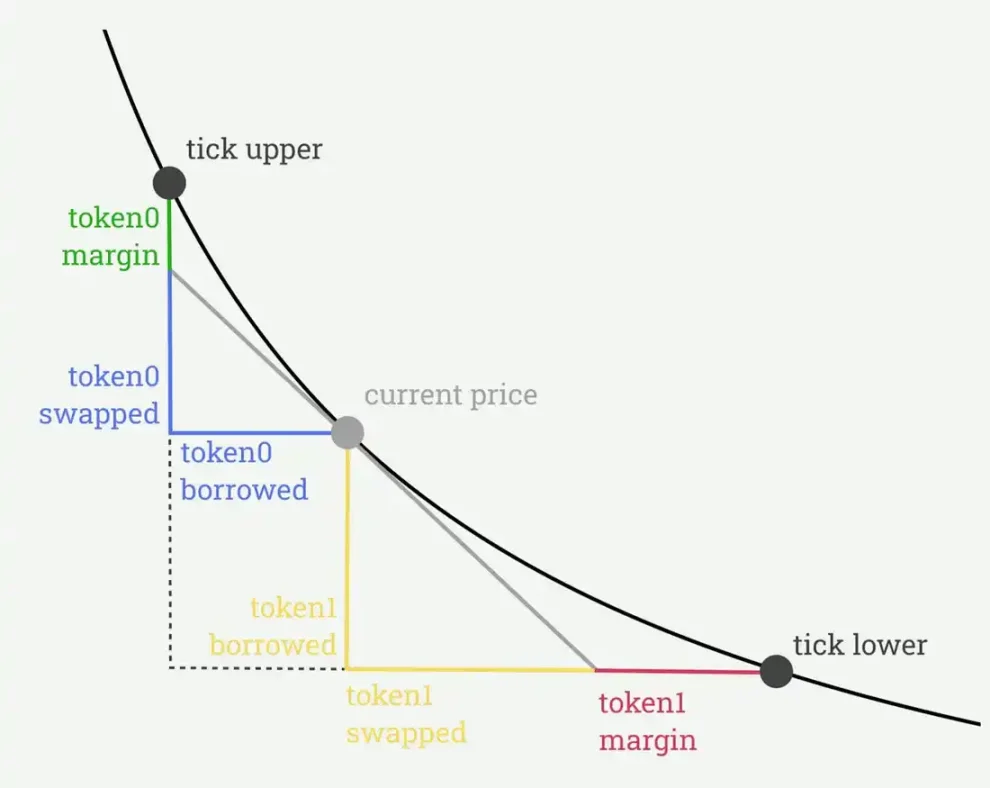
On the liquidation front, LAMM ensures that assets borrowed against LP tokens remain available under all price conditions, preserving liquidity.
Traditional derivatives protocols rely on accurate price oracles and external market liquidity for liquidations. Under such mechanisms, long-tail assets with insufficient liquidity face substantial risks. Particle takes a different approach: for any concentrated liquidity position in a token pair, the price boundary mathematically defines the quantity of tokens to be converted at every price point. When borrowing from a concentrated liquidity position, the protocol calculates the exact amount of collateral required to ensure the contract holds sufficient tokens to withstand adverse price movements toward the boundary.
Moreover, by tracking swap fees accumulated during borrowing and repayment, the protocol ensures borrowers pay interest no less than the swap fees the borrowed liquidity would have earned in the original pool. In this way, Particle generates strictly higher fee income for LPs without increasing impermanent loss beyond what their original swap liquidity would incur.
Example:
Consider an ETH/USDC LP position concentrated within the [1800, 2200] USDC/ETH price range.
Current ETH price is 2000 USDC; using USDC to go long ETH. Based on Uniswap’s math, borrowing 10¹⁴ units of liquidity for this LP position at the current price results in withdrawing 0.104 ETH and 229.495 USDC. Assuming no price impact, converting 229.495 USDC into ETH at the current exchange rate (2000 USDC/ETH) yields 0.115 ETH.
If the ETH price drops below the lower bound (1800 USDC/ETH), the 10¹⁴ units of liquidity will be fully converted into 0.225 ETH (with zero USDC remaining). The trader must contribute 0.225 − 0.104 (borrowed ETH) − 0.115 (converted ETH) = 0.006 ETH. This ensures that regardless of ETH’s recovery price, the LP is guaranteed to reclaim 10¹⁴ units of liquidity. At the lower bound, the maximum possible ETH quantity is guaranteed to cover the borrowed liquidity, irrespective of the ETH-USDC composition.
Leverage analysis: The trader uses only 0.006 ETH to leverage liquidity worth 0.219 ETH. This equates to a leverage ratio of 0.219 / 0.006 = 36.5x.
Through this design, the Particle protocol eliminates the need for price oracles, thereby removing many potential attack vectors and possibilities for market manipulation. Additionally, on most traditional perpetual futures platforms, a trader’s counterparty (e.g., a long position) is another trader (e.g., a short position). These platforms require complex mechanisms—such as dynamic funding rates—to balance incentives and manage counterparty risk.
On Particle, leverage arises from the relative value changes of the underlying assets. This means profit and loss (PnL) are determined by the performance of the assets themselves, not by the losses of a counterparty. The scalability of the Particle protocol implies that, given sufficient available liquidity, it can efficiently support various trading positions.
Incentive Mechanisms for LPs and Traders
Particle offers a premium model with a fixed 7-day borrowing period. When opening a position, traders select a portion of liquidity as a premium. The position accrues interest at a rate equivalent to the swap fees the borrowed liquidity would earn in its original pool. Technically, the Particle contract records the fee growth tracker at the liquidity boundary when the position is opened. The current fee tracker enables proportional calculation of swap fees earned by the borrowed liquidity.
When LPs decide to withdraw liquidity and stop earning interest, unborrowed liquidity can be withdrawn at any time. Particle includes a feature allowing preemption of liquidity after the 7-day term. Whenever the interest depletes the premium or the borrowing period expires, anyone can act as an external liquidator to close the position and earn a portion of the premium as a liquidation reward. The share amount and 7-day parameter can be adjusted later.
From the liquidity provider’s perspective, there are two yield-enhancement methods in Particle.
Trading fees: For each leveraged position opened, traders pay a fee of 0.05% of the leveraged amount. This trading fee is in addition to the standard interest earned by the borrowed liquidity through swap activity. This mechanism is designed to ensure LPs earn significantly higher fees by lending within the Particle ecosystem. The Particle treasury shares trading fees with liquidity providers and will use funds to further incentivize and boost liquidity across different token pairs.
Borrowing out-of-range liquidity: Normally, when a concentrated liquidity position moves outside its price range, it stops earning regular swap fees. However, in Particle, traders can still borrow this out-of-range liquidity for leveraged trading, directly paying position fees to those LPs. This model enables LPs to continue earning returns from their liquidity even when it lies outside the active trading range.
From the trader’s perspective, this setup offers the advantage of interest-free leverage, provided the price does not return to within the concentrated liquidity range.
Based on these designs, the Particle protocol aligns the interests of multiple parties. For token projects, it increases visibility and accelerates price discovery. Moreover, since leveraged trading involves actual asset swaps in the spot market, it directly boosts trading volume for token projects. For liquidity providers, it delivers returns from both borrowed liquidity and swap fees. Furthermore, Particle’s LAMM architecture is built atop concentrated liquidity AMMs. Since every transaction in the protocol involves spot market trades, the underlying AMM also earns fees.
Entering the NFT Derivatives Space?
Coincidentally, today (January 19) marks the final day of Particle’s Alpha testnet, while nftperp—an NFT-focused decentralized perpetual contracts protocol—also unveiled its V2 interface today. BlockBeats previously covered nftperp, known for enabling leveraged shorting of NFTs, whose V1 was shut down six months ago due to scalability limitations of its vAMM model.
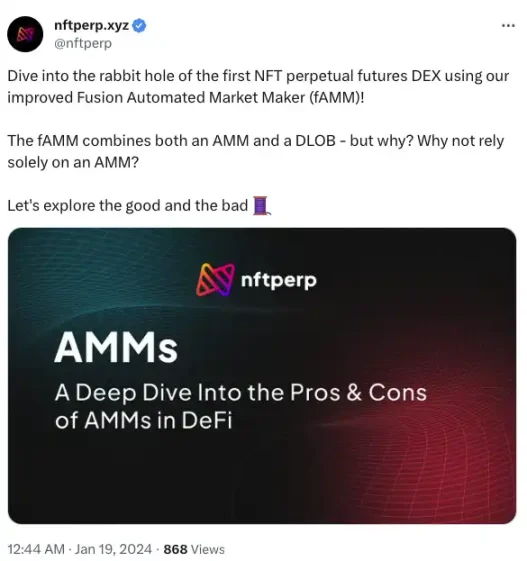
According to the Particle team’s introduction in Discord, prior to launching Particle, the team developed a product related to NFT liquidity solutions. However, Particle has not disclosed specific details about the team, only revealing that team members have years of experience at companies like Google and Facebook, and that the founder dropped out of MIT to pursue Web3 entrepreneurship.
In terms of marketing, in a September 2023 tweet, Particle described itself as enabling traders to “short any NFT collection and profit from price declines.” In October, Particle announced a partnership with Flooring Protocol, an NFT fractionalization protocol. During Particle’s recently concluded Alpha testnet, supported trading pairs included FLC/ETH and μBAYC/ETH—both being fractionalized NFT tokens.
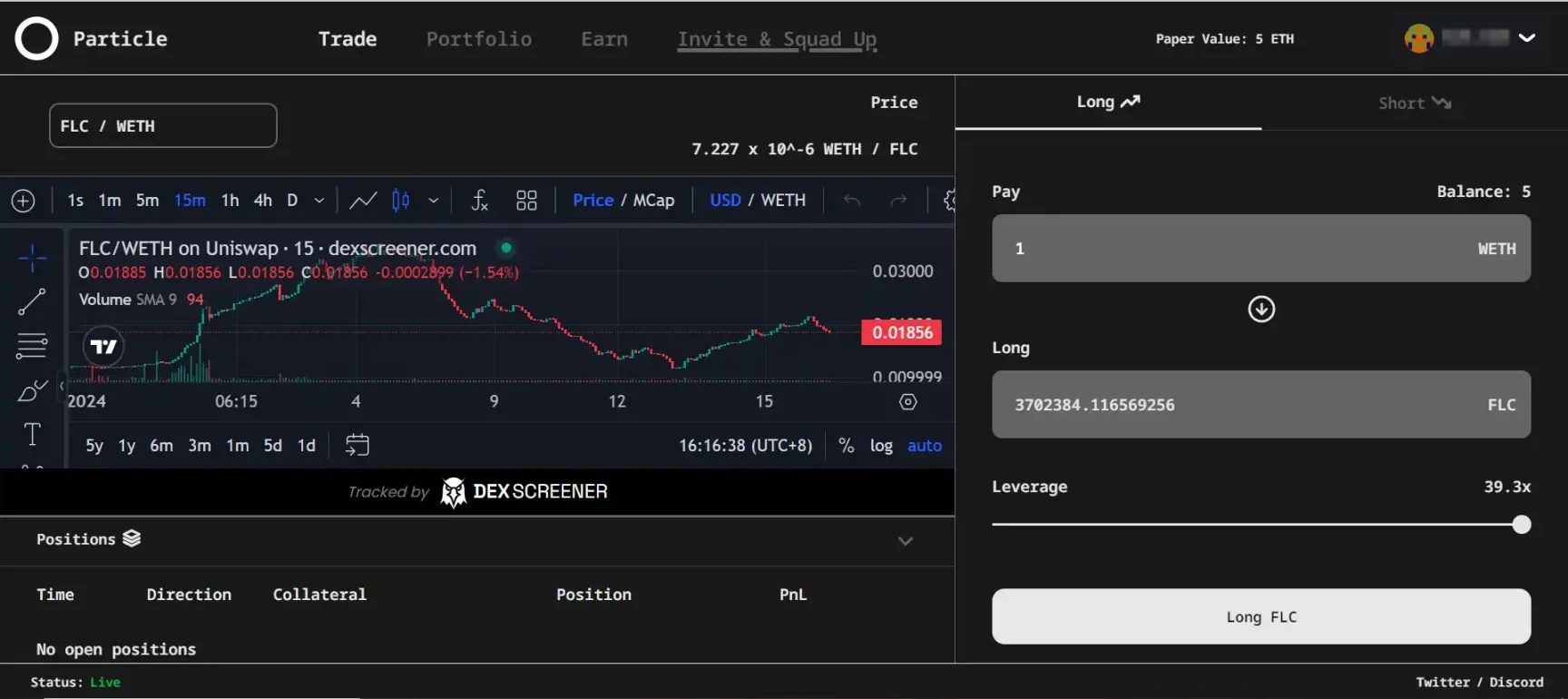
Although Particle’s Twitter bio currently describes it as a “permissionless leveraged trading protocol for any digital asset,” and it announced on January 17 its participation in Blast’s Big Bang competition under the Perp Dex category, based on these signals, Particle may lean more toward the NFT market in its future trading pairs.
However, Particle has not yet provided further details on how it anchors NFT floor prices or whether “supporting any trading pair” aims to address the illiquidity issues of long-tail NFTs.
Regardless of whether it focuses on NFTs, derivatives remain a high-potential market favored by capital. Although few emerge unscathed from contract trading, ever since Arthur Hayes introduced the “perpetual contract” via BitMEX in 2016, derivatives offering amplified volatility, high returns, and high risks have consistently attracted traders seeking capital efficiency.
Currently, the on-chain derivatives market exhibits strong leader concentration, with distinct models emerging—including orderbook, vAMM, and P2P architectures. Several perpetual contract protocols leveraging AMM mechanisms have emerged, such as Perpetual Protocol (launched in 2021 on a virtual AMM), which once led the Perp sector in trading volume. In 2023, InfinityPools gained significant attention by offering infinite leverage on any asset. Particle is not a pioneer in this space, but given the lack of standout products over the past year, it still holds considerable growth potential.
Particle has not officially launched, and the team has not disclosed any token issuance plans, so its future trajectory remains uncertain. BlockBeats reminds readers that while leveraged trading offers potentially high returns, investors also face greater risks of loss. Therefore, when employing leverage strategies, investors must possess refined risk management capabilities, exercise caution, fully understand market risks, and develop sound risk mitigation strategies.
Join TechFlow official community to stay tuned
Telegram:https://t.me/TechFlowDaily
X (Twitter):https://x.com/TechFlowPost
X (Twitter) EN:https://x.com/BlockFlow_News
 BlockBeats







