








EIP-4844 Explained for Crypto Newcomers: What Were the Problems with L2 Before the Decun Upgrade?
TechFlow Selected TechFlow Selected
EIP-4844 Explained for Crypto Newcomers: What Were the Problems with L2 Before the Decun Upgrade?
Create a separate space where L2 can quietly conduct its business.
 Navigating Web3 tides with focused insights
Author: BLOB
Translation: TechFlow
Introduction:
Everyone is talking about the Dencun upgrade and EIP-4844 potentially ushering in a new narrative for Ethereum and Layer 2 networks—but what exactly are the Dencun upgrade and EIP-4844?
We don’t need to become technical experts, but clearly understanding the technology itself helps us better evaluate the narrative.
This article provides an accessible explanation of Layer 1 and Layer 2 blockchain concepts, explores how Layer 2 networks operated prior to Ethereum’s Dencun upgrade, and examines how EIP-4844 will improve data storage and fee structures for L2 networks.

Introduction
What is L1?
Layer 1 (L1) typically refers to a blockchain that does not depend on any external network: it can independently perform all functions required for a fully operational blockchain.
Examples of L1 blockchains include:
-
Bitcoin
-
Ethereum
-
Solana
-
Avalanche
Beyond operating completely independently, all these networks share one thing in common: other networks or blockchains can use them as service providers to fulfill certain specific needs!
These networks that rely on L1 blockchains are known as Layer 2 (L2) blockchains.
What is L2?
L2 is a blockchain built on top of an L1.
L2 blockchains only perform part of the functions needed for a working decentralized blockchain and delegate certain functionalities to another L1 network.
Generally, L2 networks propose to handle computation (roughly equivalent to smart contract execution) while delegating transaction finality (often referred to as security) to the L1.
Thus, in this context, the L1 network is often called the data availability layer for the L2!
What is a Data Availability Layer?
A data availability layer is a term indicating the network where a given L2 writes its own historical record, making all executed transaction data available for anyone to read. This is the most critical function that the L1 performs for the L2!
Because L2 networks currently do not operate with a network of nodes storing every transaction processed by the blockchain, L2s must store this history somewhere.
To explain more simply, think of L1 and L2 as parts of a computer:
-
L1 is like the computer's hard drive, where records of transactions occurring on the L2 are stored in case someone wants to review them
-
L2 is like the computer's CPU, where all computations happen and where users see the results of applying transactions. However, as new transactions arrive, these results change rapidly
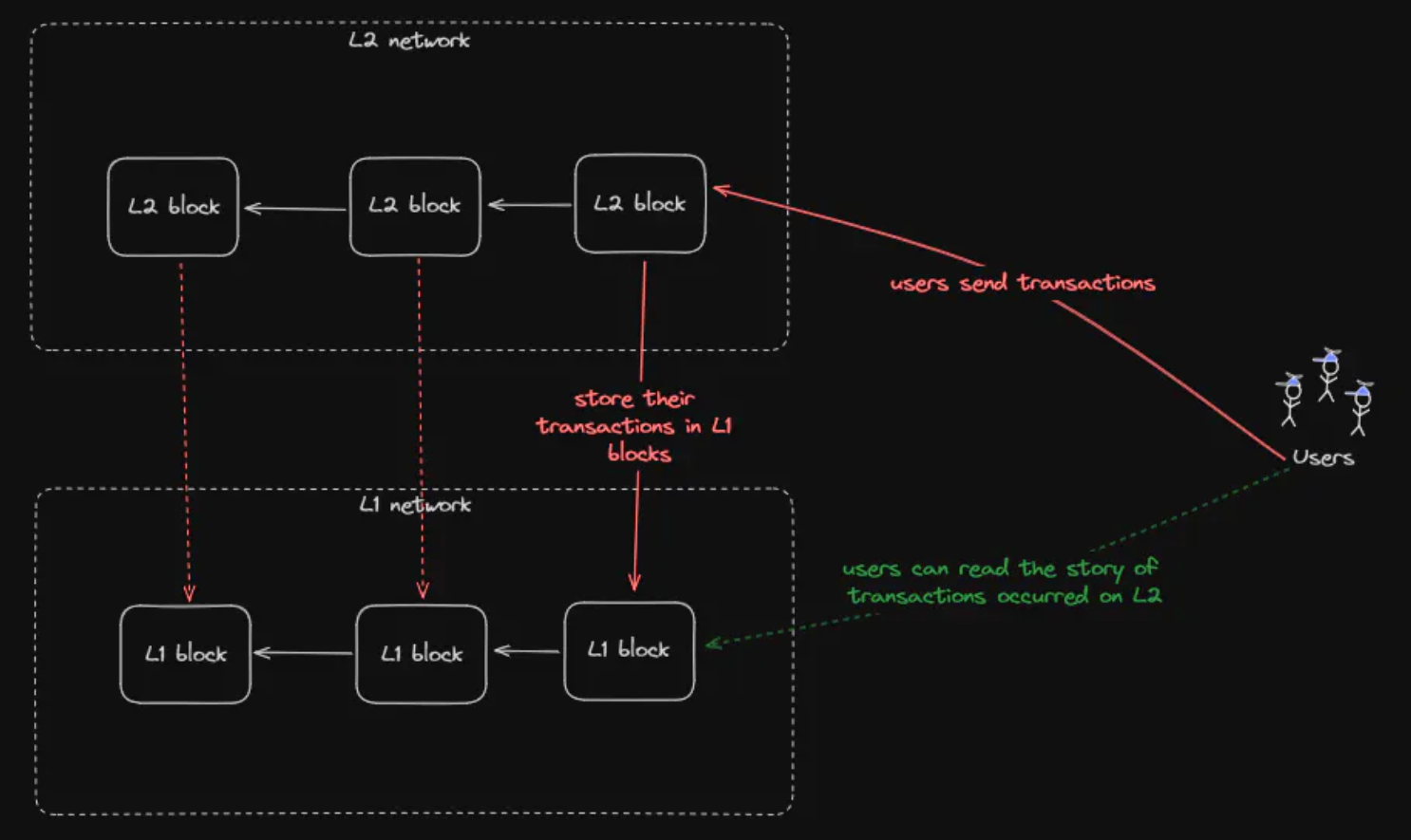
Users can send transactions to L2 just as they would on an L1 blockchain! They can also consult the L1 network storing L2 transactions to verify what happened on the L2!
Layer 2 Networks
Two Types of L2
You may have already heard of two different types of L2 networks, commonly known as "rollups":
-
Optimistic rollup
-
ZK rollup
Although they may sound intimidating and difficult to understand, the difference between them is actually very straightforward! The distinction centers on how each type of rollup writes its transactions to L1 and convinces end users that these transactions were correctly executed.
Optimistic rollups adopt a "trust me bro" approach:
-
Execute incoming transactions on L2
-
Publish the transactions and their execution results to L1 (providing all data necessary to verify correct application)
-
Allow anyone to challenge the result within a fixed time period. For example: if tomorrow you discover Arbitrum incorrectly processed your $BLOB transfer, you can report it. As a result, you receive a reward, and Arbitrum’s chain will be corrected to reflect the proper outcome!
ZK rollups take a more "this is the result, here’s the proof" approach:
-
ZK rollups use a special version of the EVM capable of
-
Executing transactions normally
-
Generating proofs of correct execution
-
-
Publish the transactions along with proofs of correct execution to L1
-
Now anyone can verify whether the L2 correctly executed the transactions simply by checking the provided proofs (the crucial point here is that verifying proof validity is far cheaper than re-running all transactions and comparing results)
How Do L2 Networks Work Today?
Generally speaking, we can summarize the operation of L2s in the following steps:
-
Users on the L2 send transactions: wrap ETH, swap on Sushiswap, borrow/lend on AAVE, buy $BLOB, etc.
-
The L2 applies incoming transactions: this is why you receive tokens after a swap
-
The L2 periodically creates batches of transactions and publishes them to L1—we'll discuss this further shortly
-
Depending on the type of L2, transactions either finalize immediately or enter a dispute period. In the latter case, they finalize after the period ends!
-
Done—repeat the process.
Now, I want to dive deeper into how L2s send transaction batches to L1, because understanding this clearly explains why we need EIP-4844.
Currently, on all EVM blockchains, there exists something called calldata: a special space within user transactions where one can write anything desired.
Since we can write anything into a transaction's calldata, L2s came up with a clever idea: write their transactions, proofs, and execution results directly into it!
Because blockchain transaction calldata allows arbitrary content, L2 networks ingeniously decided to directly write their transactions, proofs, and execution results into it. It's a brilliant idea—thanks to calldata, L2 networks can now write their historical records onto Ethereum, gaining extremely high decentralization and security, since Ethereum itself is highly decentralized and resistant to modification.
However, writing data into calldata comes with a problem that negatively impacts all users of L1 and L2: all transactions compete in the same fee market!
This means that if Ethereum gas surges due to NFT mints, the cost for L2s to publish data also increases! This leads to higher transaction costs on L2s! Conversely, if L2 networks need to publish large volumes of data, it harms Ethereum users who don't even care about L2 data!
EIP-4844 to the Rescue
Due to the above issues, the Ethereum community devised a clever solution to address this negative externality: create a separate space where L2s can operate quietly without disrupting others.
EIP-4844 introduces a simple concept: let L2s do their own thing without interfering with Ethereum users! To achieve this, it introduces a new type of transaction allowing L2 networks to publish all required data into blobspace—a new section within Ethereum blocks dedicated exclusively to carrying L2 data write operations.
Additionally, EIP-4844 will create a separate fee market, ensuring Ethereum users and L2 networks do not interfere with each other or drive up each other's transaction costs—effectively allowing everyone to safely travel in their own lane without interference.
This upgrade is expected to reduce L2 transaction gas fees by approximately 10x!
Conclusion
After the Dencun upgrade, the major impact will be on how these networks write and submit specific sets of transactions to Ethereum. From a user perspective, the only significant changes will be dramatically reduced gas fees on L2s and potentially fewer gas spikes on L1!
Join TechFlow official community to stay tuned
Telegram:https://t.me/TechFlowDaily
X (Twitter):https://x.com/TechFlowPost
X (Twitter) EN:https://x.com/BlockFlow_News
 @blob_coin












