









Correcting Vitalik's Inaccurate Statements on DA Issues and Censorship-Resistant Withdrawals
TechFlow Selected TechFlow Selected
Correcting Vitalik's Inaccurate Statements on DA Issues and Censorship-Resistant Withdrawals
Plasma's secure withdrawals do not depend on a DA system, and censorship-resistant withdrawals are not strictly dependent on a DA system either.
 Navigating Web3 tides with focused insights
Author: Faust, GeekerWeb3
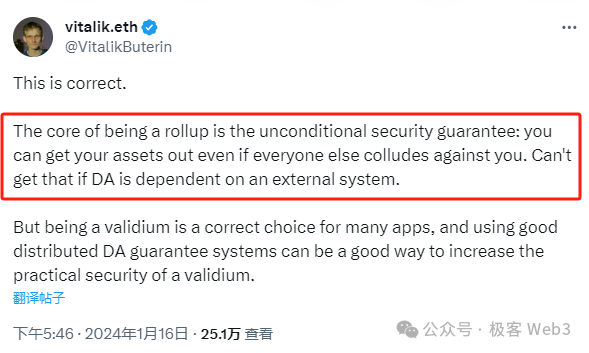
On January 16, 2024, under a tweet initiated by Daniel Wang, founder of Ethereum Layer2 project Taiko, and interacting with Zeng Jiajun, founder of AA wallet Soul Wallet, Vitalik stated: "The key to rollups lies in unconditional security guarantees: even if everyone is against you, you can still withdraw your assets. If DA depends on external systems (outside Ethereum), this cannot be achieved."
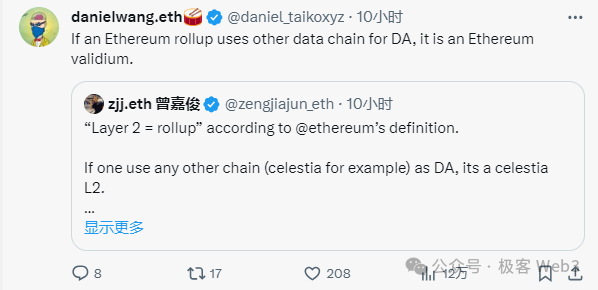
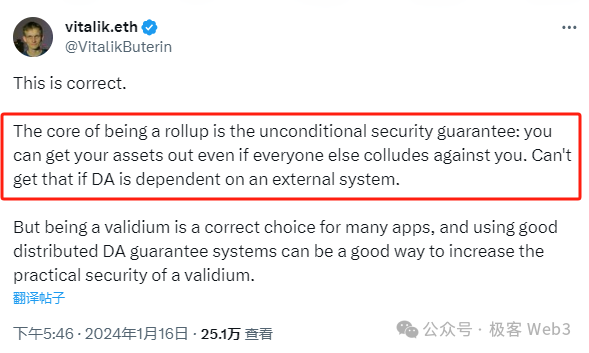
Since Vitalik discussed his views on Validium later in the same tweet (Validium refers to ZK Layer2s that do not use Ethereum for DA data publication), it attracted significant attention (previously it was widely rumored that the Ethereum Foundation equates Layer2 with Rollup).
(It should be emphasized: the concept of DA discussed within the Ethereum community refers to whether you can access newly generated data on Layer2, not whether you can retrieve long-past historical data. If new data isn't published on the Ethereum chain, Layer2 nodes may fail to correctly parse the latest L2 blocks.)
However, the so-called "Layer2 definition debate" and "DA War" have already been widely heard. This article does not intend to explore such topics, focusing instead on the first half of Vitalik’s statement, specifically the quote mentioned at the beginning of this article.
Vitalik stated here that rollups enable trustless, censorship-resistant withdrawals—meaning even if all Layer2 nodes refuse to cooperate with you, you can still withdraw your assets from Layer2. Moreover, he pointed out that only rollups can achieve this kind of "unconditional secure withdrawal," while Layer2s relying on other DA data publication methods cannot.
In reality, however, Vitalik's statement is not entirely rigorous.
First, only assets bridged from Layer1 to Layer2 can be transferred back to the ETH chain; purely native Layer2 assets cannot cross back to Layer1 (unless native Layer2 assets deploy bridge contracts on Layer1).
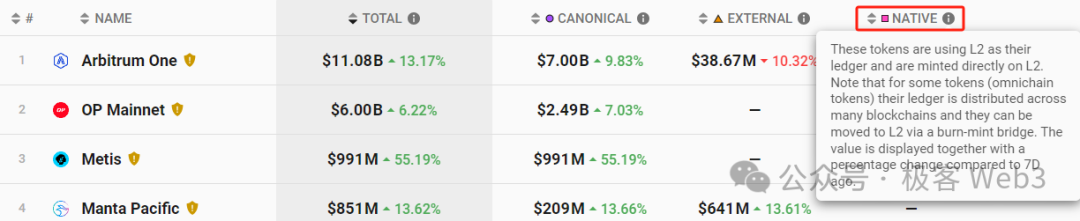
If, as Vitalik says, "everyone is targeting you," you could at best withdraw your L1-L2 bridged assets, but would be unable to withdraw your "native Layer2 tokens." At that point, whether using normal withdrawal, forced withdrawal, or Escape Hatch, none would work.
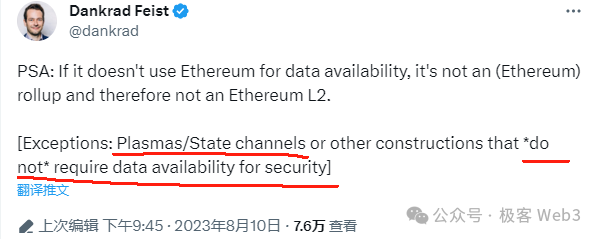
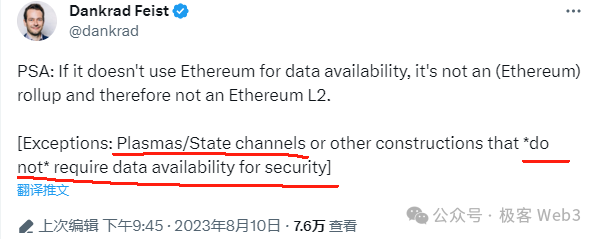
Second, "unconditional secure withdrawal" does not necessarily depend on a DA system. Early Layer2 solutions prior to rollups, such as Plasma—which implements DA data publication off Ethereum—allow users to submit asset proofs based on historical data and safely exit Layer2 when DA systems fail (i.e., during data withholding, when only sequencers/committees possess new transaction/state transition data).
In other words, Plasma's secure withdrawals are independent of the DA system; censorship-resistant withdrawals do not inherently require DA dependency (provided historical data remains accessible). Furthermore, this claim comes directly from Dankrad of the Ethereum Foundation (proposer of Danksharding), and is universally accepted as standard knowledge.
See previous GeekerWeb3 articles:"Data Withholding and Fraud Proofs: Why Plasma Does Not Support Smart Contracts"
Moreover, setting aside Celestia and Blobstream, the issue of data withholding/DA failure can also be resolved without using ETH as the DA layer. For instance, Arbitrum and Redstone teams are currently implementing a mechanism called "data availability challenges," which allows sequencers to publish only a DA Commitment (essentially a datahash) on-chain, asserting that data has been published off-chain. If someone fails to obtain the newly generated data off-chain, they can challenge the DA Commitment on-chain, forcing the sequencer to disclose the data on-chain.
This mechanism is elegantly simple, and doesn’t require reliance on third-party DAs like Celestia, Avail, or EigenDA—only requiring the Layer2 team to set up off-chain DAC nodes, making it arguably a potential "Celestia killer."
Below, the author will interpret Vitalik’s notion of "unconditional secure withdrawal" and the unmentioned "data availability challenge," attempting to explain: why third-party DA projects like Celestia, Avail, and EigenDA are not mandatory choices for Layer2s pursuing off-chain DA with strong security?
Additionally, we previously argued in an article about "Bitcoin Layer2 Risk Assessment Metrics" that censorship resistance in withdrawals is more fundamental and critical than the DA system itself—this article further elaborates on that perspective.
Escape Hatch: Vitalik's "Unconditional Secure Withdrawal"
Actually, Vitalik’s statement isn’t hard to analyze—it refers to the escape hatch mechanism in ZK Rollups. An escape hatch, also known as an Escape Hatch, is a withdrawal mode directly triggered on Layer1. Once activated, the Rollup contract enters a frozen state, rejecting any new data submitted by the sequencer, and allowing anyone to present a Merkle Proof proving their asset balance on Layer2, thereby transferring their assets out from the official Layer2 bridge deposit address.
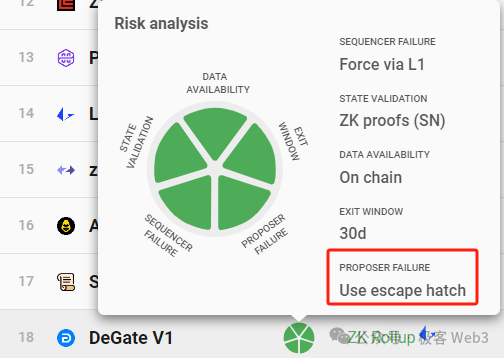
More precisely, the escape hatch is a "trustless withdrawal mechanism" manually triggerable on Layer1 when a user's transactions have been persistently rejected by the Layer2 sequencer.
However, before activating the escape hatch, users whose transactions were rejected must first call the forced withdrawal function in the Rollup contract on Layer1, initiating a forced withdrawal request and emitting an event so Layer2 nodes become aware that a forced withdrawal has been requested.
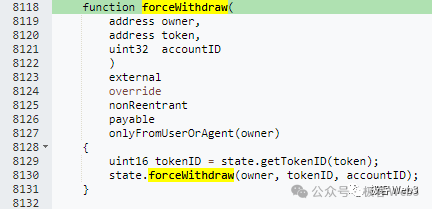
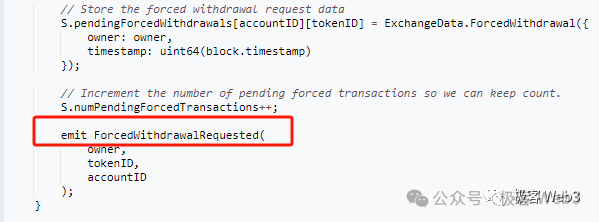
(Since Layer2 nodes run Ethereum geth clients and receive Ethereum blocks, they can listen for the forced withdrawal event.)
If the forced withdrawal request is ignored for too long, the user can proactively trigger the escape hatch mode (Loopring defaults this waiting period to 15 days; StarkEx uses 7 days). Then, as described at the start of this article, the user submits a Merkle Proof corresponding to their assets, proving their Layer2 asset holdings, and withdraws assets from the Rollup-related contract.
But to construct a Merkle Proof, one must first know the complete L2 state, requiring querying data from an L2 full node. In the extreme scenario described by Vitalik, where no Layer2 nodes cooperate, you can launch your own Layer2 full node, retrieving historical data posted by the L2 sequencer onto Ethereum via the Ethereum network, synchronizing block-by-block from the genesis block until computing the final state and constructing the Merkle Proof, enabling safe withdrawal through the escape hatch.
Clearly, at this point, the "censorship resistance" is equivalent to that of Ethereum/Layer1 itself. As long as Ethereum full nodes provide older historical data, the process approaches being trustless.
However, after EIP-4844, Ethereum full nodes automatically discard certain historical data, meaning Layer2 data older than ~18 days will no longer be backed up across the entire ETH node network. At that point, the censorship resistance of escape hatch withdrawals will no longer be as close to trustless as today.
Post-4844, we’ll need to trust that a limited number of Ethereum nodes storing full historical data are willing to provide that data (natively operated Layer2 nodes are typically too few to rely upon). Thus, the trust assumption for Layer1 historical data retrievability / Layer2 escape hatch withdrawals shifts from today’s trustless or 0 to 1/N—assuming at least one out of N nodes will serve you the data.
The EthStorage team appears to aim at increasing this N, incentivizing more nodes to store older historical data. If the denominator of 1/N becomes large enough, the fraction approaches zero, effectively avoiding meaningful trust assumptions. This might help mitigate post-4844 historical data retrieval issues.

Relationship Between Escape Hatch and DA — The Ransom Attack on Validium
To reiterate: The escape hatch allows you to prove your Layer2 asset holdings via Merkle Proof and perform trustless withdrawals on Layer1.
The reason Vitalik mentions that withdrawal-related asset security requires DA as a prerequisite mainly concerns how Validium schemes can be rendered unable to withdraw due to "data withholding attacks" (publishing only stateroot, not corresponding transaction data).
The specific mechanism works as follows: the sequencer may withhold transaction data while only publishing a Merkle Root (Stateroot) on the Ethereum chain, then use validity proofs to get the new Stateroot verified and accepted as the current legitimate state root.
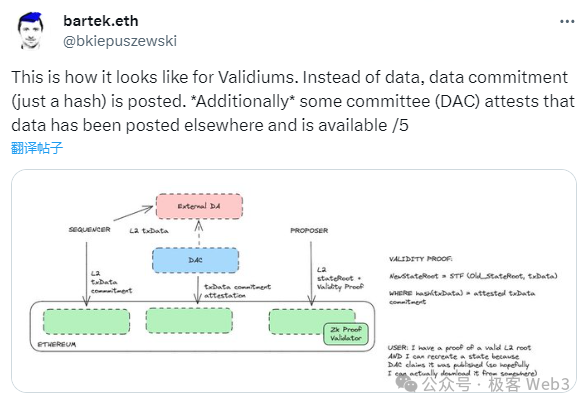
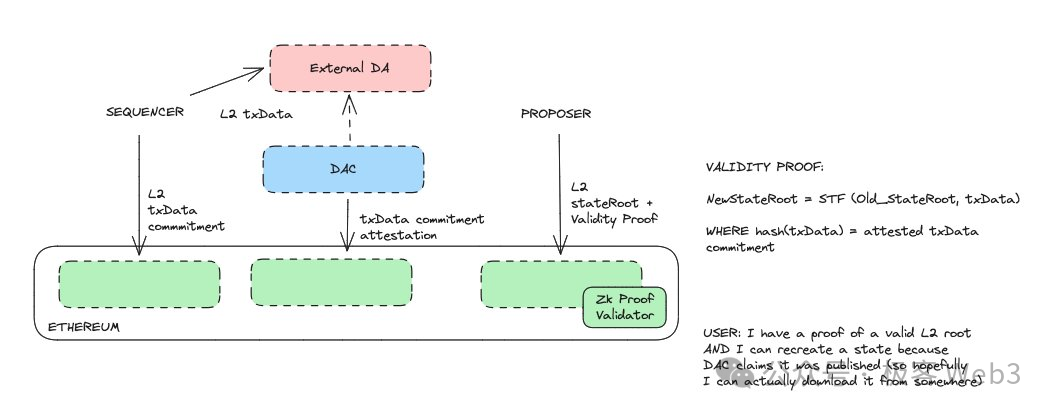
At this point, no one knows the full state corresponding to the valid Stateroot, making it impossible to construct the required Merkle Proof to initiate an escape hatch withdrawal. You can only withdraw if the sequencer chooses to release the data—an issue one Arbitrum tech lead vividly termed a "ransom problem" (I personally prefer calling it a ransom attack).
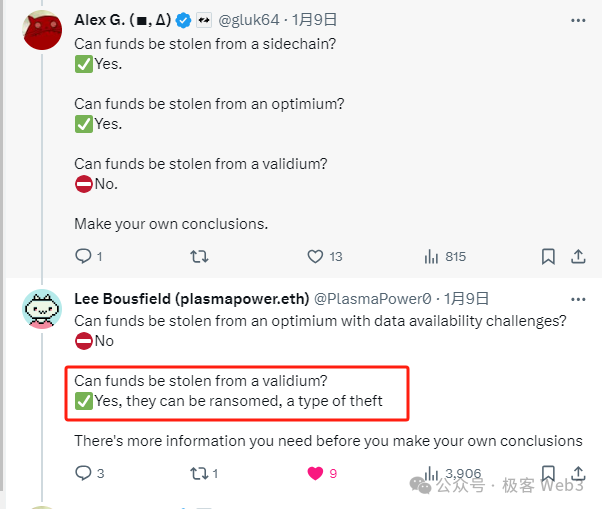
However, the reason off-chain DA Validiums are prone to "ransom attacks" is due to their own inadequate mechanism design. Introducing challenge mechanisms tied to withdrawal behavior, or data availability challenges, could theoretically solve the ransom attack problem.
By the way, as previously mentioned, Plasma—which allows withdrawals using old historical data—does not suffer from such "ransom attacks" as Validium, despite also having off-chain DA (off-chain DA + on-chain fraud proof verification).
Reference:Data Withholding and Fraud Proofs: Why Plasma Does Not Support Smart Contracts
Thus, censorship-resistant withdrawals / escape hatches do not inherently depend on DA; everything hinges on the mechanism design of the withdrawal process. Vitalik assumes DA dependence because he starts from pre-existing frameworks like Validium and smart contract rollups, already operating under a cognitive bias.
This doesn't mean all off-chain DA Layer2s face the same problems as Validium, nor that smart contract rollups represent the ultimate end-state—innovation can always emerge (e.g., the aforementioned data availability challenges).
Conversely, if your Layer2 design doesn't include features like escape hatches or censorship-resistant withdrawals from the outset, your Layer2 is fundamentally less trustless and secure. In other words, good DA and proof systems are sufficient conditions for achieving censorship-resistant withdrawals, but not necessary ones.
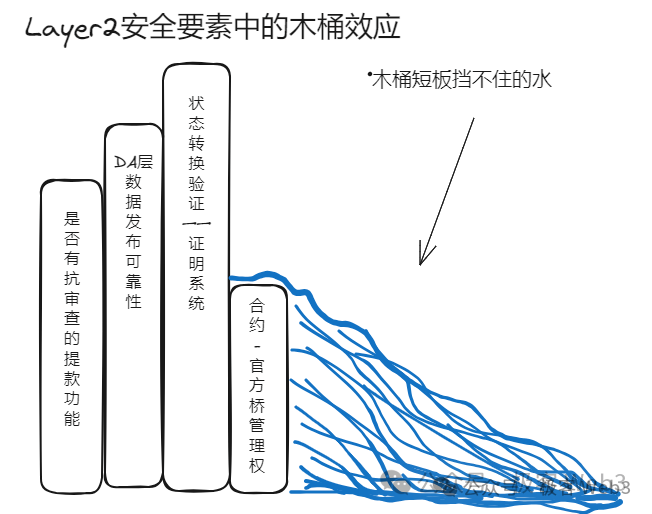
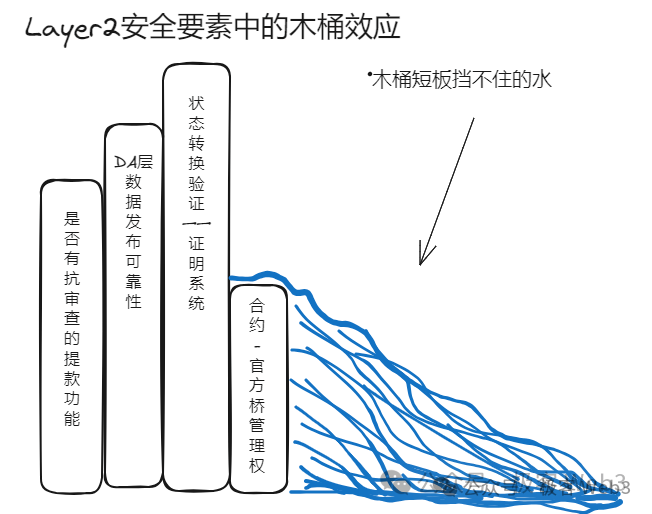
Hence, our earlier argument—that in the Layer2 "bucket theory," censorship-resistant withdrawal represents a more fundamental weakness than DA and proof systems—is well-founded.
Reference:"Dissecting Bitcoin/Ethereum Layer2 Security Models and Risk Indicators Using Bucket Theory"
Celestia Killer: Arbitrum and Redstone's Data Availability Challenges
Having discussed the relationship between escape hatches and DA, let’s now reconsider DA itself: Layer2s don’t necessarily have to publish DA data on Ethereum to prevent sequencers from performing "data withholding."
Redstone, Arbitrum, Metis, and others are developing a "data availability challenge" mechanism, allowing sequencers to publish only a DA Commitment (datahash) + Stateroot on-chain, declaring that state transition parameters (transaction data) have been published off-chain. If anyone fails to obtain the newly generated data off-chain, they can challenge the DA Commitment on-chain, forcing the sequencer to disclose the data on-chain.
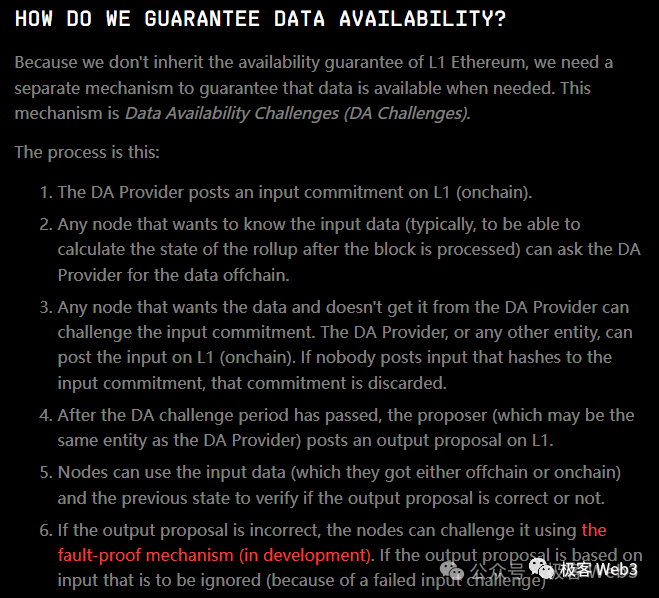
If, after being challenged, the sequencer fails to timely publish the data on the ETH chain, its previously published datahash/commitment is deemed invalid, rendering the associated stateroot invalid as well. Clearly, this directly resolves the data withholding issue (publishing stateroot without corresponding transaction data).
Obviously, compared to off-chain DA Layer2s like Validium and Optimium, this adds a "data availability challenge." Yet this simple design alone poses strong competition to Celestia, Avail, and EigenDA. By setting up their own DAC and introducing data availability challenges, projects no longer need to rely on Celestia.
However, data availability challenges face economic challenges that must be addressed. The zkSync founder, during a debate with an Arbitrum technical lead, pointed out that data availability challenges are theoretically vulnerable to DoS attacks. For example, a sequencer could rapidly publish thousands of DA commitments on-chain while withholding the full data, draining challengers' funds through repeated challenges, then publishing an invalid block to steal user assets.
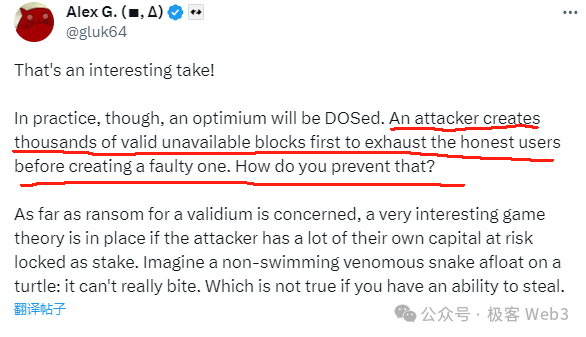
Of course, this scenario is overly extreme—it's essentially a game-theoretic博弈 between attacker and defender. In practice, sequencers are actually more likely to be DoS-attacked by malicious challengers, potentially degrading into rollup-like operation after repeated challenges. The strategic dynamics between challengers and sequencers around data availability challenges are fascinating, and the resulting mechanism designs will thoroughly test the ingenuity of teams like Arbitrum, Redstone, and Metis (a topic worthy of its own dedicated article).
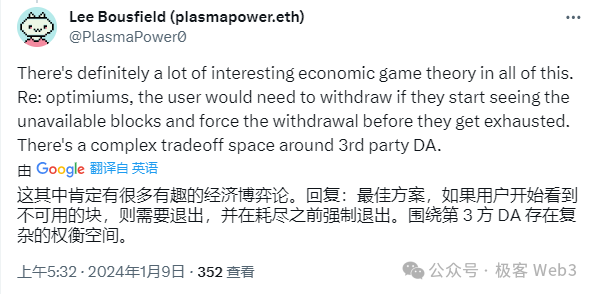
Regardless, data availability challenges will bring greater innovation to Layer2 DA design and leave a significant mark on the Bitcoin Layer2 ecosystem.
Join TechFlow official community to stay tuned
Telegram:https://t.me/TechFlowDaily
X (Twitter):https://x.com/TechFlowPost
X (Twitter) EN:https://x.com/BlockFlow_News
 @godrealmx










