The Era of Encrypted Broadband: The Modular Blockchain and Rollup Revolution
TechFlow Selected TechFlow Selected
The Era of Encrypted Broadband: The Modular Blockchain and Rollup Revolution
How do two tech giants pioneer the future of DeFi with modular rollups?
 Navigating Web3 tides with focused insights
Author: TheRollup
Translation: Kate, Mars Finance
Rollers: The blockchain space is undergoing a transformative shift, as modular blockchains usher us into what's being hailed as the "crypto broadband moment." This groundbreaking move sees two industry giants teaming up to build modular rollups, redefining the DeFi user experience through unprecedented technological advancements.
This collaboration marks a pivotal moment in blockchain technology development, promising faster transaction confirmations and significantly reduced costs.
Today, we’ll dive deep into the intricacies of this partnership, explore the mechanics of modular rollups, and glimpse into the future of value accrual within this innovative framework.
The Rollup
After yesterday’s announcement, modular blockchains are moving toward a “crypto broadband moment,” as two giants join forces to build a modular stack with unprecedented technical advantages…
Amid the Cambrian explosion of modular infrastructure, the arrival of the rollup revolution over the past 18 months is rapidly shifting focus to “modular rollups.”
The creator-centric energy behind modular blockchains—building exactly how you want—is gaining attention for good reason:
Soon, advanced DeFi users will experience previously unimaginable UX improvements—faster confirmations and cheaper transactions powered by modular rollups.
In today’s article, you’ll learn about the recent collaboration between two modular heavyweights, how building modular rollups enables better user experiences, and my predictions on where value accumulation will occur.
Yesterday, Celestia and Polygon Labs jointly announced the integration of Celestia’s data availability layer (DA) with the Polygon CDK.
This allows zk L2s launched using Polygon’s CDK to integrate Celestia’s DA layer.
Let’s dive into the Polygon CDK to understand how building modular rollups enables superior user experiences:
Polygon’s Customizable Development Kit (CDK) is a toolset enabling rapid development of modular blockchains.
Its modular approach allows developers to select specific components tailored to their blockchain use case, offering a “custom-fit” solution that eliminates the friction of choosing which stack to deploy on.
The true power of CDK lies in its ability to enable interoperability across all blockchains built with it.
What I mean is:
As shown below, builders can pick specific parts of a modular stack to incorporate into their chain design.

This gives developers the freedom to choose virtual machines, sequencer types, gas tokens, and data availability solutions, while still seamlessly sharing liquidity and connecting with the broader Polygon ecosystem via composable interoperability.
The Polygon CDK primarily consists of four components:
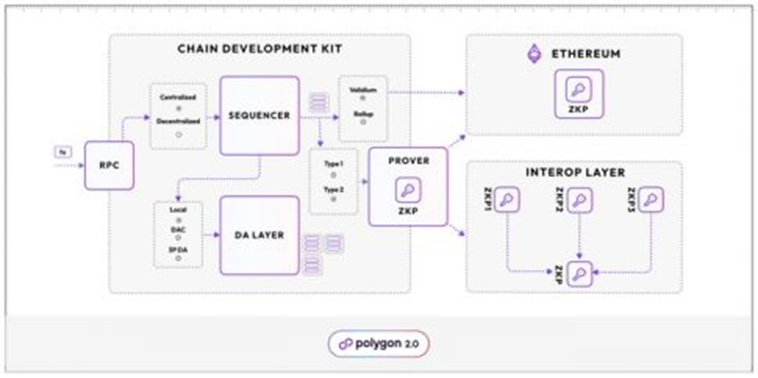
1. ZK-Provers: Type-1 (future), Type-2:
Using Polygon’s ZKP for batching further reduces verification load per blockchain, resulting in higher throughput.
The Polygon Labs team plans to implement a Type-1 ZK-Prover in the future for faster scaling.
2. Data Availability: Ethereum, DAC, Third-party (Celestia):
Ethereum ensures data availability by storing full state and transaction history on its blockchain. While it is currently the most secure, it is also the most expensive.
Next, we have Data Availability Committees (DAC), specialized off-chain groups that use ZK proofs to enhance security while storing and providing access to blockchain data.
While DACs consist of trusted nodes, there remains a risk of collusion among members.
See below for trade-offs across different data availability options:
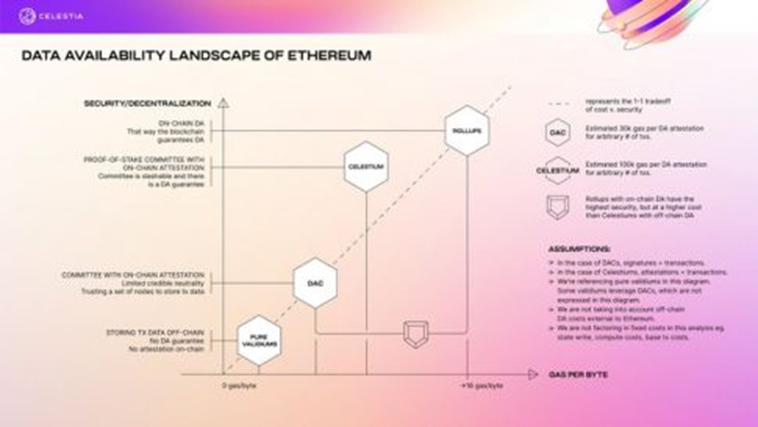
Then, we have third-party solutions like Celestia, which provides a separate data availability layer for other blockchains, enhancing scalability and striking a balance between speed and security.
3. Virtual Machine (VM)—zkEVM, Miden VM (future):
Polygon zkEVM has been under development for years and has undergone rigorous security testing. Deployment via Polygon CDK enables developers to tap into the liquidity, talent, infrastructure, and tools of the zkEVM ecosystem.
Additionally, during Epicweb3 ETH Infra Days, schmiddominik1 delivered an epic talk, from which I learned that the Miden VM will soon be available for deployment by builders.
Polygon Miden offers a secure “actor model,” leveraging ZKPs as “annotations,” flexible transaction patterns, and generating a proof for every transaction.
It will be fascinating to see how this evolves.
4. Sequencer: Centralized, Decentralized (future):
The sequencing mechanism in Polygon CDK resembles many current rollups—all relying on a single sequencer.
Like many other ecosystem teams, they are heavily focused on building a decentralized sequencer to address the single point of failure dilemma.
The challenge lies in achieving this without disrupting state alignment between L2 and L1, or introducing potential economic downsides from distributing sequencer fees across multiple parties.
Polygon’s CDK also offers additional customization features around transaction costs, data storage, and compliance. It provides EVM compatibility, dedicated throughput, and native gas tokens.
Two recent examples of chains built on CDK are CantoPublic and X1 (a project from OKX Chain).
Canto, originally a Cosmos L1 appchain, transitioned to an Ethereum L2 using Polygon CDK, focusing on driving on-chain adoption of real-world assets.
The modularity offered by CDK makes it well-suited for integrating and trading various real-world assets.
On the other hand, X1, also known as OKX Chain, is a ZK L2 network designed to support builders within the on-chain ecosystem and expand into its vast network.
It will be interesting to see how these two converge—but one thing is certain…
The rapid rise of modular blockchains driven by Polygon’s CDK will propel the evolution of “excellent user experience.”
User conditions may improve even further following integration with Celestia.
Quoting from Celestia’s post:
“This integration will enable fully on-chain applications and reduce Ethereum L2 transaction fees by approximately 100x. Celestia’s DA solution will be available to developers early next year as an easy-to-integrate component for ZK L2s built with Polygon CDK.”
I expect cumulative fees during peak times to drop below $0.01, compared to over $1 today.
For users who care about transacting in better execution environments, this UX improvement will be 100x.
Frankly, this is one of the main reasons I’m so bullish on the development of modular blockchains…
It simply makes life better for advanced users on-chain.
When you add additional layers to the stack—like alternative VMs—security and developer experience also improve dramatically… See some of my “highlight” articles on this topic.
We’re only scratching the surface. Celestia and DA layers are leading the adoption of modular blockchains.
As we wrap up this article, I’d like to take a moment to share some thoughts on value accrual within the modular stack:
Without diving into any specific asset or subsector, I generally believe all parts of the ecosystem will appreciate in value.
This includes “stack providers,” data processing layers, altVMs, interoperability protocols, sequencers, and settlement layers.

In traditional monolithic vs. modular charts, we only see three layers. I hope interoperability and sequencing layers make their way into updated, next-generation diagrams.
Markets will slowly figure out how to value these new segments through experimentation and speculation—which is incredibly exciting.
Testing these new chains, interacting with modular stacks, and being on the front lines is absolutely a great way to capture this value.
In summary, we’re still in the early stages of modular theory. As this evolves, I’ll dive deeper into value accrual models (so be sure to follow @ayyyeandy).
As for you:
Get ready for blazing-fast user experiences, a wave of new modular rollups, and chains as easy to spin up as smart contracts.
Builders are embracing this “build however you want” mantra and will run with it in ways we’ve never seen before.
As always, the key message remains the same:
Modularity, not maximalism.
Join TechFlow official community to stay tuned
Telegram:https://t.me/TechFlowDaily
X (Twitter):https://x.com/TechFlowPost
X (Twitter) EN:https://x.com/BlockFlow_News
 @therollupco