








Data Surges Across the Board: A Look at Messari's Q4 Solana Ecosystem Report
TechFlow Selected TechFlow Selected
Data Surges Across the Board: A Look at Messari's Q4 Solana Ecosystem Report
Solana saw significant month-over-month growth across multiple key metrics, including market capitalization (+423%), DeFi TVL (+303%), average daily DEX trading volume (+961%), and average daily NFT trading volume (+359%).
 Navigating Web3 tides with focused insights
By Peter Horton
Translated by Frank, Foresight News
Key Takeaways:
-
Many of Solana’s metrics maintained quarter-over-quarter growth in Q4 2023, including market cap (+423%), average daily fee payers (+102%), DeFi TVL (+303%), average daily DEX volume (+961%), and average daily NFT volume (+359%).
-
Solana Foundation's annual Breakpoint conference drove ecosystem growth, with major announcements from teams including Jupiter’s perpetuals product and token launch, Frankendancer, Backpack Exchange, and Render;
-
The JTO airdrop and BONK listing on Coinbase further boosted on-chain activity in December 2023;
-
Catalysts for Q1 2024 and beyond include the Jupiter airdrop, token extensions rollout, and continued progress on Firedancer and TinyDancer.
Introduction to Solana
Solana is a public open-source blockchain designed to provide scalability and smart contract support without sacrificing decentralization and security. It achieves this through a timestamping mechanism called Proof of History (PoH). With PoH, the network can order and batch transactions before processing them via a proof-of-stake (PoS) mechanism. Other design goals of Solana include sub-second settlement, low transaction costs, and support for all LLVM-compatible smart contract languages such as Rust, C, C++, and Move.
Key Metrics
Financial Analysis
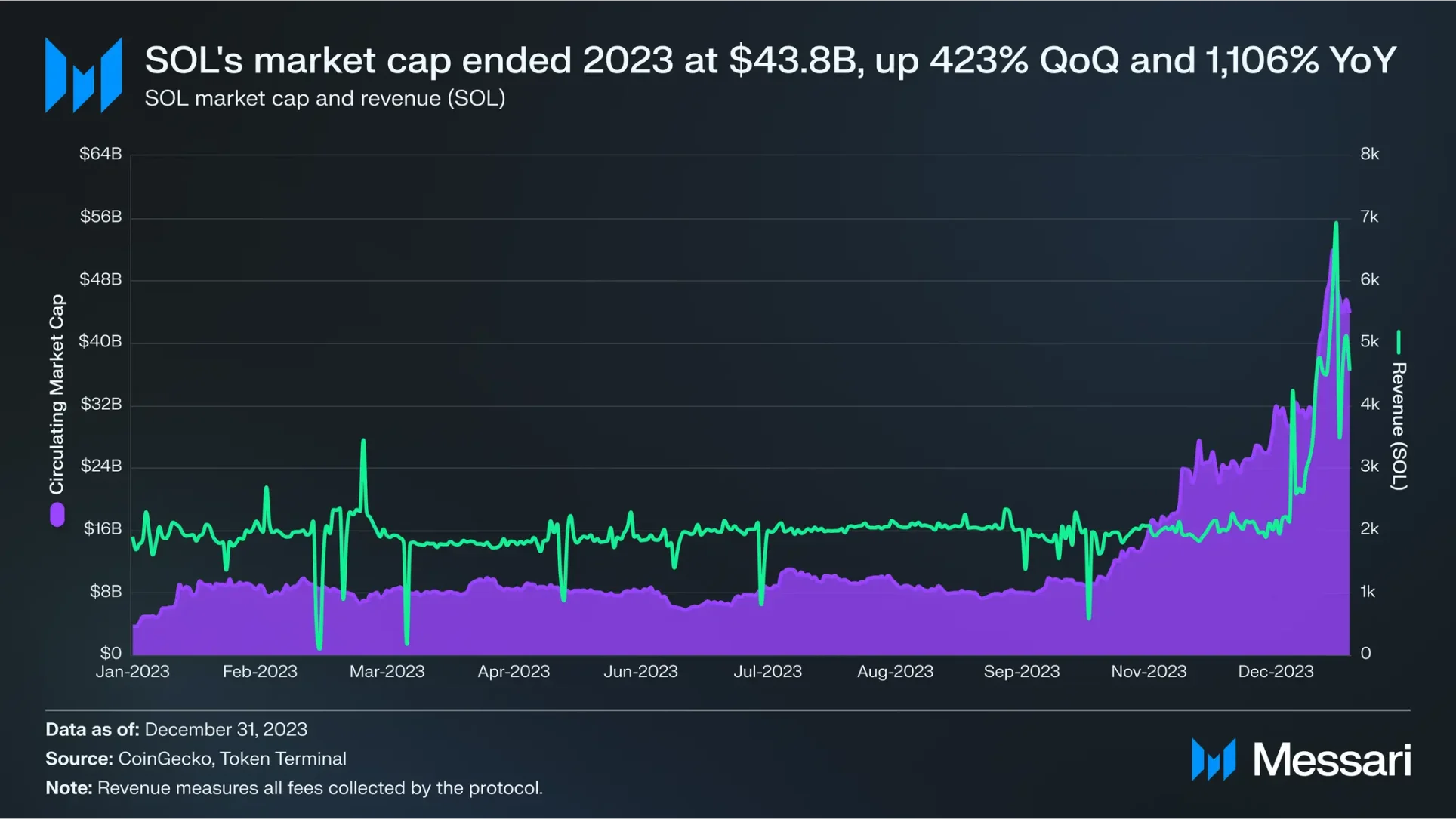
SOL was one of the leading assets during the crypto market rebound in Q4 2023. By the end of 2023, SOL had a market cap of $43.8 billion, up 423% quarter-over-quarter and 1106% year-over-year.
In Q4 2023, SOL surpassed ADA, USDC, and XRP in market cap, ranking fifth among all cryptocurrencies, compared to 17th at the beginning of 2023.
Solana’s quarterly revenue measured in SOL (the total fees collected by the protocol) increased 19% quarter-over-quarter. As the price of SOL rose, quarterly revenue in USD more than tripled to $13.7 million, with half of these fees burned and the other half distributed to block producers.
Currently, these burned tokens do not significantly reduce inflation. Thus, inflation at the end of Q4 2023 was 5.6%—this rate strictly measures newly issued tokens for validator rewards, excluding other token unlocks.
Inflation will continue to decline at a rate of 15% per epoch until it stabilizes at 1.5%. At the time of writing, 71.5% of eligible SOL is staked, meaning holders choose not to have their holdings diluted. Note that tokens held by Solana Labs or the Foundation are not fully counted as circulating, even though they are not locked. As fees rise, the annualized real yield for SOL stakers increased 58% quarter-over-quarter to 1.7%.
One of the key narratives around SOL in Q3 2023 was the fate of Alameda/FTX’s SOL holdings (now controlled by the FTX Estate), which included over 57 million SOL purchased from the Solana Foundation and Solana Labs under various unlock schedules, with an average unlock date in Q4 2025.
The FTX Estate has already unstaked and transferred most of its unlocked SOL. Upcoming unlocks can be tracked on Solana Compass and Gelato.
Network Analysis
Usage
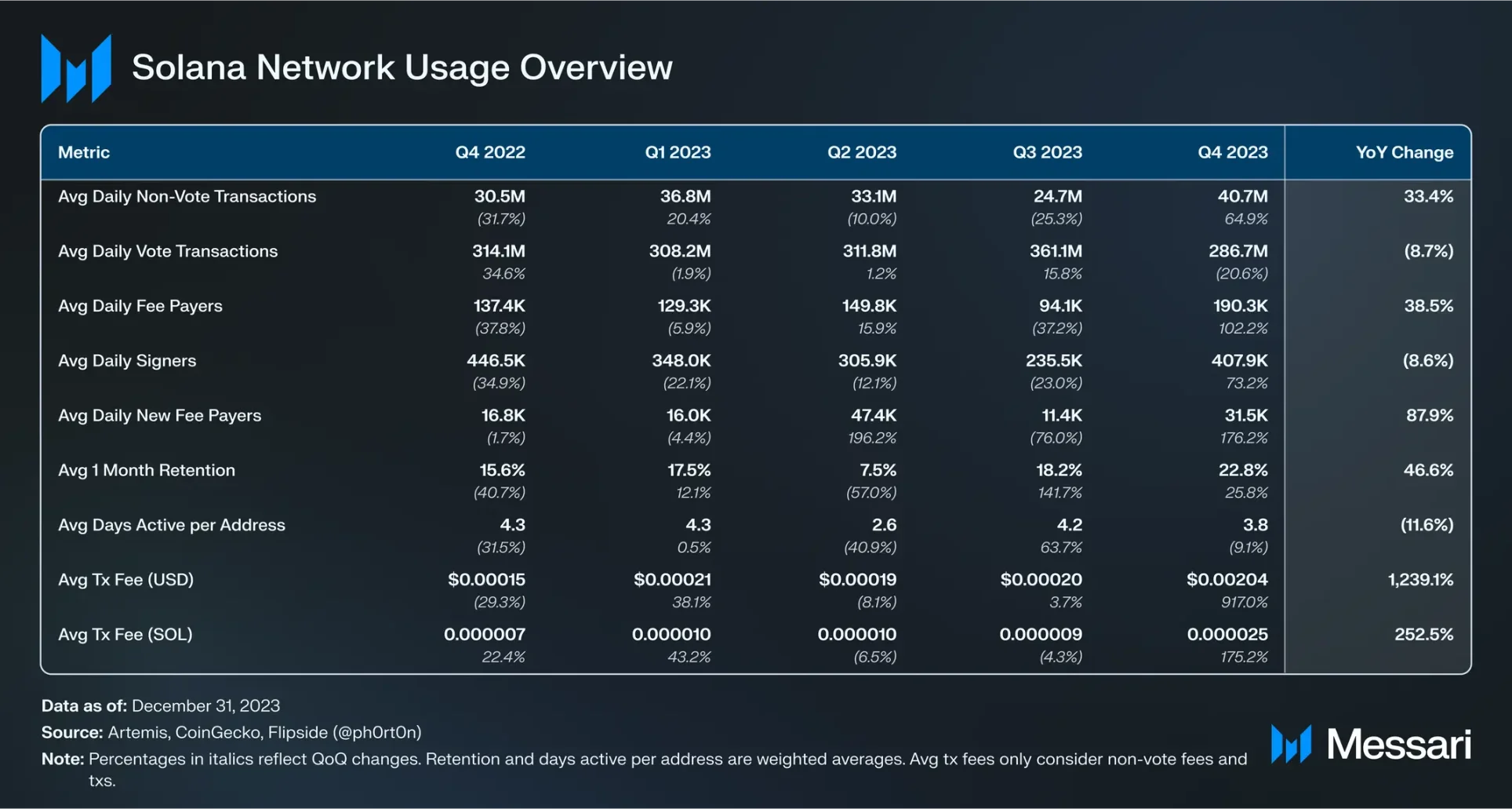
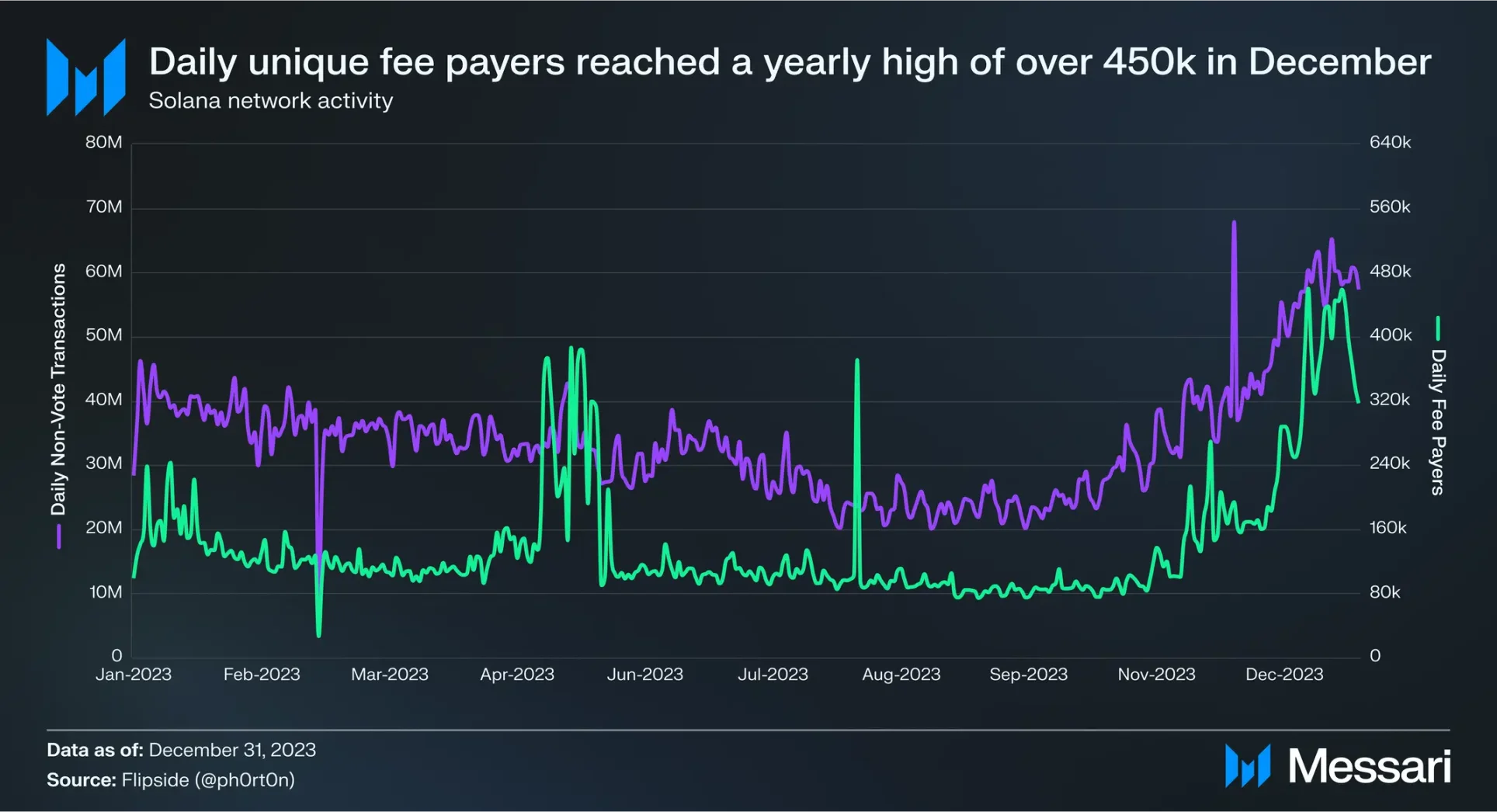
Network activity, measured by non-voting transactions and fee payers, rose alongside the increasing price of SOL. For much of 2023, the number of daily fee payers hovered between 80,000 and 100,000. The Solana Foundation’s Breakpoint conference from late October to November 2023 triggered the first phase of growth. Additional events, including the JTO airdrop and BONK listing on Coinbase, further fueled this growth.
Overall, Solana saw a 102% quarter-over-quarter increase in average daily fee-paying users, reaching 190,000, and a 65% increase in average daily non-voting transactions, reaching 41 million.
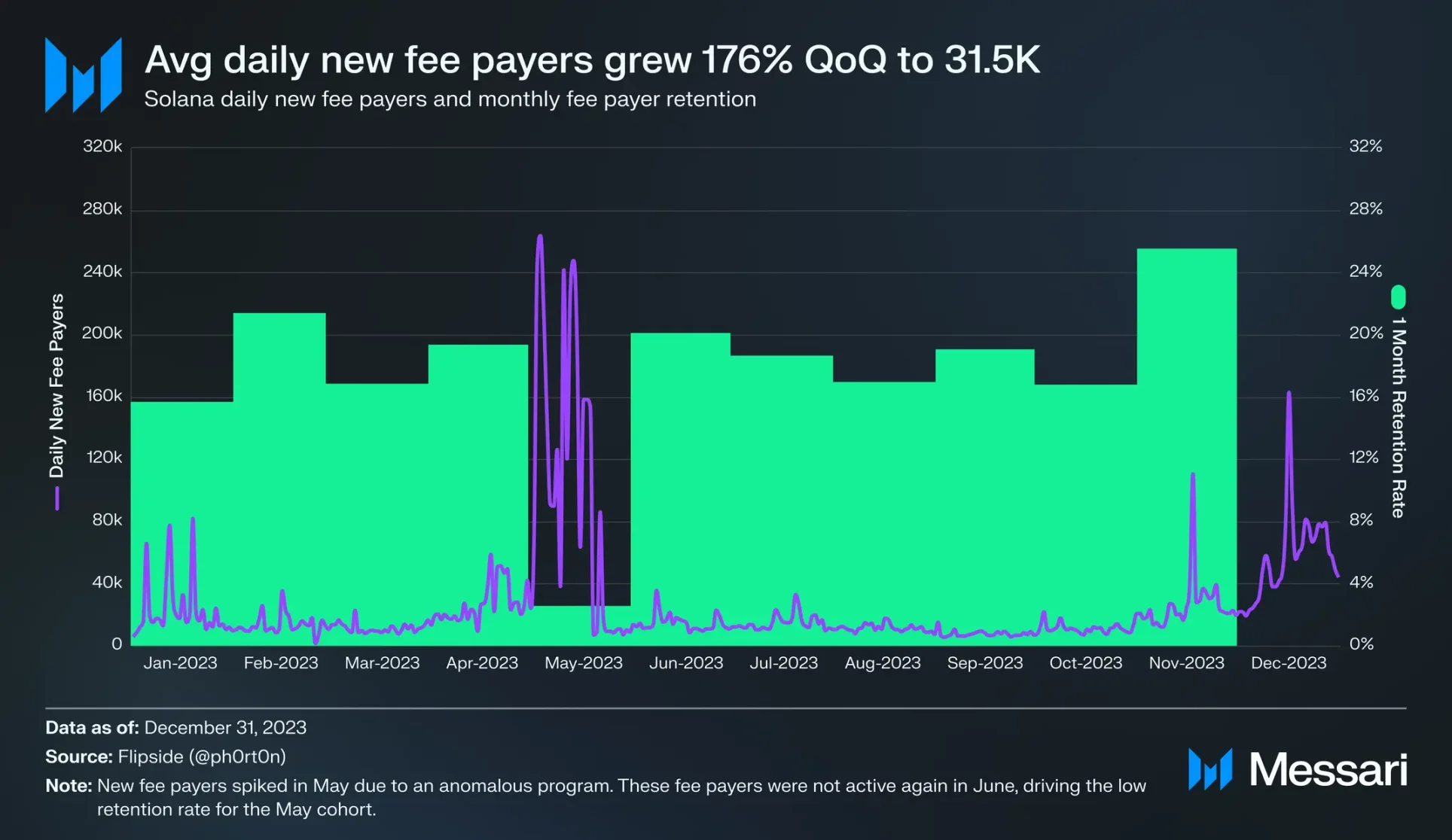
New fee-paying users followed a similar growth trend, hitting an annual high after excluding abnormal activity in Q2. Average daily new fee-paying users surged 176% quarter-over-quarter and 88% year-over-year, reaching 32,000. The one-month retention rate for new fee-paying users in November 2023 was the highest of the year at 25.6%.
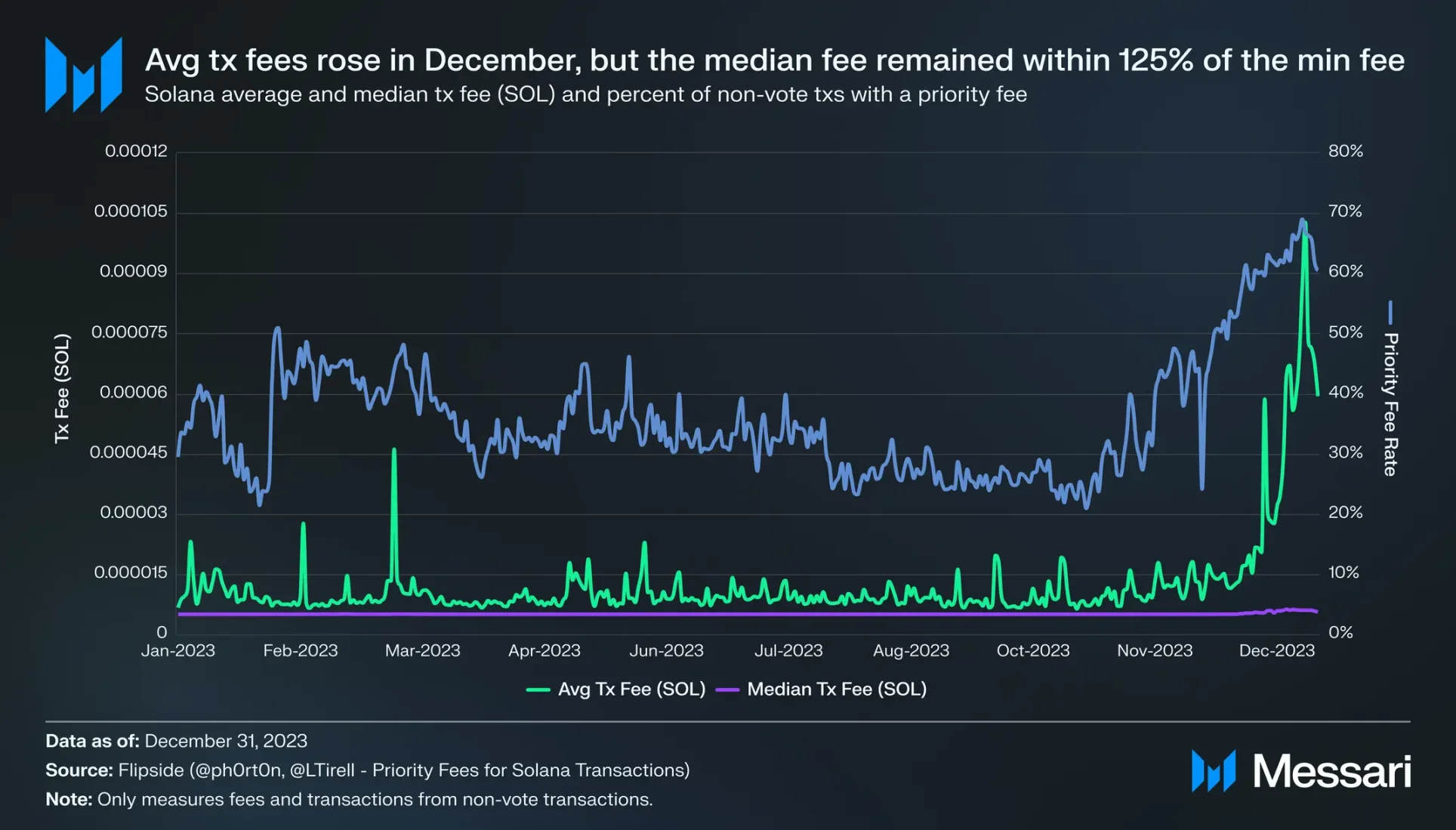
Increased on-chain activity in December 2023 led to higher transaction volumes, including priority fees, causing average transaction fees to rise 175% quarter-over-quarter to 0.000025 SOL ($0.002). Daily priority fees peaked at nearly 69% on December 26, while average daily transaction fees hit a peak of 0.001 SOL on December 27—four times the Q4 average and eleven times the Q3 average.
However, median fees remained stable—the daily median of maximum fees was 0.00000623 SOL, less than 1.25 times the fixed base fee of 0.000005 SOL (the median on most days). The difference between the relative increases in average and median transaction fees suggests that the local fee market is successfully preventing global fee spikes.
Of course, Solana’s fee market is not perfect. Discussions about improving it intensified in Q4 2023, with the community debating inefficiencies and proposing controversial solutions, including the following.
-
Problem: Inefficient resource pricing and allocation
-
Potential Solution: Base fee determined by compute units
Solana Compute Units (CU) estimate the computational resources required to validate a transaction, similar to Ethereum’s gas units. Each transaction requires a certain number of CUs, with a maximum of 48 million CUs per block and 12 million CUs per account.
Unlike Ethereum, Solana’s base fee is not determined by compute units but rather by the number of signatures, with most transactions having only one signature. Although each transaction requests CUs, actual usage is only known after execution. This leads to a general lack of incentive for computational optimization: transactions often request more CUs than needed, and developers don’t prioritize minimizing computation when building programs.
One proposed solution is to price transactions based on CUs.
-
Problem: Off-protocol附加 transactions
-
Potential Solution: Allocate 100% of priority fees to validators
Half of each priority fee is burned, and the other half is sent to the leader, unlike Ethereum, where 100% of priority fees go to block producers. Burning half of each transaction fee enables off-protocol transactions with validators (e.g., Jito auctions).
The potential solution here is simple: allocate 100% of priority fees to validators, recently formally proposed in SIMD-0096.
-
Problem: Existing incentives for spam transactions
-
Potential Solution: Scheduler upgrade (V1.18) and economic upgrades (PRAW, write-account EMA)
Although multiple upgrades have reduced spam transactions, they haven't eliminated them entirely. With increased on-chain activity in December 2023, most computation was used for failed transactions.
There is debate over the best way to further reduce spam. Some attribute it primarily to inefficiencies in Solana’s scheduler (block-building mechanism), while others believe economic upgrades are necessary.
Scheduler
Solana’s scheduler uses parallel threads for continuous block building, lacking a global transaction order, making priority fees less effective in determining order.
The lack of deterministic ordering based on priority fees leads to partial reliance on FIFO and variations in exchange latency (network jitter). This incentivizes spam transactions to be prioritized.
Therefore, an upgrade to the scheduler is planned for V1.18, increasing reliance on priority fees for transaction ordering instead of randomness, thereby reducing spam.
Economic Upgrades
Solana’s parallel execution engine requires prior knowledge of user-declared dependencies. Transactions declaring dependency on the same account cannot be executed in parallel. However, if a transaction ultimately does not access the specified account, there is no penalty.
This causes a spam problem where transactions declare accounts they never use. Spam worsens the experience for others trying to access those accounts and degrades overall network performance: the more accounts declared, the higher the likelihood of replay peaks.
To address this, proposals suggest introducing dynamic, per-account write-lock fees (the higher the chance of replay peaks). Macroscopically, the fee system would resemble an EIP-1559-style improvement for local fee markets. Further debate exists over whether pricing curves should be set by individual account owners or by global parameters.
Mango Markets developers proposed the former in "SIMD-0016: Proposed Refundable Account Write Fees (PRAW)", a proposal over a year old and still under active discussion. In a recent post, Anatoly proposed the latter—per-account write-lock fees adjusted based on the exponential moving average (EMA) of CU usage per block.
In both proposals, at least half of the write-lock fees would be refunded to the account being written to. Beyond reducing spam, these proposals also address how much sovereignty applications on shared blockchains should have. While some argue that write-lock spam can mainly be mitigated through scheduler improvements, this doesn’t resolve the underlying need to grant applications greater sovereignty.
Security & Decentralization
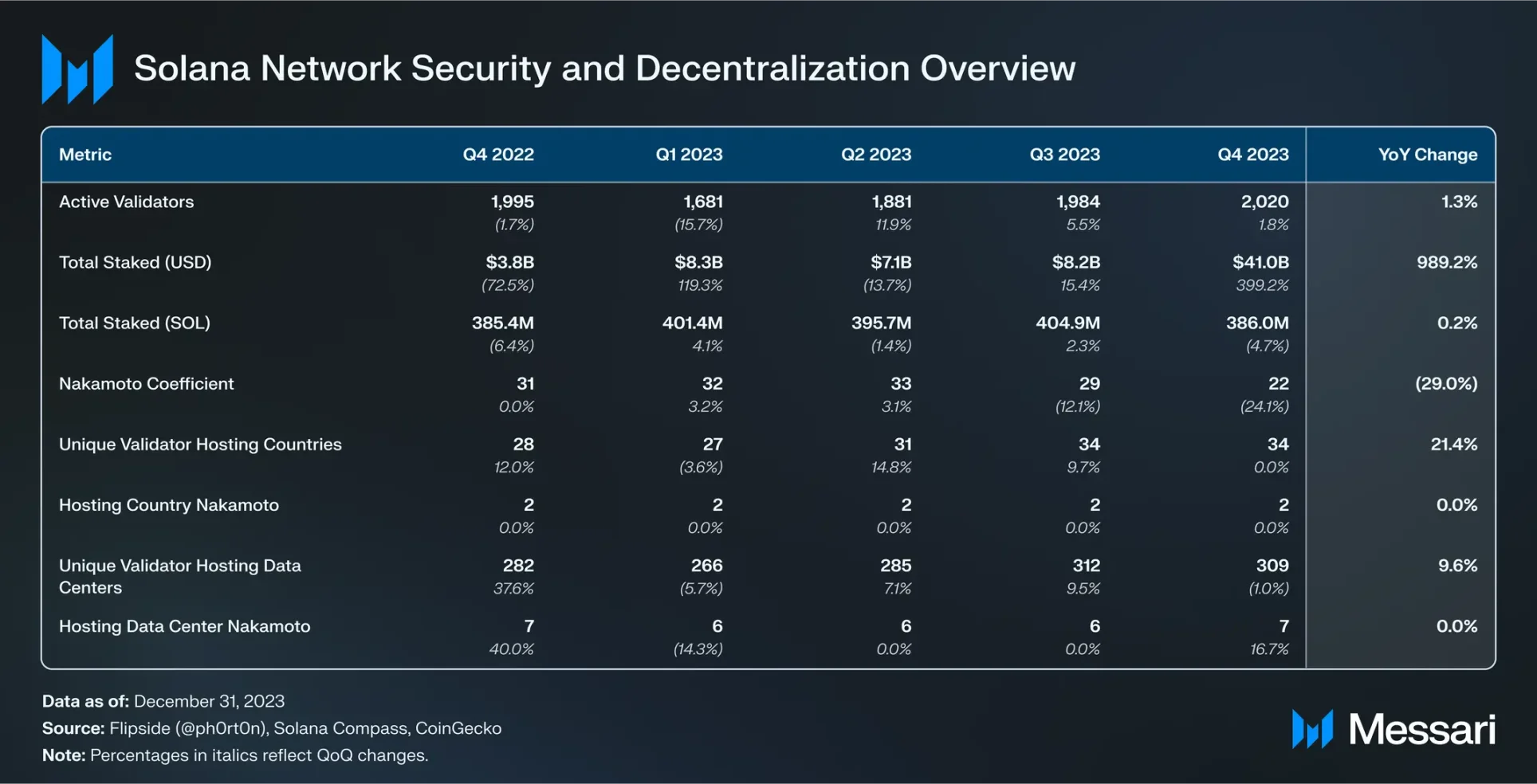
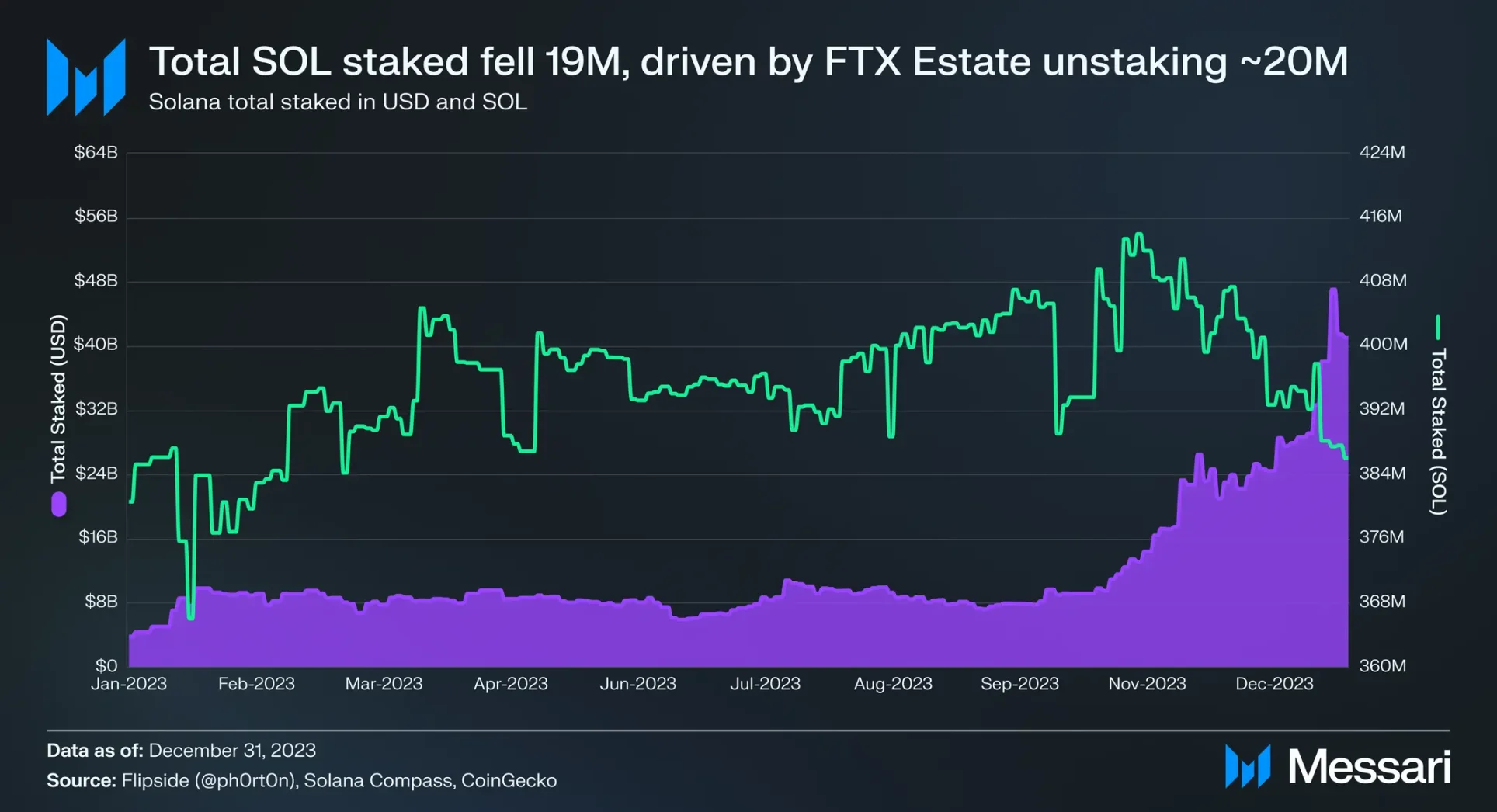
Staked SOL decreased by 19 million (5%) quarter-over-quarter, primarily due to the FTX Estate unstaking approximately 20 million SOL. As the price of SOL rose, the dollar value of staked SOL increased 399% quarter-over-quarter to $41 billion, ranking second across all networks, behind only Ethereum.
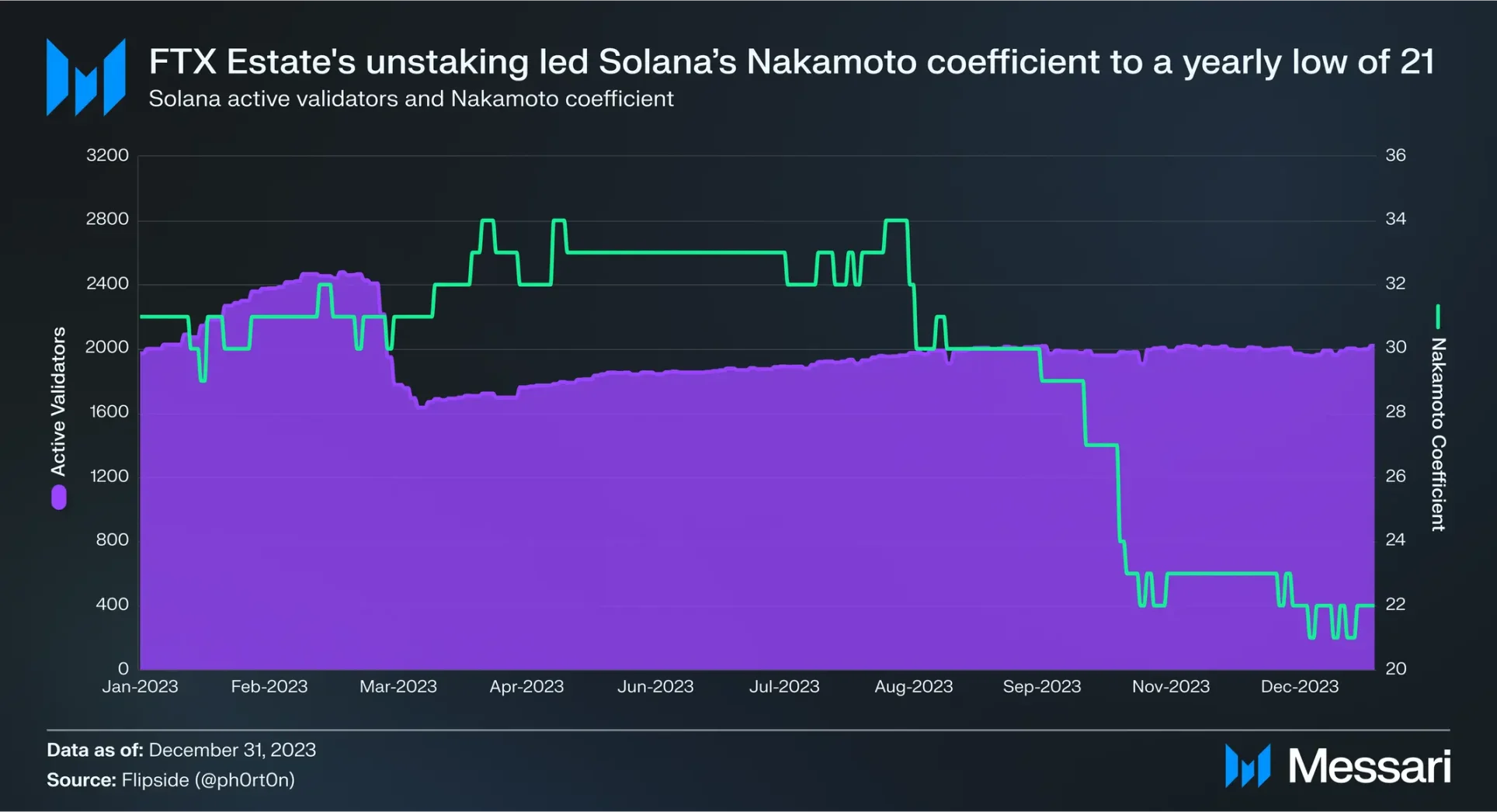
The FTX Estate’s unstaking harmed Solana’s Nakamoto coefficient, as Alameda/FTX previously staked across a wide range of validators. At the time of writing, Solana’s Nakamoto coefficient stands at 22—the lowest in over a year—but still above the median of other networks.
Solana’s Nakamoto coefficient benefits from the Solana Foundation Delegation Program, currently delegating 68 million SOL. In early December 2023, the Foundation proposed changes to help participating validators gradually become self-sustaining over time.
The Nakamoto coefficient represents the minimum number of nodes required to disrupt on-chain activity. This metric can also be measured across other dimensions critical to validator network resilience, including validator location, hosting providers, and client distribution.
Solana has 2,020 validators spread across 34 countries, a 21% year-over-year increase, with the U.S. leading at 30%. Solana’s geographic Nakamoto coefficient is slightly below the 33.3% threshold, so the Foundation noted in its October 2023 validator report its plan to address the increasing U.S. share over the past year.
At the end of 2023, Superfast launched its Cape Town validator node—the network’s first in Africa.
Solana validators operate in 309 unique data centers, a 10% year-over-year increase. Currently, Solana’s data center Nakamoto coefficient is 7.
As reported in the validator report, Solana’s hosting provider Nakamoto coefficient is 3, consisting of TeraSwitch, AWS, and OVH.
Solana currently has two clients: the original Solana Labs client and Jito Labs’ MEV-optimized fork. Currently, 48% of the stake runs the Jito client, up 51% quarter-over-quarter and 534% year-over-year. However, it does not offer the same level of client diversity as clients written from scratch. Two upcoming clients are being built from the ground up: Firedancer and Sig.
Firedancer is being developed by Jump Crypto in C. At Breakpoint, Jump announced “Frankendancer,” a version of Firedancer now live on testnet. Frankendancer runs new C-based code for “transaction propagation” functions like sending transactions between validators and verifying signatures. It retains the original Solana Labs client code for Runtime V2 (transaction processing) and consensus mechanisms.
The team also discussed mechanistic details of one of the first components needed for Firedancer to achieve 8 million TPS. Firedancer previously sustained over 1 million TPS in test environments, compared to ~55,000 TPS for the Solana Labs client in similar conditions.
Beyond Firedancer, the Syndica team discussed details of Sig, a fourth validator client optimized for RPC reads to reduce slot latency—the delay between completion of two blocks. In other words, Sig aims to reduce latency by enabling smoother flow of certain user requests from users to validators. It also emphasizes readability and simplicity, aiming to make it easier for developers to use.
As Firedancer’s release draws closer, discussions intensify around its impact on client diversity. Some believe Firedancer could bring either short-term client diversity or higher throughput, but not both simultaneously.
Anatoly and others argue that if over a third of validators run Firedancer as their primary client and the Solana Labs/Jito client as secondary, this would benefit client diversity without sacrificing Firedancer’s performance advantages. The secondary client can verify downloaded blocks, which is easier than running a full data propagation node. If the Firedancer client fails, validators can fall back to the secondary client. Thus, it brings security benefits of client diversity. But for higher activity, another high-performance client is needed.
A lightweight client, TinyDancer, is also under active development. TinyDancer will allow users to verify state without running a full node themselves, enhancing the network’s trustlessness. "SIMD 64: Consolidation of Transaction Receipts" brought lightweight clients closer in late October 2023. SIMD 64 inserts a mechanism into the core protocol to verify confirmed transaction states, eliminating the need to trust RPCs.
While exploring methods to build rollups on Solana, Sovereign Labs developed a proof-of-concept enabling Simple Payment Verification (SPV) light clients on Solana without any changes to Solana’s consensus.
Performance, Upgrades, and Roadmap
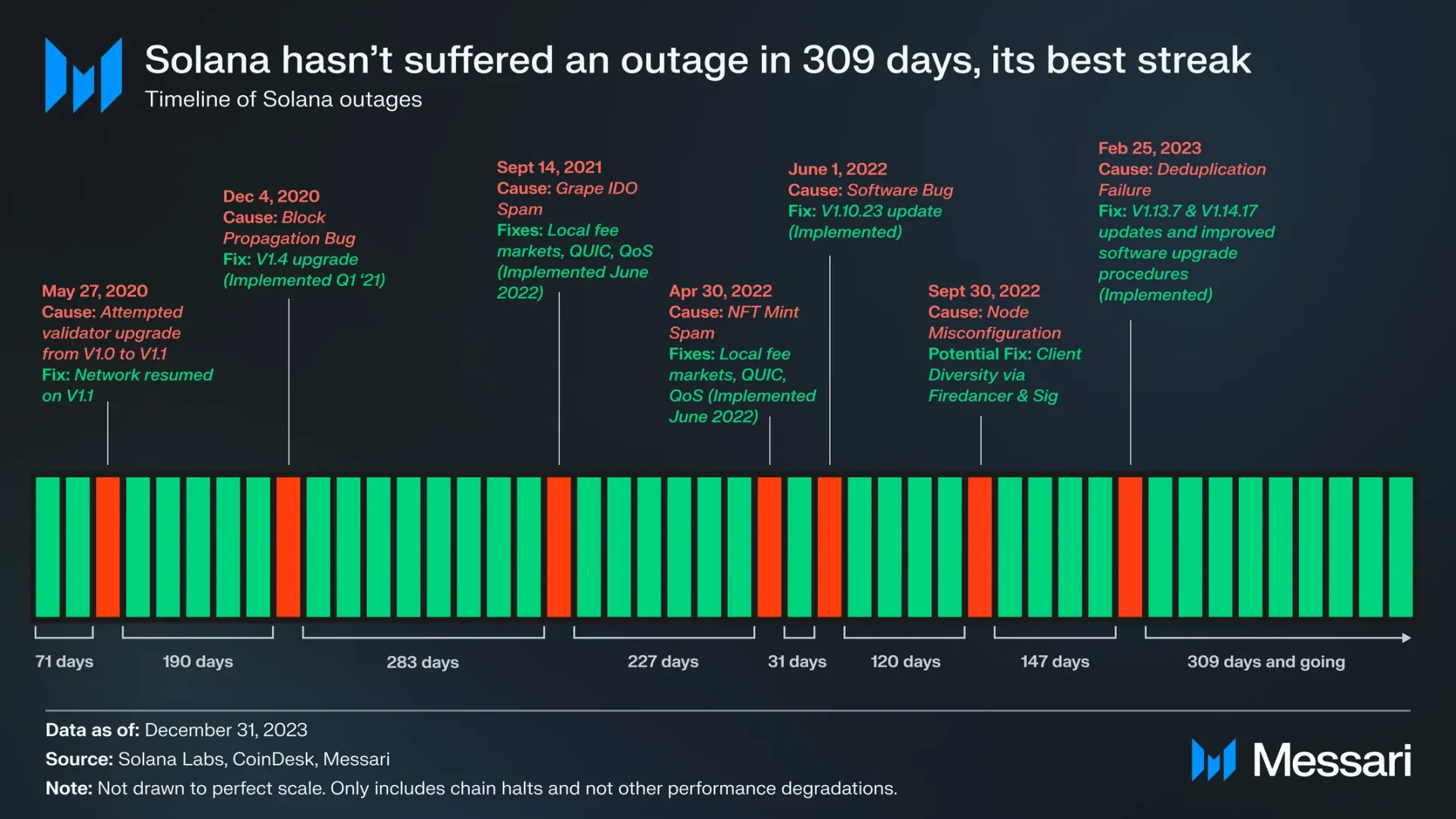
As of December 31, 2023, the Solana network achieved its longest continuous uptime without disruption—309 days. This streak results from new technical features rolled out over the past year, such as QUIC, stake-weighted QoS, and local fee markets, along with improvements to the network upgrade process. While this doesn’t mean Solana will never go down again, it’s worth acknowledging the successful work developers have done addressing widely criticized issues.
After successfully upgrading to V1.16 at the end of Q3 2023, Solana plans to launch the V1.17 upgrade on mainnet in Q1 2024, bringing further ZK support—potentially including Poseidon system calls—and resilience and performance updates, such as improved compute unit estimation.
Beyond Firedancer and potential fee market changes, other upcoming features include token extensions, Program Runtime V2, and potential consensus/execution optimizations via multiple concurrent leaders and asynchronous execution.
Token Extensions
Token extensions are part of the new SPL token standard, providing token issuers with a set of configurable features. They were designed primarily based on feedback from discussions with enterprises and financial institutions, but also have use cases in more crypto-native DeFi and consumer applications. There are over ten extensions, particularly:
-
Confidential Transfers: Confidential transfers generated the most buzz related to token extensions. If the token creator enables this extension, the source address, destination address, and token remain public. However, the transfer amount is hidden from everyone except optional third-party auditors added by the source and destination addresses;
-
Transfer Fees: Token issuers can add protocol-enforced fees to each token transfer, with options including fixed fees, variable fees, and per-transfer fee caps. This extension has already been implemented by tokens such as Bonk Earn (BERN);
-
Transfer Hooks: Transfer hooks add additional programmable logic beyond transfer fees, allowing token issuers to set conditions for successful token transfers. Examples of such logic include whether an account holds a KYC token (which itself could be created via NFT extensions), appears on a compliance-related list, or conducted transactions before 2023;
-
Permanent Delegate: The permanent delegate extension grants the token issuer full authority over the token, allowing them to destroy or transfer any amount of tokens at will, even if held by another account. This extension is best suited for tokens representing off-chain assets or data that issuers must comply with regulatory requirements. This extension could be misused, but infrastructure providers have added features to warn users (if enabled);
-
For more information on other extensions, see Solana’s documentation and Helius’ blog;
The functionalities supported by these extensions can largely be implemented on other networks, but currently require developers to build their own infrastructure or operate in permissioned environments. Implementing them directly at the token program layer offers several advantages:
-
Infrastructure Support: All major wallets, applications, and other infrastructure providers will support token extensions. Achieving this level of ecosystem infrastructure support would be much harder for projects building their own solutions;
-
Composability: Tokens and applications that would otherwise need to be isolated in permissioned environments can coexist on the Solana mainnet with existing permissionless token experiences. Users won’t need to cross chains, and applications and infrastructure providers won’t need to support another network;
Token extensions already exist in Solana’s open-source code, but the Foundation and Labs are waiting for final steps like security audits before recommending widespread use. Token extensions may officially launch in mid-January 2024, although the confidential transfers extension will require further upgrades in 1.17 and 1.18 to be fully enabled.
Several tokens and applications have already experimented with token extensions. As mentioned, BERN charges a 6.9% fee on every transfer, which goes to BERN holders, burns, developer funds, and the BONK DAO. FluxBeam is a DEX supporting token extensions. It also features a Telegram bot service, FluxBot, and UI tools for creating and managing extensions. Another project, Hyperdrive’s The Vault, uses token extensions like transfer hooks to create staked SOL derivatives where staking rewards are separated from the derivative token.
Finally, major infrastructure providers including Phantom, Solflare, Metaplex, and Helius added support for token extensions in Q4 2023 to prepare for the official January 2024 launch.
Runtime V2
In short, Solana Program Runtime V2 is part of the Sealevel Virtual Machine (SVM), allowing Solana validators to execute programs (smart contracts). At Breakpoint, Solana Labs engineers presented Program Runtime V2. The Runtime V2 upgrade focuses on software optimizations to improve cost efficiency and API accessibility.
With lower average program execution costs, the design space for programs expands. Engineers can pack more instructions into a single program call, increasing program complexity. Higher maximum program complexity gives application developers greater freedom.
Multiple Concurrent Leaders and Asynchronous Execution
Solana developers and researchers have also been working on long-term plans to further increase throughput and reduce latency. Solana co-founder and Solana Labs CEO Anatoly Yakovenko recently shared his most exciting future projects, including:
-
Multiple Concurrent Leaders: Slot leaders are responsible for producing blocks within a time interval. Currently, each slot has one leader. Anatoly suggests having multiple leaders per slot could reduce average latency, MEV, and censorship risk. Open questions remain, including how to allocate bandwidth among leaders and handle forks;
-
Asynchronous Execution: Asynchronous execution aims to simplify transaction processing by decoupling execution from consensus. Currently, the slot leader manages both transaction execution and scheduling (building and propagating blocks). Instead, the slot leader could focus solely on scheduling. Non-leader validators could opt out of immediate execution. Validator subcommittees would only reach consensus on fork choice. Removing execution from the critical consensus path reduces blocking time, improves efficiency, and mitigates issues like execution-related latency spikes. Validators would asynchronously execute transactions at set intervals (e.g., per epoch). Full nodes could still execute transactions in real-time to serve end-users. For more, see Anatoly’s recent article. He believes asynchronous execution is a rare design with “almost no tradeoffs.”
Ecosystem Analysis
DeFi
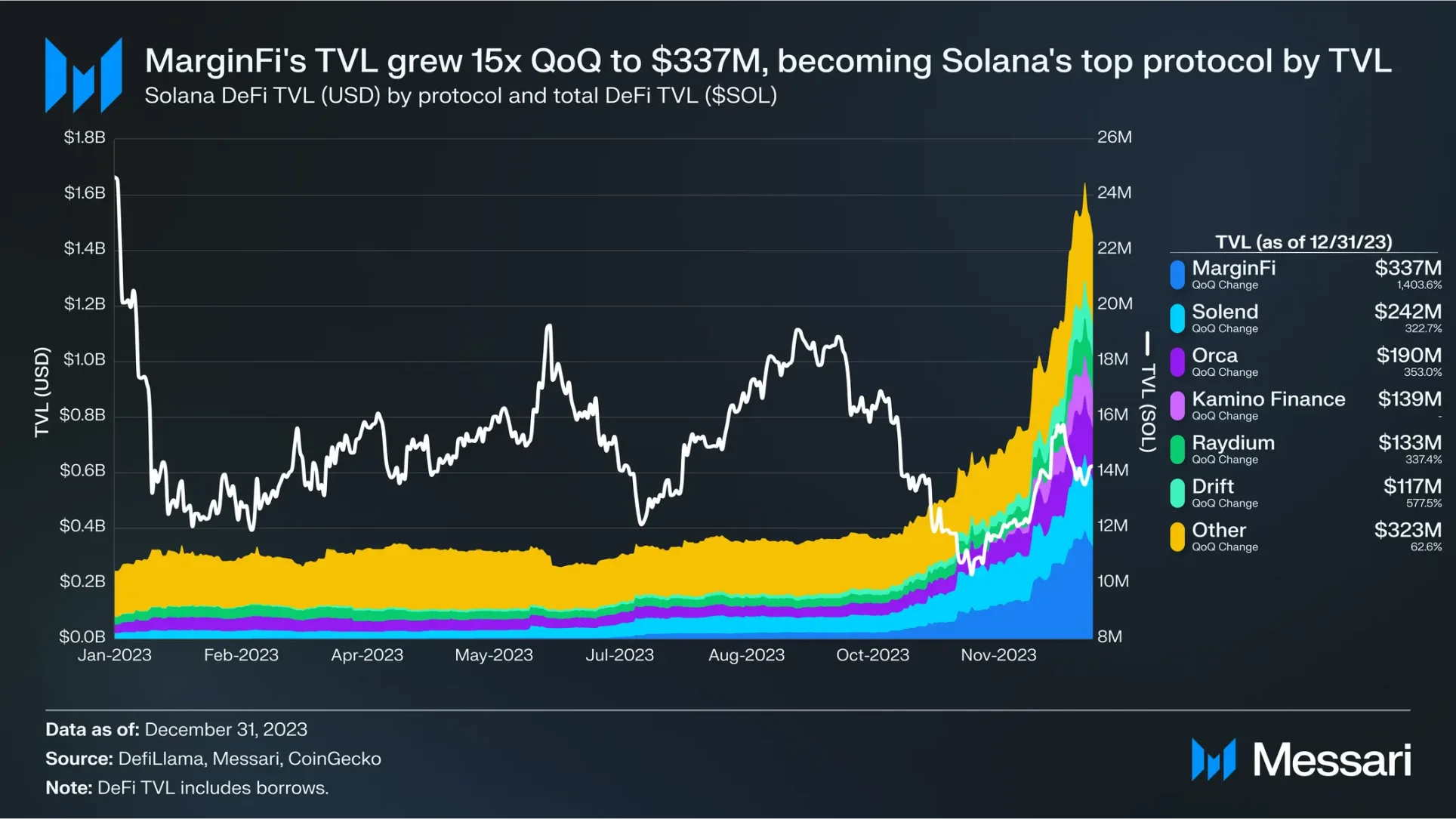
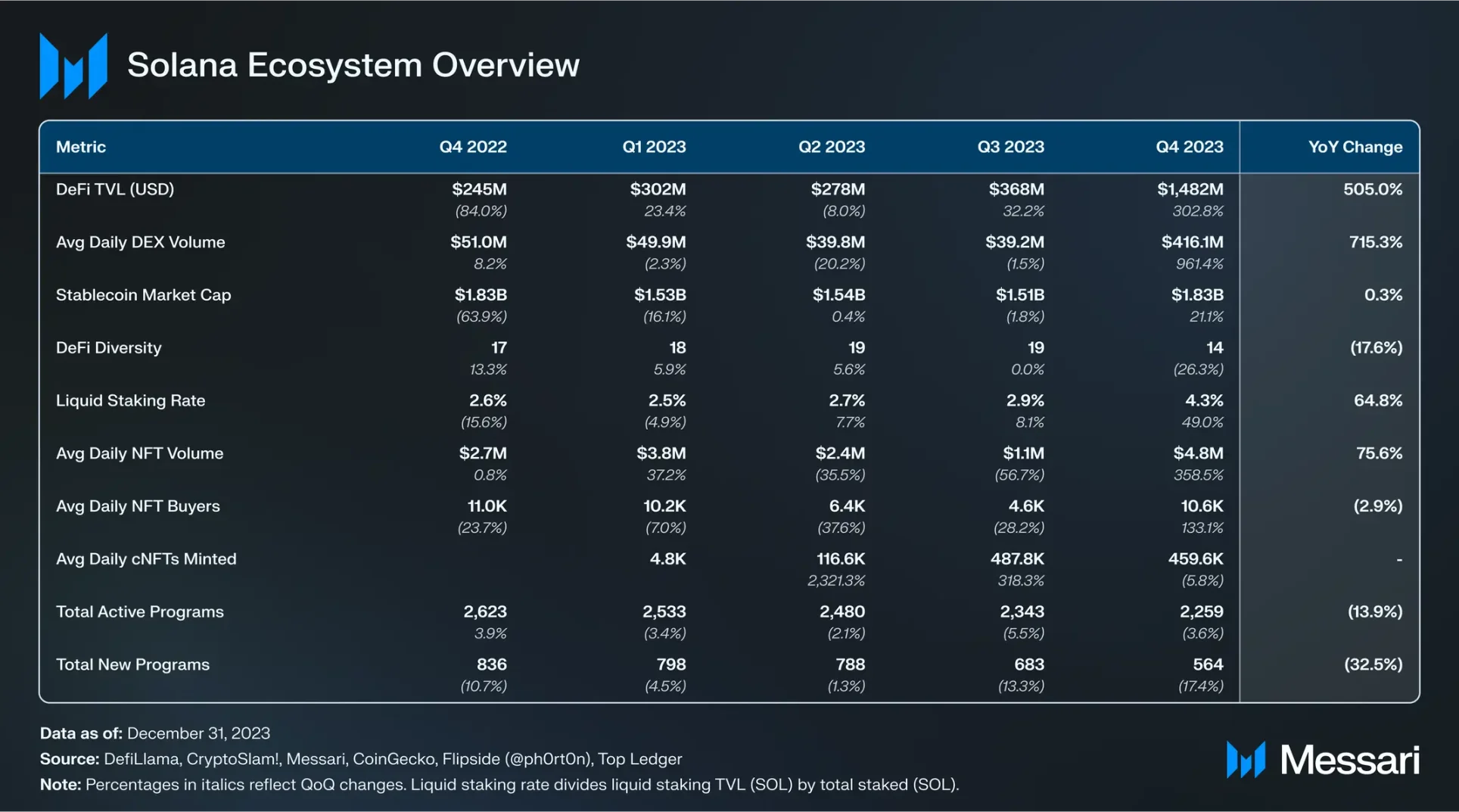
Solana DeFi TVL grew 303% quarter-over-quarter and 505% year-over-year to $1.5 billion. MarginFi’s lending protocol TVL surged 1404% quarter-over-quarter to $337 million, jumping from sixth to first place. When it launched its points program on July 3, 2023, MarginFi’s TVL was just $3.2 million. In Q4 2023, it rolled out multiple UX upgrades, including a PWA and simplified UI, and teased YBX, an upcoming LST-backed stablecoin.
Lending protocol Solend’s TVL increased 323% quarter-over-quarter to $242 million, with market share growing 5% quarter-over-quarter. Its Season 1 points program launched in August 2023 and concluded in early December with a preview of Season 2. Unlike MarginFi, Solend already has a native token, so its points program has always been tied to SLND and other rewards, not potential airdrops. Solend also launched a native Android app available on the Solana DApp Store.
Kamino entered the lending race in Q4 2023 with its 2.0 upgrade, including a new lending protocol. Since launching in mid-November 2023, Kamino Lend has accumulated $139 million in TVL. Days after Kamino announced plans for a points program linked to a future airdrop, its TVL roughly doubled. Kamino 2.0 also introduced one-click leveraged tools for SOL staking yields (circular xSOL/SOL) and long/short tokens for USDC. Its original liquidity vault product ended the year with $88 million in TVL (but excluded from Solana’s aggregate data to avoid double-counting).
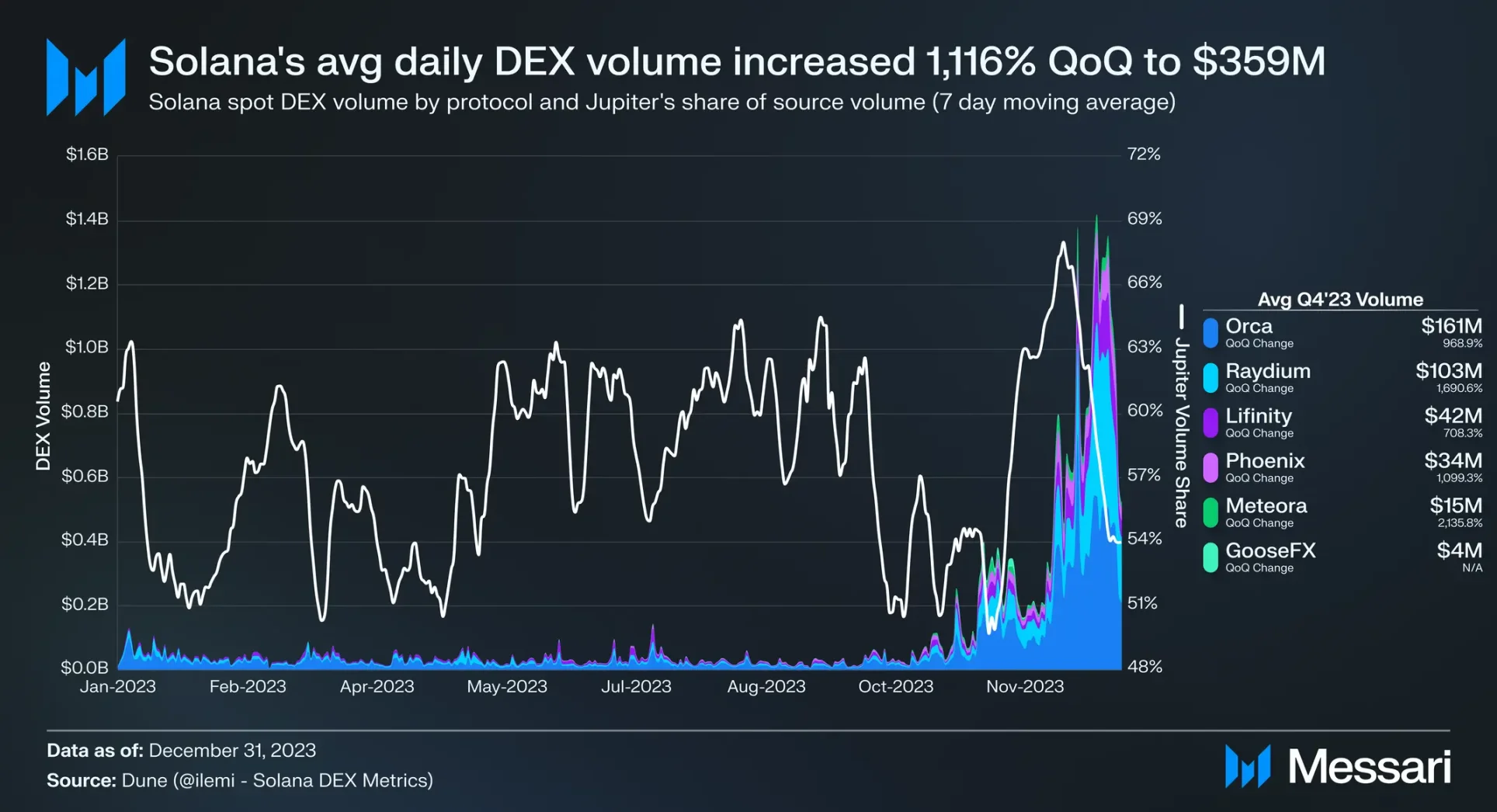
DeFi trading volume also grew significantly, with average daily spot DEX volume rising 1116% quarter-over-quarter to $359 million. In Q4 2023 trading volume, 45% used liquidity from Orca, followed by Raydium (29% market share). Orca and Raydium rank third and fifth in Solana TVL at $190 million and $133 million respectively.
Despite Phoenix holding only 0.8% of DEX TVL market share on average, it captured over 9% of DEX trading volume—Phoenix is a fully on-chain limit order book DEX praised for its capital-efficient design.
BONK-SOL ranked fourth in trading volume among token pairs in Q4 2023, behind only SOL-stablecoin and stablecoin-stablecoin pairs. The pair’s total volume in Q4 approached $1.3 billion, up 11,000% quarter-over-quarter. BONK is a meme coin airdropped to Solana developers as a Christmas gift in 2022. In mid-December 2023, Coinbase listed BONK, achieving $238 million in first-day trading volume—the 12th highest in the exchange’s history.
On average, 57% of DEX spot trading volume flowed through Jupiter, one of the most watched DeFi protocols in Q3 2023 across all crypto. Interest surged following its Breakpoint announcements, including a new GMX-style perpetuals product (launched shortly after Breakpoint), a new stablecoin backed by a new SOL liquid staking token (not yet launched), and an airdrop. It plans to distribute the first of four airdrops in January 2024 (equivalent to 40% of total supply), with criteria finalized after multiple refinements based on community feedback.
Since launch, Jupiter’s perpetuals product has averaged $53 million in daily trading volume. Another major player, Drift, was one of the fastest-growing DeFi protocols on Solana in Q3 2023 and continued growing in Q4, with daily trading volume increasing roughly tenfold to $23 million. At its Breakpoint talk, Drift announced a $23.5 million Series A round.
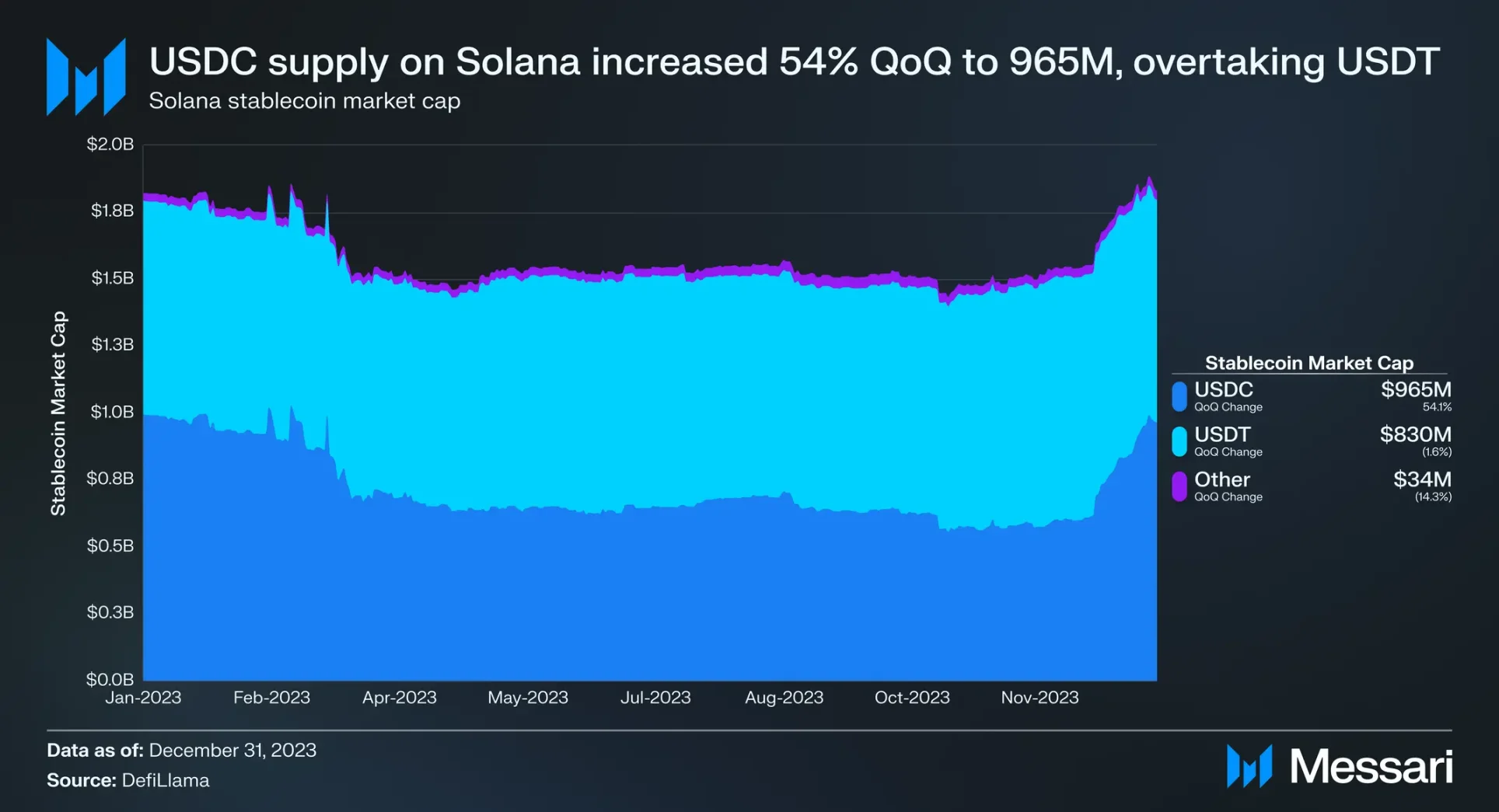
After remaining relatively flat for much of 2023, Solana’s stablecoin market cap grew by over $300 million quarter-over-quarter, primarily driven by increased USDC supply in December 2023. USDC liquidity and interoperability on Solana should continue growing through Circle’s Cross-Chain Transfer Protocol (CCTP).
CCTP allows USDC to be transferred across networks without wrapping. It launched on Solana’s devnet in early November 2023, with mainnet expected in H1 2024. Circle also launched EURC, a euro-backed stablecoin, on Solana in mid-December 2023. Near the end of Q4 2023, Paxos announced plans to expand its NYDFS-regulated USDP stablecoin to Solana in mid-January 2024, making Solana the second network to support USDP after Ethereum.
Other notable DeFi-related events include Parcl V3 and points, Cube Exchange’s $9 million funding and litepaper release, OpenBook V2, Zeta points, Hashflow expanding to Solana, Ondo expanding to Solana, Rain.fi update, SDX launch, Starport litepaper, Meteora Stimulus Package, Cypher’s IDO, Fluidity launching Flash.Trade, and LiquidProp beta launch, among others.
Liquid Staking
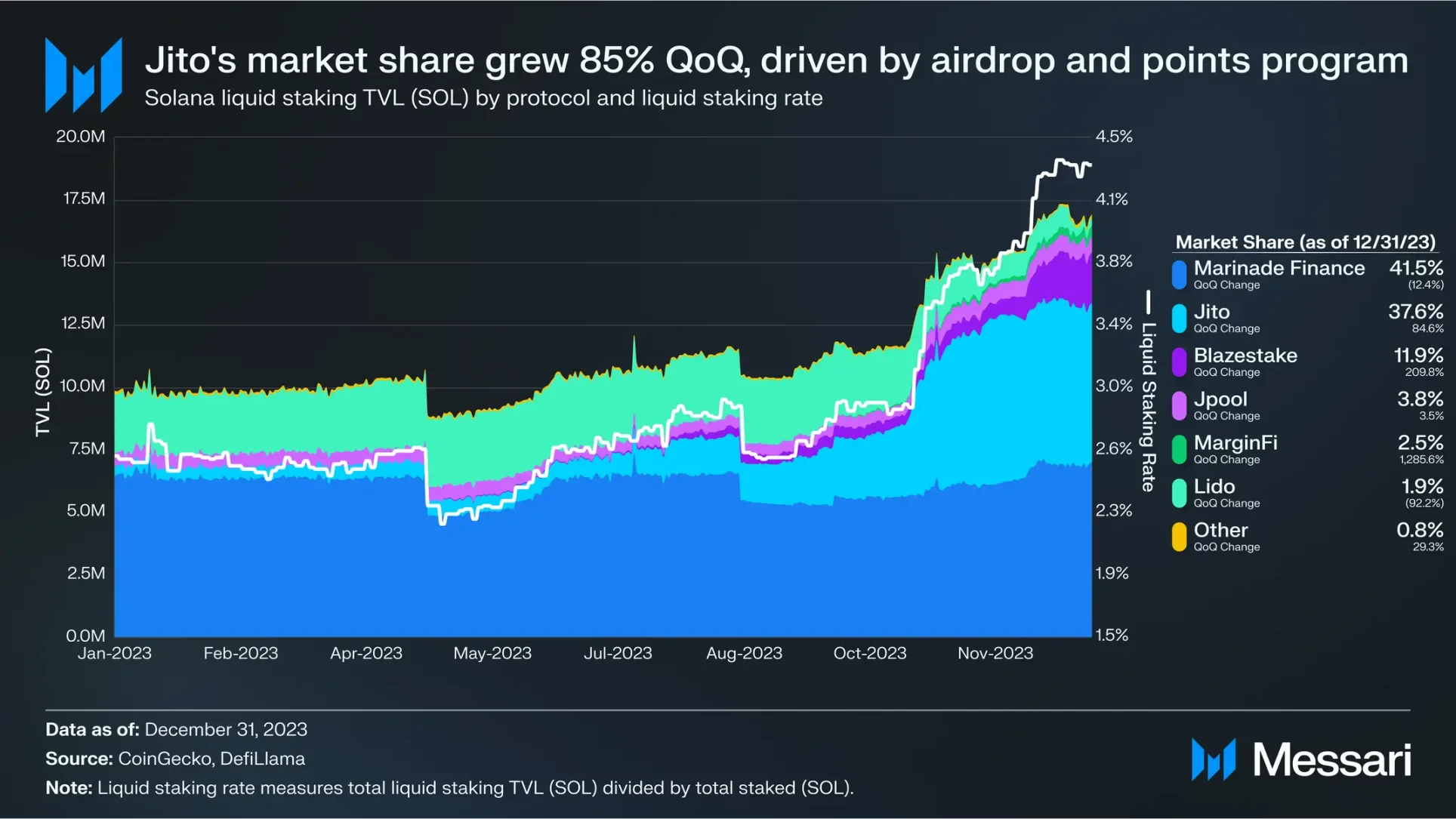
With 72% of eligible SOL supply already staked, liquid staking protocols are crucial for building an ecosystem atop yield-bearing SOL. Recent incentive programs have successfully increased the total staked SOL in liquid staking—the growth rate rose 49% quarter-over-quarter but remains relatively low at 4.3%.
Jito has been driving growth in Solana liquid staking. After launching a points system in mid-September 2023, Jito released its token JTO in early December, airdropping 10% of total supply to JitoSOL holders, Jito client validators, and Jito MEV searchers.
With fewer than 10,000 qualifying wallets and allocations favoring smaller addresses, the smallest airdrop amounted to nearly $10,000 based on JTO’s price at the end of Q4 2023. JTO listed on Coinbase on its launch day, becoming the highest-volume newly listed token on the exchange since APE in March 2022 (before being quickly overtaken by BONK). The Jito Foundation also released its charter, outlining governance frameworks for the JTO DAO.
Jito’s TVL (in SOL) grew 164% quarter-over-quarter to 6.4 million SOL, with market share increasing 85% quarter-over-quarter to 38%, trailing only Marinade. Jito’s growth benefited from Lido shutting down its Solana service—Lido’s market share dropped from 24% at the end of Q3 2023 to under 2% by Q4’s end.
As noted earlier, Jito’s MEV-optimized Solana client also gained traction, capturing 48% market share, up 51% quarter-over-quarter. With increased on-chain activity, MEV revenues have recently rebounded.
At Breakpoint, Jito launched StakeNet, an open-source protocol for decentralized operation of Solana staking pools. Currently, all Solana staking pools are managed by centralized parties who store historical validator data from on-chain snapshots and off-chain sources on their own servers. They then use proprietary delegation logic and parameters to rebalance stakes across validators and add/remove validators from the pool.
StakeNet moves all of this on-chain, introducing a guardian network that runs validator history and management programs. The validator history program stores up to three years of cryptographic validation data for each Solana validator on-chain. The steward program manages delegation logic and validator scoring to operate the stake pool. Everything is on-chain, so delegation logic and parameters can be adjusted via on-chain governance. When live, Jito will adopt StakeNet and hopes other pools will follow.
Although its market share declined by 12%, Marinade’s TVL (in SOL) still grew 26% quarter-over-quarter. Marinade already has a native token MNDE, but in Q3 2023 it launched a rewards program to compete with newer, tokenless protocols. In Q3 2023, Marinade also launched Marinade Native, a native staking product complementing its liquid staking services.
Marinade Native is a staking automation platform routing stakes to over 100 top-performing validators, charging no performance fees or introducing smart contract risks. Marinade Native’s TVL reached $416 million.
Near the end of 2023, Marinade launched Protected Staking Rewards (PSR). Under PSR, validators must stake SOL to qualify for Marinade staking. If a validator goes offline or faces other performance issues affecting staking rewards, staked SOL will be used to compensate Marinade stakers for losses.
Blaze continued its ongoing BLZE airdrop, which began in August 2023. After growing 1234% quarter-over-quarter in Q3 2023, its TVL in SOL increased 344% in Q4, capturing 12% market share.
MarginFi launched its own liquid staking protocol at the end of Q3 2023, distributing stakes to three validators operated by the MarginFi team. Its liquid staking TVL in SOL grew 1886% quarter-over-quarter, entering the top five liquid staking protocols. As noted earlier, the MarginFi team is preparing to launch a liquid staking stablecoin backed by SOL.
Sanctum further strengthened the liquid staking ecosystem, providing liquidity and stability for Solana’s liquid staking and DeFi ecosystems. In early December 2023, Sanctum launched 2.0, introducing new products such as single-validator LSTs, upgraded multi-LST liquidity pools, and a zero-fee flash loan program.
As LST adoption grows within Solana DeFi protocols, LST liquidity will become increasingly important, especially as users leverage them against SOL. This dynamic became evident in mid-December 2023 when a user sold ~$8 million worth of Marinade mSOL, causing its price to drop below SOL. While Sanctum provides unified LST liquidity pools, mSOL was still being integrated. Temporary de-pegging sparked debates among several lending protocols regarding optimal risk management and liquidation practices.
Consumer Applications
NFTs
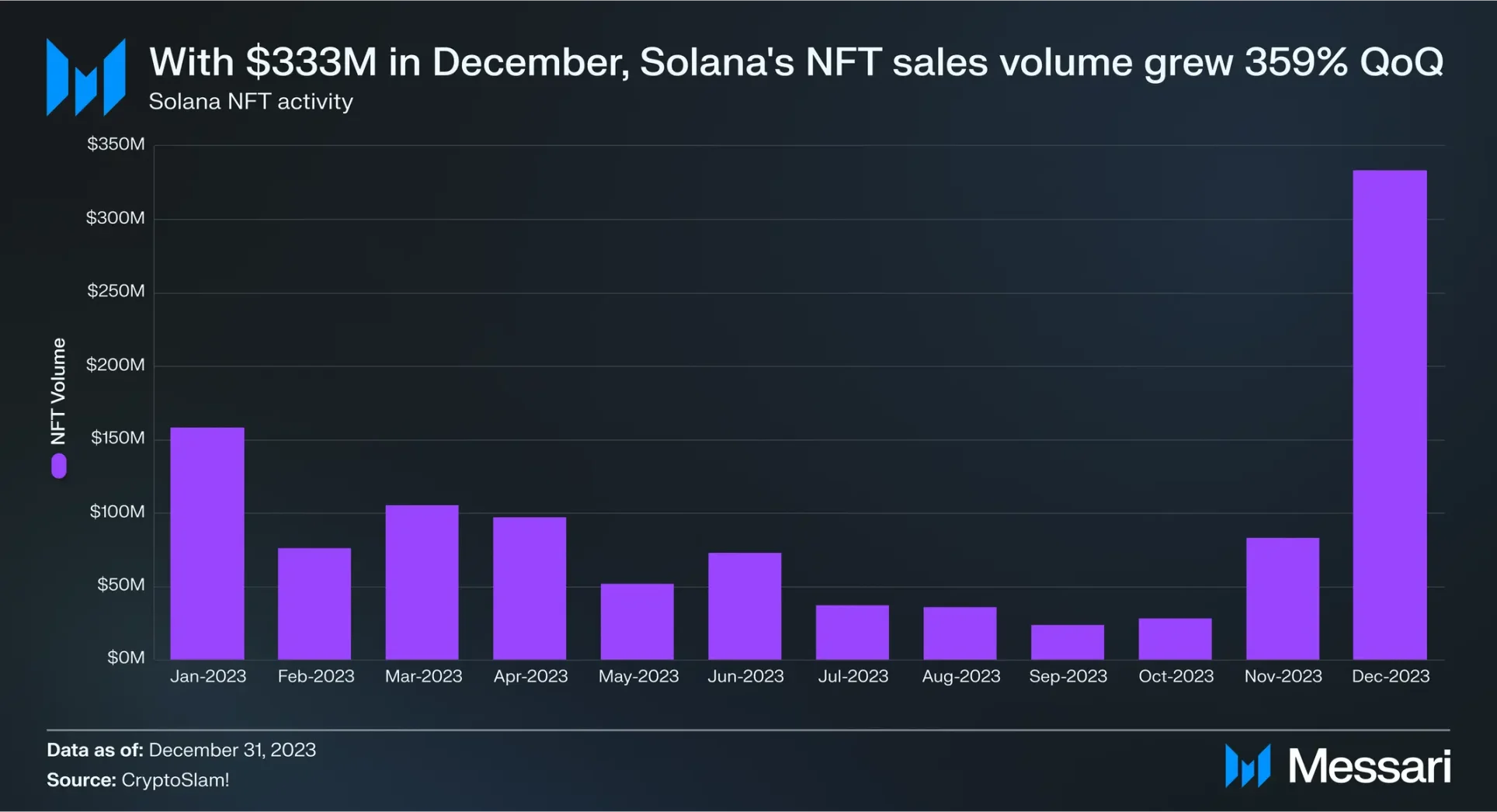
Solana’s average daily NFT trading volume increased 356% quarter-over-quarter to $4.8 million. Excluding Bitcoin, Solana’s share of NFT trading volume rose from 9% to 26% quarter-over-quarter.
Although Magic Eden reclaimed majority market share by the end of Q4 2023, Tensor’s market share grew to over 80% in early December—compared to just 1.2% at the start of 2023.
Top-volume NFT collections in Q4 2023 included Mad Lads (613,000 SOL), Tensorians (510,000 SOL), and Claynosaurz (171,000 SOL)—all representing a shift from PFP NFTs toward brand building and practical applications.
-
Mad Lads were launched by the team behind Backpack Wallet and Exchange. Backpack Exchange was announced during Breakpoint and opened registration in November 2023. Pyth, Dymension, Wormhole, and Monad have announced or previewed airdrops to Mad Lads holders, who also hope to receive a Backpack Exchange airdrop;
-
Tensorians are Tensor’s native project, offering holders benefits such as anticipated Tensor airdrop points and partner project perks;
-
Claynosaurz have experimented with IP, content creation, and merchandise launches, similar to Pudgy Penguins on Ethereum;
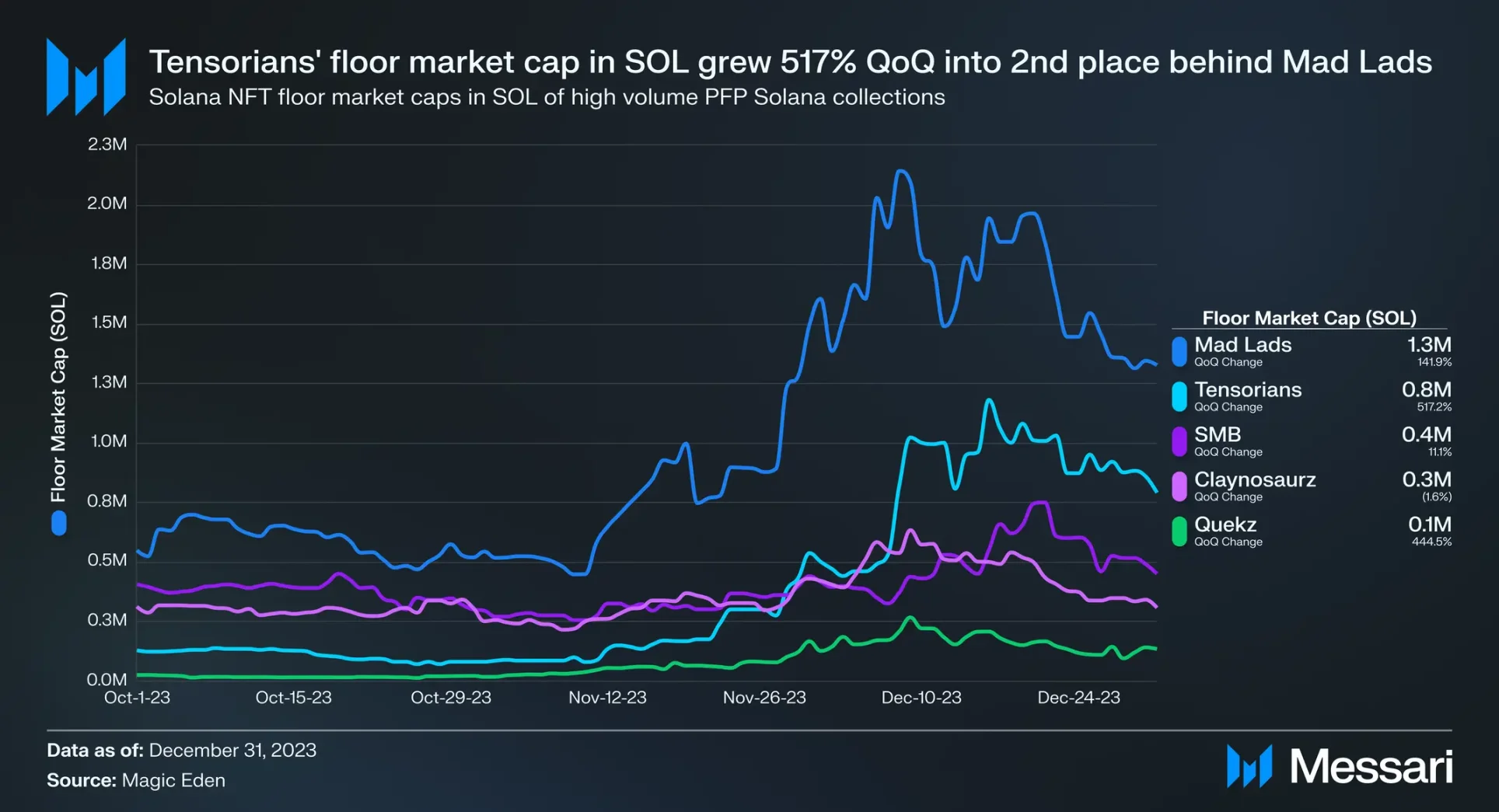
Many prominent Solana NFT collections saw significant floor price increases in SOL terms quarter-over-quarter. Mad Lads’ on-chain market cap grew 142% quarter-over-quarter to 1.3 million SOL ($135 million), while Tensorians grew 517% to 800,000 SOL ($80 million)—both now top projects by floor-price market cap on Solana.
Social and Creator Platforms
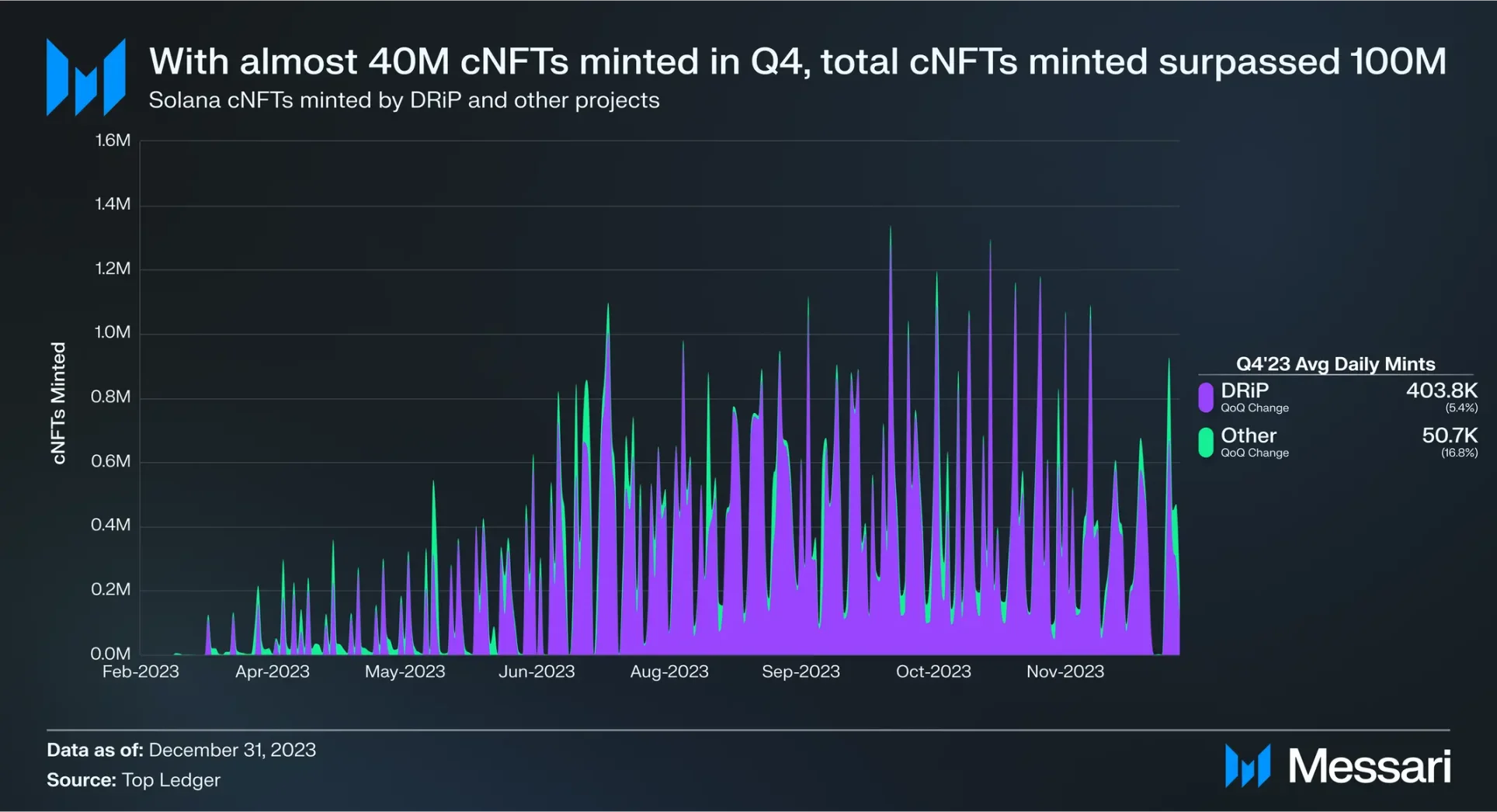
Compressed NFTs (cNFTs) were the first successful use case of state compression, launched in early Q2 2023. State compression provides a cost-efficient method for on-chain data storage by hashing data into a Merkle tree and publishing its root hash on-chain. Depending on composability levels, minting and storing 1 million cNFTs costs between 5.3 and 63.7 SOL, versus 24,000 SOL when uncompressed.
cNFTs enable new use cases across consumer, DePIN, and other domains. DRiP is the most important example of a consumer application only possible with cNFTs. DRiP partners with artists to offer free NFT art mints, with collection sizes far exceeding the typical 10,000. In Q4 2023, DRiP minted over 35 million cNFTs, with another 4 million minted by Dialect, Helium, and other projects.
In early Q4 2023, DRiP launched Droplet, powering its in-app economy. Initially, Droplets were distributed to users based on varying participation levels and automatically spent when users received collectibles from the platform.
In early December 2023, DRiP refined the system with Droplets 2.0. Users can still receive Droplets for free, but only through a spin-to-win mechanism refreshing every six hours. Users can now also purchase Droplets using tokens or fiat (powered by Sphere), and finally, users can directly gift Droplets to creators for potential perks.
Droplets are converted to USDC and paid to creators. In
Join TechFlow official community to stay tuned
Telegram:https://t.me/TechFlowDaily
X (Twitter):https://x.com/TechFlowPost
X (Twitter) EN:https://x.com/BlockFlow_News
 Messari










