The Story Behind Solana Meme Coin WIF's Surge: A Whale's Heartbreaking Tale of Being Front-Run by MEV Arbitrage
TechFlow Selected TechFlow Selected
The Story Behind Solana Meme Coin WIF's Surge: A Whale's Heartbreaking Tale of Being Front-Run by MEV Arbitrage
How does MEV on Solana generate huge profits in a short period of time?
 Navigating Web3 tides with focused insights
Author: Jito Foundation
Translation: TechFlow
Recently, the Solana-based meme coin WIF experienced a sharp price surge.
It seems that during every meme coin rally, people envy the whales who caught early signals or reaped massive gains with extraordinary returns. But in reality, even they are not immune to losses.
In the dark forest of crypto markets, risk is equally distributed among all participants. Sometimes, rather than envy, self-reflection and caution are more appropriate responses.
On January 10, 2024, a whale made a significant trading error while transacting WIF, resulting in millions of dollars flowing into the hands of arbitrage bots, Jito validators, and their stakers.
This article provides an in-depth analysis of the incident, illustrating how MEV (Miner Extractable Value) on Solana can generate massive profits in a very short time.
On January 10, 2024, the address 5qYuZ9ZLShLB1MuV83xHRcTgVA9A5pUajnQUUcPbk3bf (zer0xtrading.sol) made a costly mistake, transferring millions of dollars from their wallet to arbitrage bots, Jito validators, and their stakers.
In one transaction, they exchanged 86,739.1 SOL (worth approximately $8.6 million) for 17,225,407.03 WIF tokens—a popular meme coin on Solana. Unfortunately, due to extremely low liquidity, this trade consumed nearly all available liquidity, causing the WIF price to surge by 2800% from around $0.14 to $3.99. Subsequently, Solana-based arbitrage bots rushed in en masse to capture the arbitrage opportunity, earning millions of dollars.
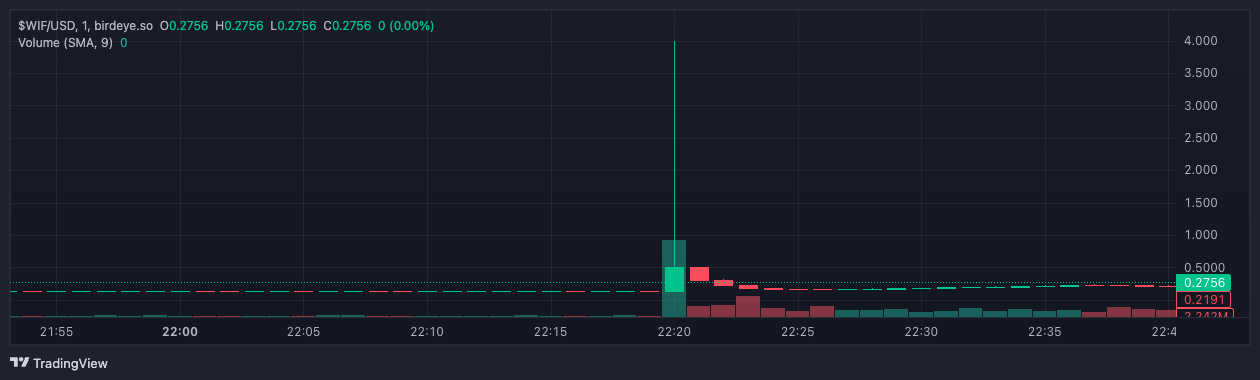
One-minute WIF K-line chart
What Happened?
At slot 241056629, zer0xtrading.sol initiated a transaction that caused massive price impact on the WIF market on Solana. Trader 2Fast used Jito's block engine to send a bundle, capturing this arbitrage opportunity atomically. The bundle was executed on Figment’s validator. Ultimately, 2Fast earned $1.9 million in profit and paid a total of 890.42 SOL ($89,000) to Figment’s validator and its stakers. However, due to limited capital, 2Fast failed to capture the entire arbitrage opportunity.
Editor’s Note:
-
Bundle: A group of transactions bundled together. This allows traders to execute multiple transactions simultaneously to optimize strategies or exploit specific market opportunities.
-
Slot: A specific time interval or position within a sequence used for processing transactions or data.
In the same block, pUEsyy conducted a triangular arbitrage via SOL → BONK → WIF → SOL, turning 6.4 SOL into 132.81 SOL. In the following blocks, numerous bots flooded in to seize remaining arbitrage opportunities.
Within the subsequent 50 blocks (24 seconds) after the initial WIF-related transactions, the following occurred:
-
2,286.5 SOL was paid to Jito validators through bundles
-
Validators earned 8.53 SOL in fees from base and priority fees
-
13% of total compute units were spent processing WIF-related transactions during this period
-
54% of WIF compute units came from failed transactions
-
44% of WIF-related transactions failed
-
The top three highest-earning validators were:
-
Validator.com: 978.95 SOL
-
Figment: 890.42 SOL
-
Staking Facilities: 403.64 SOL
-
Given over 500 transactions touching the WIF token across these 50 blocks, I will skip detailed descriptions of each arbitrage transaction. For deeper insights, refer to this spreadsheet generated via code. I highly recommend reviewing the data, as it includes over 572 WIF transactions involving 69 distinct arbitrageurs, several of whom earned over $100,000. Let’s examine a few charts to understand the broader picture, which ultimately brought substantial profits to traders, Jito-Solana validators, and their stakers.
Data Observations
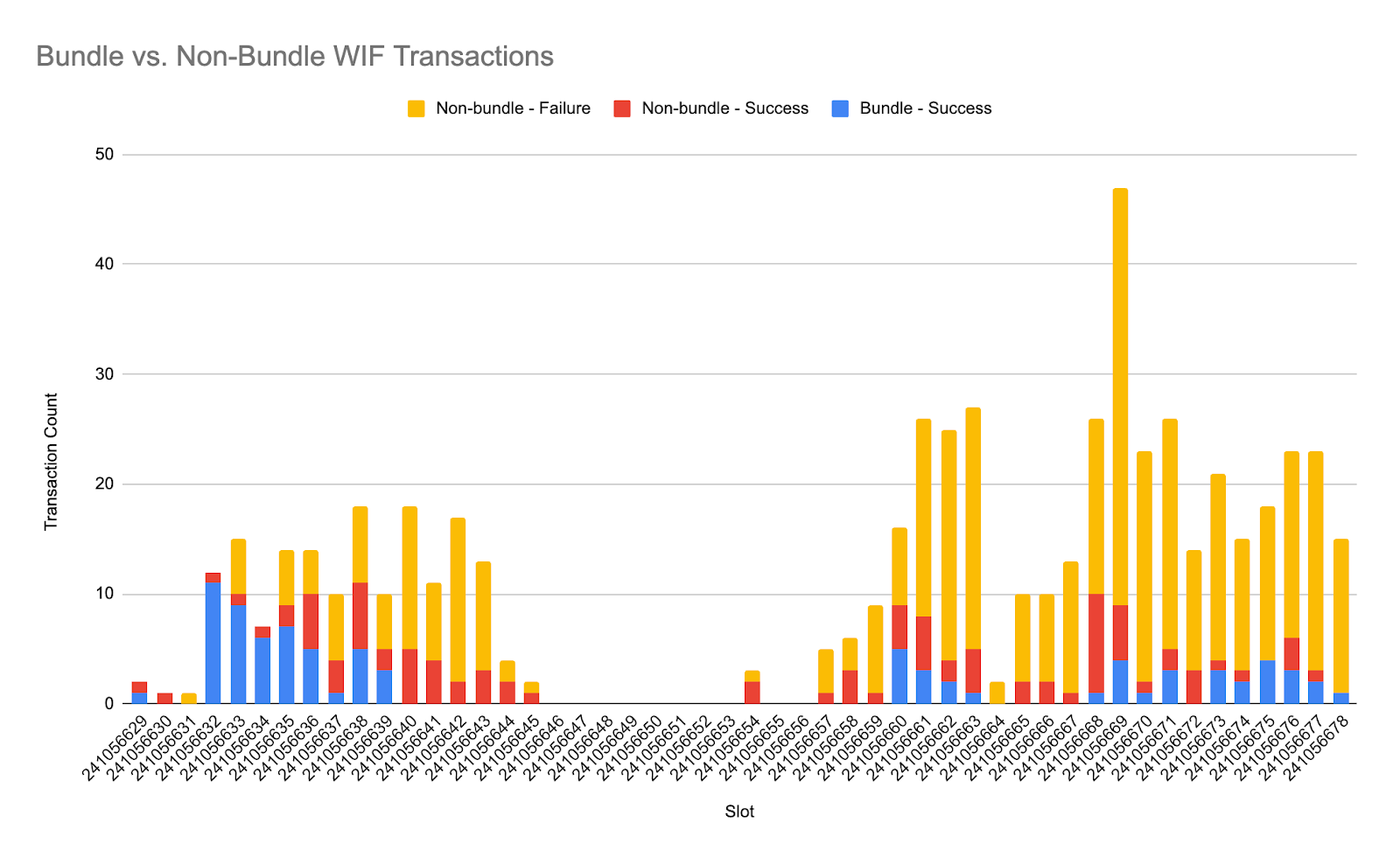
The above chart shows the number of bundles per slot (only successful ones get included on-chain) compared to non-bundled successful and failed transactions. By comparing the blue and red data points, we can see that a large number of arbitrageurs using bundles reacted swiftly. There are gaps where the leader wasn’t running Jito-Solana, so no bundles landed. Over time, more and more bots detected the opportunity and began executing more trades in the WIF market.
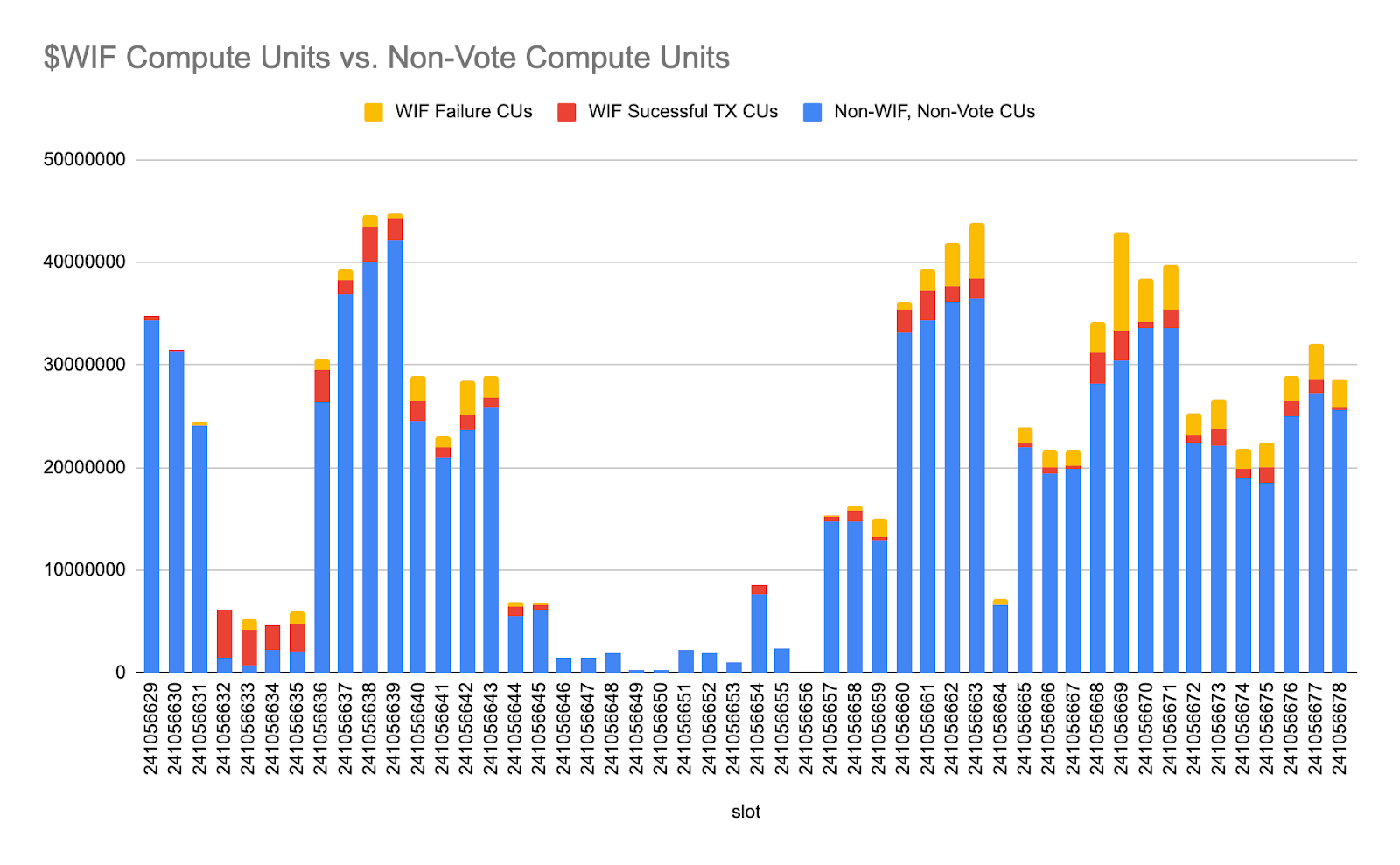
The above chart breaks down compute units per block. It highlights differences between validators and the volume dedicated to executing WIF transactions (as a function of all non-voting transactions). In fact, approximately 13% of total non-voting compute units were spent on WIF-related transactions across these blocks.
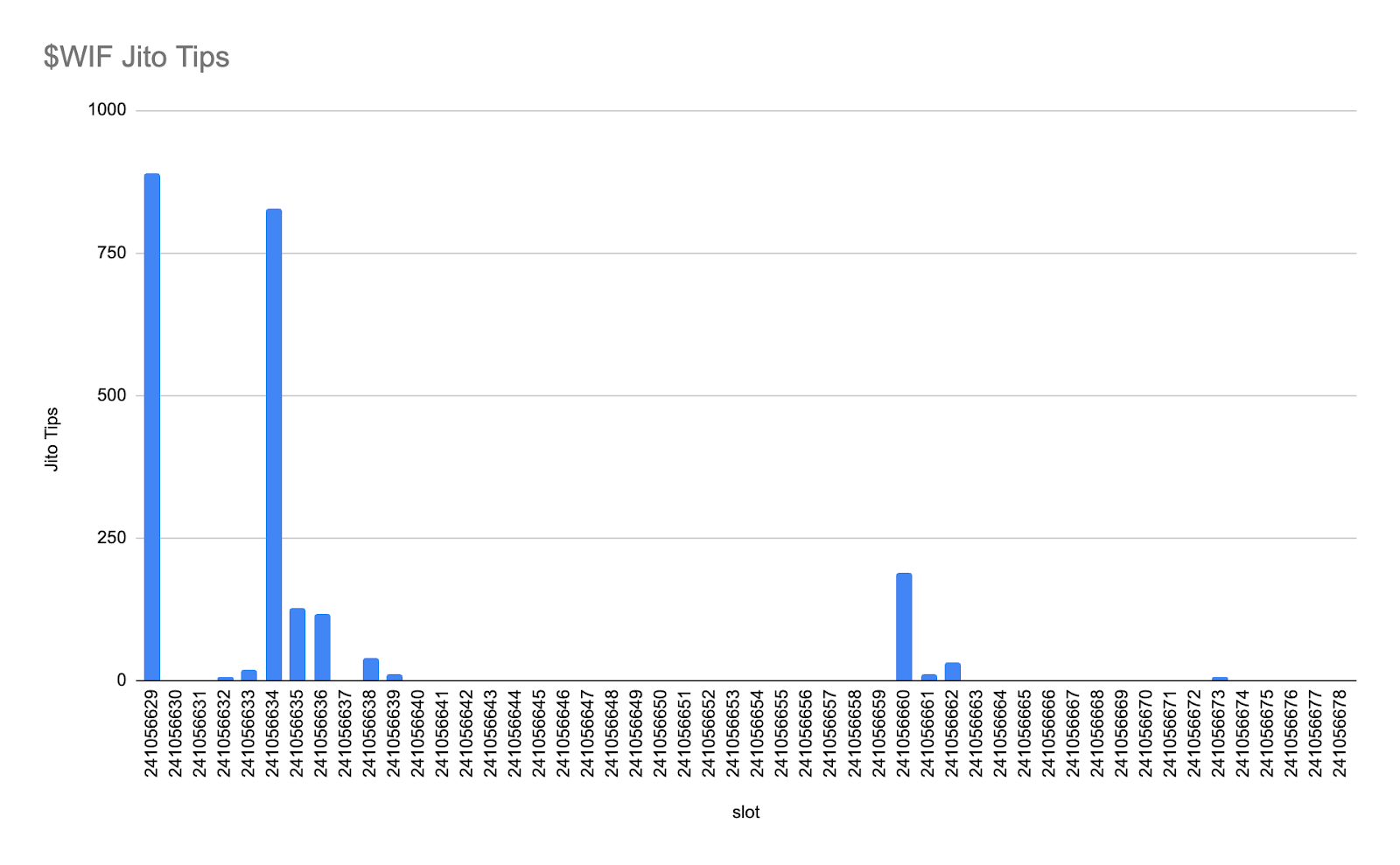
Over roughly 50 slots, more than 2,286.5 SOL in fees were paid through WIF transactions, generating approximately $228,650 in revenue for validators and their stakers within just 24 seconds. The most profitable validators included:
-
Validator.com: 978.95 SOL
-
Figment: 890.42 SOL
-
Staking Facilities: 403.64 SOL
Staking Facilities was fortunate enough to win two leading slots during this period: 241056636–241056639 and 241056660–241056663. During their first batch of slots, they earned 170.68 SOL; in the second batch, they earned 232.96 SOL.
Conclusion
The rapid growth of MEV on Solana serves as a perfect example of how a small number of transactions can generate enormous revenue for MEV arbitrageurs, validators, and stakers. Importantly, such situations are preventable.
Anyone planning large-scale trades should fully understand the price impact of their transactions. If your trade significantly affects the price, consider splitting it into many smaller buy/sell orders and allow arbitrage bots to handle any resulting price imbalances.
Join TechFlow official community to stay tuned
Telegram:https://t.me/TechFlowDaily
X (Twitter):https://x.com/TechFlowPost
X (Twitter) EN:https://x.com/BlockFlow_News
 @jito_sol