Should We Hype Ethereum Again? Reviewing ETH Ecosystem Tailwinds and Potential Assets
TechFlow Selected TechFlow Selected
Should We Hype Ethereum Again? Reviewing ETH Ecosystem Tailwinds and Potential Assets
This article summarizes the upcoming catalysts and key assets in the ETH ecosystem over the next few months.
 Navigating Web3 tides with focused insights
Author: Joyce
Editor: Jack
On January 11, the U.S. SEC announced the approval of 11 Bitcoin ETFs, a milestone event that has ushered in a new chapter for the crypto industry. The crypto market is poised to welcome increased capital inflows. With the long-anticipated "final shoe to drop" for the Bitcoin ecosystem now realized, market expectations have shifted toward the ETH ecosystem—today, ETH has already surged 7%. BlockBeats has compiled upcoming catalysts and key investment opportunities within the ETH ecosystem over the coming months.
Upcoming Catalysts for the ETH Ecosystem
Cancun Upgrade
To fulfill its vision as a "world computer," Vitalik outlined an upgrade roadmap for Ethereum from its inception, consisting of four phases: Frontier, Homestead, Metropolis, and Serenity. Currently, Ethereum remains in the Metropolis phase, constrained by performance issues and high gas fees.
The Cancun-Deneb (Dencun) upgrade marks another major enhancement to the Ethereum mainnet following the Shanghai upgrade. It will significantly improve Ethereum’s scalability, security, and usability, increasing mainnet TPS and reducing gas fees, thereby enabling effective scaling of the Ethereum main chain.
Once implemented, the Dencun upgrade will greatly enhance Ethereum's network utility, further solidify its infrastructure, and reinforce its status as the "king of public blockchains." Beyond Ethereum itself, the Layer2 sector is also set for unprecedented growth and prosperity.
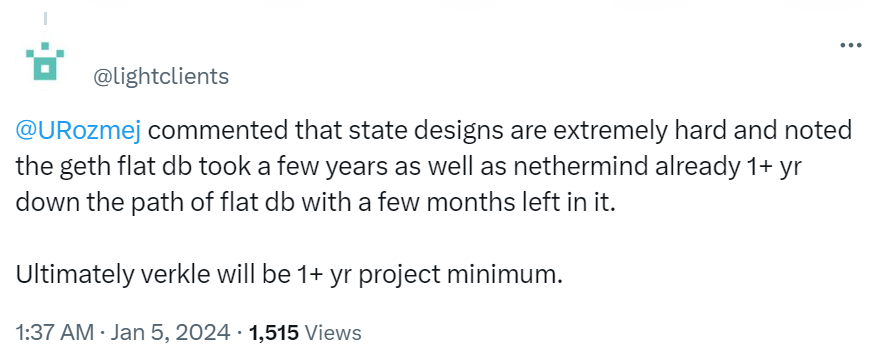
On January 5, Geth team developer lightclients announced that the 178th Ethereum Core Developers Execution (ACDE) meeting concluded, confirming the Goerli testnet’s Dencun upgrade for January 17, with Sepolia and Holesky testnets scheduled for January 30 and February 7, respectively. If all proceeds smoothly, developers will release the Goerli client next week, followed by Sepolia/Holesky clients during the week of January 22.
Ethereum ETF
With Bitcoin ETFs now approved, the spotlight has turned to Ethereum ETF applications—which the SEC has repeatedly delayed.
On December 19, the U.S. SEC postponed decisions on spot Ethereum ETF applications from ARK/21Shares and VanEck, setting new decision deadlines for late May 2024. On the same day, The Block reported that the SEC also delayed rulings on Hashdex’s Nasdaq Ethereum ETF and Grayscale’s Ethereum Trust conversion application.
Bloomberg analyst James Seyffart hinted on the Unchained podcast that the SEC might be shifting its stance on Ethereum. He noted that the recent approval of Ethereum futures ETFs suggests the SEC may be subtly acknowledging Ethereum as a commodity rather than a security.
On January 11, Cointelegraph reported that Bloomberg ETF analyst Eric Balchunas estimated a 70% chance of spot Ethereum ETF approval by May, adding he had “heard behind channels that spot Ethereum ETFs are looking good.”
However, digital asset lawyer Joe Carlasare believes approval for a spot Ethereum ETF may take longer than expected, as the SEC aims to carefully establish a precedent allowing it discretion in approving future digital asset ETFs.
Layer2 Scaling Narrative
On one hand, the implementation of EIP-4844 (Proto-Danksharding) in the Cancun upgrade will unlock new possibilities for Layer2 Rollup projects. On the other, Layer2 solutions have already cultivated a thriving market in addressing Ethereum’s scalability challenges. Beyond the Dencun upgrade, various Layer2 platforms launched their own scaling initiatives during the “scaling war” that began in summer 2023.
Today, leading Layer2 platforms such as Optimism, Arbitrum, and rising star Metis exemplify the diverse potential of the Layer2 ecosystem. It is foreseeable that Layer2 will continue to expand the imagination of Ethereum’s ecosystem throughout 2024.
Optimism: OP Stack Unveils the "Superchain Universe"
Currently, Optimism and Arbitrum dominate the majority of funds in the Layer2 market.

In October 2022, Optimism introduced the OP Stack—a highly scalable, interoperable, modular open-source blueprint. In February 2023, Optimism unveiled its Superchain strategy: L2 chains built using the OP Stack can achieve secure, efficient, atomic-level communication and asset transfers due to shared technical architecture, similar to Cosmos’ Interchain concept—this interconnected network is known as the Superchain.
Since its launch, OP Stack has gained broad adoption, receiving strong brand endorsements from major chains including Coinbase, opBNB, Zora, and Worldcoin. In June 2023, the Optimism blockchain was rebranded as OP Mainnet to distinguish it from other chains in the OP Stack ecosystem. The multi-chain universe powered by OP Stack is expected to flourish even further in 2024.
Arbitrum: Orbit Fuels an Explosion of Layer3 Ecosystems
On January 3, Binance’s latest Launchpool project Xai (XAI) attracted community attention. After several days of post-launch decline, XAI surged over 25% on January 11. As a specialized Orbit network developed by Arbitrum to meet the demands of large-scale Web3 gaming, XAI and the broader Orbit ecosystem hold significant strategic importance for Arbitrum.
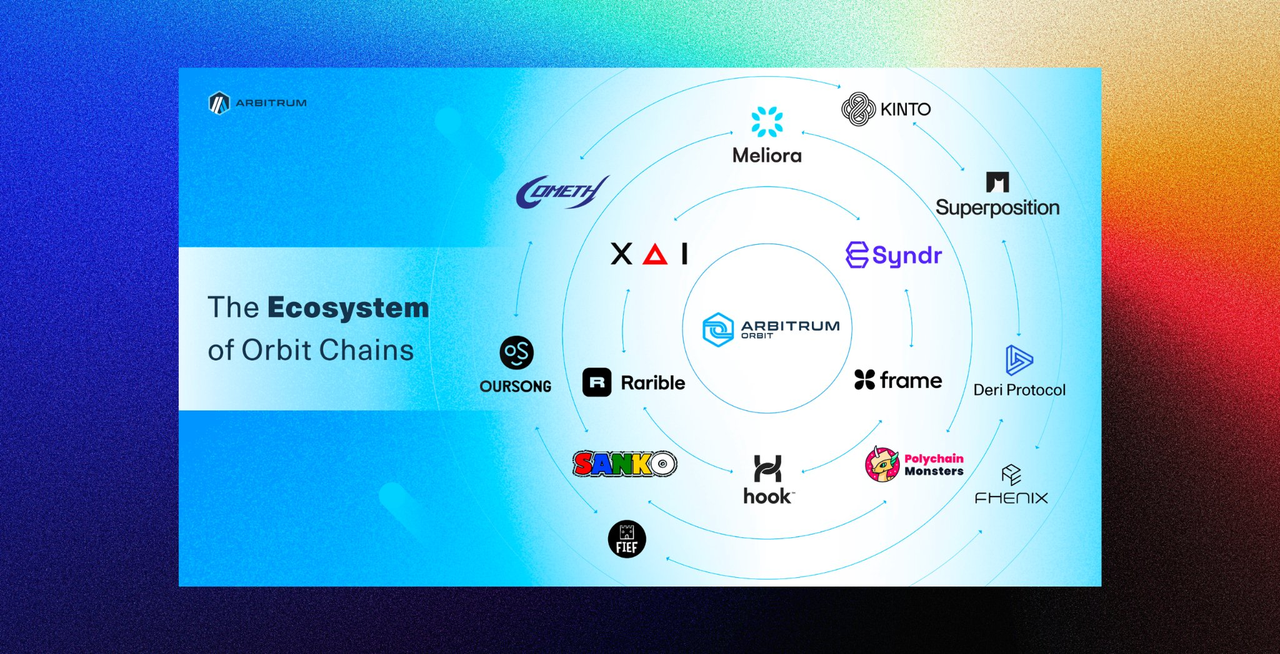
Arbitrum Orbit Ecosystem
In June 2023, Offchain Labs, the development team behind Arbitrum, released Arbitrum Orbit—a suite of developer tools designed to simplify building on L3 blockchains based on Arbitrum Orbit, and managing Arbitrum Rollups and AnyTrust chains.
Arbitrum Orbit offers compatibility with Stylus’ EVM+, allowing developers to use Solidity, C, C++, and Rust to deploy EVM-compatible smart contracts without changing existing toolchains. Additionally, Arbitrum Orbit now supports custom gas tokens—ERC-20 tokens used to pay transaction fees—enabling Orbit chains to process gas costs using specific compliant ERC-20 tokens instead of solely relying on Ethereum as before.
The community believes Orbit could drive breakthroughs across the Arbitrum ecosystem. In December 2023, TreasureDAO on Arbitrum announced plans to build a gaming chain using MAGIC as its gas token. Going forward, such developer-focused innovations by Layer2 platforms will bring greater liquidity to the Ethereum ecosystem.
Metis: Decentralized Sequencer
Beyond established players like Optimism and Arbitrum, Metis—up over 350% in two weeks—also reveals the untapped potential of Layer2. In December 2023, Metis’ TVL briefly surpassed $700 million, overtaking Base and zkSync to rank third.

Metis is an Ethereum Layer2 scaling solution based on Optimistic Rollup, founded in 2018 by Elena Sinelnikova, Kevin Liu, and Yuan Su as a general-purpose Layer2 infrastructure project.
Layer2 platforms are often criticized for centralized sequencers, with most teams opting for centralized operations early on to ensure security and stability. However, after the Metis Foundation announced a 4.6 million METIS token ecosystem development fund, Metis is expected to become the first Optimistic Rollup with a decentralized sequencer by early next year. This progress adds positive momentum to the technological narrative around sequencer decentralization. A decentralized sequencer is just the beginning of unlocking Rollup potential—the community’s aspirations for native Layer2 DeFi and full ecosystem breakout hinge on this foundation.
Various ZK Rollups: Starknet Airdrop Imminent, Ecosystem Poised for Growth
On December 1, 2023, the Starknet Foundation announced it had completed its airdrop snapshot and would distribute STRK tokens to select active past users and contributors in Q1 2024, while unlocking previously issued tokens.
RabbitX, a derivatives platform built on Starknet, saw its RBX token surge over 400% between October and November 2023, though it has since pulled back. Beyond DEXs, Loot Realm—an on-chain gaming ecosystem on Starknet—has drawn market attention with its “omnichain game” concept. Driven by the Loot NFT community DAO, Loot Realm includes multiple subgames; its LORDS token has risen nearly 90% over the past month.
Beyond Starknet, anticipation for zkSync’s airdrop is also growing. Notable DEXs on zkSync include SyncSwap and Mute.io. SyncSwap reports daily trading volume exceeding $9 million, with a total supply of 100 million SYNC tokens, 15% allocated for airdrops. Mute.io, one of the first native DEXs on zkSync Era, offers yield amplifiers alongside trading—users can purchase discounted MUTE tokens with a 7-day lock-up via bond mechanisms inspired by the (3,3) model. At time of writing, MUTE has gained over 15% in the last 24 hours.
Additionally, Linea, the Layer2 network under ConsenSys, deserves attention. According to Dune Analytics, as of December 24, 2023, Linea Mainnet had attracted over 290,000 ETH and more than 390,000 interacting addresses. Currently, over 40 protocols operate on Linea, with Mendi Finance being a native lending protocol ranking second in TVL. Its token MENDI has surged over 48% in the past 24 hours.
Mantle Network is a unified, EVM-compatible Layer2 ecosystem formed by the merger of Mantle and BitDAO, adopting a modular architecture with EigenLayer as its data availability (DA) layer, offering new scalability possibilities for Ethereum. Recently, Trader Joe launched Merchant Moe, a DEX dedicated to the Mantle ecosystem, distributing 2.5% of the new MOE token supply to JOE holders at TGE, with an additional 5% to be allocated over the next 12 months.
FusionX, Mantle’s native DEX, has tripled its TVL over the past two months, reaching $25 million at time of writing. As the first community-driven AMM on Mantle, FusionX features a unique mechanism allowing users to gain preferential access to new tokens through staking specific assets.
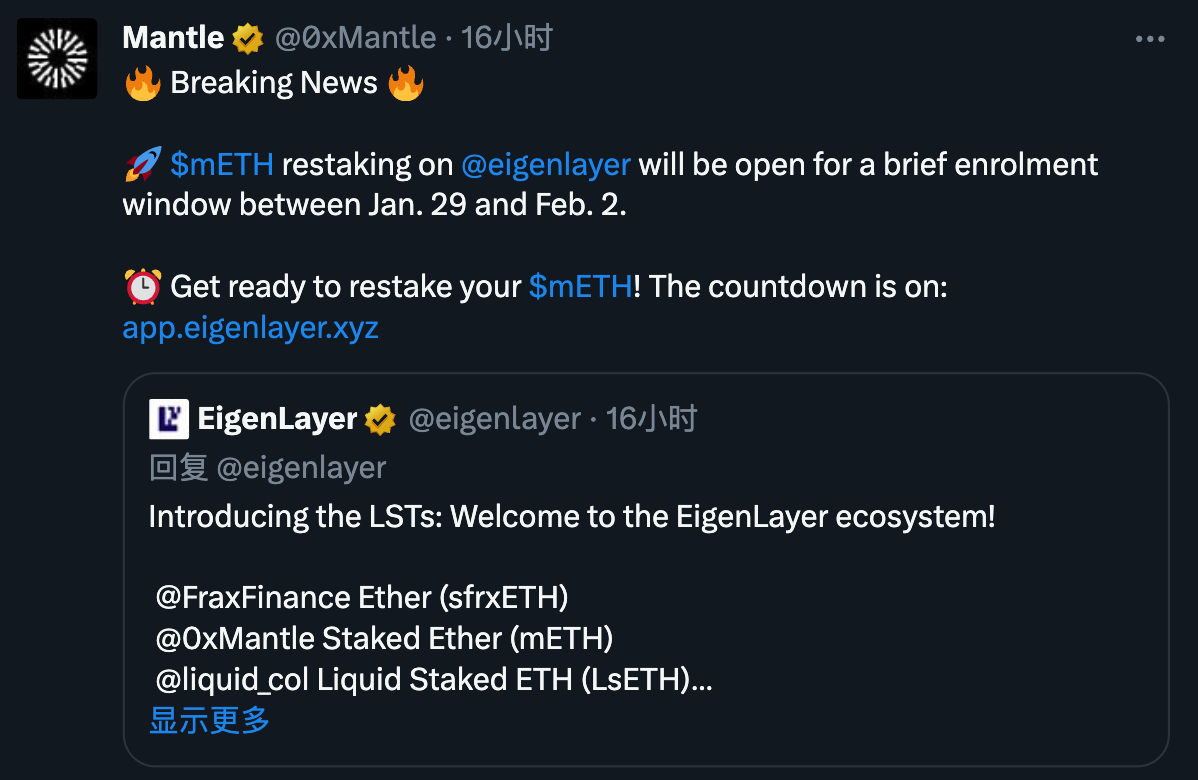
On January 10, EigenLayer announced three new liquid restaking tokens with restaking services, including mETH—the receipt token for Mantle LSP—with an annual yield of 7.2%.
Taiko, a Type 1 zkEVM network favored by top VCs and recognized by Vitalik, is worth watching. In June 2023, Taiko raised $22 million across two seed rounds—$10 million led by Sequoia China, and $12 million led by Generative Ventures. Regarded as one of the most promising projects in the zkEVM space, Taiko aims to become a fully decentralized, Ethereum-equivalent zero-knowledge scaling solution, enabling developers and users to securely experience Ethereum with lower fees—without altering Ethereum itself.
Currently still on testnet, Taiko launched a $30 million developer incentive program in December 2023 and initiated community education campaigns where users earn loyalty points by completing tasks.
Low-Market-Cap L2 Projects
Compared to Layer2 giants like Arbitrum and Optimism, which boast circulating market caps of around $3 billion, newer, lower-market-cap Layer2 platforms often offer fresher narratives and remain in early stages of value discovery—making them prime candidates for outsized returns in the next bull cycle.
On December 7, 2023, ZKFair, a ZK L2 community network, officially launched its testnet to all users. As the first L2 built on Polygon CDK, Celestia DA, and Lumoz ZK-RaaS, ZKFair immediately drew widespread attention for its 100% community fair launch model. On its launch day, over 30,000 users interacted with the network, and within three days, ZKFair’s TVL exceeded $12 million.
On January 10, ZKFair announced a ZKF staking mechanism: users who stake ZKF will receive 75% of the gas fee revenue from the ZKFair chain, with distributions starting January 15. Additionally, from January 14 to 20, ZKF stakers will receive airdropped rewards from Sideswap (SIDE), the first fair-launched project on ZKFair.
In the crypto space, blockchain gaming still holds promise. Hypr Network is a Layer2 blockchain built atop Ethereum, designed to enhance functionality and overcome limitations. Hypr specializes in providing a fast and cost-effective platform for zero-knowledge-based on-chain games. Leveraging zero-knowledge proofs, Hypr ensures enhanced data privacy and security for gaming applications, enabling players to transact and interact without exposing sensitive information. According to Coingecko, its HYPR token has gained 25% over the past week.
EigenLayer Activates Restaking Economy
Introduced by EigenLayer in June 2023, the concept of restaking has become a hot topic in Ethereum. Restaking allows users to re-stake already-pledged ETH or liquid staking tokens (LSTs) to provide additional security for various decentralized services on Ethereum, earning extra rewards in return.
However, restaking models can restrict capital liquidity, prompting the emergence of LSTs. BlockBeats highlights notable projects in the LST space.
Restake Finance is the first protocol to introduce modular liquid restaking for EigenLayer. Users depositing LSTs generated from liquid staking into Restake Finance can route them into EigenLayer and receive rstETH as a restaking receipt. rstETH can then be used across various DeFi protocols to generate yield, while also accruing EigenLayer reward points.
Restake Finance recently entered the spotlight, with its RSTK token surging over 200% in the past two weeks. Additionally, Renzo Protocol—the LRT and strategy management platform serving as a gateway to the EigenLayer ecosystem—officially launched on Ethereum mainnet on December 19 and announced its Renzo ezPoints rewards program on January 4, incentivizing user contributions through ezETH minting.
In the restaking space, several projects have transitioned from LSD businesses. KelpDAO, backed by LSD protocol Stader Labs, focuses specifically on liquid restaking, operating similarly to Restake Finance. Notably, Kelp DAO currently has no token, but Stader Labs’ SD token has gained over 100% in the past month.
On October 18, DeFi protocol ether.fi launched its liquid staking token (LST) eETH, allowing users to earn rewards by staking ETH. At time of writing, ether.fi’s TVL has surpassed $150 million. According to its roadmap, ether.fi plans to launch its token in April.
SSV Network, an Ethereum staking infrastructure provider, announced on January 4 that it has begun restaking operations—allowing EigenLayer validators’ responsibilities to be distributed across SSV nodes, leveraging SSV’s decentralized and non-custodial nature to enhance validator performance and security. Notably, SSV’s restaking nodes are highly decentralized, currently integrating with ANKR, Forbole, Dragon Stake, and Shard Labs. Over the past week, SSV has gained over 30%.
Originally an Ethereum staking protocol, Swell has gradually expanded into restaking. Its derivative LST token swETH ranks third in TVL on EigenLayer after stETH (Lido) and ETH, with over 110,000 ETH staked. The restaking version, rswETH, focuses squarely on the restaking赛道, and its Liquid Restaking Committee now includes AltLayer and InfStones.
On January 11, Pendle—a yield strategy protocol positioning itself at the intersection of LSD and RWA—announced on social media it will support ether.fi’s LST eETH, officially entering the Restaking/LRTfi space. Users can leverage Liquid Restaking Tokens (LRTs) to earn additional yields. On the same day, PENDLE surged over 30%.
Since EigenLayer ignited the Ethereum restaking race, other EVM and non-EVM ecosystems have begun launching their own restaking concepts. Picasso, a network supporting cross-ecosystem IBC, has deployed its native token PICA as a unified network token across multiple L1 blockchains including Polkadot, Kusama, and Cosmos. Recently, Picasso brought restaking to Solana, allowing users to stake SOL, mSOL, jitoSOL, and other LP tokens to support Solana’s cross-chain IBC validators.
Layerless, an omnichain liquid restaking protocol backed by EigenLayer and LayerZero, is developing Omnichain Restaked Tokens (ORT). When users deposit LSTs (e.g., stETH, cbETH, or rETH) into EigenLayer, they receive an ORT representing their EigenLayer share—providing liquidity, composability, and usability across DeFi. Layerless plans to launch its testnet in Q1.
LSDFi, RWA, DEX, and Other Themes
The Shanghai upgrade in 2023 fueled unprecedented growth in the LSD sector, injecting substantial liquidity into the Ethereum ecosystem. According to DefiLlama, $32 billion is currently staked, with Lido holding over $24 billion in staked ETH—capturing 75% market share, far ahead of competitors. As more capital flows into Ethereum, the LSD market is expected to keep heating up. On January 10, LDO briefly broke $3.80, gaining over 18% in 24 hours.
Beyond EigenLayer-driven liquidity, smaller-cap projects with strong backing like Prisma are also worth watching. Prisma enjoys joint endorsement from founders of Curve Finance, Convex Finance, Swell Network, and CoingeckoFinance, and has attracted investments from top-tier entities including Frax Finance, Conic Finance, Tetranode, OK Venture, Llama Airforce, GBV, Agnostic Fund, Ankr Founders, MCEG, and Eric Chen.
Driven by RWA adoption, the potential market cap of real-world assets could reach tens of trillions of dollars in the next five years. MakerDAO, a stablecoin provider for Ethereum, has already made moves in the RWA direction.
MakerDAO’s first official RWA project, New Silver, established in 2021, has a debt ceiling of $20 million, backed by mortgage loans originated by New Silver and tokenized via SPVs on Centrifuge. Additionally, BlockTower Andremeda—a U.S. Treasury RWA project initiated by BlockTower Capital—is one of MakerDAO’s largest RWA initiatives, with a $1.28 billion debt ceiling and current assets exceeding $1 billion.
Meanwhile, Uniswap v4, Uniswap X, and intent-based DEXs are shaping up to be key themes in 2024.
In June 2023, Uniswap published a draft of Uniswap v4, envisioning a system where anyone can influence trade execution via “hooks.” According to Uniswap Labs, Uniswap v4 will launch after the Dencun upgrade. A month later, Uniswap announced UniswapX—a non-custodial, Dutch auction-based protocol. While Uniswap v4 enhances pool customization for maximum flexibility, Uniswap X optimizes routing to maximize output tokens. Together, these protocols deliver optimal trading experiences while maintaining commitments to decentralization, censorship resistance, and permissionless access.
Other intent-focused projects include CowSwap, a DEX aggregator combining batch trading, intent-based execution, and MEV protection. Using batch auctions as its core price discovery mechanism, CowSwap determines a single settlement price for all trades in a batch, eliminating frontrunning common in immediate execution models. Batch auctions also settle multiple trades simultaneously, optimizing gas usage.
Join TechFlow official community to stay tuned
Telegram:https://t.me/TechFlowDaily
X (Twitter):https://x.com/TechFlowPost
X (Twitter) EN:https://x.com/BlockFlow_News
 BlockBeats