








Bitcoin Spot ETF Has Arrived: Analyzing the Strength of 11 Issuers and Identifying the Biggest Beneficiaries
TechFlow Selected TechFlow Selected
Bitcoin Spot ETF Has Arrived: Analyzing the Strength of 11 Issuers and Identifying the Biggest Beneficiaries
How should investors choose the right ETF for themselves? Focus on three metrics: fees, liquidity, and trading costs.
 Navigating Web3 tides with focused insights
Author: RockFlow
Key Takeaways
① Effective dialogue between the SEC and potential issuers was a key reason behind the final approval of spot Bitcoin ETFs.
② The simultaneous approval of 11 spot Bitcoin ETFs (including GBTC) reflects lessons learned from the Bitcoin futures ETF market, where one fund capturing a three-day head start secured most of the market share. Allowing all prepared issuers to launch at once ensures fairer competition and benefits investors.
③ How should investors choose the right ETF? Three key metrics: fees, liquidity, and trading costs. Buy-and-hold investors should focus on fees, active traders should prioritize liquidity, and all investors should consider how an issuer’s own trading costs ultimately affect ETF performance.
On July 1, 2013, Cameron and Tyler Winklevoss applied to establish the Winklevoss Bitcoin Trust. At the time, it was seen as a landmark financial innovation, but the U.S. SEC was not ready to approve an ETF investing in an unregulated asset on an unregulated market.
More than a decade later, the Winklevoss brothers’ original vision has become reality—the SEC has finally approved spot Bitcoin ETFs.
1. The History of Spot Bitcoin ETFs
Although the Winklevoss Bitcoin Trust was first proposed in 2013, it wasn’t formally rejected by the SEC until 2017. Over the past decade, the SEC repeatedly expressed concerns about lack of regulation and potential fraud in the cryptocurrency market, yet this did not stop issuers from attempting to bring spot Bitcoin ETFs to market.
Grayscale launched the Grayscale Bitcoin Trust (GBTC) as early as 2013, initially available only to accredited investors. After listing in 2015, retail investors could also trade it. Why was GBTC able to launch smoothly? Because it operates as an over-the-counter product and does not require SEC approval (though FINRA approval is required).
As a closed-end trust, its main drawback is that market price can significantly deviate from net asset value. While technically buying GBTC equates to holding Bitcoin (since the trust directly holds BTC), its price has consistently traded at a premium or discount to Bitcoin’s NAV—reaching nearly 50% discount at its worst in 2021. This means investing in Bitcoin via GBTC has not been particularly efficient.
Thus, issuers including Bitwise and VanEck have repeatedly attempted to launch their own spot Bitcoin ETFs in recent years.
The landscape began shifting in late 2017 when CBOE listed the first Bitcoin futures contracts. With these derivatives now available, investor demand for related financial products grew. In October 2021, the SEC finally approved Bitcoin futures ETFs.
However, Bitcoin futures ETFs soon faced their first major issue: ProShares Bitcoin Strategy ETF (BITO) launched three days before Valkyrie Bitcoin Strategy ETF (BTF).
In the ETF space, first-mover advantage is immense. That three-day gap allowed BITO to capture the vast majority of investor attention. Out of the current $2.3 billion invested in crypto ETFs, over $1.8 billion is in BITO—not BTF—making ProShares the clear winner thanks to timing.
A second problem with Bitcoin futures ETFs is their inability to perfectly track Bitcoin’s actual performance.
Because Bitcoin futures ETFs are based on futures contracts, rolling from expiring contracts to new ones incurs contango costs, causing returns to lag behind Bitcoin itself. Last year, while Bitcoin rose 171%, BITO returned only 151%—a 20% gap that is far from negligible.
The chart below compares BITO and Bitcoin price movements (red = BITO, green = Bitcoin):
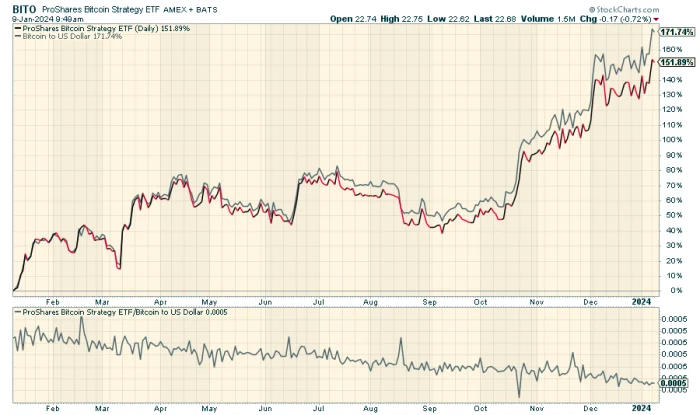
This is precisely why spot Bitcoin ETFs are so important. For investors bullish on Bitcoin, the optimal choice is Bitcoin itself—not derivatives.
In fact, spot Bitcoin ETFs already exist in Canada and Europe, proving there are no technical barriers. Therefore, the SEC’s approval in the U.S.—the world’s largest capital market—was inevitable.
2. Recent Changes in the Past Six Months
Before the second half of 2023, the typical path for spot Bitcoin ETF filings looked like this:
-
Issuer submits application for a spot Bitcoin ETF
-
Wait patiently
-
SEC delays decision on approval
-
Continue waiting
-
SEC delays again
-
Continue waiting
-
SEC rejects the application
The SEC consistently cited risks of fraud and manipulation in crypto markets, choosing silence and indefinite delays. While some investors viewed “delaying instead of outright rejection” as a silver lining, after years of waiting, many had grown disillusioned.
That changed in the second half of 2023. The SEC began soliciting feedback from issuers, investors, and other stakeholders, inviting them to revise and resubmit applications. This marked a critical breakthrough—indicating the SEC was now willing to engage in dialogue rather than ignore proposals.
Over the past month, the SEC engaged in repeated discussions with issuers, demanding multiple revisions to filings—ultimately addressing all major concerns, particularly around surveillance (how issuers monitor and prevent manipulation/fraud) and custody (how Bitcoin is stored).
This effective communication between the SEC and potential issuers clearly played a crucial role in the final approval of spot Bitcoin ETFs.
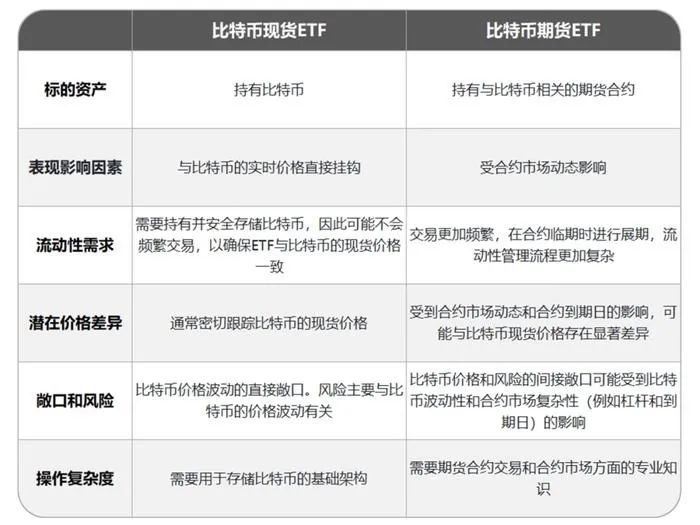
So why was January 10 so significant?
Simply put, it was the deadline for approving the ARK 21Shares Bitcoin ETF (ARKB). As one of the key applicants, the SEC needed to decide by January 10 whether to approve or reject it.
Why were 11 spot Bitcoin ETFs (including GBTC) approved simultaneously on that day? Because the SEC learned from the Bitcoin futures ETF experience—where a mere three-day lead allowed one fund to dominate. By allowing all prepared issuers to launch together, competition is fairer and more beneficial for investors.
3. Outlook and Analysis: Pros and Cons of Spot Bitcoin ETFs
All 11 ETFs are backed by Bitcoin—what differentiates them? Which issuers will emerge as leaders? And how should investors choose the right ETF for themselves?
Three key metrics: fees, liquidity, and trading costs. Buy-and-hold investors should prioritize fees, active traders should focus on liquidity, and all parties should assess how an issuer’s internal trading costs impact ETF performance.
Detailed analysis of each fund follows:
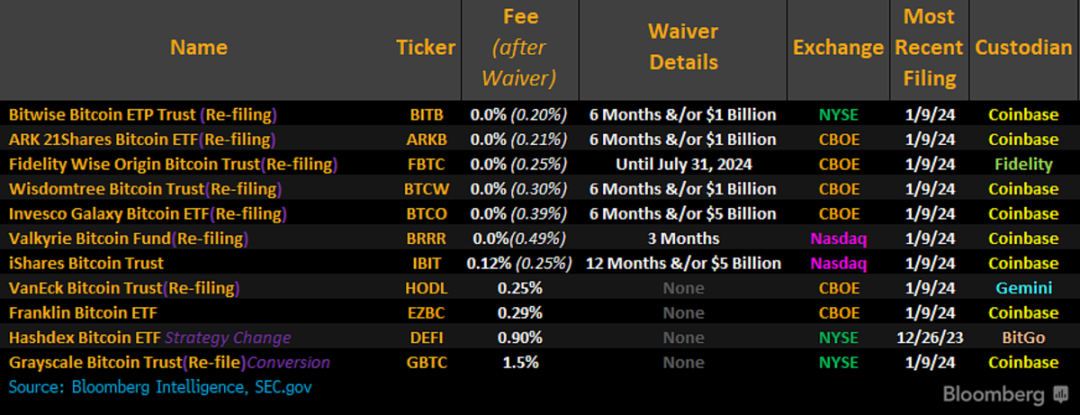
iShares Bitcoin Trust (IBIT), Fee: 0.25% (waived to 0.12% during promotion), Outlook: Excellent
IBIT is the most promising spot Bitcoin ETF. Given BlackRock’s massive scale and client base, it’s hard to imagine IBIT failing.
Moreover, before BlackRock announced its entry, market sentiment suggested SEC approval was unlikely. BlackRock’s involvement significantly boosted confidence—some even speculated they had insider knowledge. From news coverage to public attention, BlackRock remains the focal point.
Fidelity Bitcoin Trust (FBTC), Fee: 0.25% (waived to 0% during promotion), Outlook: Excellent
Unless something unexpected happens, Fidelity’s scale advantage is formidable. Though not an absolute leader in ETFs, it manages trillions in assets and will actively promote crypto investments to its existing clients. As a major asset manager, Fidelity’s influence is substantial—making FBTC a likely top-tier spot Bitcoin ETF.
ARK 21Shares Bitcoin ETF (ARKB), Fee: 0.21% (waived to 0%), Outlook: Strong
Cathie Wood has long been involved in crypto and holds GBTC across several ARK funds—currently around $80 million—which may soon shift entirely into ARKB. The Bitcoin ETF aligns perfectly with ARK’s disruptive innovation theme, and the 0.21% fee is very competitive. Considering ARK typically charges 0.75% for actively managed funds, this shows serious commitment to winning market share.
However, after ARK’s poor performance in 2022, its reputation isn’t what it once was in 2021. Whether investors will fully trust Cathie Wood again remains to be seen.
Grayscale Bitcoin Trust (GBTC), Fee: 1.50%, Outlook: Solid
GBTC was once a $27 billion trust and is transitioning from a closed-end structure. It used to be the “only” way to invest in Bitcoin. Futures ETFs didn’t pose a real threat—but spot ETFs do, especially from giants like BlackRock and Fidelity. Now, it aims to maintain its 1.5% fee (down from 2% pre-conversion) on its existing $27 billion base.
GBTC is unlikely to attract large inflows of new capital. The key question is how long it can retain its current size. It may lose assets to newer funds, but will continue generating substantial revenue for the foreseeable future.
Bitwise Bitcoin ETF Trust (BITB), Fee: 0.20% (waived to 0%), Outlook: Strong
While Bitwise may seem outmatched against giants like BlackRock and Fidelity, BITB could be a dark horse.
With the lowest fee in its category at 0.20%—plus a fee waiver—and a recent nine-figure investment commitment from Pantera (which manages ~$3.6 billion), Bitwise, as a crypto-native firm, is gaining momentum. More partnerships may follow.
WisdomTree Bitcoin Trust (BTCW), Fee: 0.30% (waived to 0%), Outlook: Strong
WisdomTree is a veteran ETF provider (9th largest by AUM), known for ETFs in cybersecurity, cloud computing, and AI—though its roots are in traditional stocks and bonds. BTCW may appeal to more conservative, established investors.
Invesco Galaxy Bitcoin ETF (BTCO), Fee: 0.39% (waived to 0%), Outlook: Strong
Invesco is larger and more well-known than WisdomTree, with strong offerings in Nasdaq-100 and related ETFs, potentially creating spillover interest.
But its edge is not overwhelming. While the fee waiver is a good start, the post-waiver 0.39% fee lacks competitiveness.
VanEck Bitcoin Trust (HODL), Fee: 0.25%, Outlook: Strong
VanEck manages significant assets but isn’t large enough to be a leader. As one of the first to push for spot Bitcoin ETFs, it has name recognition—but offers little fee advantage.
Valkyrie Bitcoin ETF (BRRR), Fee: 0.49% (waived to 0%), Outlook: Moderate
Valkyrie is a veteran in crypto ETFs—its futures ETF ranks fourth in size. Missing the early launch window is understandable, but both VanEck and ProShares launched their Bitcoin futures ETFs later and have since surpassed it. This suggests limited competitive strength. Facing giants like BlackRock, Fidelity, and ARK, it’s unlikely to gain traction. Plus, its post-waiver fee is among the highest.
Franklin Bitcoin ETF (EZBC), Fee: 0.29%, Outlook: Moderate
Franklin is a traditional asset manager better known for mutual funds than ETFs. Among spot Bitcoin ETFs, EZBC is likely the least recognized.
In 2017, Franklin launched a series of index ETFs at just 0.09% fees, aiming to disrupt the market. Some achieved modest success, but most remain under $100 million in AUM—proving low cost alone wasn’t enough. Without any fee waiver, EZBC lacks compelling reasons to succeed.
Hashdex Bitcoin ETF (DEFI), Fee: 0.90%, Outlook: Moderate
Like Bitwise, Hashdex is a native crypto firm, which could offer some advantages. But its 0.90% fee is a major weakness. Also, it lacks broad name recognition among retail investors.
4. Conclusion
We’ll soon see which issuers win the race. But clearly, investors are the biggest winners.
Previously, the leading Bitcoin futures ETF—BITO—charged 0.95%, so many expected spot ETF fees to be at least 0.50%. Instead, fierce competition has driven rates down to 0.20%, with temporary zero-fee periods. Billions in new capital are poised to enter the market.
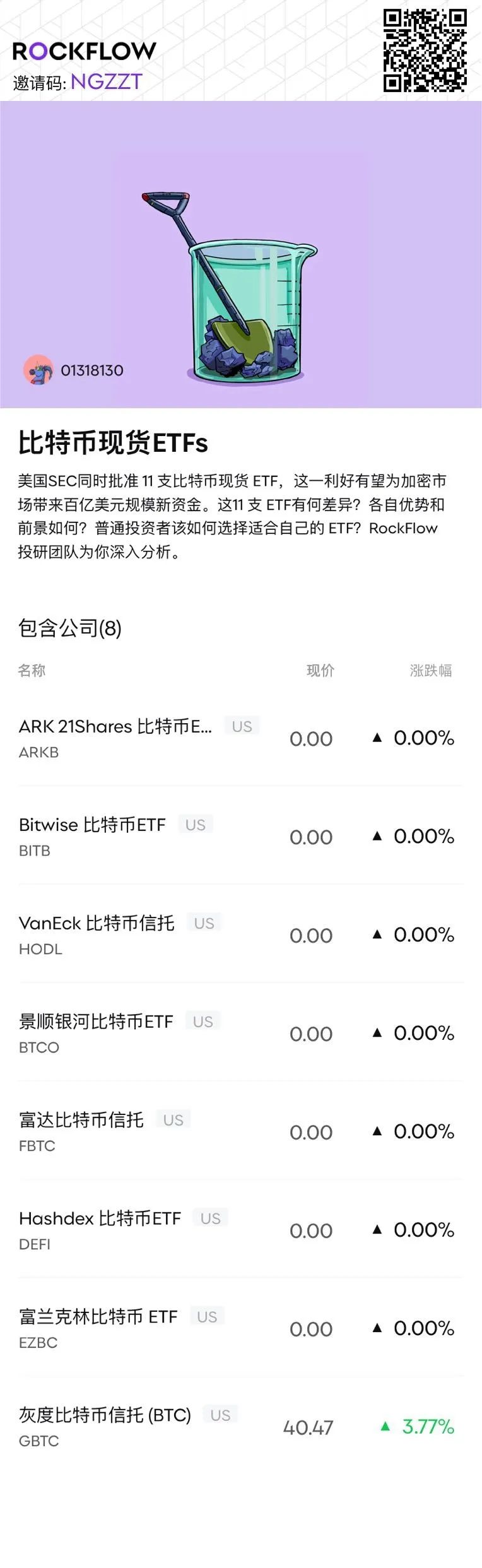
The RockFlow research team has compiled all these ETFs into a single “Spot Bitcoin ETF” watchlist, enabling one-click access to the crypto market:
Join TechFlow official community to stay tuned
Telegram:https://t.me/TechFlowDaily
X (Twitter):https://x.com/TechFlowPost
X (Twitter) EN:https://x.com/BlockFlow_News












