DA War: The Emerging Narrative of the Post-Cancun Upgrade Era
TechFlow Selected TechFlow Selected
DA War: The Emerging Narrative of the Post-Cancun Upgrade Era
After the Cancun upgrade, modular blockchains may become the dominant paradigm for public chains, and the DA layer will become the most fiercely contested area within the modular stack, with the DA War heating up.
 Navigating Web3 tides with focused insights
Author: NingNing
After completing the Cancun upgrade in the first half of this year, Ethereum will have finished the prototype (ProtoType) phase of its transition from a monolithic blockchain to a modular blockchain.
Post-Cancun, Ethereum can be seen to some extent as a modular public chain system composed of the Ethereum mainnet as L1 and L2s built on Ethereum (Arbitrum, Optimism, ZkSync, Starknet, Scroll, Taiko, Metis, etc.).
We can catch a glimpse of this profound shift from Optimism’s slogan—“Ethereum, scaled”—which emphasizes full equivalence with Ethereum.
The post-Cancun Ethereum stack will be explicitly divided into consensus layer, data availability (DA) layer, settlement layer, and execution layer. The execution layer functions will be partially (or fully under Danksharding) outsourced to Ethereum-based L2s; the DA layer ensures reconstructability of L2s; the settlement layer guarantees asset security on L2s; and the consensus layer provides finality.
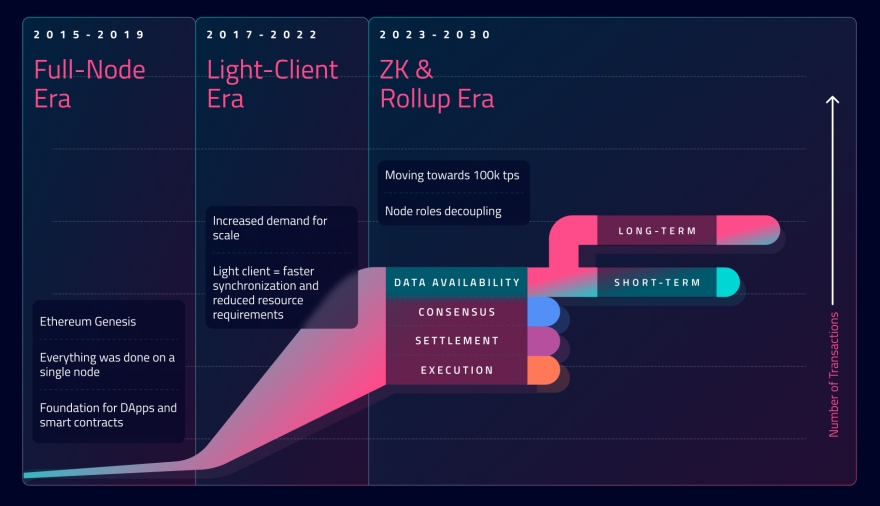
DA (Data Availability) refers to the rollup of state data—including transactions—from L2 to L1, which after verification and consensus is stored on the L1 mainnet, providing fraud proofs for Op-Rollups and ZKP validation support for ZK-Rollups.
Currently, L2 state data is stored within Ethereum mainnet blocks in the form of calldata. After the Cancun upgrade, this data will instead be stored in newly introduced Blob space.
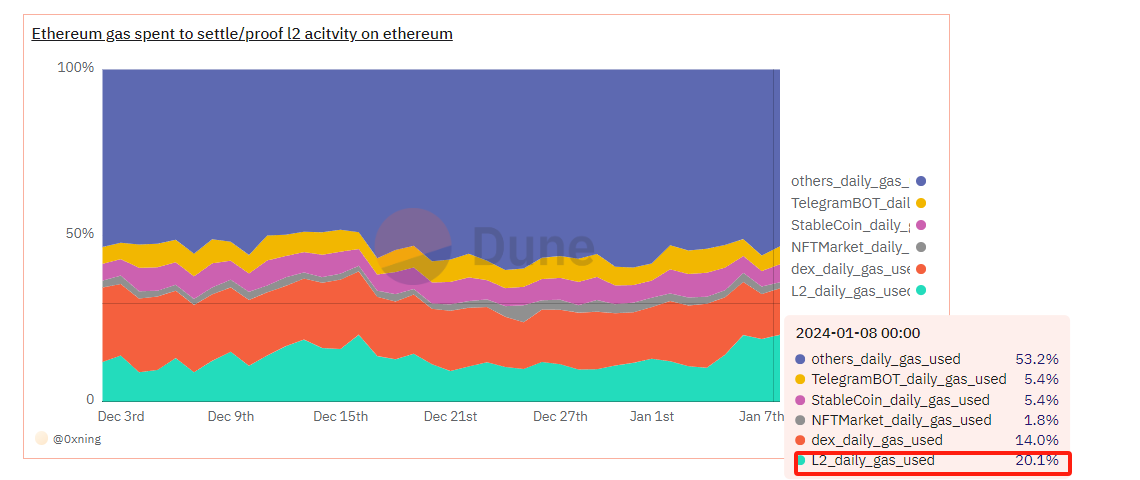
Currently, gas fees consumed by L2 verification and settlement account for 10–20% of total Ethereum mainnet gas usage. Of that, DA service costs paid to the Ethereum mainnet make up 95% of L2 gas expenditures.
Before the launch of Celestia—the modular public chain dedicated to DA services—Ethereum held a monopoly over 100% of the DA market.
Celestia introduced DAS (Data Availability Sampling) and NMT (Namespace Merkle Tree) to enhance consensus security and scalability. DAS enables light nodes on the Celestia network to participate in data availability verification, while NMT reduces the consensus load on Celestia.
From day one, Celestia began competing head-on with the Ethereum mainnet in the DA market, leveraging its low-cost, secure, and highly trust-minimized characteristics. Privacy-focused L2 Manta, Lyra’s decentralized options protocol DappChain, and many ecosystem partners like Dymension joined Celestia’s fold.
This move angered the Ethereum community and Vitalik himself, ultimately leading L2Beat to remove L2s using Celestia’s DA from its official L2 list.
This wasn’t solely due to Celestia undermining Ethereum’s value capture in the DA market, but more because such actions weakened the coupling, equivalence, and interoperability between Ethereum and its L2s.
However, Celestia isn’t the only one eyeing the DA market. EigenLayer, creator of the new primitive Restaking, urgently needed an AVS (Actively Validated Service) use case to deploy its $1 billion TVL into real-world applications.
Faced with the allure of the blue-ocean DA market, EigenLayer毫不犹豫ly launched EigenDA as its first AVS instance.
However, EigenDA’s architecture differs from Celestia’s. It primarily uses ZK technologies such as KZG commitments to verify state data submitted by L2s, relies on the EigenDA network secured by restaked ETH for finality, and ultimately still submits and stores the L2 state data on the Ethereum mainnet.
In essence, EigenDA acts as a subcontractor for the verification and finality components of Ethereum’s DA services—not a competitor like Celestia.
Beyond Ethereum, Celestia, and EigenDA, there’s another overlooked player in the DA market: Covalent.
We know that after the Cancun upgrade, the Ethereum mainnet will retain L2-submitted state data for only one month before discarding it. To maintain decentralization and ensure the functionality of DAS light nodes, Celestia also periodically deletes submitted L2 state data.
As a professional on-chain data platform backed by giants like Binance, Coinbase, and CoinGecko, Covalent launched its long-term DA service EWM (Ethereum Wayback Machine) at the end of last year, permanently archiving L2 state data discarded by Ethereum.
Moreover, Covalent indexes and structures this data, integrating it into its on-chain data API services, offering support to professional blockchain data websites, government regulators, and AI research teams.
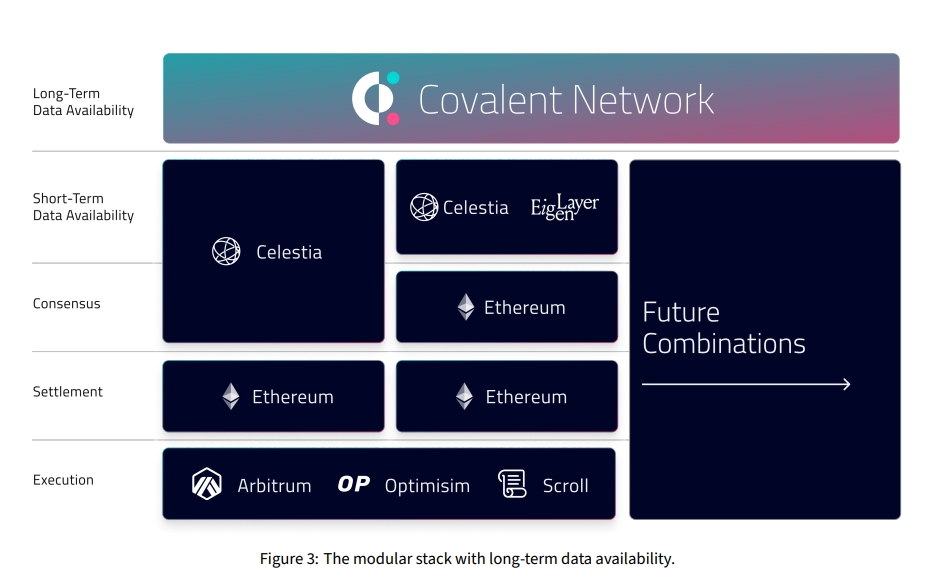
The above image is a modular stack diagram created by the Covalent team: L2 projects such as Arbitrum, Optimism, and Scroll handle writing state data; Ethereum handles asset custody and settlement; the consensus layer features competition between Ethereum and Celestia; the DA layer becomes a three-way battle among Ethereum, Celestia, and EigenLayer; while Covalent specializes in reading L2 state data.
In my view, after the Cancun upgrade, modular blockchains will become the dominant paradigm, and the DA layer will emerge as the most fiercely contested segment of the modular stack. The DA War will heat up rapidly, and protocols within the modular stack will become a major investment theme in 2024.
Join TechFlow official community to stay tuned
Telegram:https://t.me/TechFlowDaily
X (Twitter):https://x.com/TechFlowPost
X (Twitter) EN:https://x.com/BlockFlow_News
 @0xNing0x