








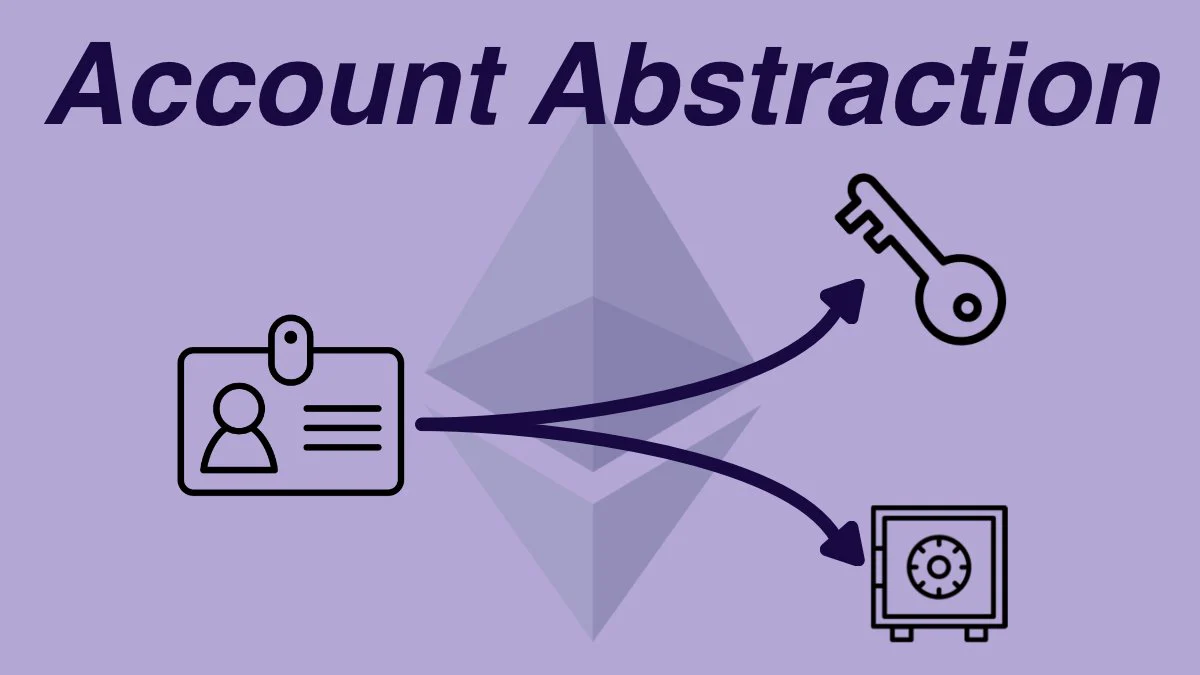
Annual Review of Modular Account Abstraction: Milestones, Data, and Trends
TechFlow Selected TechFlow Selected
Annual Review of Modular Account Abstraction: Milestones, Data, and Trends
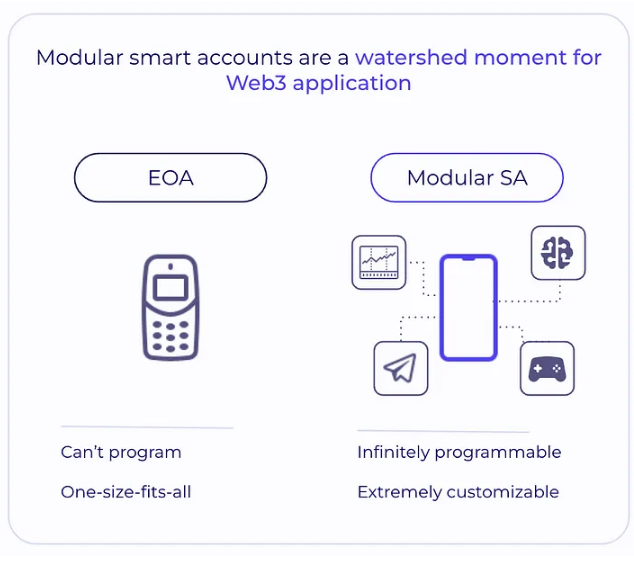
Modular account abstraction promises a world where smart accounts are easily extensible, customizable, portable, and secure.
 Navigating Web3 tides with focused insights
Author: Konrad Kopp
Translation: Baihua Blockchain
2023 was the year of innovators in account abstraction. ERC-4337 sparked initial excitement and launched a developer community (the 4337 Mafia), but its impact extended far beyond the standard itself. New wallets emerged (such as Soul Wallet and Clave), key smart contract account features were enhanced (session keys, new recovery mechanisms, and passkeys), and related verticals began leveraging smart accounts to drive infrastructure improvements for other critical UX advancements (e.g., intent-based transactions).
One emerging vertical that has seen significant innovation built upon ERC-4337 sits at the heart of these developments: modular account abstraction. Modular account abstraction promises a world where smart accounts are easily extensible, customizable, portable, and secure. We are highly excited about this space in 2024. To kick things off, we’d like to review last year’s key milestones and briefly outline our predictions for 2024.
1. Before 2023
The idea of modularizing smart accounts has existed for some time. Prior to 2023, the most prominent (and, to our knowledge, only) modular account was Safe. Its architecture allowed executor modules to callback into the account internally, along with a guardian/hook module and a fallback handler. Examples of modules built for Safe include the Zodiac modules developed by GnosisDAO. Other players in the account abstraction space had previously explored certain aspects of modularity—Argent being one example—but to our knowledge, they have not yet transitioned to using such a paradigm in production.
2. The Beginning
At the end of 2022, while finalizing the audit of ERC-4337, the idea arose to modularize ERC-4337 accounts using Diamond Proxies. At ETHDenver in February 2023, Rhinestone built the first prototype of such an account, featuring:
1) Modularity
2) Native compatibility with ERC-4337
3) Built on Diamond Proxies, and selected as one of the hackathon finalists.
This triggered extensive discussions, community efforts, prototypes, and products.
3. Technical Milestones / Proposals
After ETHDenver, one of the first major steps was the launch of ERC-6900 (April 18, 2023). This proposal aimed to standardize modular smart accounts, drawing inspiration from early prototypes developed during ETHDenver. It formally opened up discussion around using Diamond Proxies—and particularly delegatecall—for modularizing smart accounts. Shortly after, ZeroDev launched their Kernel on April 25, which remains one of the most minimal and extensible smart accounts. Then, Biconomy launched their own modular smart account on September 27 by forking Safe to make it natively compatible with 4337 and enabling modularized validation logic. Additionally, Thirdweb announced Dynamic Accounts toward the end of summer.
However, modular accounts are not the only piece of the puzzle. The promise of modular account abstraction is that any developer can build a smart account feature, and any smart account user can install and use it. Introducing third-party developers into the account introduces significant security risks. To address this specific issue and create a platform for module distribution and discovery, we launched the Module Registry in July, quickly followed by ERC-7484 on August 14. The Safe{Protocol} whitepaper was then released on August 15, aiming to solve exactly this problem within the Safe ecosystem.
In 2023, module development primarily focused on foundational account features. This included novel account recovery systems (e.g., Safe's Recovery Hub), improved use of passkeys as a signing mechanism, and cross-chain modules enhancing account synchronization across multiple networks. Beyond these basic features, we began seeing more sophisticated modules offering users greater security, privacy, and convenient direct access to DeFi from their accounts (more on this in predictions below). To equip developers with the tools needed to easily build custom account features using this modular architecture, Rhinestone launched ModuleKit on August 25—the first developer framework dedicated to module development.
In November, Biconomy and Rhinestone partnered to announce the first “Module Store,” planned for release in Q1 2024. This store will allow dApp and wallet developers to discover modules built by others and integrate them into their applications to improve user experience or create new product experiences.
In December 2023, ZeroDev, Biconomy, Rhinestone, and OKX collaborated to launch a more streamlined standard for modular smart accounts: ERC-7579. This ERC aims to achieve minimal interoperability required by module developers and application builders while allowing account providers room to innovate—something that ERC-6900 heavily restricted.
4. Related Data
1) Modular accounts deployed
Although the modular account abstraction ecosystem only began gaining attention in 2023, the vast majority of production accounts are already modular. Kernel and Biconomy accounts account for over 80% of native 4337 accounts, while Safe remains the market leader in smart account adoption. Kernel has deployed nearly 1 million accounts, and Biconomy has deployed over 600,000 (source). In 2023, Safe maintained its dominance with over 4.1 million accounts deployed—an increase of 355% year-over-year. Many of these were deployed on behalf of Worldcoin, which reached 2.7 million verified accounts earlier this year.
2) Applications leveraging modular smart accounts
Within the 4337 ecosystem, CyberConnect and FanTV (a decentralized media startup) are the largest applications in terms of number of accounts and user operations, with 550,000 and 470,000 unique accounts respectively. The ZTX hoodie sale generated over 200,000 accounts, and Grindery, a Telegram-based smart wallet, created over 200,000 accounts. All these applications used token incentives to convert users, making it difficult to assess early product-market fit (an effect visible in the next section regarding user engagement). These products primarily leverage smart accounts to deliver seamless onboarding experiences—a benefit not exclusive to modular account abstraction.
The area where modular smart accounts enable more innovative application experiences is DeFi through account automation, which has become the preferred platform for intent-based transaction infrastructure and product builders. For instance, Composable CoW uses Safe’s modular architecture to create intent-like transactions for users. Rage Trade and CapX offer seamless DeFi operations via specially designed session keys. However, these products remain in early experimental stages and have not yet fully leveraged smart account modules.
3) User statistics
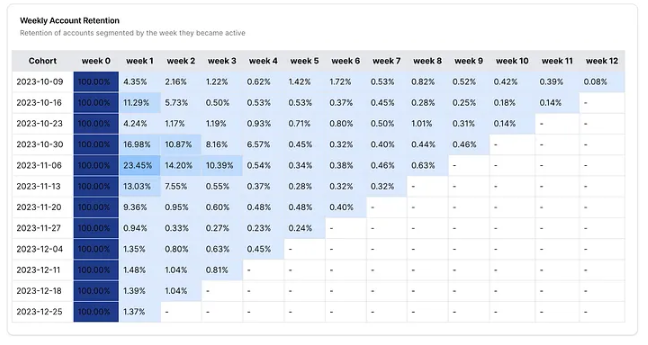
A major drawback of the ERC-4337 ecosystem overall so far has been extremely low user retention rates, as shown in the chart below (from BundleBear). Since the vast majority of ERC-4337 accounts are modular, the same applies to the modular account abstraction ecosystem. As mentioned above, one likely reason is the widespread use of token incentives to drive early adoption of associated products.
5. Predictions for 2024
We believe the two keywords for 2024 will be adoption and interoperability.
1) Adoption
In 2023, most smart account adoption occurred via embedded wallets—or what some suggest calling embedded signers. The vast majority of smart accounts controlled by these signers are modular, and we expect this trend to continue in 2024. The rise of new embedded signer SDKs and improvements to existing ones will drive continued competition among developers to offer new functionalities to their users. We believe smart account modules will play a crucial role in differentiating various players in this space.
Adoption of existing modules—such as passkey validators or various recovery and session key types—will continue to grow. Developers will also experiment with more unique modules like DeFi automation executors, helping them deliver distinctive product experiences that compete with or surpass traditional centralized finance offerings. Modules can play a key role in bringing any given user’s bots on-chain and drastically lowering the knowledge barrier to DeFi adoption.
We also anticipate increased adoption of modules in security and privacy. Spending limits and configurable multisig setups (e.g., requiring an additional signer when interacting with a new contract) provide simple security enhancements, while more advanced vulnerability detection modules could integrate with offline services. Privacy-focused modules will emerge, giving users means to obscure their identities and enhance privacy—whether ensuring account recovery processes do not expose user data or enabling novel mechanisms for private peer-to-peer interactions.
2) Interoperability
In 2023, many different participants forged their own paths in modular account abstraction, resulting in fragmentation. While we expect innovation to continue, we believe interoperability will play a much larger role in 2024—making it easier for applications and users to adopt modules and enabling developers to distribute their modules to any user regardless of their account implementation.
We see interoperability evolving across three levels:
1) At the account contract level
2) At the account creation level, and
3) At the module level.
ERC-7579 is the leading candidate for the first level. ZeroDev, Biconomy, and OKX—which together currently account for over 80% of all 4337-compatible smart accounts—plan to adopt it in Q1, with more account builders expected to follow. The second level aims to simplify creating and reusing embedded signers across multiple applications powered by the same SDK, and potentially even across different SDKs.
In 2023, we already saw an example of a standard targeting this goal: ERC-7555. During DevConnect’s WalletUnconf, multiple discussions were dedicated to solving this very challenge.
Finally, we believe 2024 will be a pivotal year for module-level interoperability—both at the higher level proposed by standards like ERC-7579, and at more module-specific layers, such as standardizing how session keys work.
Join TechFlow official community to stay tuned
Telegram:https://t.me/TechFlowDaily
X (Twitter):https://x.com/TechFlowPost
X (Twitter) EN:https://x.com/BlockFlow_News
 @rhinestonewtf







