








The Next Battleground for Strategic Competition: The Market for Generating ZK Proofs
TechFlow Selected TechFlow Selected
The Next Battleground for Strategic Competition: The Market for Generating ZK Proofs
Brilliant engineers are applying ZK to: scalability, privacy, and data credibility.
 Navigating Web3 tides with focused insights
Author: Yiping, IOSG Ventures
TL,DR;
-
ZK technology is primarily applied to enhance scalability, privacy, and credibility across various projects such as Starkware, zkSync, Scroll, Mina, Risc0, Giza, and EZKL.
-
ZK technology demands substantial computational power, resulting in 10^4 to 10^6 computation overhead, posing significant challenges for infrastructure teams.
-
The two main approaches to generating ZK proofs are Proof Markets and Proof Networks. Proof Markets operate as open markets for trading ZK proofs, while Proof Networks use internal servers to offer a cloud-like service for proof generation.
-
The Proof Market approach enables flexibility and cost efficiency by facilitating an open market for ZK proof transactions without requiring high-end server management.
-
The Proof Network approach provides a seamless and developer-friendly experience, offering a reliable and fast solution for proof generation without reliance on market mechanisms. In theory, it can generate proofs faster since Proof Markets require time to match orders.
-
Challenges include difficulties in testing and debugging, emerging security issues, potential vendor lock-in, higher costs under certain usage patterns, and loss of token utility.
-
Leading players are likely to be companies with the highest internal demand for ZK proofs, as they can leverage existing infrastructure and expert teams to maximize hardware utilization.
-
Emerging applications such as ZK Coprocessors, ZK Attestation, ZKML, and ZK Bridges are driving greater demand for ZK proof generation.
-
Decentralized proof networks in the ZK space are driven by the blockchain industry's preference for security, censorship resistance, and privacy, even though the inherent security of ZK means these advantages do not strictly require decentralization. For ZK, performance remains the primary concern.
Introduction
Growing Demand for ZK
After years of research in the ZK field and significant improvements in performance, ZK is finally being applied in real-world applications. Talented engineers have applied ZK to:
-
Scalability
-
Privacy
-
Data credibility
Numerous interesting projects rely on ZK, including Starkware, zkSync, Scroll, Mina, Risc0, =nil;Foundation, EZKL, Giza, Polygon, and Manta. These projects consistently generate ZK proofs every day. Currently, the most popular use case for ZK is zkRU to address Ethereum’s scalability issues. Over the past month, millions of dollars have been spent on ZK verification on Ethereum and its L2s.
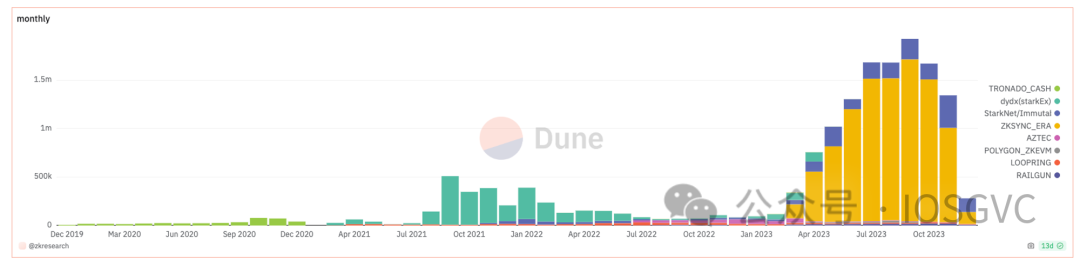
This chart, created by the Near team, shows zkSN(T)ARK gas consumption on Ethereum and L2s. It includes popular ZK projects such as zkSync, Polygon, Aztec, Tornado Cash, Loopring, Worldcoin, Tailgun, Sismo, StarkNet, ImmutableX, and dydx.
Compared to zkStark, zkSnark accounts for 80% of total verification costs. Among all these projects, Worldcoin has the highest verification cost, followed by zkSync. Each Worldcoin verification costs about $2, while each zkSync verification costs around $30.
The Burden of Proof Infrastructure
ZK can solve scalability problems but at a cost—it requires massive computational power. ZK introduces significant computation overhead, which Rollup teams must manage. @_weidai estimates that current ZK technology incurs a computation overhead of 10^4 to 10^6. Theoretically, we could achieve 10x overhead with dedicated circuits. With the abstraction layer of a virtual machine, overhead increases to 100x.
The following graph, based on Koomey's Law, illustrates growing computational capacity over time. Chip efficiency improves tenfold every decade after 2000. If we take 2000 as the baseline, computing power will reach 784x by 2025. This also indicates that current ZK computations are still not on par with 2000-level capabilities.
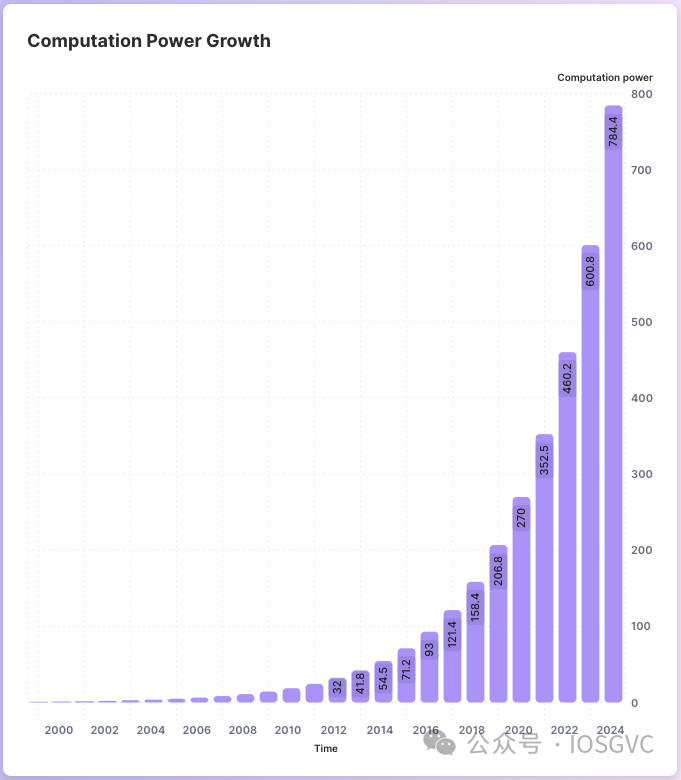
Think carefully. We're trying to scale transaction volume by 10 to 100 times using ZKRU. As transaction volume grows, we face 10^4 to 10^6 computation overhead. These figures place immense pressure on ZKRU infrastructure teams. Leading ZKRU teams are already using high-end machines with at least 200GB of memory and skilled operators to manage this complexity.
What does this mean for a small team wanting to launch a ZKRU or build a Layer 3 solution using ZK tech stack? How can an independent developer building a ZK dApp purchase and properly operate such high-end servers?
Nowadays, launching a ZKRU isn’t difficult—you can use the ZK Stack and follow deployment documentation. The hardest part is getting high-end infrastructure up and running. Managing a cluster of servers is far more complex than maintaining a personal laptop.
Moreover, hardware acceleration isn't plug-and-play—different teams need to configure their servers differently depending on the zero-knowledge proof system they use.
Ensuring high availability is another tricky issue. What if your ZKRU suddenly faces a 1000x throughput surge due to users minting Ordinals? Even experienced teams like Arbitrum have gone down for hours due to spikes in Ordinals transactions.
Generating large volumes of zero-knowledge proofs requires support from high-end servers. For small and medium-sized teams, setting up and maintaining a series of high-end servers would be a heavy burden. To better help teams quickly adopt zero-knowledge technology, emerging projects are attempting to handle all computational infrastructure complexities for them.
Proof Markets
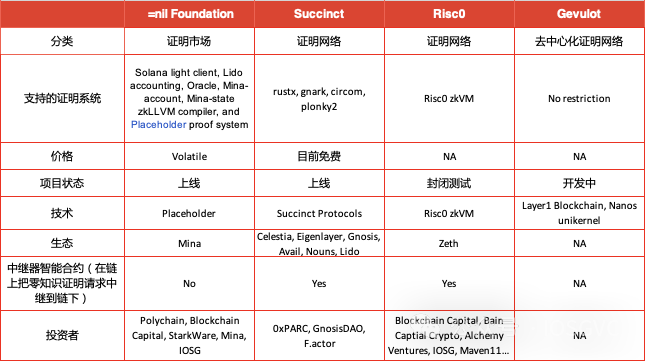
Source: IOSG Ventures
Proof Markets and Proof Networks are two primary approaches. A Proof Market functions like an open marketplace—users seeking to generate a proof must find counterparties willing to sell proofs at a given price. A Proof Network works like traditional cloud services: developers submit their circuits and inputs, and a centralized load balancer assigns internal servers within the network to generate the proof.
Proof Markets are a popular method in ZK proof infrastructure. They function as open markets where buyers and sellers trade ZK proofs. Teams building Proof Markets don’t need to manage ZK proof hardware or own high-end servers—they focus instead on proof trading and validation mechanisms to onboard third-party hardware providers.
Proof Markets represent a more open approach. They welcome third-party hardware suppliers. As long as there are sellers of proofs, buyers can purchase ZK proofs at dollar-denominated prices. During proof verification, consensus among all market participants isn’t required—only the market operator bears responsibility for validation. In a Proof Market, zkDapp developers submit a proof order specifying price, generation time, timeout, and public inputs. Third-party hardware providers then accept the order and generate the proof.
The economic structure of Proof Markets is simple. Proof generators must stake collateral. If they produce an incorrect proof or fail to deliver before the deadline, they are penalized. Generators with larger stakes can simultaneously produce multiple proofs.
Key players in the Proof Market space include =nil and Marlin.
=nil Foundation
Proof Markets consist of sellers and buyers. Buyers are dApp developers who pay sellers to generate proofs. Several factors influence proof pricing, primarily circuit size, proof system, generation time, and input size.
Below is the workflow of the =nil Proof Market:
-
The proof requester sends a request to the market with a desired price c_r.
-
The proof market locks c_r tokens in the buyer’s account.
-
Proof producers send proposals to the market at a price c_p <= c_r.
-
The proof market matches the request with a producer’s proposal.
-
The proof producer generates the proof and sends it to the market.
-
The proof market verifies the proof and pays c_r - fee tokens to the producer.
-
The proof requester retrieves their proof and uses it.
The market design offers a trading-like experience. Proof generation prices fluctuate in real time.
Below is a product screenshot of the =nil Proof Market.
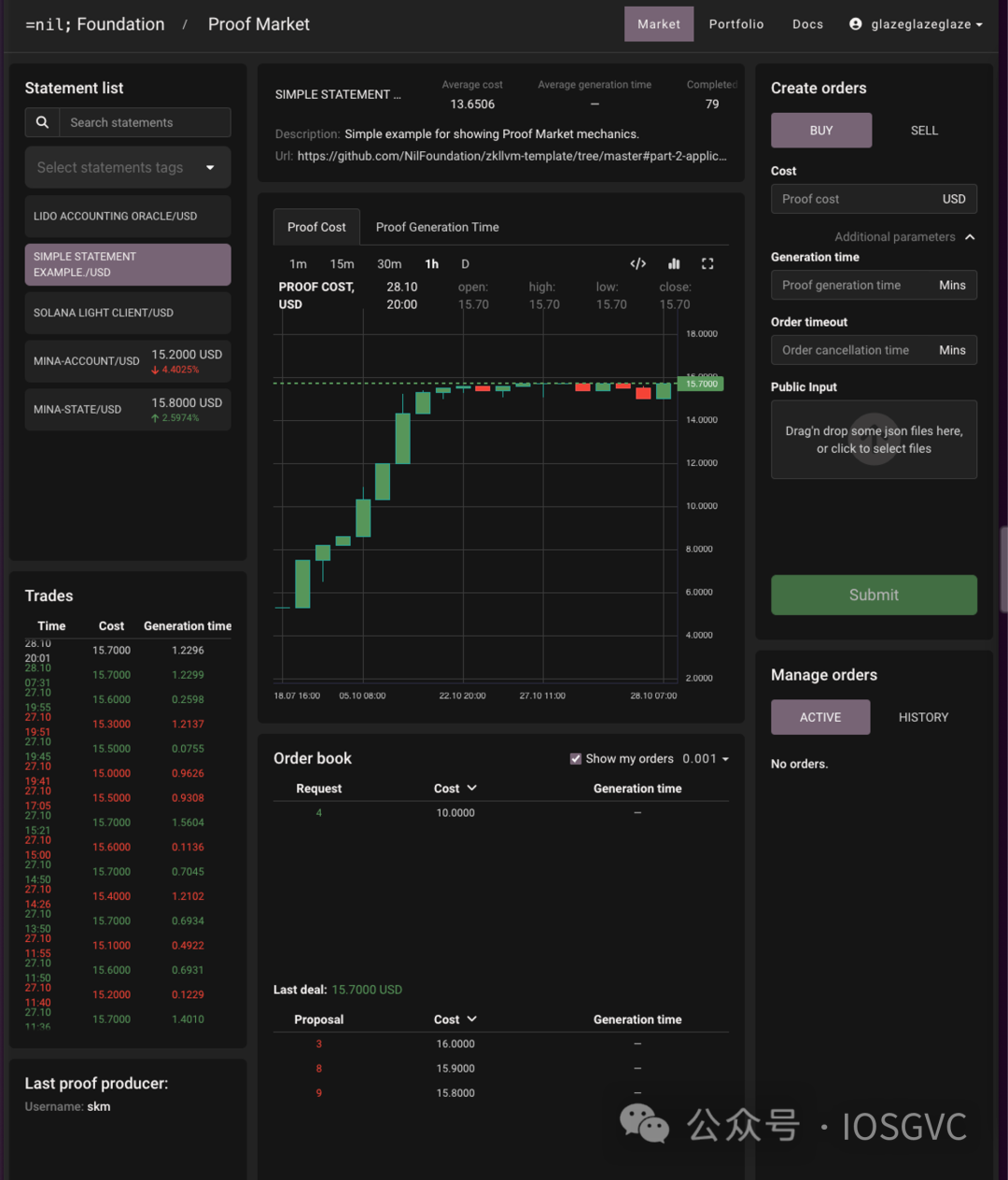
Currently, the Proof Market supports a limited number of claims, with Mina claim proofs being the most active. Specifically, the Proof Market accepts circuits based on its zkLLVM compiler and Placeholder proof system.
Gevulot
Gevulot aims to bring decentralization to the Proof Market. Gevulot is an open, programmable Layer 1 blockchain specifically designed for proof markets. The Layer 1 blockchain handles distribution, validation, and reward allocation for proof requests. The prover network leverages lightweight unikernels for high performance. Gevulot uses verifiable random functions (VRF) to assign proof work to small groups of provers, ensuring system reliability.
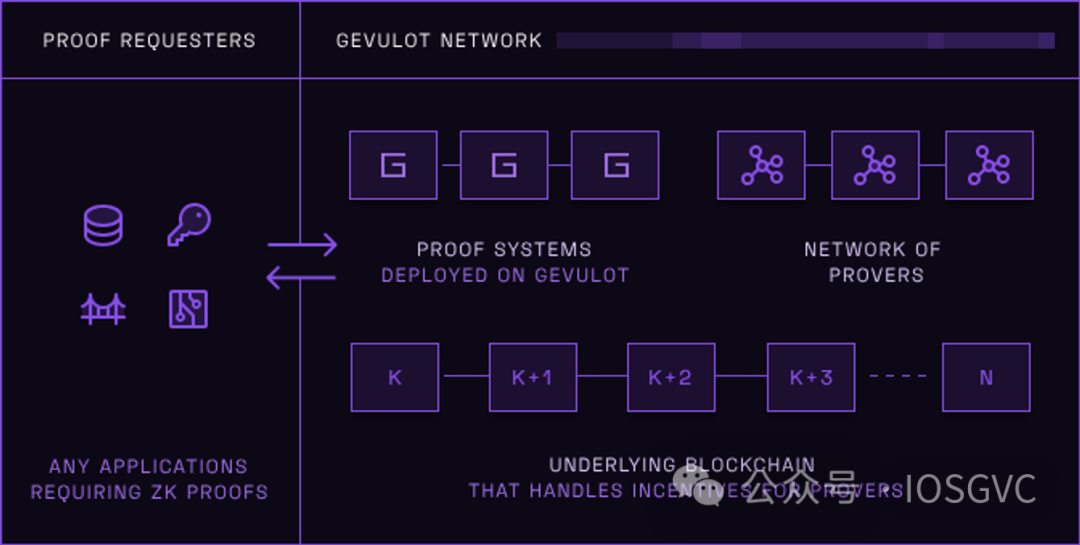
Users can seamlessly deploy programs with predictable fees, setting maximum costs based on the number of cycles required for program execution.
Provers are rewarded through the Gevulot network and user fees, incentivizing efficient and competitive proof generation. The fastest provers receive the largest network rewards. User fees are shared equally among all nodes completing the proof.
Gevulot supports deploying programs in multiple programming languages—including C, C++, Go, Java, Node.js, Python, Rust, Ruby, PHP—because its underlying VM, Nanos, supports x86_64 Linux ELF binaries.
Gevulot is a general-purpose computing platform supporting different languages and proof systems. Leveraging Nanos unikernel ensures provers can easily run across different machines. All provers must compile into a single unikernel image.
Proof Networks
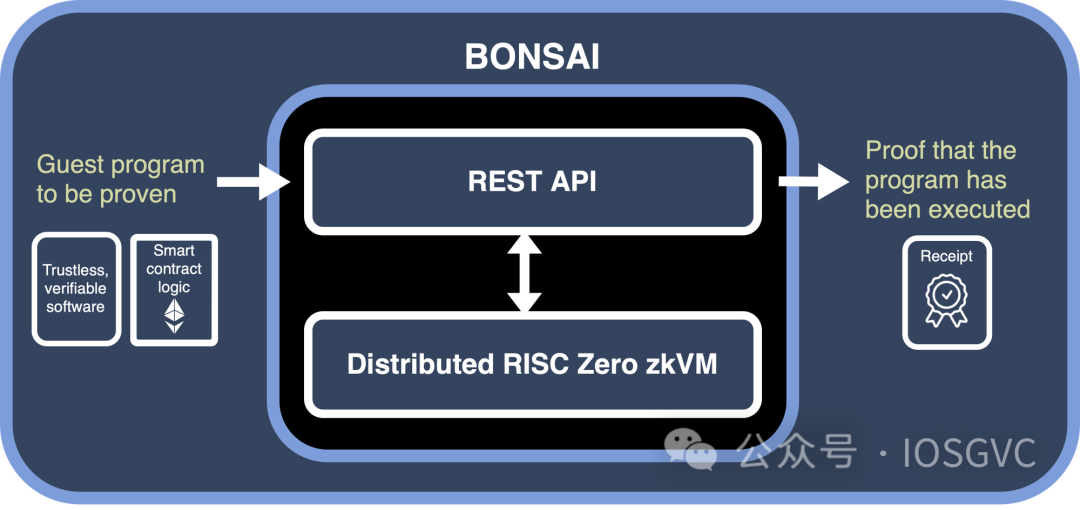
Proof Networks provide a more developer-friendly approach. They operate similarly to Web2 cloud service providers. Developers send payload data via REST API, and the Proof Network returns the proof. Developers don’t need to worry about price fluctuations or which party will generate the proof.
Risc0
Risc Zero has launched Bonsai using their zkVM. Leveraging the power of zkVM, users can have Bonsai generate various proofs. For example, Zeth uses Bonsai and the Risc0 VM to generate proofs for Ethereum blocks.
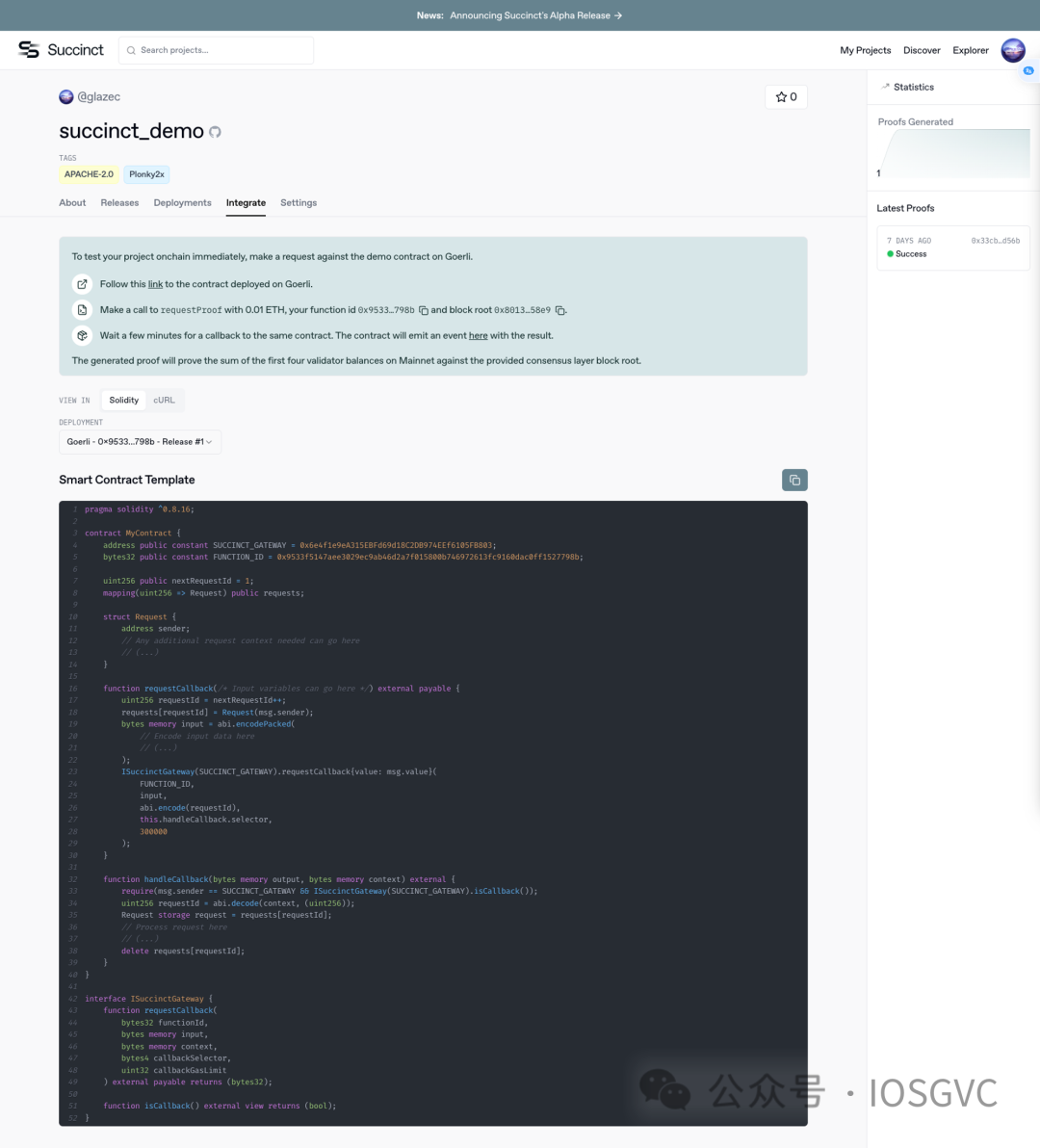
Succinct
Recently, Succinct launched a new product. Instead of offering REST API circuits, Succinct provides a model more akin to cloud functions.
Here is the user workflow:
-
Connect GitHub account and deploy circuit
-
Call API via REST or smart contract with circuit inputs
-
Query results via REST API or smart contract
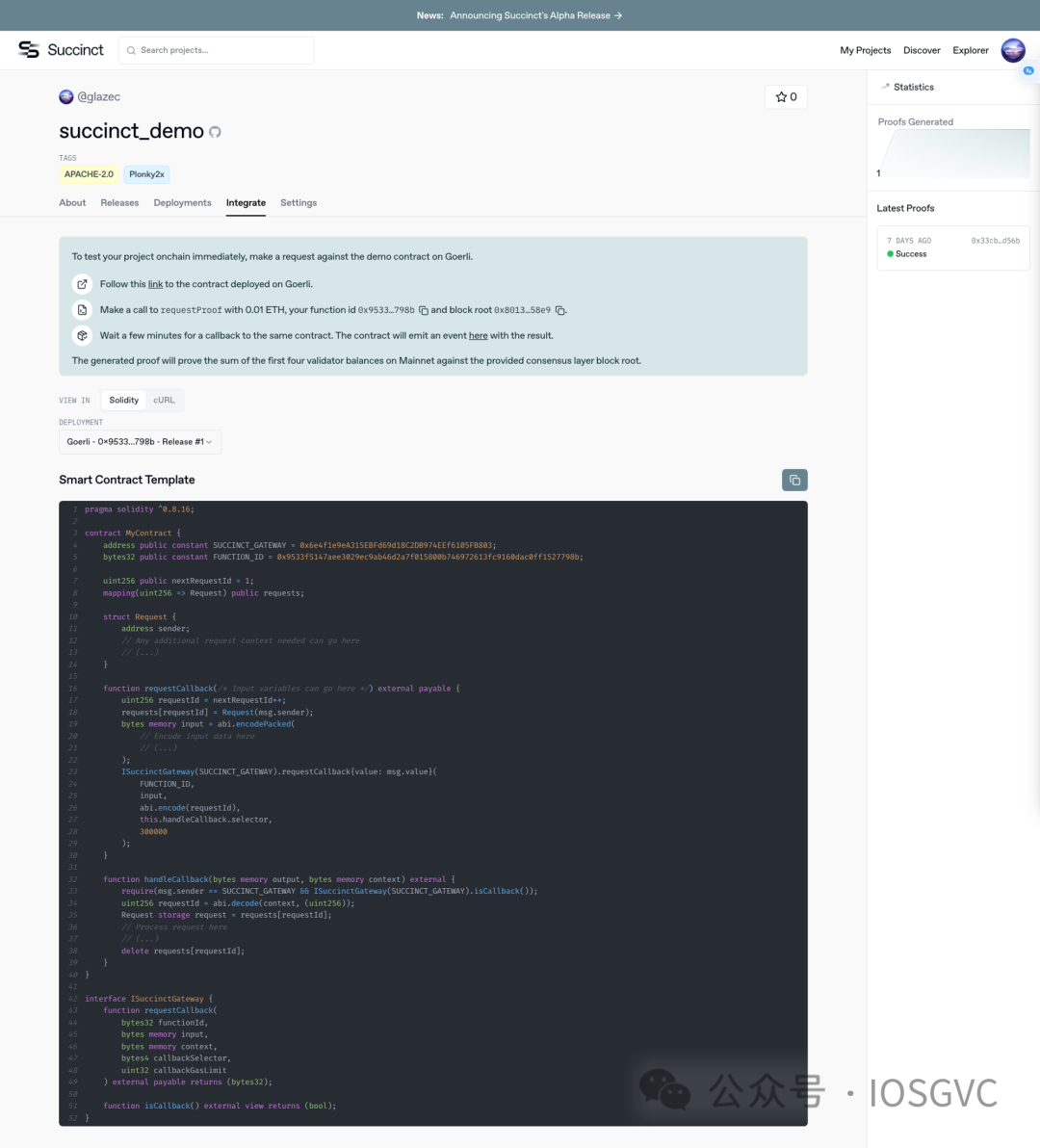
Compared to BONSAI, Succinct offers the following advantages in developer experience:
-
Easier management of circuit codebase
-
No need to resubmit circuits
-
One-click deployment of smart contracts for on-chain proof generation and verification
-
Explore popular ZK proofs
-
Dashboard to monitor proof generation status
-
Supports rustc, gnark, circom, plonky2
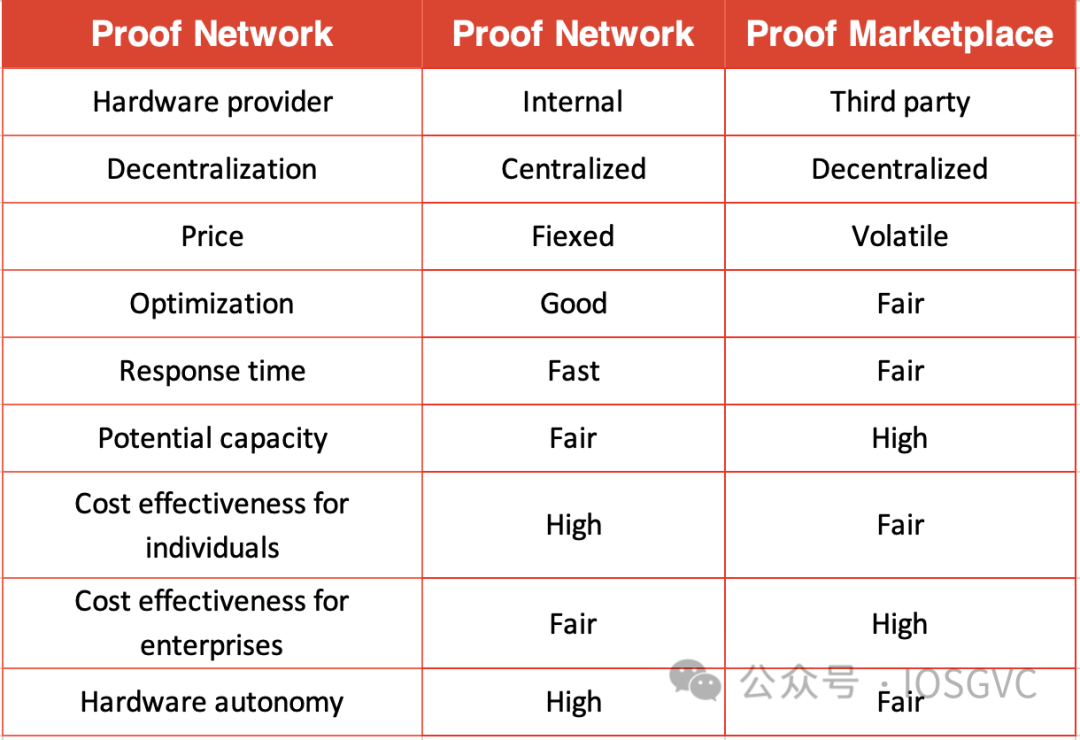
Proof Network vs. Proof Market
Proof Markets offer greater pricing flexibility for both buyers and sellers of proofs. By inviting all hardware providers to participate, they help reduce costs for buyers. However, the savings may vary between individuals and enterprises. Typically, centralized services like Proof Networks might offer free access to individuals while charging enterprises premium fees with VIP customer support. For instance, enterprises planning new events or features can reserve compute capacity in advance on a Proof Network. A decentralized market may present more balanced and competitive pricing.
In today’s market, products based on Proof Networks seem to offer developers a smoother experience. They handle all proof generation tasks and support major proof systems without introducing new complexities. They provide consistent user experience. Theoretically, Proof Networks enable faster proof generation since Proof Markets require time to match orders. If you're familiar with cloud computing, Proof Networks resemble stateless cloud functions.
We have =nil Foundation and Gevulot working on Proof Markets. Succinct and Risc0 are focused on Proof Networks. Hardware companies like Ulvetanna and Cystic are also making significant contributions by improving ZK proof performance on GPUs and developing next-generation specialized ZK chips.
Proof Markets are relatively easy to launch. For ZK infrastructure projects, the Proof Market design allows easier onboarding of hardware providers. With its decentralized architecture, it can scale efficiently to meet future computational demands.
In the future, we expect to see hybrid designs combining Proof Networks and Proof Markets. The goal is to provide developers with a seamless experience while integrating Proof Markets as a backend to enable additional compute resources. This is the direction Succinct plans to pursue soon. We’re seeing similar shifts in other markets too, like Infura. Infura owns its servers but also plans to route permissioned parties to provide infrastructure.
Source: IOSG Ventures
Who Truly Needs Cloud-Based ZK Infrastructure?
We believe developers aiming to shorten time-to-market and build lightweight, flexible applications capable of rapid scaling or updates will benefit greatly from cloud-based ZK infrastructure.
For applications with large gaps between peak and off-peak usage, cloud-based ZK infrastructure will reduce costs.
For such applications, purchasing a set of always-on servers guaranteed for peak availability would be expensive, leading to significant waste during low-usage periods. Cloud infrastructure can scale on demand to boost performance and automatically release excess compute capacity outside peak times.
Who Will Be the Leaders?
Drawing from our understanding of the Web2 cloud industry, we observe that companies with the highest computational demands often lead in cloud infrastructure businesses. They can leverage advantages in scalability, cost, teams, and innovative products.
The same applies to cloud-based ZK infrastructure. We believe projects with the highest internal demand for proof generation have the potential to become leaders in ZK cloud infrastructure.
Projects that internally generate large volumes of ZK proofs already possess extensive infrastructure, optimizers, and expert teams. By sharing proof resources across applications, they can maximize hardware utilization—when one application doesn’t need immediate proof generation, provers can be repurposed.
These large projects often have their own proof systems. Third-party proof infrastructure typically struggles to optimize across the diverse proof systems used by major projects. By offering fast and easy-to-use cloud provers, big projects can effectively expand their proof system ecosystems.
For ZKRUs, cloud-based ZK infrastructure can increase fork adoption. Launching a new Layer 2 or 3 on these ZKRUs isn’t hard, but maintaining ZK infrastructure is costly. Offering plug-and-play, flexible cloud provers can attract more developers. Currently, most developers opt for OPRU SDKs to build new Layer 2s or 3s because the corresponding infrastructure is easier to manage.
Without building their own ZK infrastructure, these large ZK projects would need to pay high fees to third-party compute providers. They’d also face development speed limitations, unable to continuously customize infrastructure for further performance gains and lower proof costs.
Who Has the Highest Demand for Zero-Knowledge Proofs?
Beyond ZKRUs and Layer 1 networks, we’ve recently seen many emerging zero-knowledge proof applications—all of which create massive demand for proof generation.
Zero-knowledge coprocessors allow smart contract developers to trustlessly access historical blockchain states. These coprocessors generate zero-knowledge proofs for those past states—a potentially safer, more trustless alternative to oracles.
Zero-knowledge attestation helps users bring off-chain data or identity information onto blockchains. After verifying the data off-chain, attestors generate a zero-knowledge proof and post it on-chain.
Zero-knowledge machine learning (ZKML) enables on-chain inference. Compute providers perform ML calculations off-chain, generate a zero-knowledge proof, and publish it on the blockchain.
Zero-knowledge bridges are more secure versions of cross-chain bridges. They generate storage proofs—or even consensus proofs—from the source chain and post them to the target chain, potentially replacing current cross-chain bridge models.
What's Special About Decentralized Proof Networks?
Within the blockchain industry, decentralization is the dominant narrative. Decentralization brings many benefits:
-
Security
-
Censorship resistance
-
Privacy
Zero-knowledge proofs differ from general computation. ZK has inherent security—anyone can quickly and easily verify a proof to ensure the prover's honesty. In the ZK domain, decentralization is not a prerequisite for security.
Zero-knowledge proofs focus on intricate underlying details, structured as circuits. While content inside these circuits is extremely difficult to censor, censorship can still be effectively enforced by targeting the proof requesters themselves.
For Proof Networks, privacy could become an issue since users send private inputs to the network. The ideal solution would be local proof generation to prevent any data leakage—though this poses performance challenges locally. Alternative solutions might involve new zero-knowledge multi-party computation protocols or generating proofs within trusted execution environments. A decentralized proof network does not inherently offer more privacy.
Beyond narrative appeal, censorship resistance may be the primary reason for building decentralized proof networks. ZK technology is still in its early stages, and we haven't observed any form of censorship in this space yet. However, the main challenge hindering ZK advancement is performance. Introducing decentralized proof networks may increase computational demands for proof generation.
Conclusion
Applications of zero-knowledge proofs are rapidly expanding across diverse domains. We expect ZK to be integrated into various technology stacks. We've already seen ZK Layer 1s, ZK L2s, ZKML, ZKVMs, and ZK Email. Developers are building ZK oracles, ZK data sources, and ZK databases. We are on the path toward “ZK-everything.” The computational overhead introduced by ZK forces developers to deploy their circuits on high-end servers. Therefore, we anticipate growing demand for cloud-based ZK proof infrastructure to help developers overcome operational complexities.
Our key insights in this space include:
-
Proof Markets and Proof Networks are the two main approaches helping ZK dApp developers avoid infrastructure complexity.
-
We expect to see hybrid models combining Proof Network and Proof Market mechanisms.
-
Not all ZK dApp developers are suited for cloud-based ZK infrastructure. Medium-sized projects with stable traffic can reduce costs by self-hosting servers.
-
Leaders in cloud-based ZK infrastructure will be projects with high internal demand for ZK proof generation, such as leading ZKRUs. They have strong economic incentives to run this business.
-
Decentralization is the dominant narrative in crypto due to its associations with privacy, censorship resistance, and security. ZK proofs already embody some of these traits. Currently, the main selling point of decentralized proof markets is censorship resistance.
-
The popularity of cloud-based ZK proof infrastructure closely correlates with the current number of ZK dApps in the market. While some projects initially emphasize their cloud ZK proof infrastructure as a core feature, many eventually pivot to other narratives.
Join TechFlow official community to stay tuned
Telegram:https://t.me/TechFlowDaily
X (Twitter):https://x.com/TechFlowPost
X (Twitter) EN:https://x.com/BlockFlow_News
 IOSG Ventures







