Inscription Boom: Can the Orthodox Runes Continue the Token Protocol Myth?
TechFlow Selected TechFlow Selected
Inscription Boom: Can the Orthodox Runes Continue the Token Protocol Myth?
Despite challenges from copycat projects like Rune Alpha, Runes has garnered widespread attention within the Bitcoin community, demonstrating its technical potential and application prospects.
 Navigating Web3 tides with focused insights
Author: Trustless Labs
1. The Battle Between Real and Fake Runes
1.1 Origins of Runes
The Runes protocol was introduced by Casey Rodarmor, the creator of the Ordinals protocol, in his blog.
Casey stated that although he is skeptical about creating fungible token protocols on the Bitcoin network, given their growing popularity, lack of signs of fading interest, and the advantages they bring—such as significant transaction fee revenue for Bitcoin, attracting developer attention, and expanding user base—he decided to take a step back and design a simpler, more efficient fungible token protocol. This protocol aims to optimize token operations within the Bitcoin ecosystem through a simplified UTXO model and efficient token transfer mechanisms.
The Runes protocol supports token issuance, allowing the creation of an arbitrary number of tokens with customizable human-readable symbols and decimal places. Its transfer mechanism is based on integer sequence tuples involving token ID, output index, and allocation amount.
1.2 The "Fresh" Design of the Runes Protocol
Characteristics of the Runes Protocol
-
During registration, users can specify divisibility (equivalent to decimals), supply, symbol (only one Unicode character allowed), and the rune name.
-
Names must consist of uppercase letters, with variable length; shorter rune names are gradually unlocked as block height increases.
-
Names are unique and non-repeating. Each rune has a unique number starting from 0 based on deployment order, and a unique ID encoded by block height and position within that block—for example, 173940/256 represents the 256th rune deployed at block height 173940.
-
The characters . or • can be used as display separators in the name; these only affect presentation and do not impact registration. For instance, once CASEY•RUNES•EVERYTHING is registered, names like CASEYRUNES•EVERYTHING or CASEYRUNESEVERYTHING cannot be registered.
-
Distribution mechanism pending: According to current code, the entire supply is sent directly to the registrant’s wallet upon registration. Changes may follow in future updates.
Advantages of Runes Over BRC-20
-
UTXO-based model: The Runes protocol adopts a system aligned with Bitcoin's native architecture. It avoids reliance on off-chain data and does not require a native token, resulting in a smoother user experience.
-
Transfer via OP_RETURN: Token transfers in Runes are executed using OP_RETURN scripts, making distribution and transfers more efficient.
-
Issuance mechanism: Runes defines issuance through specific message formats, making token flow and distribution more transparent and clear.
-
Higher efficiency: The Runes protocol addresses issues of UTXO fragmentation and inefficiency found in BRC-20. It streamlines operations—both registration and transfers require only one transaction—significantly improving overall efficiency.
-
Reduced on-chain footprint: Runes aims to minimize its on-chain presence and reduce the generation of problematic UTXOs.
-
Lightning Network compatibility: Runes is compatible with the Lightning Network, opening new use cases and possibilities for developers and users.
-
Destruction mechanism: Runes included in transactions containing invalid protocol information will be destroyed.
1.3 Rune Alpha: A Runes Clone
Due to its theoretical legitimacy and technical superiority, the Runes protocol attracted significant attention from the Bitcoin community shortly after its announcement. However, its slow development pace created opportunities for clone projects to mimic its concept for marketing and profit.
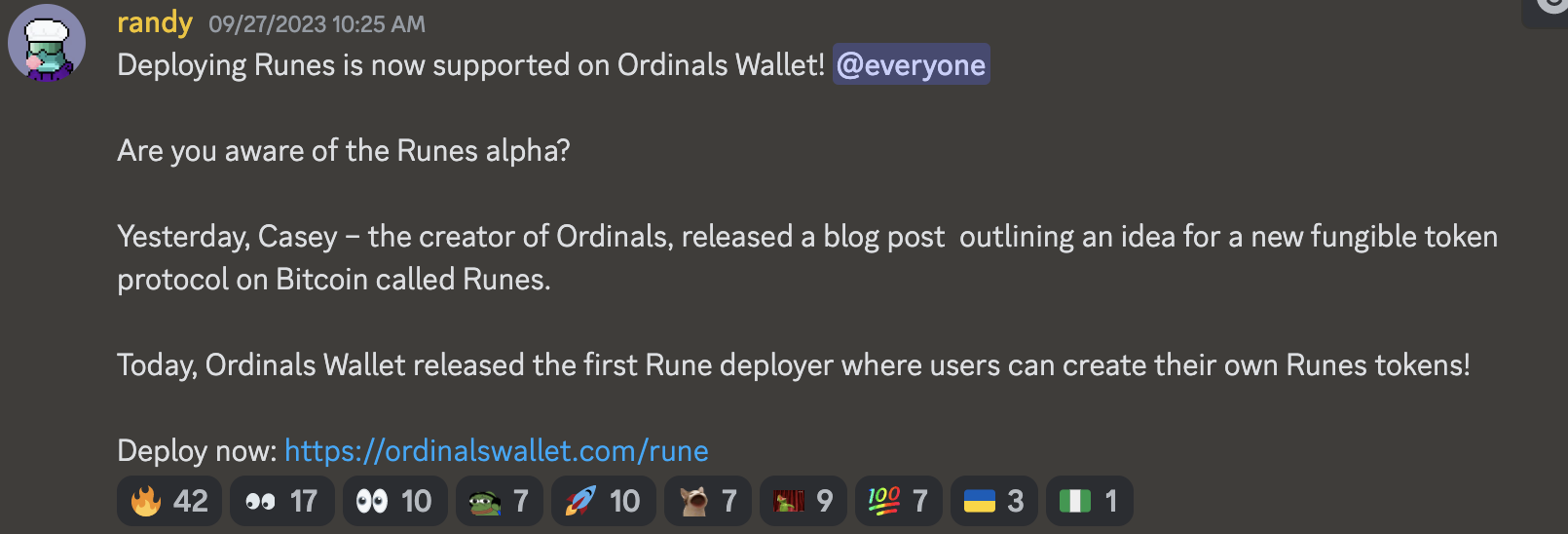
Runes Deployer by Ordinals Wallet
As early as the day after Casey announced the Runes concept, Ordinals Wallet capitalized on the hype and began deploying so-called "Runes," launching comprehensive promotion across communities, social media, and media outlets. Although Ordinals Wallet captured initial traffic around the Runes concept, momentum faded quickly, and the project eventually stalled without further progress.
Rune Alpha
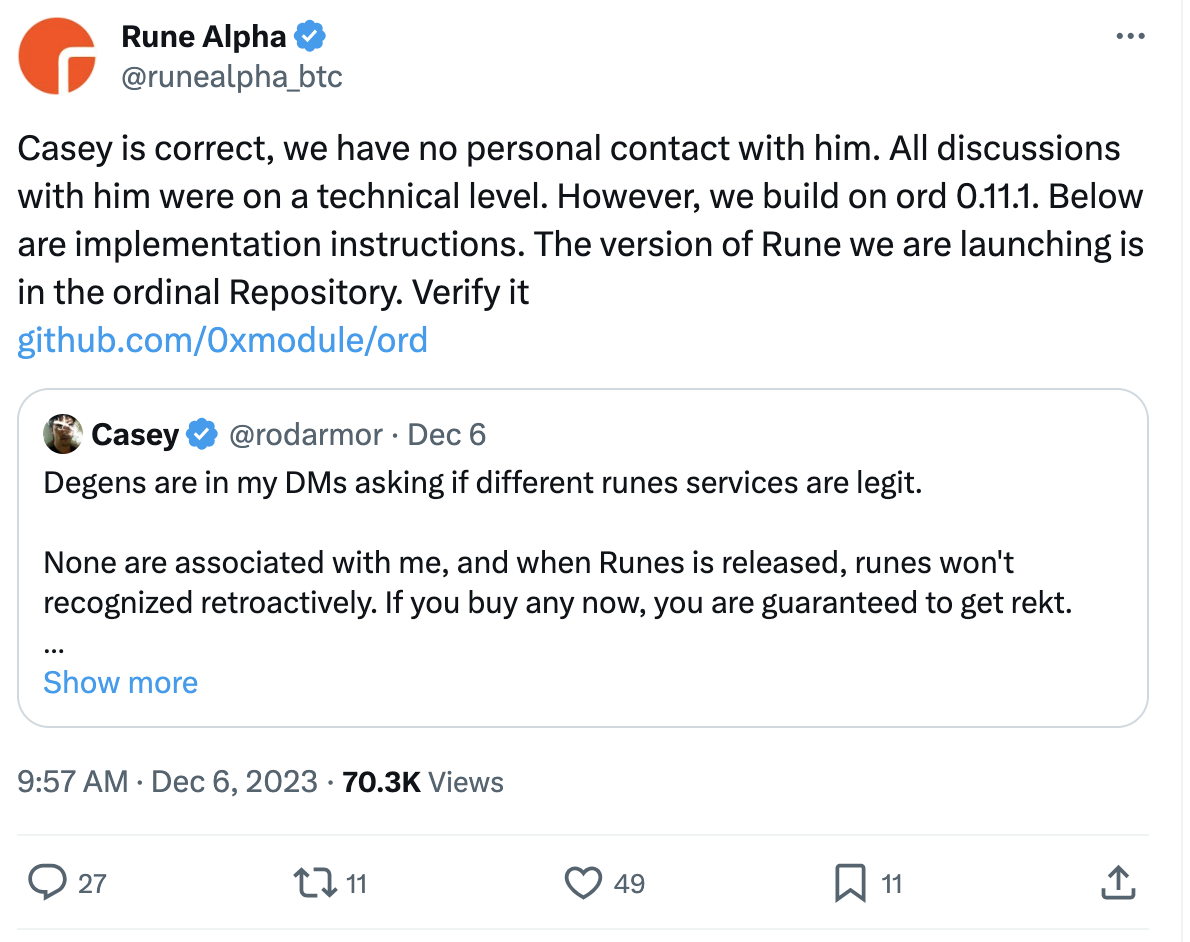
On December 5, the Bitcoin inscription project Rune Alpha officially launched, issuing its first mainnet token $COOK. According to Rune Alpha’s official statement, they had technical discussions with Casey and built Rune Alpha on top of ord version 0.11.1, with code written into the Ordinals repository.
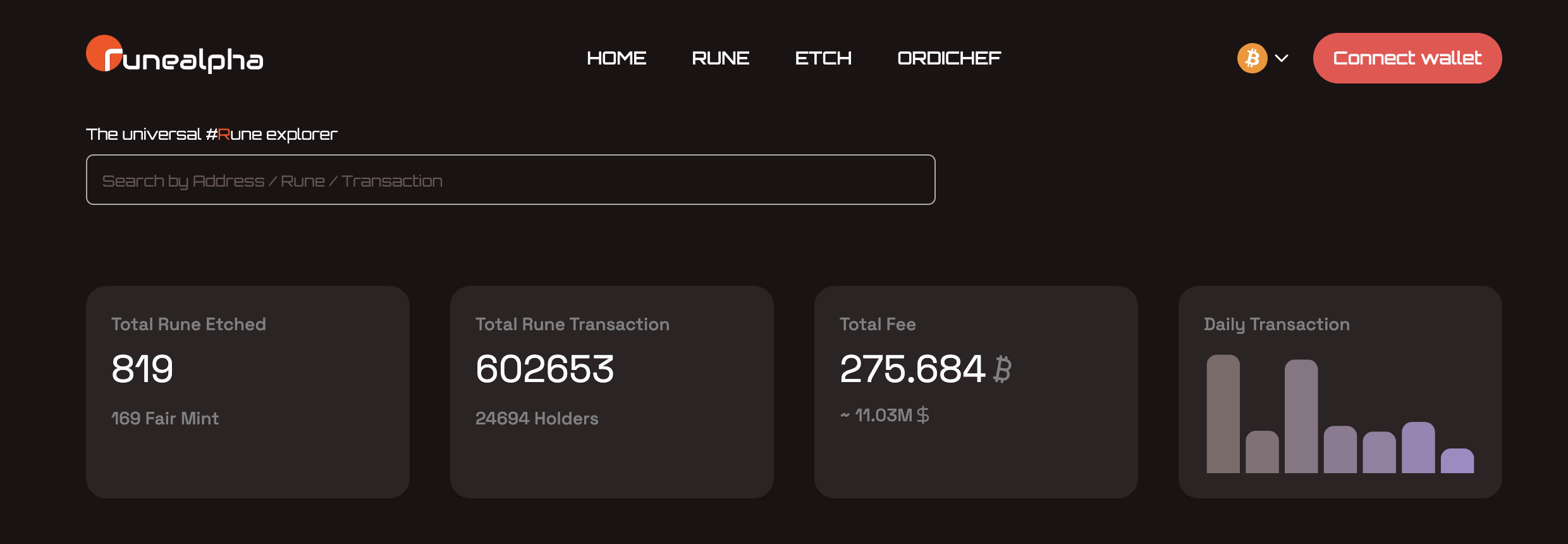
Some members of the Bitcoin community who were eagerly awaiting the official Runes protocol mistook Rune Alpha for Casey’s original Runes due to the similar naming. Driven by market FOMO, many rushed to mint tokens on Rune Alpha.
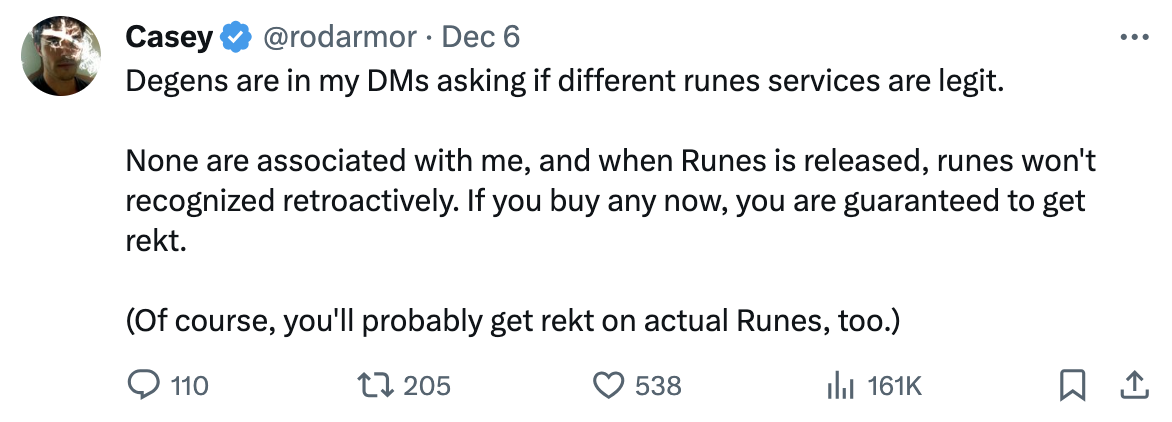
On December 6, Casey tweeted that all Runes-related protocols and services were unrelated to him personally, and when the official Runes protocol launches, he will not retroactively recognize any clones. Meanwhile, some users reported asset losses and inscriptions being burned as gas fees during interactions. Rune Alpha responded that such issues stemmed from user errors and claimed they had already issued warnings in their Discord community.
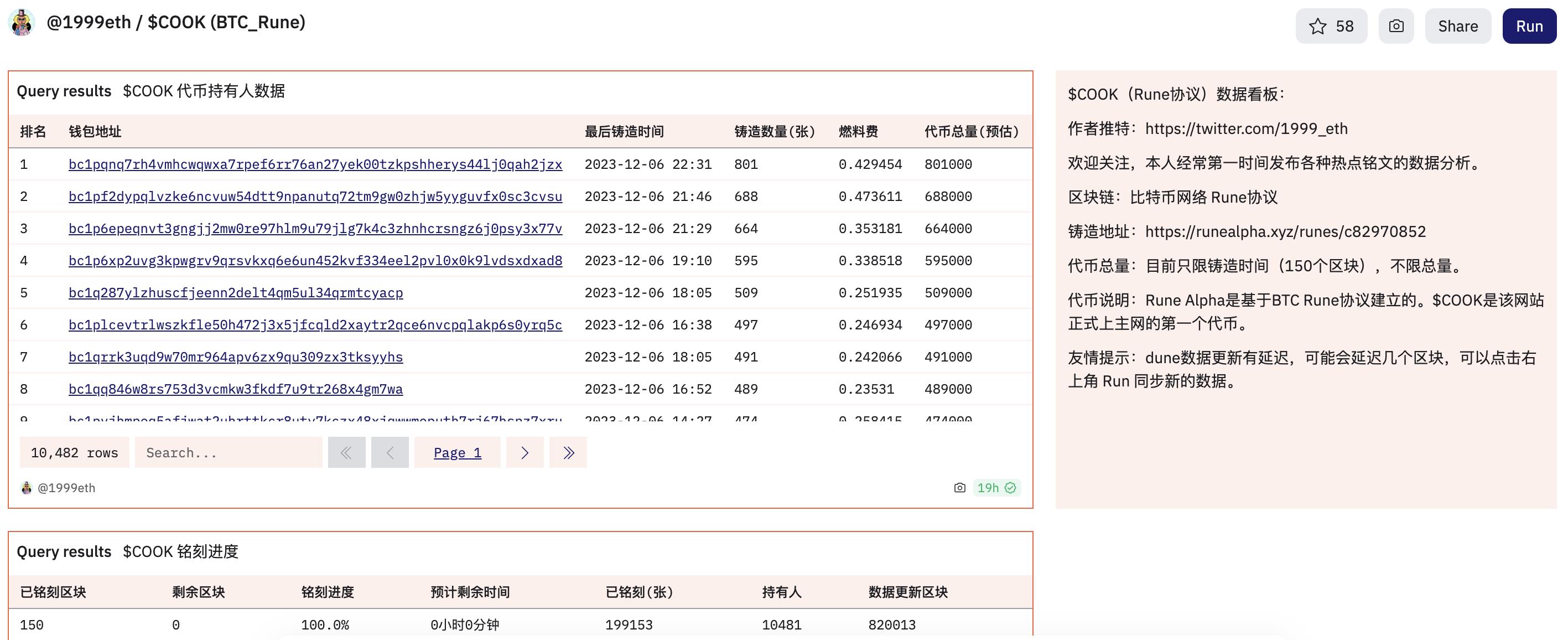
Despite losing the narrative of “authenticity,” market FOMO and speculation continued to dominate. Rune Alpha’s minting feature is described as “time-limited but unlimited quantity”: users could mint within 150 blocks from block 819863 to 820013, receiving 1,000 tokens per mint, with no cap on total supply. According to Dune analytics dashboard data, as of December 22 at 20:50, all 150 blocks have been fully inscribed, totaling 199,153 inscriptions held by 10,481 individuals.
After Casey officially launched the Runes protocol on Bitcoin’s testnet signet, Rune Alpha quickly responded by deploying tokens on signet and providing screen recordings and data analysis to argue that Rune Alpha tokens can be recognized and indexed by the official Runes protocol in ord version 0.13.1. Additionally, responding to community demand, Rune Alpha is actively building its marketplace.
However, according to current code, the official Runes protocol on mainnet will begin parsing at the block height of the Bitcoin halving, indexing only those tokens issued after the halving height and compliant with the Runes protocol standard.
2. Community Voices
Enthusiastic Adoption
1. Official Ordinals community Ordicord https://discord.com/invite/ordinals
-
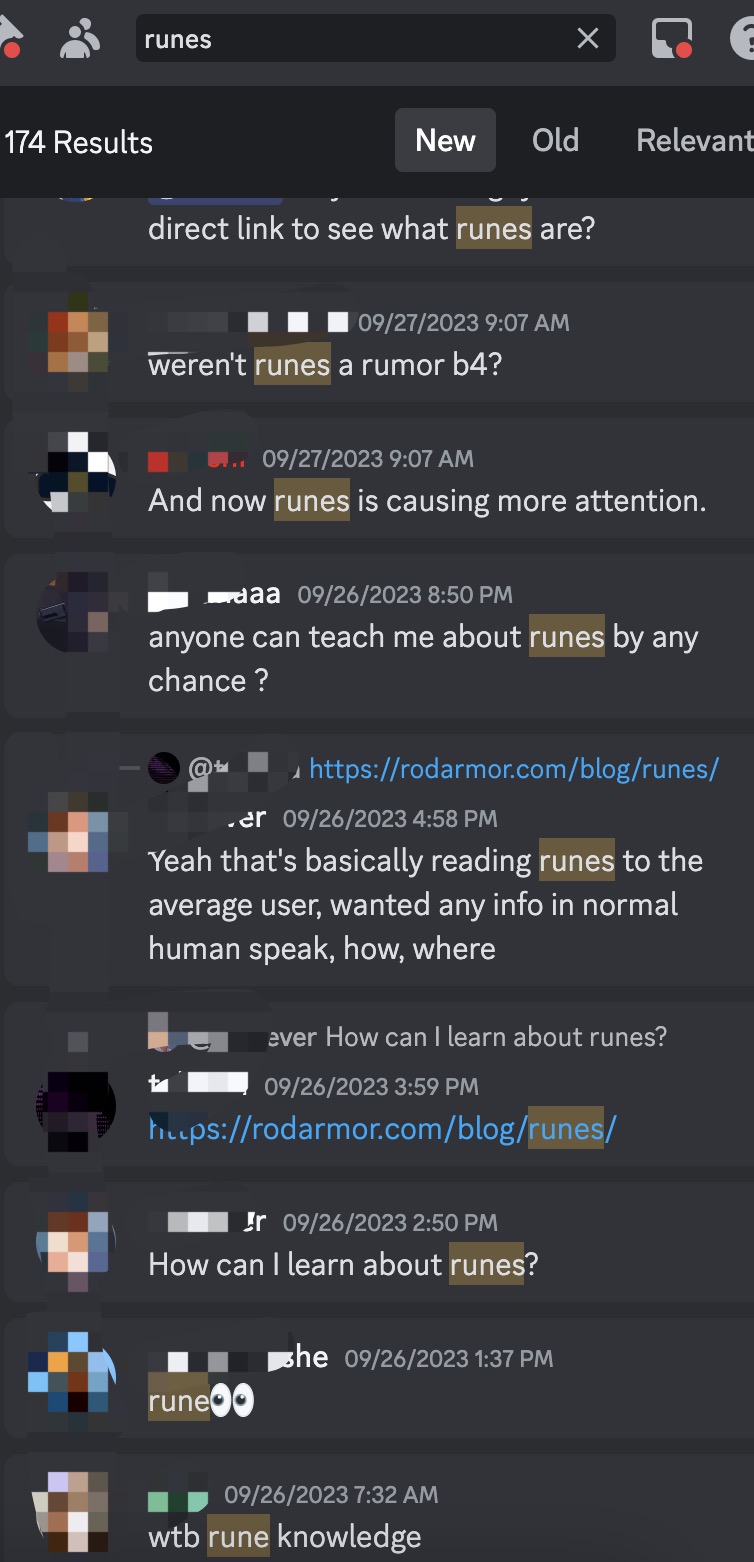
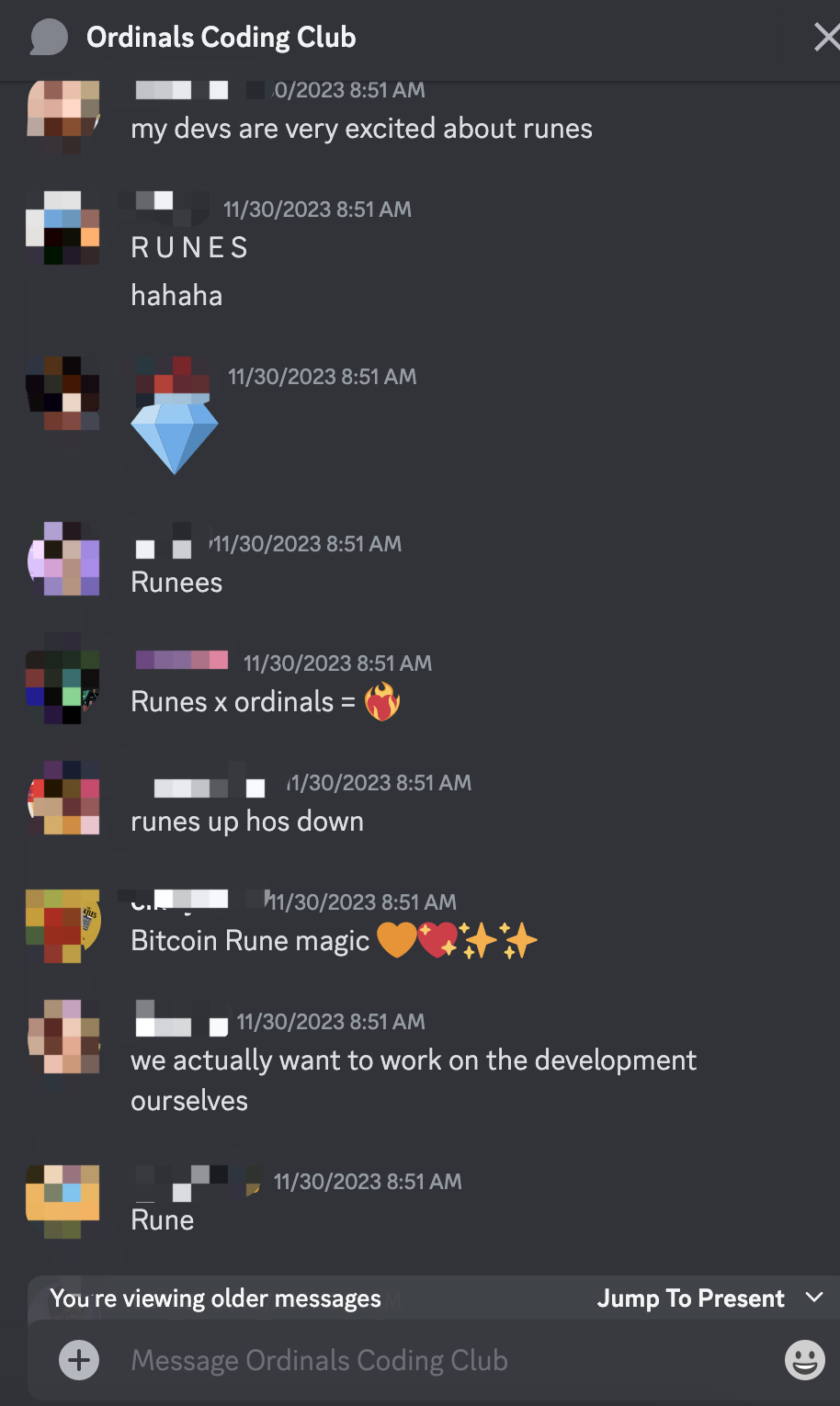
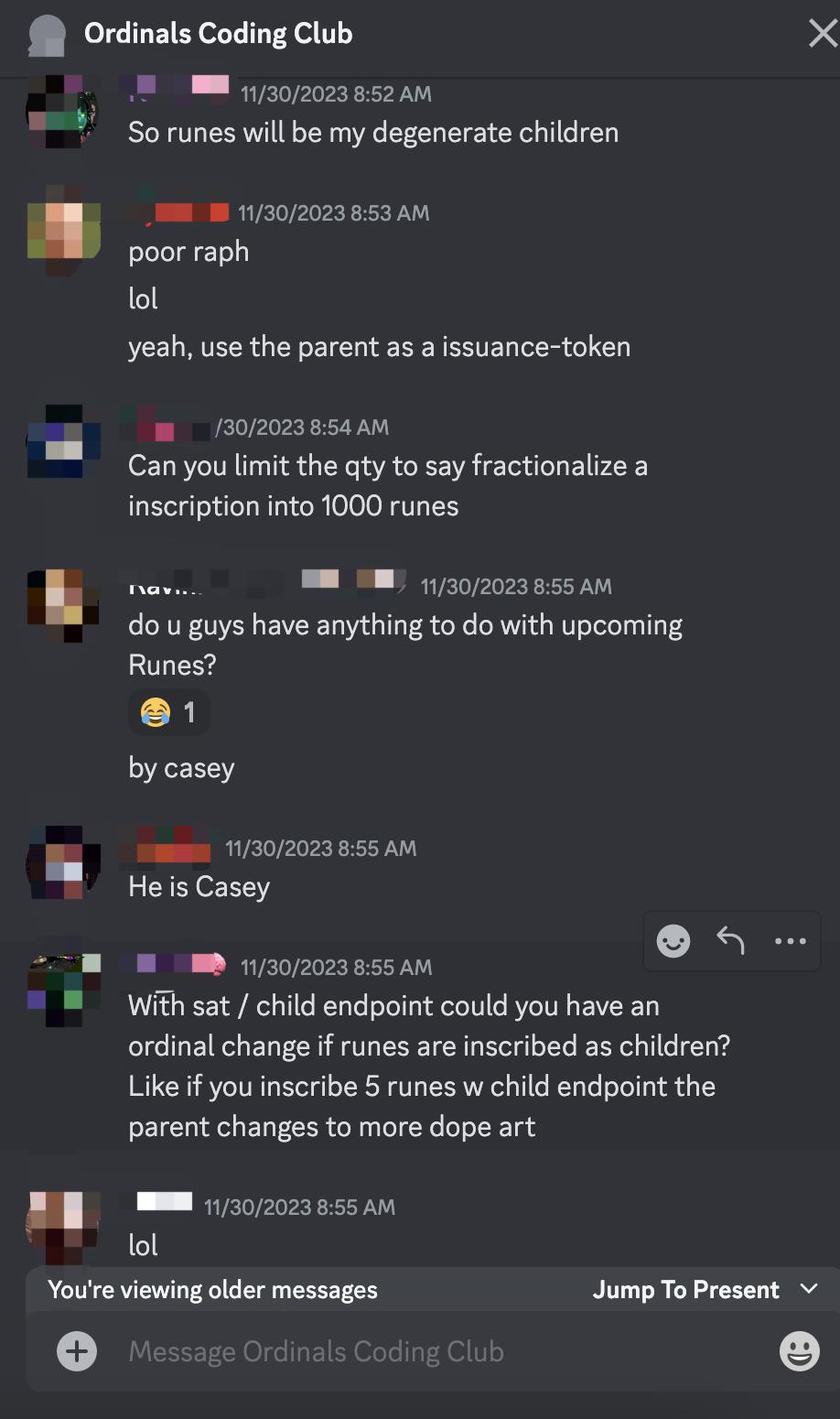
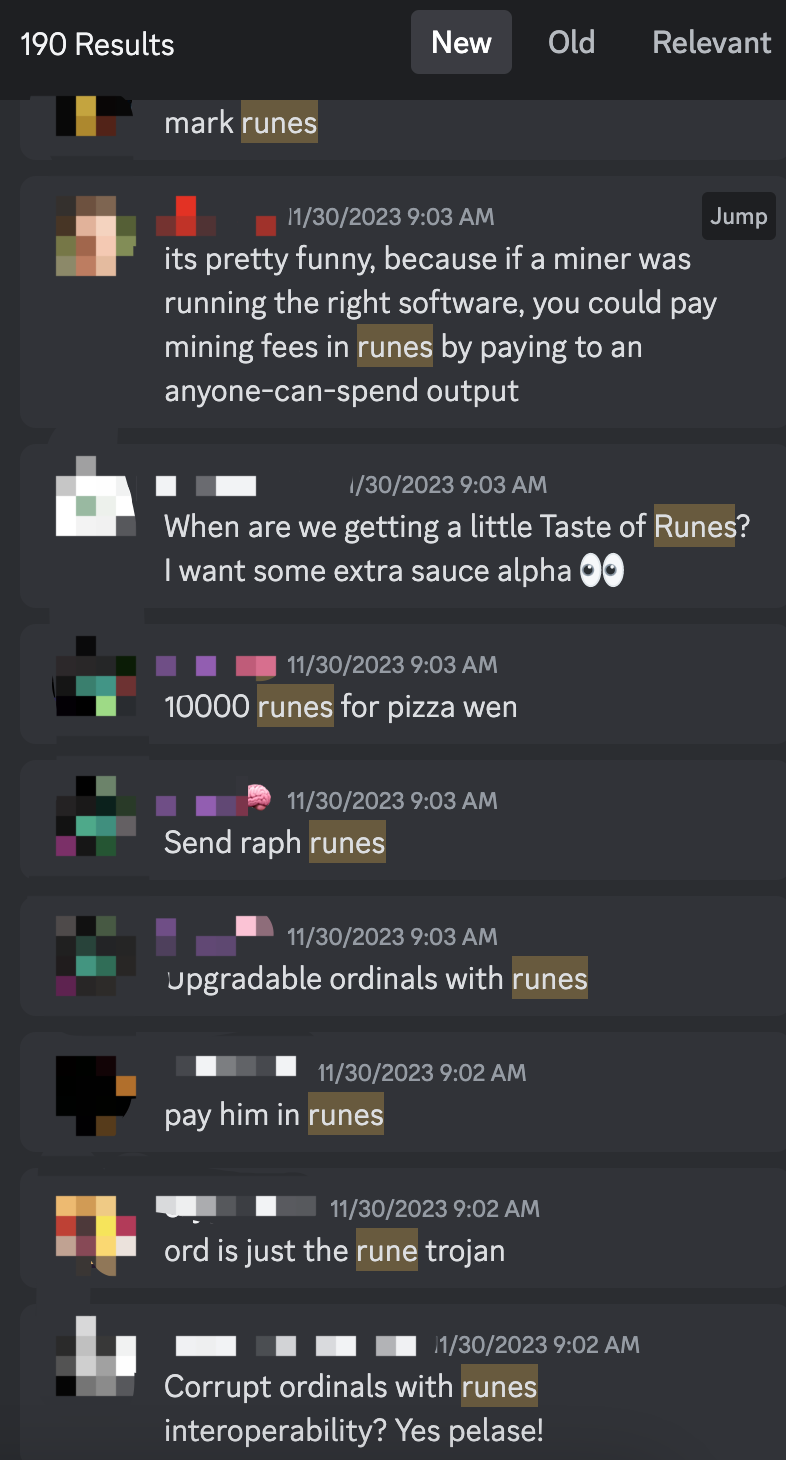
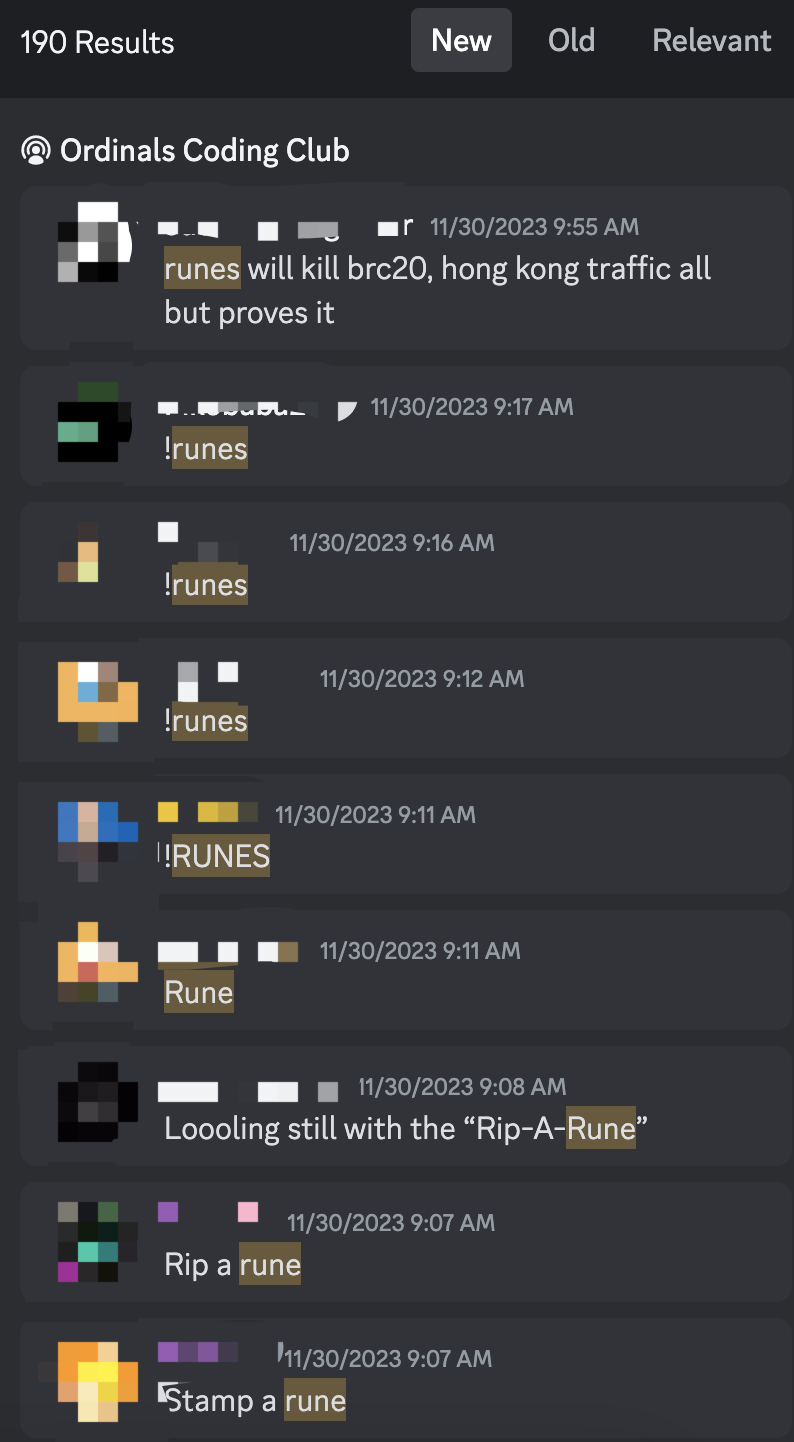
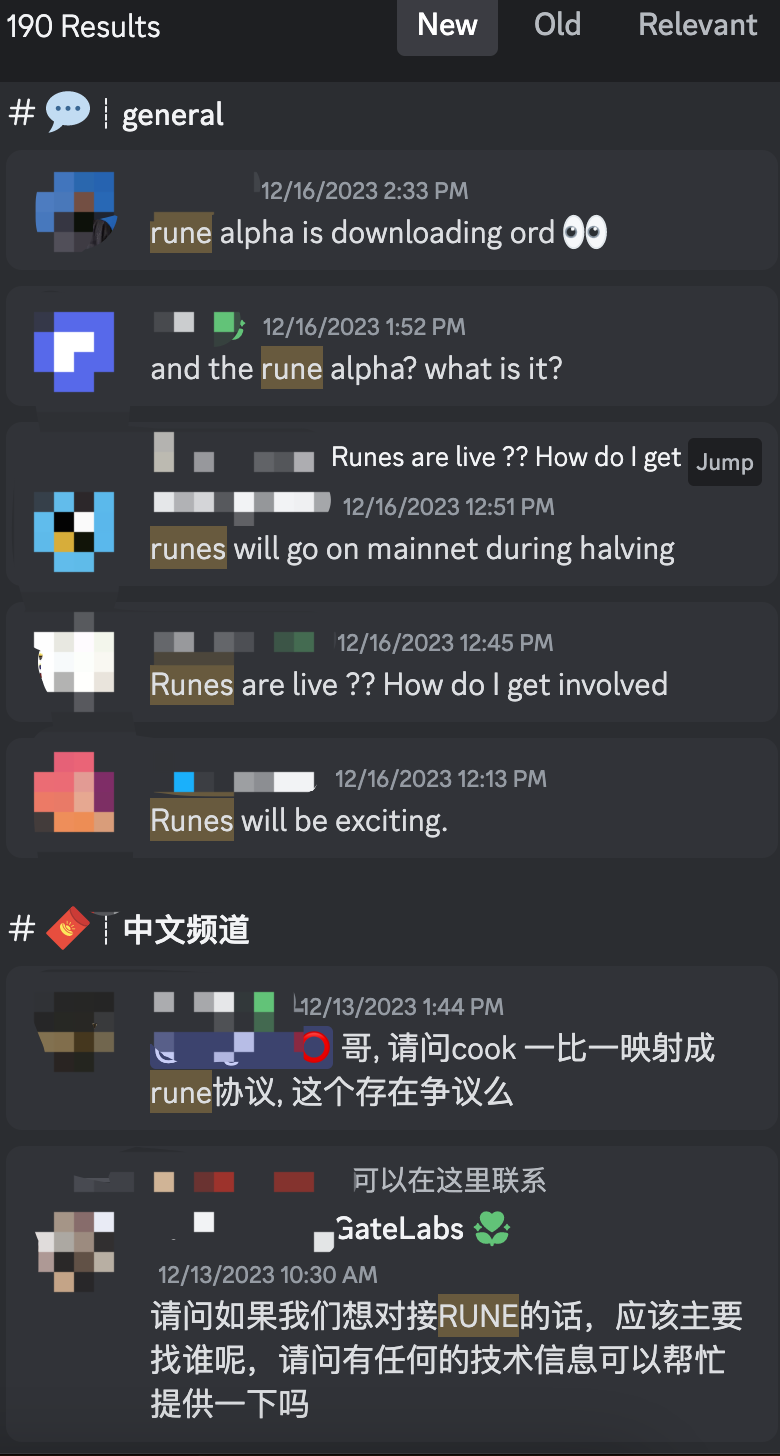
Starting in late September, discussions about Runes began increasing in the community
-
From November onward, extensive discussions emerged regarding Runes' technical implementation and clone projects. Users within the Ordinals ecosystem generally view Runes as an upgraded version built upon the Ordinals protocol, maintaining an optimistic outlook and high expectations for the official team’s technical progress.
-
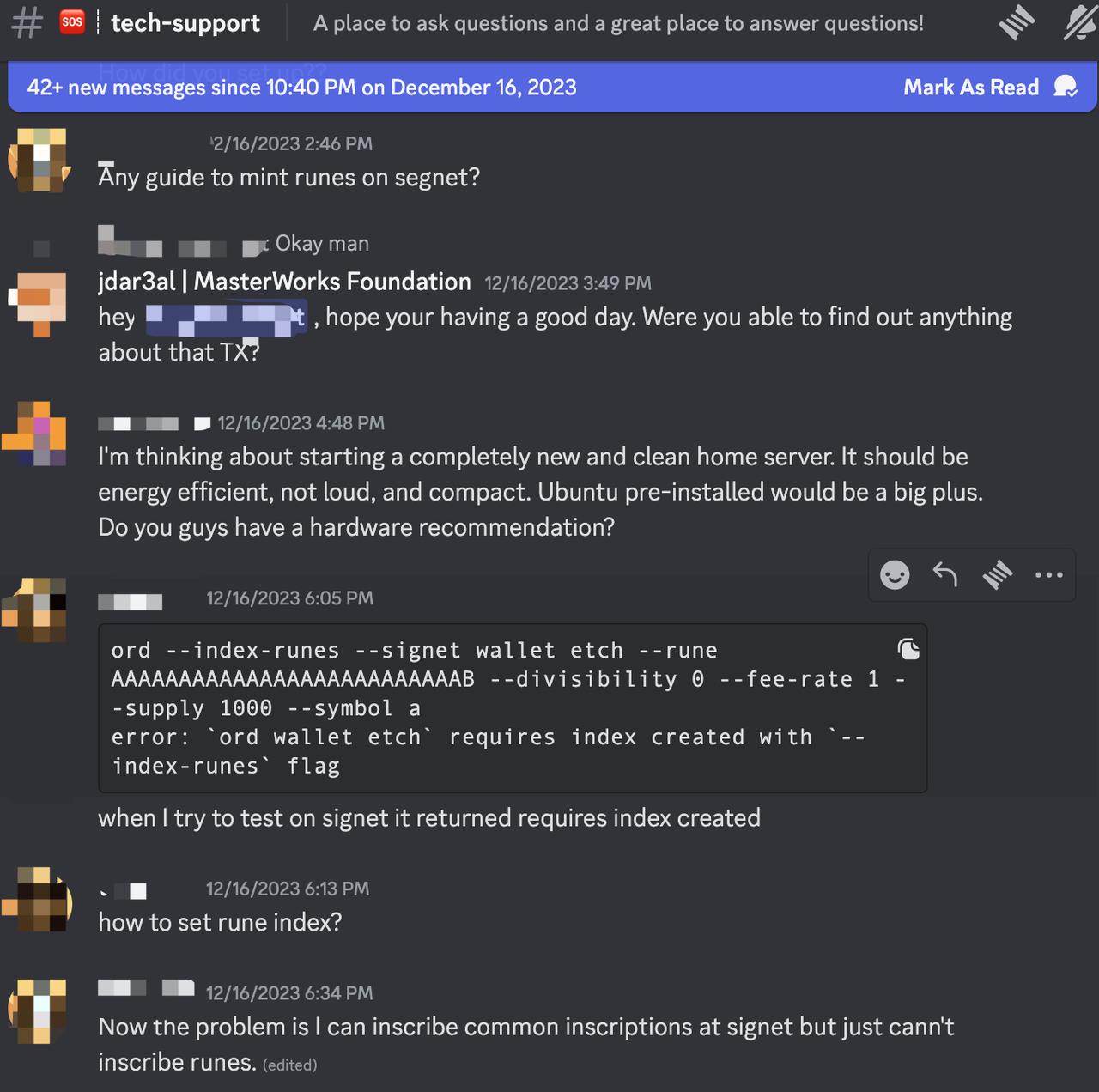
Following Runes’ roadshow at Taipei Blockchain Week on December 16, a new wave of discussion arose in the community. Users began noticing the clone project Rune Alpha and expressed doubts about whether the first token $COOK deployed under this protocol could be mapped onto the official Runes protocol.
-
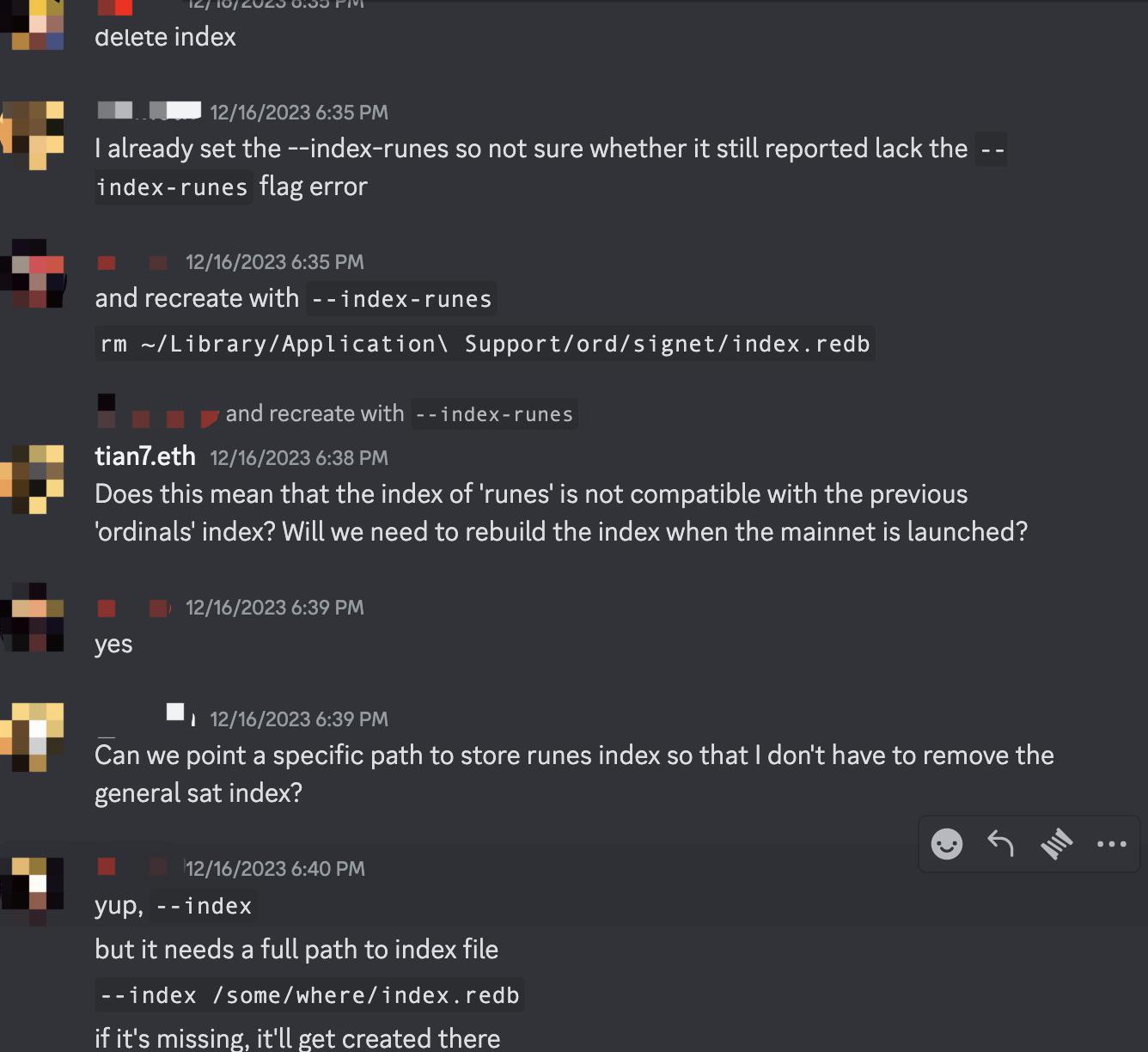
Users started actively experimenting with the Runes protocol on Bitcoin’s signet testnet, with community moderators assisting them in resolving issues.
-
Based on community conversations, currently on signet, Runes and Ordinals indices are incompatible. Once Runes is officially deployed on Bitcoin mainnet, users will need to rebuild a unified index.
-
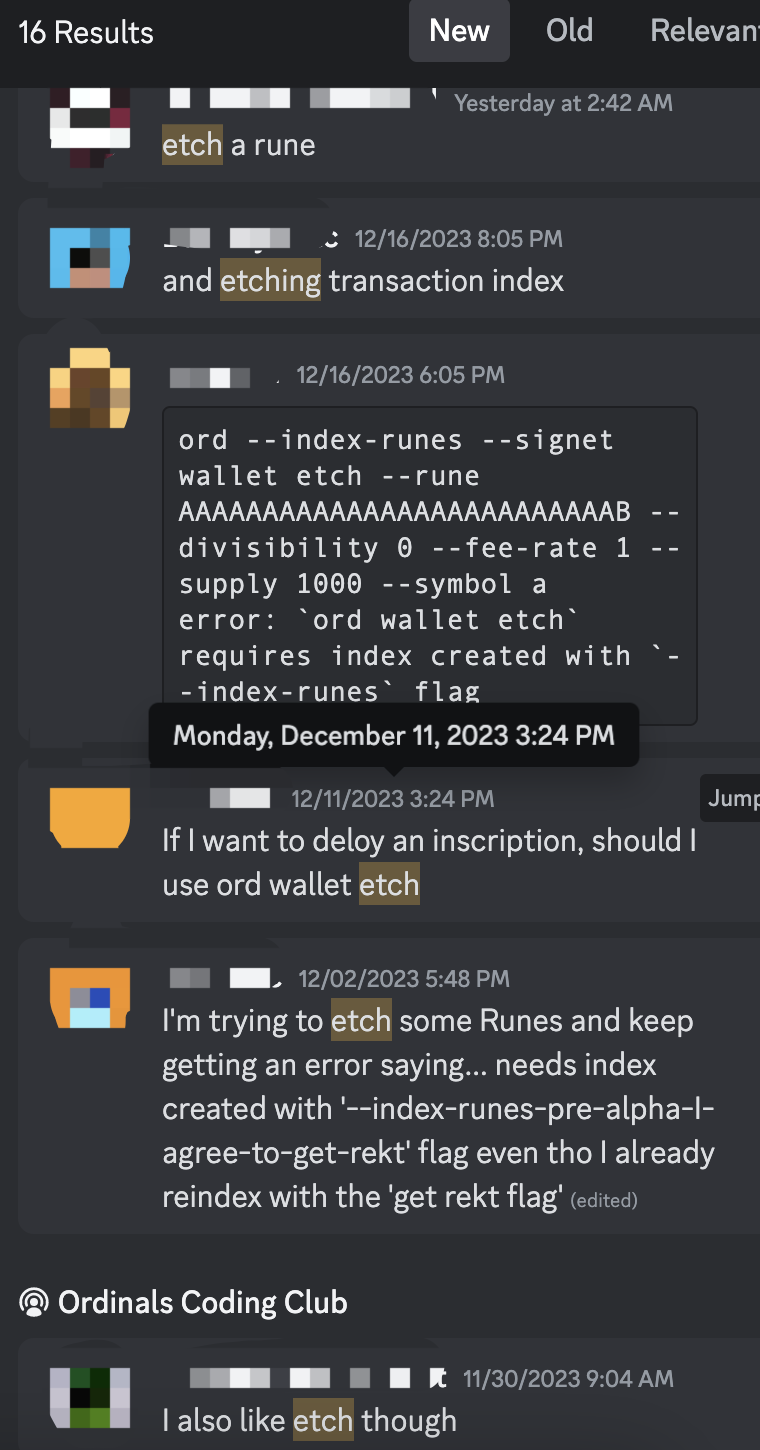
Compared to previous protocols that use terms like “inscription” or “inscribe,” Runes introduces new terminology such as “rune” and “etch.” These subtle linguistic shifts reflect Runes’ higher precision and lighter footprint.
2. OrdinalHub https://discord.com/invite/ordinalhub
-
OrdinalHub community members also express recognition and anticipation toward Runes, eager to contribute. However, due to the slow development progress and limited information, they feel somewhat helpless.
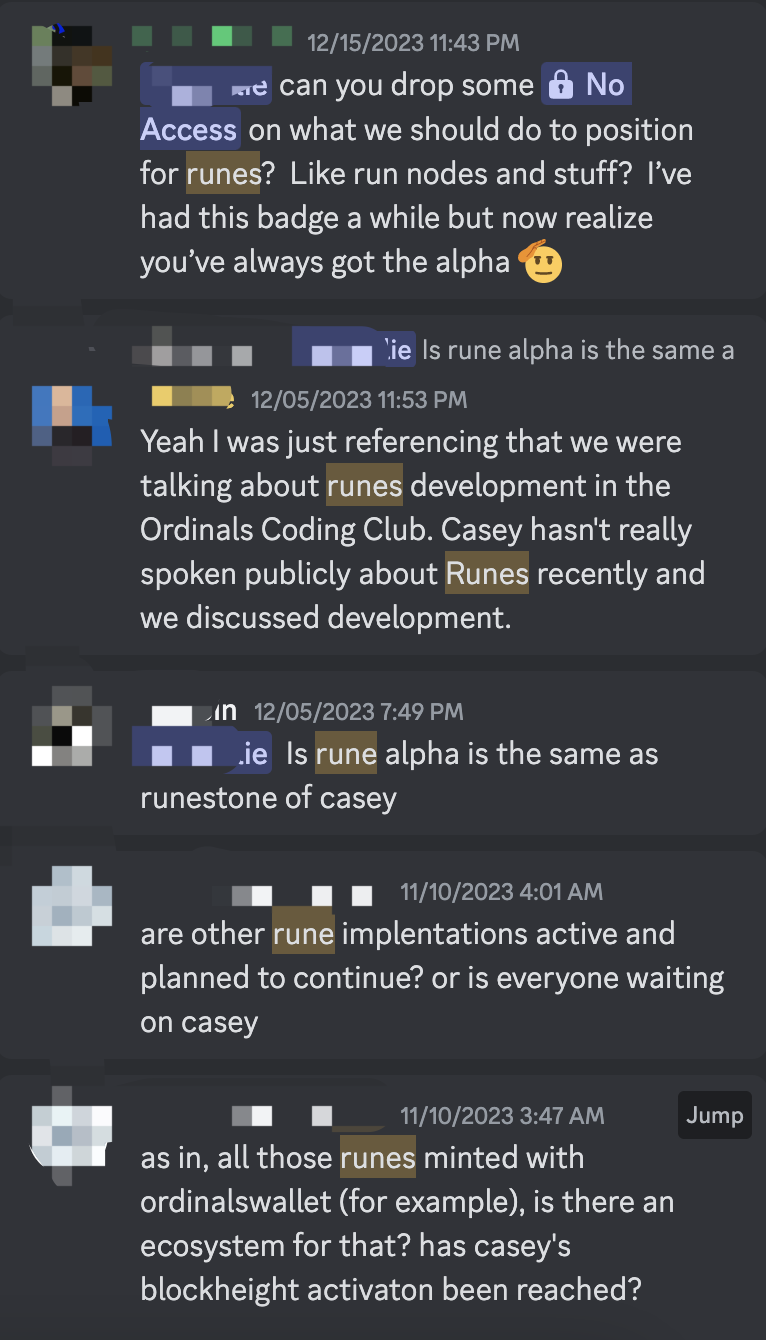
3. sating.io https://discord.com/invite/kcwE9jH67n
Opposition and Resistance
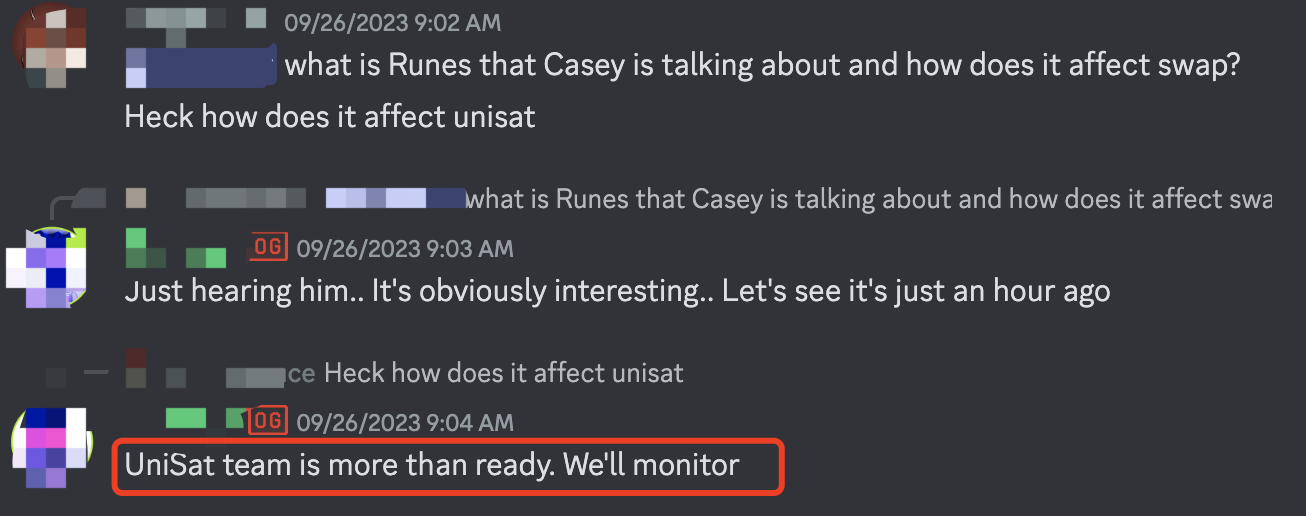
UniSat Community https://discord.com/invite/unisat
-
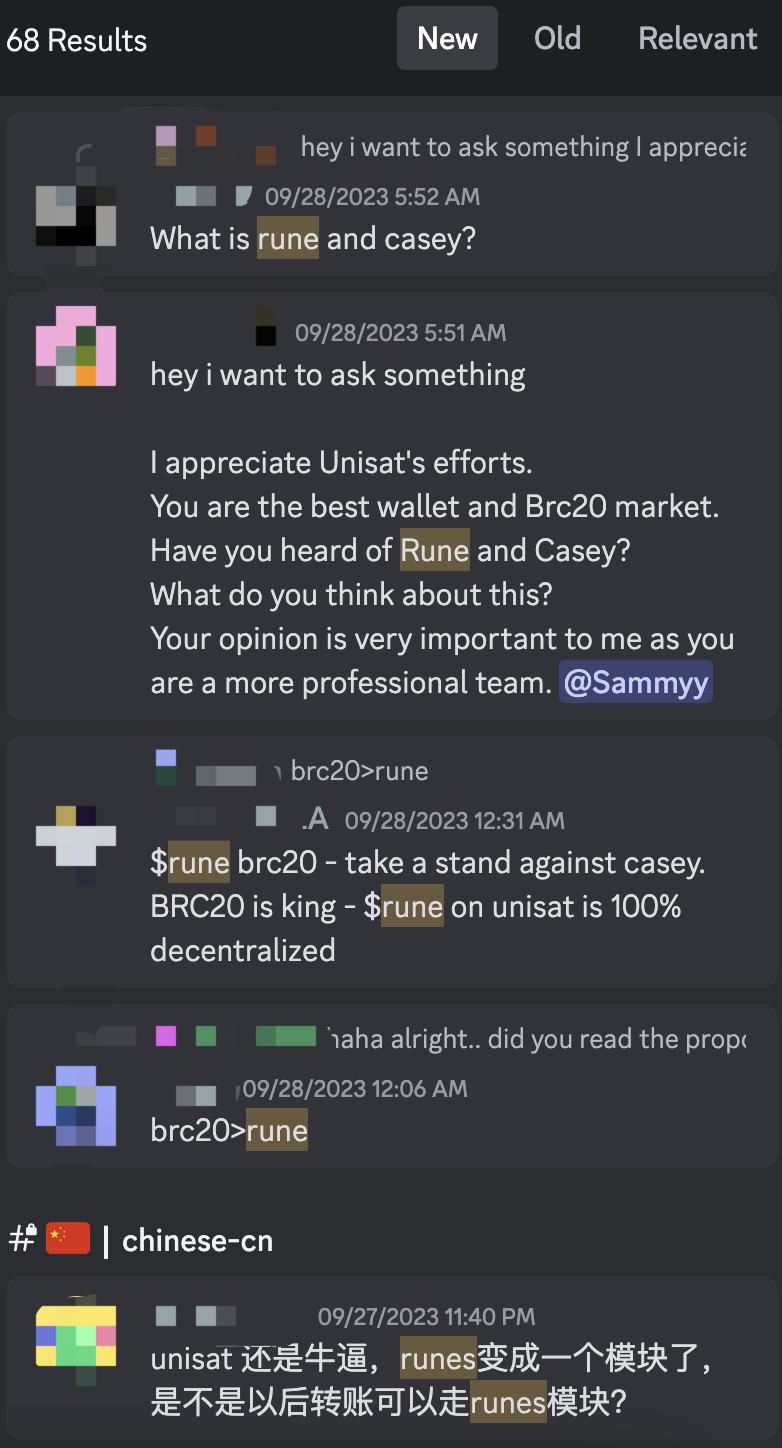
The UniSat official team stated they are interested in Runes and will closely monitor its development, preparing full technical support.
-
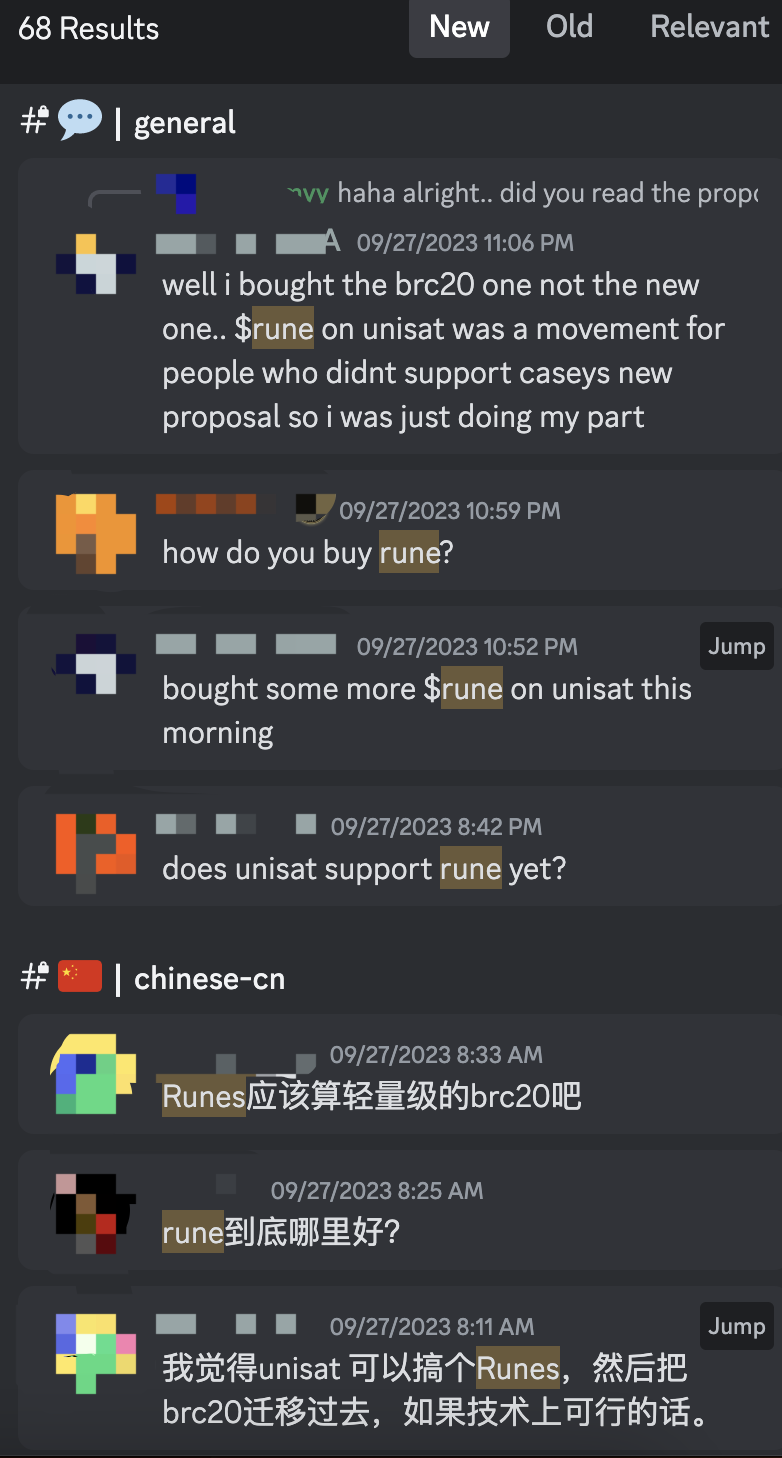
Subsequently, UniSat added a Runes module and introduced a new BRC-20 token $rune.
-
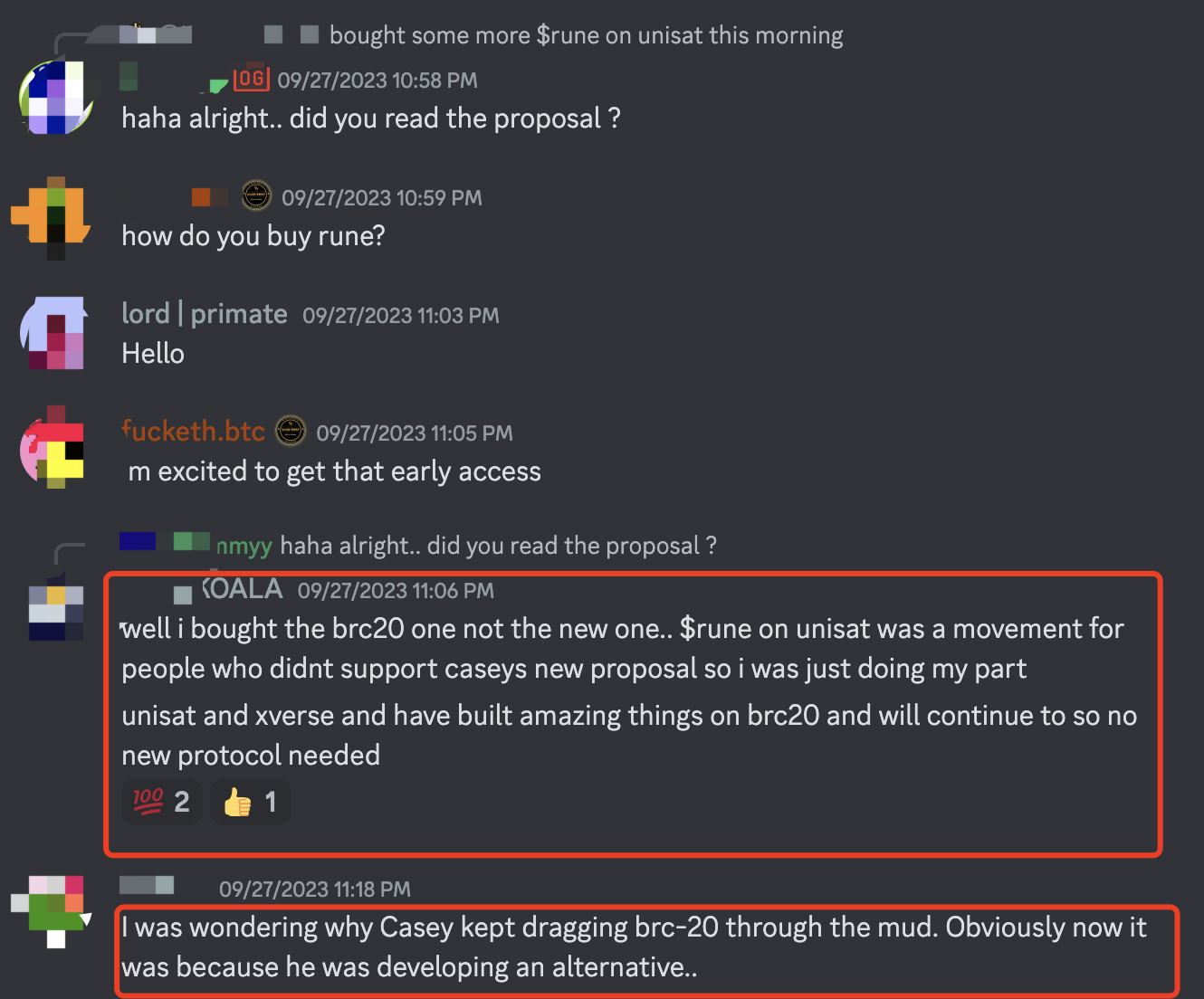
Some individual BRC-20 ecosystem users in the UniSat community took sides: "BRC-20 > Runes." A few利益-driven hardcore BRC-20 supporters firmly defend the BRC-20 protocol, calling it the most authentic, decentralized, fair, and irreplaceable, purchasing the BRC-20 protocol token $rune as a form of protest against Casey-led Runes. (An official UniSat staff reacted with a "thumbs-up" emoji.) They also accused Casey of continuously disparaging the BRC-20 protocol because he wants to promote his own new protocol.
Neutral Observation
1. ordinex https://t.me/ordinex
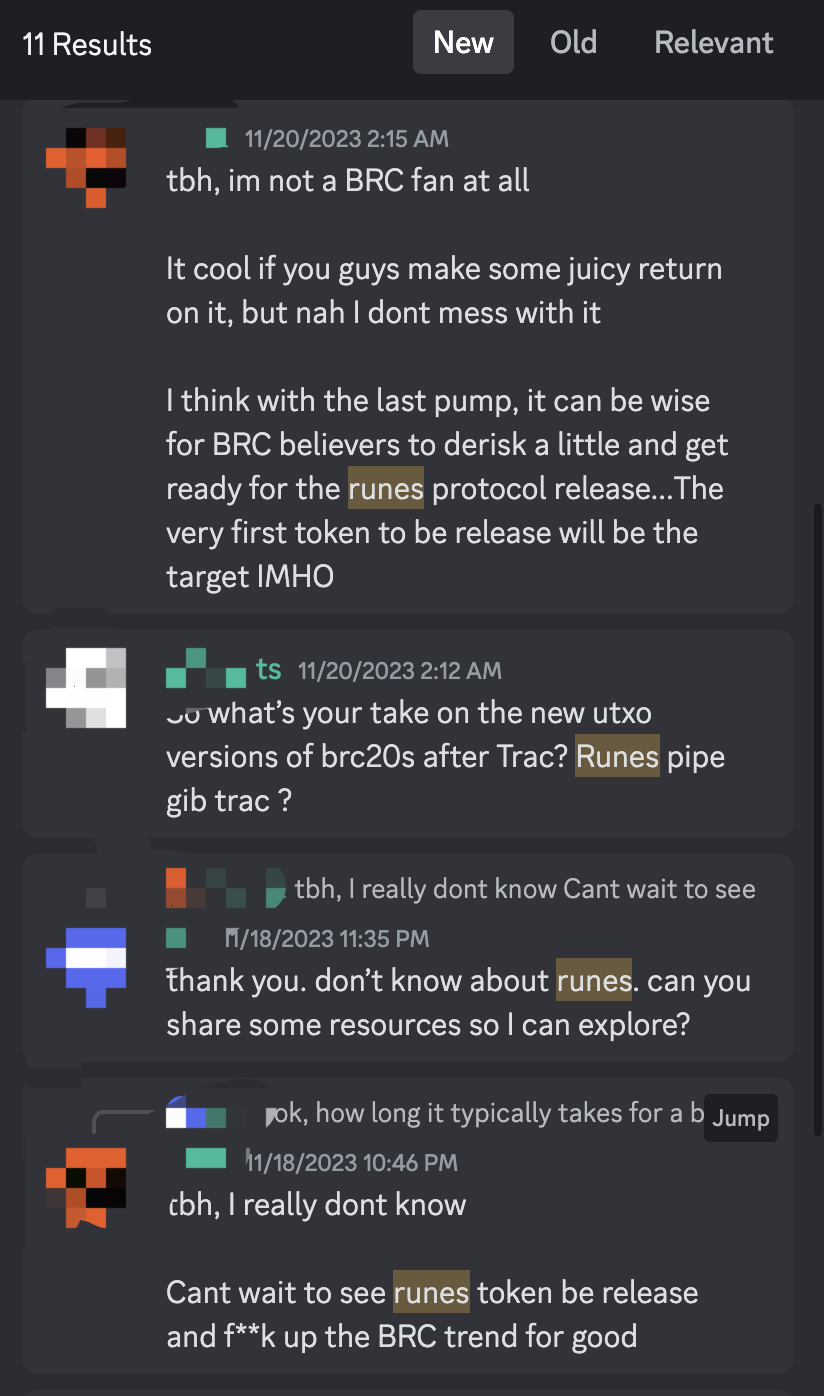
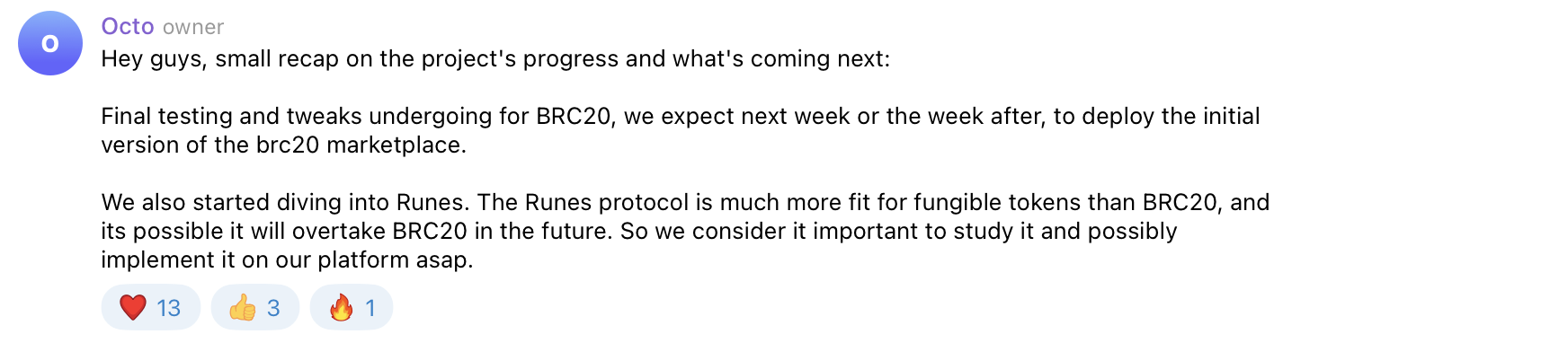
At the end of October, the ordinex community lead stated that ordinex had begun monitoring Runes, acknowledging that theoretically, Runes is superior to BRC-20 as a fungible token protocol. However, they maintained a cautious stance, noting that ordinary users typically don’t deeply care about the technical logic behind a protocol. Therefore, widespread market adoption remains key to winning protocol competition.
2023.10.22
2023.10.23

2. Leather https://discord.com/invite/67cZyTz8w6
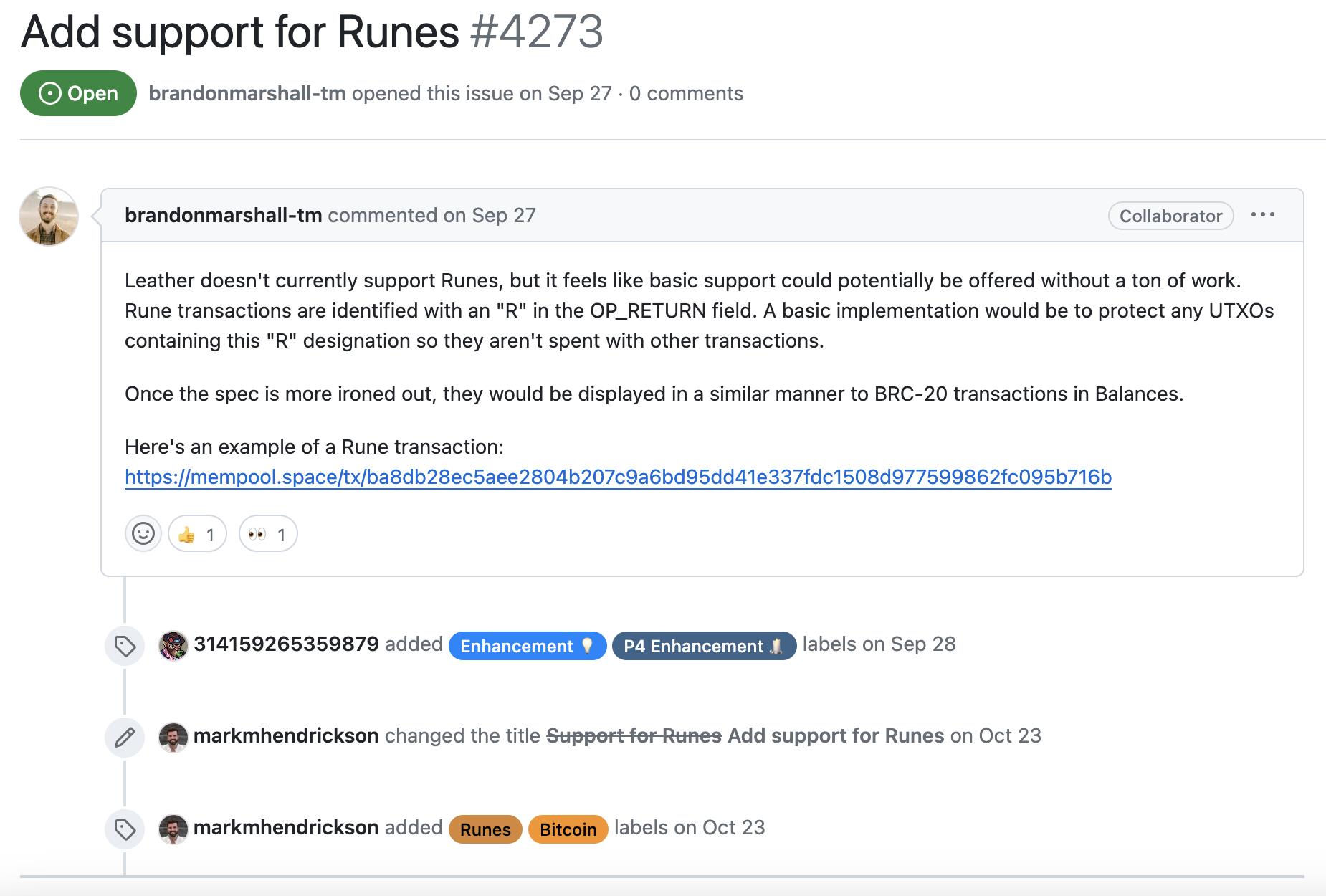
Leather wallet developers added basic Runes support in their GitHub repository: https://github.com/leather-wallet/extension/issues/4273
3. Trac https://discord.com/invite/trac
Positive views believing Runes surpasses BRC-20:
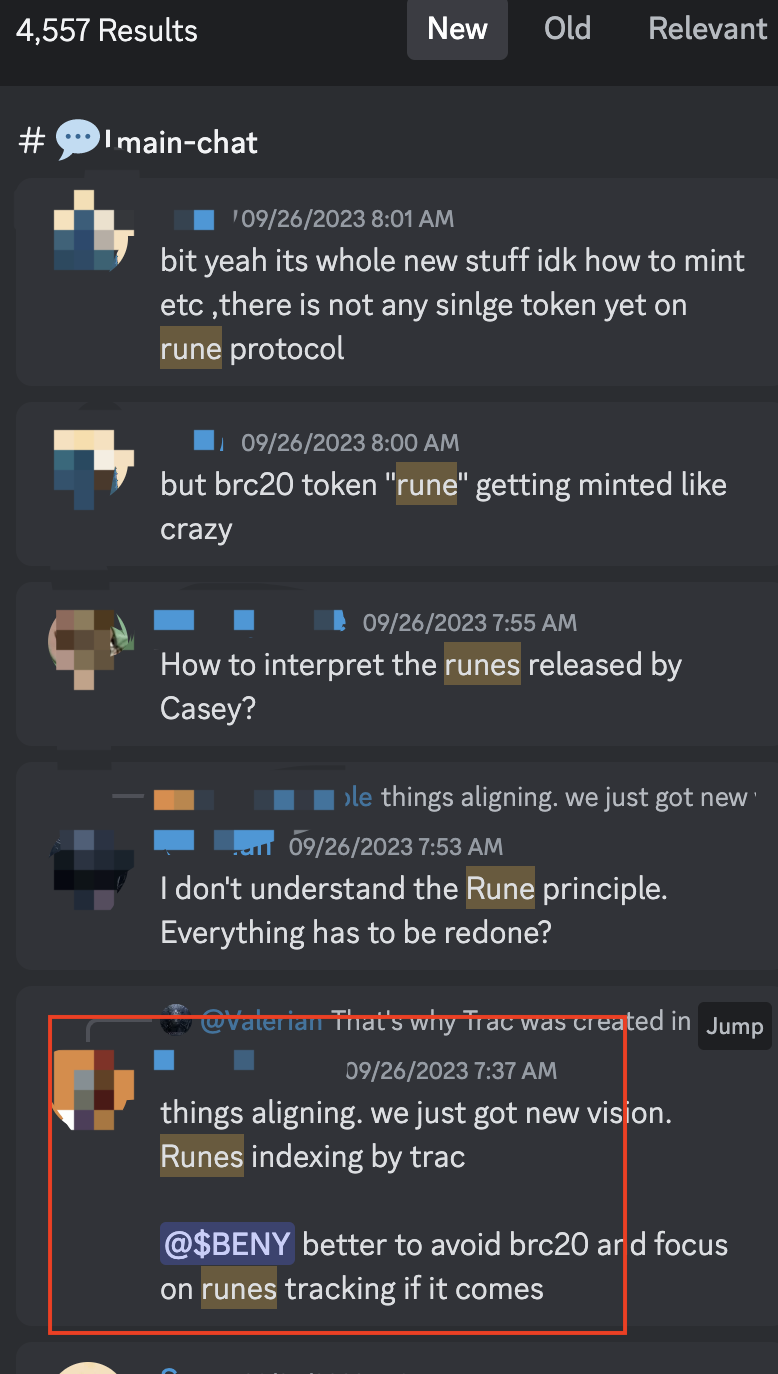
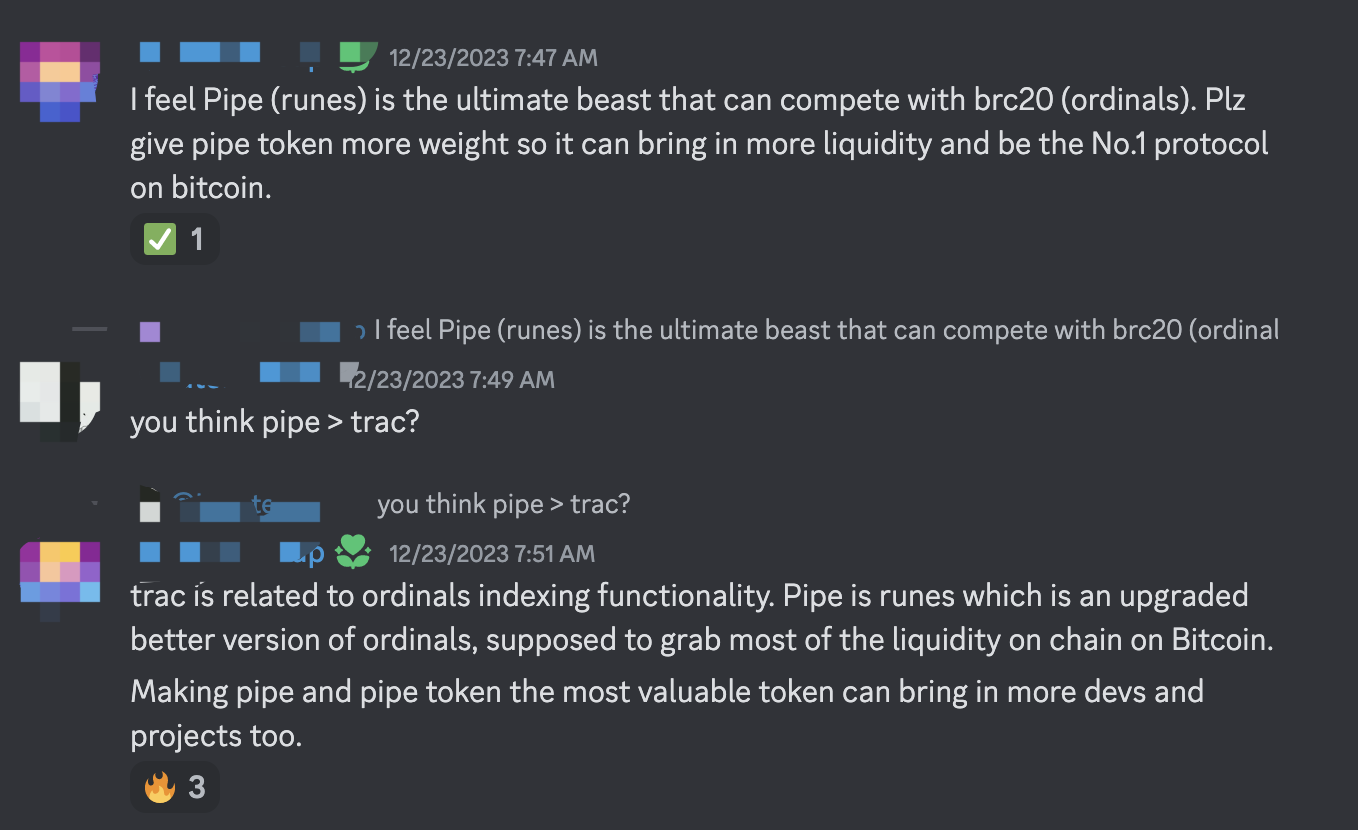
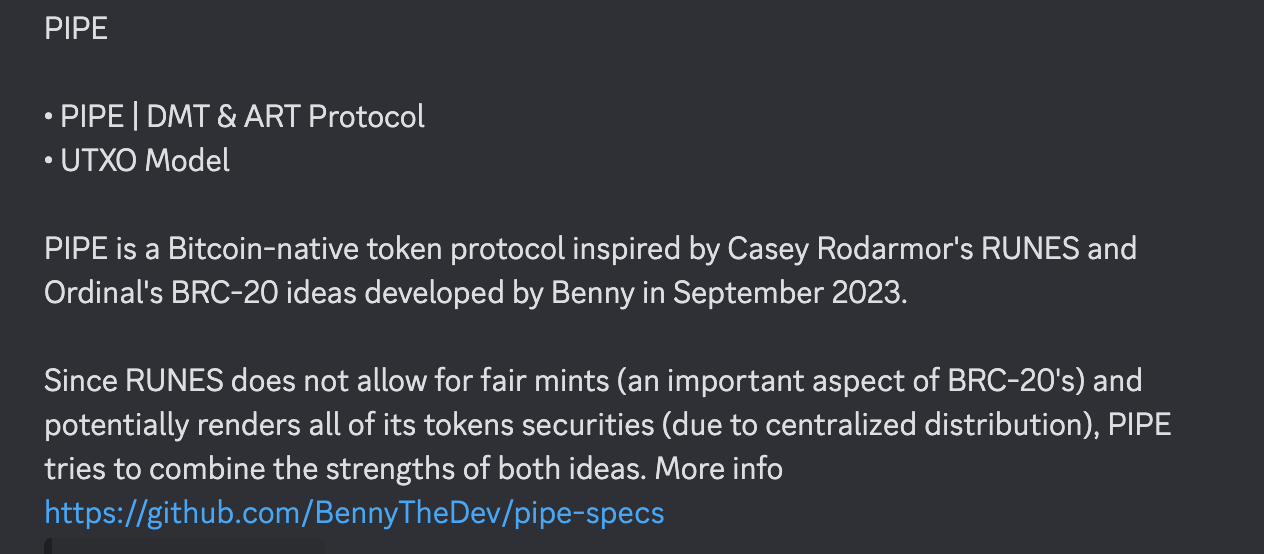
According to incomplete Runes code, its current mechanism is not "fair mint"—the entire supply is sent directly to the registrant’s address upon registration, with future changes unclear. This point serves as one of the main criticisms from BRC-20 supporters. Some users in the Trac community believe the Pipe protocol combines the strengths of both BRC-20 and Runes.
Conclusion
1. Innovation and Application Value of the Runes Protocol:
The Runes protocol demonstrates the possibility of implementing token functionality within the Bitcoin ecosystem. Its simplified UTXO model and efficient token transfer mechanism bring new momentum and scalability to the Bitcoin network. This marks a significant expansion of Bitcoin’s capabilities—adding new application layers while preserving its core characteristics.
2. Comparison Between Runes and BRC-20 Protocols:
In terms of efficiency and user experience, the Runes protocol shows clear advantages over BRC-20. Based on the UTXO model, Runes eliminates dependency on off-chain data and native tokens, offering a smoother user experience. Furthermore, Runes’ issuance mechanism and transparent token transfer process provide users with a clearer and more secure operational environment.
3. Community Response and Acceptance:
The Runes protocol has garnered widespread attention within the Bitcoin community. Despite relatively slow development, the community remains optimistic about its technical potential and application prospects. At the same time, varied reactions to clone projects like Rune Alpha reflect the complex interests and diverse perspectives within the cryptocurrency space.
4. Future Outlook and Challenges:
The primary challenge facing the Runes protocol lies in enhancing its practical feasibility and adoption while preserving its core advantages. Additionally, competition with other protocols and the market’s ability to adapt to new technologies will be crucial factors shaping its future development.
In summary, the Runes protocol, as an innovative experiment on the Bitcoin network, showcases strong potential in optimizing token operations. While facing challenges from the community, market dynamics, and technology, the emergence of Runes undoubtedly injects fresh vitality and new possibilities into the evolution of the Bitcoin ecosystem. Going forward, as the technology matures and gains broader market recognition, Runes is poised to play an increasingly important role in the cryptocurrency landscape.
Join TechFlow official community to stay tuned
Telegram:https://t.me/TechFlowDaily
X (Twitter):https://x.com/TechFlowPost
X (Twitter) EN:https://x.com/BlockFlow_News
 @TrustlessLabs