Analyzing Binance Launchpad's New Model: Locking Up Project Tokens to Secure Greater Fairness for Retail Investors
TechFlow Selected TechFlow Selected
Analyzing Binance Launchpad's New Model: Locking Up Project Tokens to Secure Greater Fairness for Retail Investors
Enhancing project fairness, differentiating initial valuations, reducing inflationary pressure, and incentivizing projects to build long-term.
 Navigating Web3 tides with focused insights
Author: CapitalismLab
Binance recently launched NFP, and the community responded with “What is this?” The core of this move actually lies in the newly introduced “Fair Mode” and the token economics report, which indicate Binance’s intent to significantly increase retail investors’ share relative to project teams and VCs—enhancing fairness.
This could become the foundational framework for future Binance Launchpad listings, creating new opportunities for BNB holders and reward farmers alike. This article breaks it down for you.

Combining the introduction of Fair Mode, NFP, and the token economics report, we can summarize the key points as follows:
1. Increase initial circulating supply to lower FDV, allocate more tokens to Launchpool and airdrops, giving more allocation to retail users;
2. Permanently lock a portion of project team and VC tokens so they cannot be sold, effectively reducing total supply;
3. Through these increases and reductions, the ratio of retail vs. project team/VC holdings may have improved by up to 10x compared to previous projects.
A. Problems with Token Allocation
What's wrong with past Launchpad/Launchpool projects? Nearly all tokens were held by project teams and VCs! Take Hook as a frequently criticized example: only 5% was allocated to Launchpad, while the team and VCs openly received 40%. The remaining 55%, labeled as "ecosystem and community," has recently been deposited into Binance by the team under the guise of “adding liquidity.”
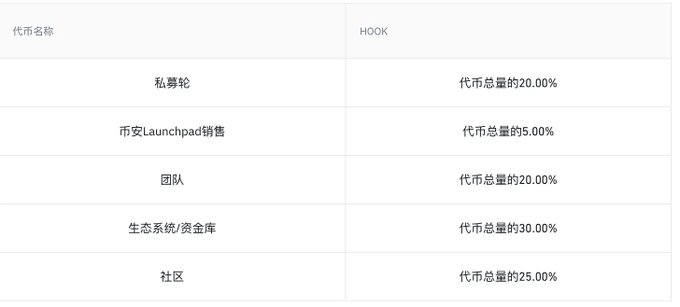
Doing the math, the nominal retail-to-team/VC ratio is 1:8—but in reality, it could be as high as 1:19, meaning nearly all tokens remain under project team control.
Why include ecosystem and community allocations? Ideally, project teams would use these funds responsibly to drive growth, allowing fundamentals to support value even as tokens unlock over time. But in practice, such funds are hard to monitor and often serve merely as tools for teams to dump tokens.
Additionally, because actual initial circulating supply is so small (only 5%-10%), projects listed on Binance are often quickly inflated to an FDV (fully diluted valuation) of around $1 billion—close to the market cap of DeFi leader MakerDAO. Even if teams use ecosystem funds wisely, sustaining such a valuation long-term is unlikely, leaving most projects devoid of real alpha.
B. Increasing Initial Circulating Supply to Lower FDV
How do we fix this? User education won’t work—retailers will just rush in regardless. The solution is to increase initial circulating supply. Since buying pressure is finite, so too is sustainable market cap; increasing circulation naturally helps lower FDV.
Looking at past Binance Launchpad projects, regardless of quality, all had roughly 5% initial allocation. As a result, application-layer projects were uniformly pumped to ~$1B FDV—a clearly absurd outcome. To users, these projects essentially became shells valued purely for being listed on Binance, irrespective of fundamentals. Binance likely aims to differentiate valuations based on project fundamentals by adjusting initial circulating supply.
For example, NFP launched with 21% in Launchpool + airdrop, versus Hook’s 5%. Assuming similar retail demand, NFP’s Day 1 FDV might only reach $200M–$300M—about one-quarter of Hook’s. With an AI narrative, even if the team becomes inactive later, there’s still some hope for price appreciation through speculation.
C. Non-Circulating Long-Term Development Fund
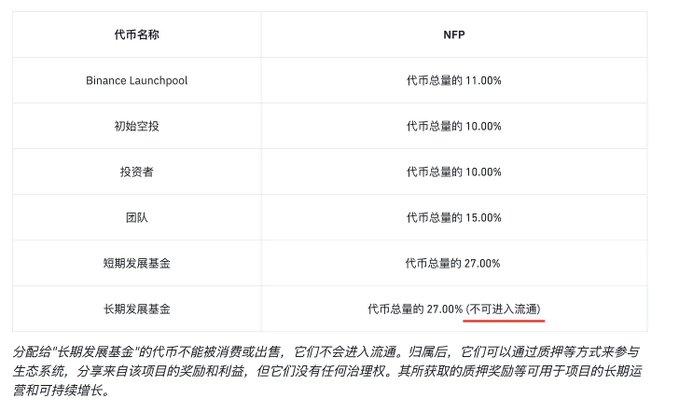
From the NFP chart, we see that 27% of tokens are allocated to a “Long-Term Development Fund” marked as “non-circulating.” This footnote deserves close attention: Tokens from the “Long-Term Development Fund” cannot be spent or sold and will never enter circulation. After vesting, they can participate in the ecosystem via staking to earn rewards and benefits from the project, but they carry no governance rights. The staking rewards earned can be used for long-term operations and sustainable growth.
What does this mean? How does the ETH Foundation currently cover development and operating costs? By selling ETH. Most project teams do the same—and clearly, this isn’t sustainable since once tokens are sold, they’re gone.

Binance’s idea seems to be: instead of selling tokens, the foundation stakes them and uses staking rewards to fund long-term growth and operations. Of course, this only works for projects capable of generating yield. The NFP report mentions support for “staking to share platform fees.” In cases where a project generates no revenue, this allocation behaves similarly to a direct burn.
If the project eventually becomes profitable, teams may also spend their short-term development funds more cautiously—since overspending dilutes their long-term staked share and reduces future income. This introduces a new layer of economic incentive.
In short, the Long-Term Development Fund effectively reduces total supply, further lowering effective FDV, while incentivizing teams to build sustainably and spend wisely.
D. Dramatically Improving Retail vs. Team/VC Token Ratio
As previously calculated, Hook’s retail vs. team/VC token ratio was nominally 1:8 and realistically closer to 1:19. For NFP, the nominal ratio is (Launchpool 11% + airdrop 10%) 21% vs. 25% (team + VC), nearly 1:1. The real ratio is 21% : 52% (100% - 21% - non-circulating 27%), approximately 1:2.5.
Moreover, Binance stated in the report that fund usage should be more strictly regulated, suggesting further improvements in practice.
With these adjustments, the retail-to-team/VC token ratio has improved nearly tenfold. While such projects still involve costs and can’t match the fairness level of inscriptions or meme coins, they are significantly fairer than before—an homage to Fair Launch principles. Hence, calling it “Fair Mode” is entirely appropriate.
Summary
Binance aims to enhance fairness by significantly increasing retail allocation relative to project teams and VCs, diversify initial valuations, reduce inflationary pressure, and incentivize long-term building.
For retail investors, the takeaway is clear: either hold BNB to claim larger Launchpool allocations, or actively participate in airdrops to secure bigger shares—both of which are expected to receive increased allocations going forward.
Join TechFlow official community to stay tuned
Telegram:https://t.me/TechFlowDaily
X (Twitter):https://x.com/TechFlowPost
X (Twitter) EN:https://x.com/BlockFlow_News
 CapitalismLab