Can the Dencun upgrade propel Ethereum's "comeback"?
TechFlow Selected TechFlow Selected
Can the Dencun upgrade propel Ethereum's "comeback"?
The Dencun upgrade may take place in the first quarter of next year.
 Navigating Web3 tides with focused insights
By TechFlow Asher Zhang
On December 5, Ryan, co-founder of Bankless, published a lengthy post on X arguing that "ETH has not yet entered a bull market." The article sparked both support and heated debate from developers within ecosystems such as Solana and Bitcoin. Ryan explained Ethereum's fundamentals from multiple angles—highlighting its high price-to-earnings ratio, deflationary supply, energy efficiency under PoS making it attractive to ESG investors—and even claimed ETH had become a form of "digital gold." However, market reactions suggest these arguments alone are insufficient to trigger a dramatic surge in Ethereum’s price performance.
This article argues that the main drivers behind Bitcoin’s recent surge are Bitcoin ETFs and the ordinals ecosystem. In contrast, Ethereum currently has only one comparable catalyst: the Dencun upgrade. This is the key weapon capable of drawing market attention and capital inflows, allowing Ethereum to compete with the Bitcoin ecosystem in this bull cycle. As the Dencun upgrade approaches, this article will analyze its core implications.

Why Is the Dencun Upgrade So Important?
Ethereum founder Vitalik Buterin once outlined the future Ethereum 2.0 upgrade roadmap in six concise phases: The Merge, The Surge, The Scourge, The Verge, The Purge, and The Splurge. Each phase focuses on specific upgrades. The most significant outcome of The Merge was transitioning Ethereum from PoW to PoS. At the time, many market analysts believed this would enable Ethereum to outperform Bitcoin in the next bull run. However, with the emergence of protocols like Bitcoin Ordinals, Bitcoin gained renewed momentum. In comparison, the Dencun upgrade holds nearly equal significance—it is a crucial component of The Surge phase.
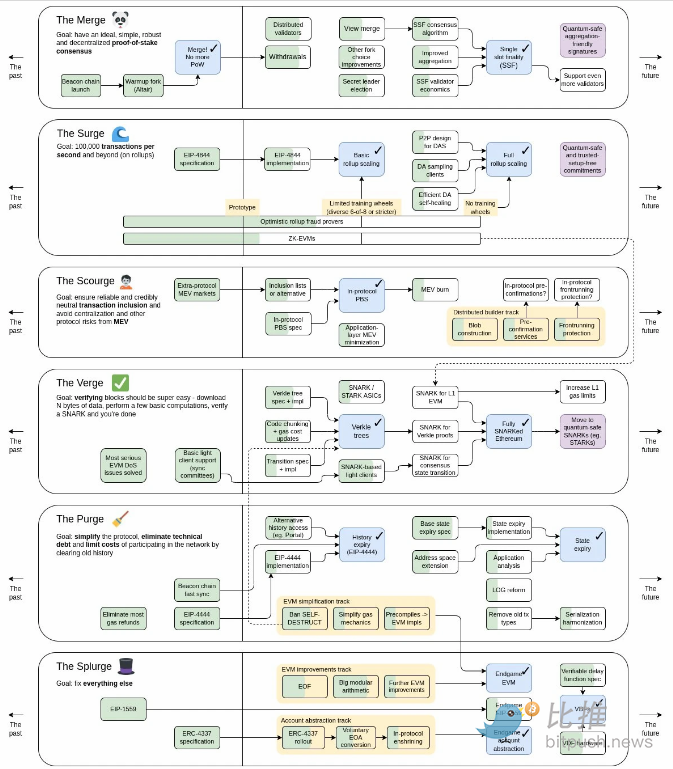
The ultimate goal of The Surge is to solve the long-standing blockchain scalability issue since its inception, aiming to achieve performance levels up to 100,000 TPS—comparable to traditional electronic payment systems like Visa. This enhancement is achieved through Danksharding (DS), or sharding. Proto-Danksharding (EIP-4844) marks the first step toward full Danksharding and is a critical component of the Deneb-Cancun (Cancun) upgrade. It represents a vital milestone for Ethereum in implementing sharding and advancing its scalability roadmap. Note: "Dencun" is a portmanteau of "Cancun" and "Deneb." Cancun refers to the execution layer upgrade, while Deneb denotes the consensus layer upgrade.
Which Sectors Will Be Transformed by the Dencun Upgrade?
As the crypto market evolves, blockchain technology is maturing, and the Dencun upgrade stands as one of its most significant milestones. With technological maturity, the crypto market is poised to enter its next application-driven phase. DeFi has already demonstrated its transformative power. Today, we stand at a pivotal juncture. So, which sectors or domains deserve attention after the Dencun upgrade? And how are they interconnected?
Layer 2
In Layer 2 transactions, the largest cost component is "Call Data," which currently accounts for over 80% of L2 transaction fees. In cases where malicious validators appear on an L2 chain, the entire chain can be reconstructed using Call Data published on L1. One of the most important improvements introduced by the Ethereum Dencun upgrade is EIP-4844. It introduces a new transaction type called "blob-carrying transactions," which are similar to regular transactions but include additional data blobs that are far more cost-effective than current Calldata storage methods. Beyond blob-carrying transactions, EIP-4844 also implements changes at the execution layer, including logic, validation rules, and a multidimensional fee market, all designed to meet the requirements for full Danksharding in the future.
Modular Blockchains
Modular blockchains focus on handling a limited set of responsibilities while outsourcing others to one or more separate layers. From the perspective of Ethereum's technical evolution, its modular stack development progresses through three stages: 1. Monolithic blockchains—represented by Ethereum L1 or the mainnet, which functions as a single, integrated system; 2. Rollups—L2 solutions acting as execution layers, such as Arbitrum and Optimism, which offload execution from Ethereum L1 and publish state roots and rollup data back to L1; 3. Modular rollups—with modular data availability.
Beyond Layer 2, the DA (Data Availability) layer in modular blockchains also deserves attention. It serves as an immutable bulletin board where transaction data and proofs are posted. Without DA, rollups cannot guarantee liveness. By leveraging transaction data provided by the DA layer, anyone can resume computation from where the previous participant left off. Projects like Celestia and Avail lead this space.
Fully On-Chain Gaming
In the application domain, beyond DeFi, blockchain gaming or the metaverse is among the most promising areas likely to achieve mainstream breakthroughs. Within fully on-chain gaming, Decentralized Autonomous Worlds (DAWs) are particularly noteworthy. DAWs are a subset of fully on-chain games—open-ended, fully on-chain games without predefined gameplay. By offering publicly accessible programmable interfaces, DAWs allow players to freely create, enhance, and expand their gaming experiences within a shared digital-physical reality, thereby extending game narratives. In October 2022, the Lattice team behind Dark Forest launched OPcraft, a fully on-chain 3D Minecraft-inspired game that attracted significant market interest.
Layer 3
Although the concept of Layer 3 in the blockchain industry lacks a widely accepted definition, it remains significant. Ethereum co-founder Vitalik Buterin suggests three potential futures for Layer 3: Layer 2 for scaling, Layer 3 for customized features like privacy protection; Layer 2 for general-purpose scaling, Layer 3 for specialized scaling; or Layer 2 for trustless scaling (Rollups), Layer 3 for weaker-trust scaling (Validiums).
How Do Crypto Influencers View Ethereum’s Future Development?
The Dencun upgrade is a major milestone for Ethereum, but there are still differing opinions in the market. Below is a summary of views from several prominent crypto influencers for readers’ reference.
Smarti Lab published an analysis stating: Contrary to popular belief, EIP-4844 alone is insufficient to significantly improve Ethereum’s scalability. They evaluated potential reductions in gas fees, TPS (transactions per second), and rollup capacity after EIP-4844 implementation using two calculation methods. Estimates suggest that depending on Calldata sizes of 10KB and 2KB, EIP-4844 could accommodate between 38x and 192x more Calldata. By fitting more Calldata into each block, the per-unit cost decreases accordingly. Assuming a uniform rollup Calldata size of 2KB, EIP-4844 could support up to 384 rollups. Under normal conditions (when blocks reach target size), Ethereum could achieve around 175 TPS via EIP-4844, peaking at 350 TPS.
Former Solana core developer @zen_llama stated: "I personally disagree with using rollups as a scaling solution, but they make great sense as a value capture mechanism for ETH assets. This redirects revenue to different networks, which is why I see rollups as potentially dangerous for ETH."
Sassal0x, founder of The Daily Gwei, expressed strong optimism: "ETH will soar above $10,000, leaving hesitant investors stuck in fiat and junk tokens. In my view, we still need to clearly articulate where ETH’s value proposition truly lies!"
Conclusion
Ethereum core developers previously indicated that the Dencun upgrade would not happen by year-end. On December 1, Christine Kim, Vice President of Research at Galaxy, announced that the Dencun upgrade had been activated on Devnet #12 as of November 30. Analysts suggest the mainnet launch is highly likely in Q1 of next year. Based on timing and current progress, a Q1 rollout appears probable. Additionally, according to documents disclosed by Bloomberg analysts, BlackRock has registered an Ethereum trust in Delaware under the name ISHARES ETHEREUM TRUST. This implies that once Bitcoin ETFs are approved, Ethereum ETFs will also gain substantial speculative momentum. Overall, in 2024, the Dencun upgrade is most likely to serve as the engine reigniting Ethereum’s dominance, with the potential Ethereum ETF acting as a powerful accelerant.
Join TechFlow official community to stay tuned
Telegram:https://t.me/TechFlowDaily
X (Twitter):https://x.com/TechFlowPost
X (Twitter) EN:https://x.com/BlockFlow_News
 比推 BitpushNews